To save content items to your account,
please confirm that you agree to abide by our usage policies.
If this is the first time you use this feature, you will be asked to authorise Cambridge Core to connect with your account.
Find out more about saving content to .
To save content items to your Kindle, first ensure no-reply@cambridge.org
is added to your Approved Personal Document E-mail List under your Personal Document Settings
on the Manage Your Content and Devices page of your Amazon account. Then enter the ‘name’ part
of your Kindle email address below.
Find out more about saving to your Kindle.
Note you can select to save to either the @free.kindle.com or @kindle.com variations.
‘@free.kindle.com’ emails are free but can only be saved to your device when it is connected to wi-fi.
‘@kindle.com’ emails can be delivered even when you are not connected to wi-fi, but note that service fees apply.
This chapter examines ways that different communities of ancient Greece accepted and integrated the goddess Peithō despite her ambiguous influence over social relations, economics, and politics. Borrowing principles from social psychology, the chapter reframes cult ritual and dramatic performance as means by which different poleis effectively enacted reactance reduction strategies for their citizenry. Collective practices like these reduced anxiety, shifted cognitions, and expanded tolerance for peithō’s enduring presence. The chapter identifies the foundation myths and worship rituals at Sicyon and Athens, along with performances of Aeschylus’ Oresteia, as social mechanisms that raised awareness of peithō’s threat while simultaneously foregrounding her unitive potential within the community. The chapter includes a survey of textual and material evidence for these cults and a close analysis of peithō’s double-binding effects on characters in the Oresteia, one of the most famous political dramas of the Athenian democracy.
Akin to Aristotle’s attempt in the Poetics to lay out the various conditions of artistically rendered human action that make for the most gripping treatments, Hegel develops a poetics of action that attempts to articulate what makes for the most beautiful artistic presentations of action. This chapter focuses on this “poetics of action,” and it is argued that the key to understanding Hegel’s aesthetic privileging of heroic action in his poetics lies in the peculiar ontology of the artwork itself: that is, it is argued that the decisive, transformative events that are the focus of scenes of heroic action in effect provide art with that express content that most readily fits with the artwork’s own deeper nature as such a transformative event in its own right. The chapter explores various of Hegel’s specific aesthetic judgments about dramatic settings, characters, narrative structure, and the role of ethics in art, in each case arguing that the basis of these judgments is oriented both in terms of the heroic and in terms of what enables the character of a transformative event to become most manifest.
This chapter takes up the question of whether the higher-order beauty of art is for Hegel best exemplified in the static, serene repose of classical sculpture or in the dramatic, developmental movement characteristic of the depiction of human action. Both paradigms are prevalent in Hegel’s lectures on art, and in the end the tension between them has not been fully addressed within Hegel’s lectures, nor has it been adequately addressed within existing scholarship. In addition to maintaining that the developmental paradigm fits better with the present book’s account of the ontology of the artwork as featuring the dramatic event of transformation into autonomy, the chapter also brings some textual sources to bear, and attempts to show as well that such a paradigm fits more naturally with Hegel’s claim that art is ultimately rooted in intuition and its direct, eventful encounters with the world.
Edited by
Rosa Andújar, Barnard College, Columbia University,Elena Giusti, University of Cambridge,Jackie Murray, State University of New York, Buffalo
Classical linguistics and racecraft have an intertwined history, in that Indo-European linguistics arose concurrently with scientific racism, and shares many of the same metaphors and conceptual frameworks. This chapter touches on this shared history, before exploring some aspects of the metalinguistics and sociolinguistics of race in the ancient world. In particular, the concept of ‘linguistic racism’ will be used to look at how ancient texts use lack of (shared) language to imply a lack of humanity, and how non-Greek speakers are compared to animals. It will also look at depictions of foreign-language speakers as the linguistic ‘other’, particularly in depictions of enslaved people.
This chapter focuses on the expressive functions of tears, the face and the body on the early modern stage, to probe the deep relation between drama and the law, including their entwined but distinct investments in natural self-evidence and the rhetoric of presence. Through an interdiscursive approach, it shows how drama mines the complexities of hypokrisis through an engagement with the radical performativity at the core of law, and offers the provocation that law’s disknowledges are turned into a poetic condition of theatrical knowledge, and a forging of subjecthood and inwardness that complicates the distinction between the fiction of theatre and the reality of the law court. It ends with the suggestion that the theatre looks at, as well as beyond, the vivid invisibilities of judicial encounters to unpack the epistemic, affective and ethical impulses structuring the ‘scene’ of law.
In 1937, Graham Greene recruited Bowen to write theatre reviews for Night and Day, his short-lived journal. Throughout her career, Bowen thought about and wrote dramas for radio and the stage. In the 1940s, she wrote several short dramatic features for BBC radio with an emphasis on dialogue: one about Frances Burney, another about Jane Austen, a short play called ‘The Confidante’??IN TEXT ’The Confidant’, and an autobiographical piece called ‘A Year I Remember – 1918’. Castle Anna, a play that Bowen co-authored with John Perry, received indifferent notices when it was staged in February 1948. She also wrote a pageant on the history of Kinsale and a ‘Nativity Play’. As much as she was drawn to theatre, Bowen’s strength lay in writing for the ear rather than the eye.
This chapter explores works by two contemporary London-based Black British playwrights who also direct, produce, and perform: debbie tucker green and Mojisola Adebayo. Examining plays produced and performed between 2005 and 2019, the chapter suggests that both women create distinctive work that combines singular dramaturgy with transformative politics, shifting the framing of spectatorial perspective. They are also known for making innovative, experimental, and poetical work at the intersection of aesthetics and politics. The chapter traces the Blochian utopian possibility of ‘something’s missing’ (etwas fehlt) in tucker green’s dramaturgy of refusal. In her plays, the chapter suggests, we can identify what Herbert Marcuse’s called ‘the Great Refusal’, which develops a utopian sensibility via negation. Frequently working class, Black, and female, tucker green’s belligerent characters reveal to audiences what is missing in their difficult lives, how everything should be different in Britain. In Adebayo’s work, forged in the community-led Black Mime Theatre in the 1990s, utopian possibility forms part of the affective spectatorial encounter with her theatre. Whilst Adebayo’s plays are less abrasive, they similarly highlight what is missing. The transformative energy of her dramaturgy can be seen in utopian foretastes of alternative lives, in which Black, queer, and de-colonial modes of intersubjectivity become possible.
Cultural exchange was another critically important mechanism for influencing popular emotions. This chapter looks at Sino-North Korean exchanges in theater, film, and the arts. It argues that these exchanges reached large audiences in both countries while inculcating official emotions.
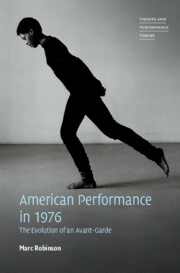
1976 was a febrile, transitional year in cultural history, coming after Watergate and Vietnam and before the AIDS epidemic and the rise of the Conservative movement. Bicentennial triumphalism sounded dissonant against a violent past and uncertain future. Marc Robinson here explores how innovative artists across disciplines – drama, dance, music, film, visual art – responded to this period, before zeroing in on avant-garde theater. Over 1976, five landmark productions could be seen within months of one another: Cecil Taylor's A Rat's Mass / Procession in Shout, Meredith Monk's Quarry, the Robert Wilson / Philip Glass opera Einstein on the Beach, Joseph Chaikin's production of Adrienne Kennedy's A Movie Star Has to Star in Black and White, and, finally, the Wooster Group's first open rehearsal of Spalding Gray and Elizabeth LeCompte's Rumstick Road. In close readings of these five works, Robinson reveals the poetics of a transformative moment in American culture.
The volume outlines modern British literature's relation to global empire from the 16th century to the present. Spanning the interactions between Britain, Europe, and the world outside, in Asia, Africa, Australasia, North America, and the Caribbean, it suggests the centrality of colonial-capitalist empire and global exchanges in the development of major genres of literary fiction, poetry, drama, and non-fiction. Illuminating the vital role of categories such as race, class, gender, religion, commerce, war, slavery, resistance, and decolonization, the twenty-one chapters of the book chart major aspects of British literature and empire. In rigorous yet accessible prose, an international team of experts provides an updated account of earlier and latest scholarship. Suitable for a general readership and academics in the field, the Companion will aid readers in familiarizing with Britain's imperial past and its continuing relevance for the present.
Realism has been disparaged for over a hundred years as an outmoded form, and, more recently, as a pernicious illusion, typical of nineteenth-century novels and Hollywood movies alike. After a long period of disrepute, realism has had in recent years something of a revival among critics and theorists. Yet this revival still represents a minority, and much of the old critique of realism remains taken for granted. This book treats realism as a persistent aspect of narrative in American culture, especially after World War II. It does not seek to elevate realism above other forms of fictional narrative – that is, to restore it to some real or imagined past supremacy. Rather, the goal is to reclaim realism as a narrative practice that has remained vital despite a long history of critical disapproval, by showing how it functions in significant recent works across media.
How we maintain a high level of narrative interest. Varying the speed at which the narrative unfolds; generating momentum; maintaining focus. Building reader anticipation in promise of revelation. Obstacles and uncertainties build suspense. A ticking clock exerts pressure. The cliffhanger.
In many ways the American War of Independence failed to revolutionize American performance culture. After the wartime ban on theater, the resurrected theatrical repertoire quickly reverted to British classics, with a sprinkling of German and French dramas thrown in. Musical performances continued to evoke familiar British folk tunes, comic operettas, or tragic operas. Parade and holiday culture drew on longstanding European forms such as charivari or other genres to celebrate the “perpetual fetes” of the wartime and postwar period. What then would prove “revolutionary” about American performance culture after the war? What could the former colonists proclaim as their own unique and substantive contributions to the cultural life of the new nation?
In his chapter, Luke Gibbons examines artists and writers who take up the subject of the “great scar” of the Civil War, and in their work he finds silence, misdirection, and the kind of temporal indeterminacies that are characteristic of so much revivalist cultural production. By examining literary and cinematic works by Louis D’Alton, Liam O’Flaherty, John Ford, and Dorothy McCardle, Gibbons argues that temporal discontinuity has a positive role to play by reactivating that which history has deactivated. Civil War literature invites the reader to go beyond the surface realism of the text in a way that provides an opening to the real, which in Lacanian terms is foreclosed and mapped over by imaginary constructs. Gibbons’s consideration of Irish literature and film strongly suggests an alternative to conventional realist accounts beholden to historical causality, a way of reading the temporal discontinuity in way that offers a fresh perspective on the trauma of the Civil War.
Douglas Clark reveals how moments of willing and will-making pervade English Renaissance drama and play a crucial role in the depiction of selfhood, sin, sociality, and succession. This wide-ranging study synthesizes concepts from historical, legal, philosophical, and theological studies to examine the dramatic performance of the will as both an internal faculty and a legal document. Clark establishes the diverse connections that Shakespeare, Jonson, Middleton, and a range of overlooked playwrights of the early Elizabethan era made between different types and understandings of the will. By doing so, he reveals the little-understood ethical issues to which they gave rise in relation to the mind, emotions, and soul. Understanding the purpose of the will in its multiple forms was a central concern for writers of the time, and Clark shows how this concern profoundly shaped the depiction of life and death in both Elizabethan and Jacobean drama. This title is part of the Flip It Open programme and may also be available as open access. Check our website Cambridge Core for details.
In Schoenberg’s Vienna the theatre, more so than music, was central to cultural discourse; unsurprisingly, opera and musical drama interested Schoenberg from early on, and he returned to dramatic genres repeatedly throughout his compositional career. In surveying the lively and varied theatrical life of Vienna around 1900 and after, this chapter examines shifting trends in modernist drama – including changing fashions in staging and set design – alongside the influence of significant authors, artists and innovators. It locates the Viennese stage as a site for cultural exchange with other major European centres, and ultimately argues that, if written from the perspective of the theatre, the history of Viennese musical modernism would look quite different from the story of post-tonal progress that has dominated our narratives of Schoenberg’s creative trajectory.
Atonement is a critical component of the cultic system described in Leviticus 1–7 and 16. Purification of sin and thanksgiving offerings shape the worship of Israel. This chapter describes the theology of sacrifice and atonement in Leviticus, the specific offerings, and how atonement has been interpreted by later commentators.
Wherever we are in society, we are surrounded by the Arts. This text has been designed by artists, and the words you read are just visual artworks representing the oral storytelling foundation of all societies. Its layout was designed by artists, using multiple media forms. You are reading it in an environment where the soundscape will hopefully allow you to concentrate. Your body is probably positioned to minimise discomfort and maximise efficiency, while communicating your current state of thought to all those around you (whether consciously or not). Surrounding you may be posters, objects, noises, people interacting with facial expressions, probably some communicating via Facebook, Instagram or other social media using increasingly advanced technologies. The Arts power our lives, yet too often we power down children as they enter formal education (preschool and upwards), stifle their natural forms of communication and interaction, and slowly destroy their ability to be creative and to think diversely.
This chapter explores much of the current research about the value and effect of the Arts in education and assists you to develop your own thinking about the importance of Arts education. This research is framed by an understanding of developing modes of engagement in Arts education, and a discussion of the importance of personal agency and Arts education as ‘praxis’. Finally, the notions of learning ‘in’ and ‘through’ the Arts are explored to enable you to understand the types of learning in which your students can engage.
This chapter will explore the fundamentals of drama, both as a skill and as a methodology for teaching other curricular requirements. It also offers practical activities and assessment practices, as well as theoretical underpinnings and methods to further develop teaching methodologies beyond this text. You will have the confidence and knowledge to engage learners of all ages and abilities to explore their own ideas through dramatic performance and to evaluate the performance of others. The key to drama is not only the development of skills, but also the ability to apply processes and value these processes as equal to the end product of a drama activity. The application of drama in literacy, numeracy and other areas of learning will be embedded throughout. A great deal of the focus on drama in the classroom in Australia is from a western perspective.