To save content items to your account,
please confirm that you agree to abide by our usage policies.
If this is the first time you use this feature, you will be asked to authorise Cambridge Core to connect with your account.
Find out more about saving content to .
To save content items to your Kindle, first ensure no-reply@cambridge.org
is added to your Approved Personal Document E-mail List under your Personal Document Settings
on the Manage Your Content and Devices page of your Amazon account. Then enter the ‘name’ part
of your Kindle email address below.
Find out more about saving to your Kindle.
Note you can select to save to either the @free.kindle.com or @kindle.com variations.
‘@free.kindle.com’ emails are free but can only be saved to your device when it is connected to wi-fi.
‘@kindle.com’ emails can be delivered even when you are not connected to wi-fi, but note that service fees apply.
Elizabeth Bowen and Virginia Woolf became friends in the 1930s, when the two were widely considered the pre-eminent women modernist novelists in the British Isles. Younger writers at the time, like literary critics later, compared the two women; yet in their private writings, both of them dwelt on their divergent personal characteristics. This underlines the importance of the notion of character to both Woolf’s and Bowen’s fictional projects. In her pivotal experimental essays and fictions of the early 1920s, Woolf returned to the idea of two people sitting opposite in a railway carriage to explore the ways in which the variety and intricacy of subjectivity could never be fully plumbed by another. Bowen, who admitted to being influenced by Woolf, used the same railway-carriage thought experiment in her own essays on the writer’s craft. Although Bowen understood character largely in terms of Woolfian notions of the vast complexity of subjectivity, she demonstrates in her own novels, particularly The House in Paris and To the North, that character needed to be delimited by more notions from previous eras that depend on the broader strokes of caricature to ascertain another’s personality.
Edited by
Latika Chaudhary, Naval Postgraduate School, Monterey, California,Tirthankar Roy, London School of Economics and Political Science,Anand V. Swamy, Williams College, Massachusetts
When colonial rule began in the mid-nineteenth century, India and Britain were both poor by modern standards, although Britain was somewhat richer. In 1947, when colonial rule ended, the gap between the two was gigantic. Britain was a sophisticated and wealthy economy where per capita income, health and education had improved dramatically, whereas India was still exceedingly poor on all these metrics. India’s economy changed over 200 years: it was far more engaged in international trade, a modern industrial sector had developed and railways criss-crossed the country. At the same time, productivity was low in all sectors of the economy, especially in agriculture. Life was precarious: as late as 1943, a devastating famine took millions of lives in Bengal, a horror that indicted colonial rule. We introduce the reader to this complex story of transformation without enrichment, briefly commenting on how each chapter fits in the narrative.
Edited by
Latika Chaudhary, Naval Postgraduate School, Monterey, California,Tirthankar Roy, London School of Economics and Political Science,Anand V. Swamy, Williams College, Massachusetts
This chapter describes the financing and building of Indian railways, the largest infrastructure investment of the colonial state, and assesses their economic effects. Due to the poor quality of pre-rail transport, railways integrated markets, reduced price dispersion and increased incomes in colonial India. Net earnings as a share of capital were low in the first wave of railway construction and operations because of moral-hazard problems. As the Government of India took ownership of railways from private British companies, working expenses decreased and net profits improved with no negative effects on productivity. Yet the government did not always maximize their railway profits, opting to purchase more expensive British locomotives over cheaper alternatives. Despite these shortcomings, railways were a unique sector of the colonial economy. By the twentieth century, railways were delivering significant tax revenues to the Government along with higher incomes to the country.
Edited by
Latika Chaudhary, Naval Postgraduate School, Monterey, California,Tirthankar Roy, London School of Economics and Political Science,Anand V. Swamy, Williams College, Massachusetts
The chapter describes colonial India’s unique urbanization story. In 1750 India had big urban centres such as Hyderabad and Delhi and urbanization was close to the global average. While urbanization in India increased over the next two centuries, the increase was small compared to the rest of the world and Indian urbanization had fallen significantly below the global average by 1950. Yet the modest temporal change masks the important shift in urban centres from inland in the 1700s to the eastern and western coasts by the 1900s. As British rule expanded, the port cities of Bombay and Calcutta emerged as the new centres of administration, trade and commerce. More generally, cities close to railways grew faster than cities close to rivers. Unlike rural India, colonial towns and cities were characterized by more educated residents, more industrial and service sector jobs, male-biased sex ratios and growing political influence.
Peat extraction profoundly transformed central Russia’s physical, economic, and social geography. This chapter traces how canals, railways, cables, as well as housing and social welfare helped make central Russia’s peatlands more habitable. From the 1920s onwards, and particularly following Stalin’s death in 1953, the government invested considerable funds allowing workers to live permanently near important peat extraction sites. Over time, workers’ settlements turned into regular parts of the landscape and homes for workers and their families. The everyday in these places blended features of urban and rural life. Enjoying access to running fresh water and basic health care, most people combined employment in peat extraction with private gardening to produce food. This chapter foregrounds the often overlooked role of workers’ settlements as spaces of reproduction in the history of Russia’s fossil economy. Peat was not just a fuel but also a source for place-based feelings of belonging that allowed workers to embrace the margins of Russia’s fossil economy as their home.
Railway infrastructure defines the narrative parameters of two texts by Elizabeth Gaskell: North and South and ‘Cousin Phillis’. Focusing on small-scale interim stations, and the construction of new lines, this chapter examineslogistical options that even dormant railway infrastructure can bring to stories otherwise concerned with being-in-place. This infrastructural reading of North and South focuses on a scene set at Outwood Station, a small but well-connected hinge between North and South. It shows that proximity to physically iterated railway infrastructure reconnects the narrative to a broad system of global exchange and mobility. In ‘Cousin Phillis’, meanwhile, Gaskell’s civil engineer narrator lays both railway lines and plot lines but neither quite coheres into a functioning, connective system. This chapter traces the uneven degrees of narrative integration in Gaskell’s works back to their differing publication intervals, with North and South’s weekly serialisation providing far greater opportunity to situate its local plot within global circulation than the monthly release of ‘Cousin Phillis’.
How did the novel come to be entangled with large-scale public infrastructure in nineteenth-century Britain? Sixteen years after the first purpose-built passenger railway opened in 1830, an anonymous writer for Chambers’s Edinburgh Journal pondered the formal compatibility of railways and fiction. ‘One half of the romantic stories of the country are more or less connected with stage-coach travelling’, the author muses, ‘but the railway, with its formal lines and prosaic punctuality, appears to be almost entirely given up to business’.1 By claiming (however hyperbolically) that ‘one half’ of ‘romantic’ stories in the 1840s work through stagecoach infrastructure, this author puts the untapped potential of railway travel under the spotlight. Yet the exact proportion of fictional references to popular transport is less important than public perception of plotlines and travel as closely intertwined modes. There was an inevitability about novelists exploring the possibilities of passenger railways in fiction.
If literary form and railway infrastructure do not neatly align in nineteenth-century novels, then what is the significance of their close, inconsistent entanglement? Chapter 4 examines George Eliot’s 1876 novel Daniel Deronda, which takes full advantage of transport and communications infrastructure in its two mainline plots. Throughout Eliot associates markers of such systems – ‘dusty waiting rooms’, un-consulted Bradshaw’s railway guides, and telegrams relaying old news – with stasis and regression. Even where they advance the plot, they draw the narrative back in time. This chapter parallels communication infrastructure and novel form to interrogate how and why Eliot reconfigures established and well-traversed form in her final novel that pushes against the margins of literary realism. By offering an upset chronology and a refusal to drive plotlines to a conventional resolution, to what extent does Eliot reconceptualise systems rooted in timeliness and destination in Daniel Deronda?
This final chapter traces railway infrastructure’s lasting impact on novel form through structural and affective dimensions of the railways in E. M. Forster’s 1910 novel, Howards End. A text poised in a transitional period in transport and literary history, Forster’s novel passes traverses the range of infrastructures examined through this book. This chapter provides a much-needed railway reading of a novel critically framed to date through its representation of motor cars and their attendant geographies. I explore how characters personalise public infrastructure in Howards End by unpacking the parallels Forster establishes between domestic space (the house at Howards End) and railway termini. While hypermobility via the motorcar affords a new kind of freedom of movement, it cannot match the established infrastructure in enabling imaginative mobility. Characters with a social outlook entrenched in railway infrastructure move less but see more than those who prefer the motorcar. This chapter argues that this work’s enigmatic instruction to ‘only connect’ is rooted in infrastructural railway poetics.
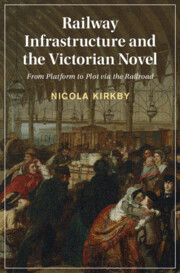
From 1830 onwards, railway infrastructure and novel infrastructure worked together to set nineteenth-century British society moving in new directions. At the same time, they introduced new periods of relative stasis into everyday life – whether waiting for a train or for the next instalment of a serial – that were keenly felt. Here, Nicola Kirkby maps out the plot mechanisms that drive canonical nineteenth-century fiction by authors including Charles Dickens, Elizabeth Gaskell, Anthony Trollope, George Eliot, Thomas Hardy and E. M. Forster. Her cross-disciplinary approach, as enjoyable to follow as it is thorough, draws logistical challenges of multiplot, serial, and collaborative fiction into dialogue with large-scale public infrastructure. If stations, termini, tracks and tunnels reshaped the way that people moved and met both on and off the rails in the nineteenth century, Kirkby asks, then what new mechanisms did these spaces of encounter, entanglement, and disconnection offer the novel?
Chapter 3 demonstrates how James uses railway journeys to dramatize the potentially endless and inherently sociable principle of narrative relations that he outlines in his Preface to Roderick Hudson. Through readings of The Sacred Fount and The American Scene, I argue that these texts evince a particular concern with ‘stopping-places’, specifically invoking the railway’s associations with distribution and supply. In The Sacred Fount, relationships operate in ways that suggest the railway’s own temporal and alimentary economy, as the train journey opening the novel tropes a continuing disquiet surrounding social contact, as well as providing a context for its central concern about the transfer of ‘resources’. The second half of the chapter examines the representation of similar anxieties throughout The American Scene. From his seat in the Pullman railcar, James is perturbed by the sense of moving ‘without personal effort or suffered transfer’, associating the Pullman’s innovative continuity, in particular, with the difficulty of social and cultural differentiation. In essays like ‘The Future of the Novel’ James deprecates the railway’s role as an arbiter of literary and critical taste.
After a decade of effort, China has established its geopolitical influence in Southeast Asia through its rail projects, which will grow further as more lines are completed. Chinese rail projects, especially those involving high-speed rail (HSR) systems, are and will be of considerable benefit to Beijing's geopolitical ambitions, but their impact may be limited by lack of progress, lack of connection, and unstable situations in some host states. Further, although China is actively shaping the landscape of Southeast Asian rail, there are opportunities for Japan, China's competitor with regards to infrastructure investment in rail systems, to explore.
In this article, I argue that leaders of the U.S. Department of War and U.S. Army developed the organizational form and management practices of the modern corporation, decades before the advent of the railroads. Following Mark R. Wilson’s call to “bring the military in” to organizational analysis, I show how leaders of the U.S. military developed modern management practices and organizational structures as a way of maintaining control over officers, soldiers, and workers over long distances, as they provided the organized violence necessary for domestic imperialist expansion. By the time that elite merchants and real estate interests in the Atlantic port cities of the U.S. became interested in building railroads, in the late 1820s and 1830s, the U.S. Army already evidenced the key characteristics of modern business enterprise as defined by Alfred Chandler: a multi-unit organization coordinated by a hierarchy of professional, salaried, career-oriented middle and top managers. All the characteristic coordination mechanisms of the corporation: staff and line hierarchies, divisional and departmental structure, and bureaucratic systems of information gathering, surveillance, and control, were developed by the state in the course of building a continental empire.
Nancy Henry examines the mid-century coexistence of trains and horses and argues that horses became industrialised, machine-like commodities as they entered a new place in the cultural imagination. Railway construction in the 1840s meant that by the 1850s novelists recognised the coexistence of train and horse travel and raised questions about their economic and physical dependence on both mechanical and animal forms of power. The number of horses actually increased dramatically during the railway age as horses were needed to access stations and to carry freight to be loaded onto trains, and this led to an increasing number of accidents which figured as the focus of anxieties about risk, danger, and the unexpected. Henry observes a tipping point in the relationship between the Victorians and progress that manifests in this case in fictional narratives of travel accidents that generated plots of financial loss, disfigurement, and death.
What was the effect of war outcomes on key indicators of state formation in a post-war phase? In this chapter I demonstrate that victors and losers of war were set into different state capacity trajectories after war outcomes were revealed. I do this using a set of cutting-edge causal inference techniques to analyse the gap in state capacity that was generated between winners and losers in the time-period of most stringent warfare (1865-1913). After substantiating that the outcomes of these wars were determined by exogenous or fortuitous events, I provide a short description of my treatment—i.e., defeat—and outcomes—i.e., total revenues and railroad mileage as key indicators of state infrastructural capacity. My estimator, a difference-in-differences model, shows defeat had a negative long-term impact on state capacity which remains remarkably robust even after relaxing key assumptions. Finally, I use the synthetic control method to estimate how state capacity in Paraguay and Peru would have evolved in a counterfactual world where these countries were spared the most severe defeats in late nineteenth-century Latin America.
Chapter 8 traces the EU governance of transport services from the Treaty of Rome to the new economic governance (NEG) regime adopted by the EU after the 2008 financial crisis. Initially, European public sector advocates were able to shield transport from commodification, but, over time, the Commission gradually advanced a commodification agenda one transport modality after another. Sometimes, however, the Commission’s draft liberalisation laws encountered enduring resistance and recurrent transnational protests by transport workers, leading the European Parliament and Council to curb the commodification bent of the Commission’s draft directives. After 2008 however, NEG provided EU executives with new means to circumvent resistance. Despite their country-specific methodology, all qualitative NEG prescriptions on transport services issued to Germany, Italy, Ireland, and Romania pointed towards commodification. But the more the Commission succeeded in commodifying transport services, the more the nature of counter-mobilisations changed. Accordingly, the European Transport Workers’ Federation’s Fair Transport European Citizens’ Initiative no longer targeted vertical EU interventions, but rather the social dumping pressures created by the horizontal free movement of services and fellow transport workers. This target made joint transnational collective action more difficult.
September 1830 saw the first purpose-built passenger railway open between Manchester and Liverpool, followed by a proliferation of local, national, and international lines. Yet the integration of railway infrastructures, perspectives, and plotlines into writing was slow. This chapter examines terminology, speculative journalism, and early engagement with railways in fiction to demonstrate how writing across genres extended the emergent ‘railway imaginary’ well beyond the scope of its built referent. Yet gaps in spatial and temporal perception opened up by the railways posed a challenge to those plotting long-form fiction that relied on a sense of momentum towards a definitive ending. While selected works, including the Mechanics’ Magazine, Railroadiana, and The Pickwick Papers, stop short of representing railways as an inhabited system closely entangled with the familiar rhythms of 1830s life, they do take seriously the task of establishing a dynamic relationship between railway and narrative form that matched technological and literary ambition alike.
GIS data on the evolution of railway networks facilitate the study of the role played by the expansion of transport infrastructure since the industrial revolution. The arrival of the railway transformed economic and social activity and the distribution of population within the territory. Given their importance, we have reconstructed and digitised the layout of the railway lines and the location of the stations and halts that existed from the opening of Spain's first railway line, in 1848, until 2023. We have also added indicators of the quality of the network, more specifically, the dates of its electrification and when the track was doubled to allow two-way traffic. The potential of this database lies in its capacity to analyse the interrelationship between the railway infrastructure and a wide range of elements located in the territory, amongst which it is necessary to highlight other modes of transport, urban expansion and socio-economic development.
Spa towns experienced a boom with the creation of rail lines that brought tourists to the resorts. These customers, beckoned by the climate and environment, sought healthful cures and leisurely activities. Resorts like those crafted by François Blanc at Bad Homburg and Monte Carlo exploded in part because they offered gambling, but they also grew because they were able to take advantage of the mechanization of travel in the mid-nineteenth century that developed in tandem with a culture of tourism. Industrialized transportation networks promoted industrialized forms of leisure even as they gestured to healthful living.
Describes the rationale for, and approach to, regulation of the rail industry. Considers the effects of restructuring, horizontal and vertical separation policies, and the experience of Ramsey pricing