To save content items to your account,
please confirm that you agree to abide by our usage policies.
If this is the first time you use this feature, you will be asked to authorise Cambridge Core to connect with your account.
Find out more about saving content to .
To save content items to your Kindle, first ensure no-reply@cambridge.org
is added to your Approved Personal Document E-mail List under your Personal Document Settings
on the Manage Your Content and Devices page of your Amazon account. Then enter the ‘name’ part
of your Kindle email address below.
Find out more about saving to your Kindle.
Note you can select to save to either the @free.kindle.com or @kindle.com variations.
‘@free.kindle.com’ emails are free but can only be saved to your device when it is connected to wi-fi.
‘@kindle.com’ emails can be delivered even when you are not connected to wi-fi, but note that service fees apply.
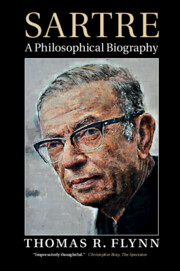
Jean-Paul Sartre (1905–1980) was one of the most influential thinkers of the twentieth century. Regarded as the father of existentialist philosophy, he was also a political critic, moralist, playwright, novelist, and author of biographies and short stories. Thomas R. Flynn provides the first book-length account of Sartre as a philosopher of the imaginary, mapping the intellectual development of his ideas throughout his life, and building a narrative that is not only philosophical but also attentive to the political and literary dimensions of his work. Exploring Sartre's existentialism, politics, ethics, and ontology, this book illuminates the defining ideas of Sartre's oeuvre: the literary and the philosophical, the imaginary and the conceptual, his descriptive phenomenology and his phenomenological concept of intentionality, and his conjunction of ethics and politics with an 'egoless' consciousness. It will appeal to all who are interested in Sartre's philosophy and its relation to his life.
This book is a comprehensive study of the writings of Jean-Paul Sartre. As well as examining the drama and the fiction, the book analyses the evolution of his philosophy, explores his concern with ethics, psychoanalysis, literary theory, biography and autobiography and includes a lengthy section on the still much-neglected study of Flaubert, L'Idiot de la famille. One important aim of the book is to rebut the charges made by many theorists and philosophers by revealing that Sartre is in fact a major source for concepts such as the decentred subject and detotalised truth and for the revolt against individualistic humanism. Dr Howells also takes into account much posthumously published material, in particular the Chaiers pour une morale, but also the Lettres au Castor and the Cranets de la drole de guerre. The work is a substantial contribution to Sartre studies, but has been written with the non-specialist in mind; to that end all quotations are translated into English and gathered in an appendix.
It is difficult, when one's mind is troubled by the ideas of Kant and the yearnings of Baudelaire, to write the exquisite French of Henri IV
(Marcel Proust, In Search of Lost Time, iii, 689)
Overall Jean-Paul Sartre (1905–80) considered himself a writer more than a philosopher. Almost as soon as he could read, he projected a career as a master of French literature, his idea of what this might mean changing as his taste moved from boys' adventure novels to the classics. In his mid-teens, he decided, following his excitement at first reading Bergson, to study philosophy at the École Normale; but that was because he regarded philosophy as “simply a methodical description of man's inner states, of his psychological life, all of which would serve as a method and instrument for my literary works … I thought that taking the agrégation exam in philosophy and becoming a professor of philosophy would help me in treating my literary subjects.” The idea was that philosophy would provide an intellectual foundation for literature.
When Sartre's philosophical thought developed and, predictably, took the direction of the new philosophy of existence, it is hardly surprising that he maintained a close tie between literature and philosophy.
In the fifth volume of his collected essays, Jean-Paul Sartre has brought together thirteen pieces written during the last ten years and dealing with the problems of colonialism and decolonization. They range from prefaces or reviews of books to polemical articles and interviews on the Algerian question and French politics; as is to be expected, they vary widely in quality as well as importance. Some of them are perhaps better seen as documents, testimonials of Sartre's courageous stand against the policies of successive French cabinets toward Algeria. At a time when the majority of the French people and of their leaders were striving to avoid seeing or acknowledging the profound moral issues confronting them, Sartre's voice was among the few raised to point out the real problems, to remind Frenchmen of their own recent experience under the Nazis, and to warn them against imitating those Germans who "did not know" what was happening at Dachau and Auschwitz. At the time of the Hungarian revolt of 1956, Sartre did not let his commitment to Marxism and to the left still his voice or his conscience. During the Algerian war, in the late 1950's, he became once again the conscience and the voice of French humanism and French culture. He and his collaborators and friends kept up the intellectual (and sometimes material) contact between France, as a nation and as an idea, and her rebellious colonial subjects.
Lucien Goldmann was one of the most important independent Marxist intellectuals in Western Europe during the past two decades. His interests and works—in philosophy, sociology, history, and aesthetics—were classically broad, insisting as he did on the indivisibility of social experience. He was probably the most prominent of the pupils of Georg Lukács and in turn helped form a whole generation of French and German humanist Marxists. The course he taught at the Ecole Practique des Hautes Etudes was a mecca for European and Third World students. His major work The Hidden God, on Pascal and Racine, remains a classic in the sociology and epistemology of literature; The Theory of the Novel is currently being translated by Random House. The study below continues the socio/structural line of inquiry followed in his work on Genet (T38) and Gombrowicz (T47).
By the time Camus and Sartre were formally introduced in 1943, they were already familiar with, and had publicly expressed measured admiration for, each other's works. In 1938 and 1939 Camus had quite favourably reviewed Sartre's Nausea and The Wall (SEN: 167–72; E: 1417–22). In 1943 Sartre wrote favourably of The Outsider (Sartre 1962a: 108–21; Sartre 1993: 92–112). They first met in Paris in June 1943, at the opening of Sartre's play The Flies, and shortly thereafter Sartre became involved with Combat (where Camus was now editor), although he did not write for it until after the Liberation. In an interview in 1944, Camus declared himself to “have three friends in the literary world, André Malraux, even if I no longer see him because of his political positions, René Char, who is like a brother to me, and Jean-Paul Sartre”. In the same year Sartre asked Camus to direct and act in his play No Exit. In 1945 Camus offered Sartre the opportunity to travel to America to write a series of reports for Combat. While there he wrote of his friend in Vogue magazine:
In Camus's sombre, pure works one can already detect the main traits of the French literature of the future. It offers us the promise of a classical literature, without illusions, but full of confidence in the grandeur of humanity; hard but without useless violence; passionate, without restraint.… A literature that tries to portray the metaphysical condition of man while fully participating in the movements of society.
… no society can complain of its intellectuals without accusing itself, for it has the intellectuals it makes.
– Sartre, ‘A Plea for Intellectuals’
When Jean-Paul Sartre (1905–1980) was arrested in 1970 for distributing seditious political literature in the streets of Paris, President de Gaulle vetoed the move to hold him in prison, reportedly saying: ‘You don't put Voltaire in prison.’ What he was alluding to by his comparison was that both men made themselves the radical consciences of their respective societies. Sartre – at once a philosopher, novelist, dramatist, literary critic, art critic, political theorist, political essayist and political activist – was as versatile and prolific as Voltaire, but more original. He dominated the intellectual life of the mid-twentieth century. He was the public intellectual par excellence.
Early years
The essential theme of Sartre's life and work is liberty. As a child, his rejection of authority was expressed in his rejection of his tyrannical grandfather, Charles Schweitzer, who ran a German school in Paris. He chose to become a writer precisely because his grandfather solemnly warned him against it. Sartre's brilliant account of his childhood, and of his relationship to culture and language, in Words (Les Mots, 1964) sheds much light on his later development. Sartre's father died when his son was fifteen months old, and Sartre and his mother were reintegrated into his grandfather's household, where they were both called ‘the children’ and brought up together almost as brother and sister. In Words he lays bare the forces that worked upon his consciousness a child, especially the bourgeois ideology embodied in his grandfather. The book is the judgement of the man on the child, but it is even more a judgement on a society that bred extreme forms of self-deception. Sartre presents himself as a young boy constrained to fit into an old-fashioned household and describes how he was constantly acting a part to please a dictatorial old man. At the heart of Sartre's work generally is a preoccupation with all forms of hypocrisy; playing roles, pretending to be someone or something one is not, came to represent a major crime in his eyes.
The purpose of this essay is to reflect on Sartre as a philosopher of the imagination in order better to describe and assess his approach to the philosophy of history. Sartre was, of course, an existentialist and we shall consider what it means to formulate an “existentialist” philosophy of history. But his was equally a philosophy of consciousness and the paradigm of consciousness for him was imaginative consciousness. Realizing this fact will open the door to a more adequate comprehension of his work as a whole, but especially his social thought, including his theory of history. For a basic thesis I wish to defend is that Sartre likens the intelligibility of history to that of an artwork because he considers the former as much the product of creative freedom as he does the latter. So we shall begin with a reading of major theses from his Psychology of Imagination and move through his posthumously published works, The War Diaries and the Cahiers pour une morale, in order to observe their expansion and application in both volumes of the Critique of Dialectical Reason and The Family Idiot. In so doing, we shall try to make sense of Sartre's claim that history in general and his Flaubert study in particular constitute “a novel that is true” (un roman vrai).
Even though Sartre repeatedly emphasized the divergences between Hegel and himself, this chapter discusses their convergences. It will be seen, moreover, that these often conflict with Sartre's own stress on the differences between them.
Sartre does not refer to Hegel in his early works; he seems to have become familiar with him only from Being and Nothingness onward, where Hegel, along with Kant, Husserl, and Heidegger, is one of his chosen interlocutors and adversaries. This essay deals with certain specifically philosophical aspects of the debate: the conception of being-for-itself and being-for-others in Sartre and Hegel. Being and Nothingness also discusses the dialectical conception of nothingness. Juliette Simont has analyzed this question in an important footnote to her article "Sartre et Hegel: le probleme de la qualite et de la quantite." I shall not therefore return to it directly.
In Sartre's analysis of being-for-itself and for-others, the most significant references are to the two Logics (the Science of Logic and the first part of the Encyclopedia) and to the Propédeutique. Sartre's perceptiveness with respect to these dry texts leads one to conjecture that he had more than a merely academic knowledge of Hegel - did he perhaps discuss him with some of Kojève's pupils, with Jean Wahl, Lefèbre, and Hartmann, authors of a collection of selected texts from Hegel, Hyppolite, and Maurice de Gandillac? It is possible, but as yet unproven.
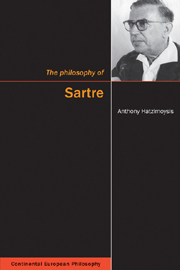
As a playwright, novelist, political theorist, literary critic and philosopher, Jean-Paul Sartre remains an iconic figure. This book examines his philosophical ideas and methods. As an introductory guide for the reader who wishes to understand Sartres philosophical argumentation, it reconstructs in plain language key instances of Sartres philosophical reasoning at work and shows how certain questions arise for Sartre and what philosophical tools he uses to address those questions. Readers are able to get a real understanding of Sartres approach to the activity of philosophizing and how his method favours certain types of philosophical analysis. Each chapter considers a range of issues in the Sartrean corpus, including intentionality, perception, emotion, imagination, being, existence and essence, which are also topics of concern to contemporary philosophical inquiry. In this way, Hatzimoysis is able to show how the Sartrean approach can advance our understanding of the current debates surrounding those issues.
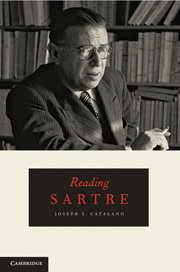
In this volume, Joseph Catalano offers an in-depth exploration of Jean-Paul Sartre's four major philosophical writings: Being and Nothingness, Saint Genet: Actor and Martyr, The Critique of Dialectical Reason, and The Family Idiot. These works have been immensely influential, but they are long and difficult and thus challenging for both students and scholars. Catalano here demonstrates the interrelation of these four works, their internal logic, and how they provide insights into important but overlooked aspects of Sartre's thought, such as the body, childhood, and evil. The book begins with Sartre's final work, The Family Idiot, and systematically works backward to Being and Nothingness. Catalano then repeats the study by advancing chronologically, beginning with Being and Nothingness and ending with The Family Idiot and an afterword on Flaubert's Madame Bovary. Readers will appreciate Catalano's subtle readings as well as the new insights that he brings to Sartre's oeuvre.
How does one of the twentieth century's great thinkers help us illuminate one of its great paradoxes? What does Sartre contribute toward clarifying the problem of thinking about history as it has emerged in the late twentieth century? After a century and a half of celebrating and living by the idea of progress, amidst staggering scientific-technological progress, almost no one in the West continues to believe in progress. In the current climate of intellectual disillusionment no serious thinker is willing to defend Bury's formulation that the world is slowly advancing in “a definite and desirable direction” leading to a “condition of general happiness”that will “justify the whole process of civilization.” On the one hand, the postmodernist temper shows, as Lyotard says, “incredulity toward metanarratives” such as the idea of progress. On the other, the current mood seems sympathetic toward negative metanarratives - those that suggest that things are getting worse. Witness, for example, the remarkable success of Allan Bloom's The Closing of the American Mind, or the works of Christopher Lasch - which suggest that as time goes by, we are losing the most vital of values, attitudes, and skills. The negative mood is starkly captured in Theodor Adorno's claim: “No universal history leads from savagery to humanitarianism, but there is one that leads from the slingshot to the megaton bomb.”
Jean-Paul Sartre (1905–1980), nephew of the Alsatian theologian, Albert Schweitzer, was born in Paris, passed his agrégation at the Ecole Normale Superieure in 1929, and was a lycée teacher between 1931 and 1945. He was called up to the French Army in 1939, captured by the Germans in 1940 and released after the armistice. In 1938 he published a novel, La Nausée, translated by Robert Baldick as Nausea (Harmondsworth: Penguin, 1965), and in 1940, L'Imaginaire: Psychologie phénoménologique de l'imagination, translated by Bernard Frechtman as The Psychology of Imagination (London: Methuen, 1972). His major philosophical work, L'Etre et le Neant, was published in 1943, and translated by Hazel E. Barnes as Being and Nothingness (London: Methuen, 1957). As a novelist he is best known for a trilogy, Chemins de la Liberté (Roads to Freedom), comprising L'Age de raison (1945) translated by E. Sutton as The Age of Reason (Harmondsworth: Penguin, 1961), Le Sursis (1945), translated by E. Sutton as The Reprieve (Harmondsworth: Penguin, 1963) and La Mort dans l'āme (1949), translated by G. Hopkins as Iron in the Soul (Harmondsworth: Penguin, 1965). His main work of literary criticism is Qu'est-ce que la littérature? (1947), translated by B. Frechtman as What is Literature? (London: Methuen, 1950). Plays includeLes Mouches (1943) and Huis Clos (1944), both translated by S. Gilbert and published in one volume, as The Flies and In Camera (London: Hamish Hamilton, 1965).
Jean-Paul Sartre as a critic has been harshly judged in Western Europe, indeed he is one of the more notable victims of cold war mental attitudes. This is well illustrated by the quarrel with Albert Camus brought into the open by Jeanson’s harsh review of ‘L’Homme Revoke’ in ‘Les Temps Modernes’, a quarrel in which a very large number of western readers have taken Camus’ side. Camus is seen as the upholder of human dignity and values, over against Sartre, the system builder, infatuated with the marxist myth of history. This attitude very much undervalues Sartre’s contribution—he points out clearly the essential weakness in Camus’ position. Moreover the whole debate is an excellent illustration of the difficulty involved in building any coherent, materialist system of ethics.
This difficulty is rooted in their common ground; both start from the atheism of Nietzsche and its consequence the absolute freedom of man. Yet both belong to the long line of French moralists and are passionately concerned with what a man ought to do, granted this double premiss. However they begin to differ even in the ways they accept this atheism. Sartre is very matter of fact, for him the death of God is so self-evident that there is no point in talking about it. Towards the end of ‘Le Sursis’ Mathieu receives a letter from Daniel in which the latter very interestingly explains his half-conversion to Catholicism. Mathieu reads part of the letter, loses patience with its to him utter irrelevance, and throws it into the waste paper basket. This contrasts sharply with Camus’ interest in the way the individual accepts atheism.
Ernest Hemingway has long been considered either a nihilist or a secular existentialist. “A vast number of critics,” writes Joseph Prud’homme, “have deemed Ernest Hemingway a nihilist. As an individual, they contend, Hemingway spurned religious truth and espoused absurdist nihilism… . The art and artist express the same worldview.” Robert Penn Warren writes that Hemingway's protagonist in the 1933 short story “A Clean, Well-Lighted Place” is “obsessed by … the meaninglessness of the world, by nothingness, by nada.” William Bache likewise asserts that the story's protagonist represents a “nihilistic way of life.” And Judith P. Saunders argues that the story's protagonist experiences “existential panic” in the face of his mortality when confronted with the old man's suicide. She says that his “cynical parody” of two Roman Catholic prayers—the Hail Mary and the paternoster—is “insistently blasphemous.” But existentialist interpretations of Hemingway's fiction extend far beyond “A Clean, Well-Lighted Place.” One can look to a handful of his better-known short stories—like “The Killers,” “The Snows of Kilimanjaro,” and “The Short Happy Life of Francis Macomber”—to see that Hemingway at the very least sympathized with an existentialist worldview. As Warren states elsewhere, “The typical Hemingway hero is the man aware, or in the process of becoming aware, of nada.” Hemingway's own confrontation with mortality, meaninglessness, and the freedom to make of this life whatever one chooses profoundly shaped his worldview, and you can see this influence throughout his body of work. As José Antonio Gurpegui notes in Hemingway and Existentialism, a search of the combined “words ‘Hemingway’ and ‘existentialism’ in Google showed 354.000 results on August 2013.” As of December 2022, that number has grown to 481,000.
Writing decades apart, Ben Stoltzfus and John Killinger take an existentialist interpretation of Hemingway's fiction a step further. As an unbeliever, Hemingway was not a Kierkegaardian existentialist, but neither would he align himself with Nietzsche, despite the considerable overlap in their views. Rather, Hemingway's own brand of existentialism resembled that of his contemporary, the twentieth-century French philosopher Jean-Paul Sartre. Like Sartre, Hemingway did not believe in God or a spiritual afterlife.
Sartre's experimentation in February 1935 with the drug mescalin has been well documented by Simone de Beauvoir in her book The Prime of Life.1 She recalls that Sartre experienced under the influence of the drug not exactly hallucinations, ‘but the objects he looked at changed their appearance in the most horrifying manner:’ [POL 209]. The residual effects of this nightmarish experience left Sartre, not only for several days ‘in a state of deep depression’ [POL 210], but also produced moods that ‘recalled those that had been induced by mescalin.’