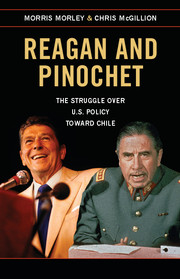
3 - Dead Ends in Chile Policy
Published online by Cambridge University Press: 05 February 2015

Summary
By the beginning of Ronald Reagan’s second term, a number of factors were conspiring to make a gradual change in U.S. policy toward Chile inevitable. Prominent among these, in the most general sense, had been Reagan’s speech to the British Parliament in June 1982, in which he committed the United States to promoting “freedom and democracy” as a matter of principle throughout the world. The context for, and background to, this speech was the American President’s deeply held belief that the Soviet Union was an “evil empire,” utterly untrustworthy, and should eventually be consigned to history unless it was willing to fundamentally transform its society, politically and economically. The more immediate trigger was Reagan’s support for the Solidarity movement in Poland, which was posing a major challenge to the Soviet-backed government of General Wojciech Jaruzelski.
That speech had important repercussions. First, Reagan’s commitment did not sit well with the wholehearted support of a military strongman such as General Augusto Pinochet and left the White House open to the charge of double standards – supporting democracy where it served U.S. interests in the struggle against leftist movements and regimes, especially in Central America, but exempting dictatorships perceived as valued allies for strategic, political, or economic reasons. Indeed, in the closing months of 1984, pressure was again building inside Congress to apply tougher measures against Chile in response to the concern of some legislators that the administration, despite its lofty rhetoric, was simply choosing to ignore Pinochet’s continued repression. Second, the London speech gave some latitude to those State Department officials eager to pursue policy approaches beyond the strictures of the Kirkpatrick Doctrine and what it implied for Washington’s relations with anticommunist Third World autocrats. Jeane Kirkpatrick’s departure in early 1985 provided an opportunity to contest her interpretation and influence, especially in the White House. “[W]e started taking a different approach to Chile,” recalled a senior U.S. official, and simultaneously “started to draw new lessons from the fall of the Shah in Iran and of Somoza in Nicaragua.”
Information
- Type
- Chapter
- Information
- Reagan and PinochetThe Struggle over US Policy toward Chile, pp. 105 - 146Publisher: Cambridge University PressPrint publication year: 2015
References
, “US Looks at Chile as the Next Place to Promote Democracy,” CSM, March 23, 1988, 1
, “Democracy and Double Standards: The View from Chile,” World Policy Journal 11, no. 4 (1985): 719Google Scholar
, In the Name of Democracy: U.S. Policy toward Latin America during the Reagan Years (Berkeley: University of California Press, 1991), 156Google Scholar
, “US Slaps Pinochet’s Hand for Extending State of Siege in Chile,” CSM, February 13, 1985, 10
, “U.S. to Abstain on Loan to Chile to Protest Human Rights Abuses,” NYT, February 6, 1985, 4
, “U.S. Envoy, Ending Chile Visit, Avoids Any Criticism of Pinochet,” NYT, February 21, 1985, 4
, “U.S. Planning Tougher Line on Chile,” WP, January 24, 1985, DC11
, “U.S. May Ask for Military Aid to Chile,” UPI, February 10, 1985
, “U.S. Official Receives Little Assurance from Chile’s Pinochet,” WP, February 23, 1985, A12
, “U.S. Abandons ‘Quite Diplomacy’ with Chile,” MH, February 21, 1985, 9A
, “U.S. Stepping Up Effort to Promote Talks in Chile,” WP, February 27, 1985, A1
, “Credits and Euronotes: World Bank May Back 1.95 Billion Dollars Chile Loans,” FT, May 13, 1985
, “Official Says U.S. Is Changing Tactics, Not Policy, in Human Rights Arena,” WP, March 20, 1985, A14
and , “House Panel Endorses Sanctions against Chile,” WP, March 21, 1985, A29
, “U.S. Chile Policy Mired in Dilemma,” MH, May 18, 1985, 5
, “U.S. Takes Role of ‘Neutral Power Broker’ in Chile,” MH, May 28, 1985, 5A
, “U.S. Pressures in Chile Are Said to Fail,” WP, May 28, 1985, A10
, “U.S. Backs Plan by World Bank for Chile Loans,” WSJ, July 1, 1985, 16
, “DE 1985 a 1986: Estados Unidos y la Transición a la Democracia en Chile,” CONO SUR 5, no. 2 (1986): 4Google Scholar
, “Chile Signs 1 Billion Loan Accord with Bankers,” FT, November 2, 1985
, “State Terror and Social Movements in Latin America,” International Journal of Politics, Culture and Society 2, no. 3 (1989): 203–204Google Scholar
, “Thaw Seen in Relations between US, Chile Diplomats,” BG, September 17, 1985, 3
, “6 Killed, 567 Arrested in Chilean Protests,” WP, September 6, 1985, A25
, “Pinochet Hits Opposition, Does Not Reject Its Plan,” WP, September 12, 1985, A39
Accessibility standard: Unknown
Why this information is here
This section outlines the accessibility features of this content - including support for screen readers, full keyboard navigation and high-contrast display options. This may not be relevant for you.Accessibility Information
Accessibility compliance for the PDF of this chapter is currently unknown
and may be updated in the future.