


Hostname: page-component-76d6cb85b7-jhrpq Total loading time: 0 Render date: 2026-07-15T11:52:33.203Z Has data issue: false hasContentIssue false

Coccidial oocyst release: once a day or all day long? Tropical bird hosts shed new light on the adaptive significance of diurnal periodicity in parasite output

Published online by Cambridge University Press:  24 November 2021

Clotilde Biard
Affiliation:
Sorbonne Université, UPEC, Paris 7, CNRS, INRA, IRD, Institut d'Écologie et des Sciences de l'Environnement de Paris, F-75005 Paris, France
Karine Monceau
Affiliation:
Centre d'Études Biologiques de Chizé, UMR 7372, CNRS and La Rochelle Université, 79360 Villiers-en-bois, France
Maria Teixeira
Affiliation:
UMR CNRS 6282 Biogéosciences, Université Bourgogne Franche-Comté, 6 Boulevard Gabriel, 21000 Dijon, France
Sébastien Motreuil
Affiliation:
UMR CNRS 6282 Biogéosciences, Université Bourgogne Franche-Comté, 6 Boulevard Gabriel, 21000 Dijon, France
Soline Bettencourt-Amarante
Affiliation:
UMR CNRS 6282 Biogéosciences, Université Bourgogne Franche-Comté, 6 Boulevard Gabriel, 21000 Dijon, France
Lucie Develay
Affiliation:
UMR CNRS 6282 Biogéosciences, Université Bourgogne Franche-Comté, 6 Boulevard Gabriel, 21000 Dijon, France
Jérôme Moreau*
Affiliation:
Centre d'Études Biologiques de Chizé, UMR 7372, CNRS and La Rochelle Université, 79360 Villiers-en-bois, France UMR CNRS 6282 Biogéosciences, Université Bourgogne Franche-Comté, 6 Boulevard Gabriel, 21000 Dijon, France
*
Author for correspondence: Jérôme Moreau, E-mail: jerome.moreau@u-bourgogne.fr

Abstract

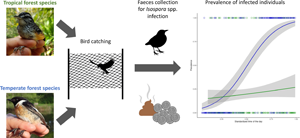
Many parasites spend part of their life cycle as infectious forms released from an infected host in the external environment, where they may encounter and infect new hosts. The emergence of infectious life stages often occurs once a day to minimize mortality in adverse environments. In bird hosts, intestinal parasites such as coccidia are generally released with feces in the late afternoon. This dynamic is adaptive since it allows avoiding desiccation and ultraviolet (UV) radiation, thus reducing mortality of oocysts in the environment until transmission to the next host. If this circadian rhythm is the result of natural selection to increase oocyst survival, we may hypothesize that oocysts will appear in feces at different times depending on the environment where hosts live. Particularly, in an environment where UV radiation and desiccation are very low, we may expect oocyst circadian release to disappear since the main selective pressure would be relaxed. We sampled different species of birds in tropical and temperate forests in spring and investigated coccidian oocyst output. A strong circadian variation in the prevalence of hosts shedding coccidian oocyst was detected for species caught in the temperate forest with an increase in prevalence in the late afternoon, whereas prevalence of birds shedding oocysts was constant over the course of the day for most species sampled in the tropical rain forest. These results are consistent with the hypothesis that oocysts’ circadian output is maintained by natural selection to increase oocyst survival. We discuss the adaptive significance of diurnal periodicity in parasite output.

Information

Type
Research Article
Copyright
Copyright © The Author(s), 2021. Published by Cambridge University Press

Access options

Get access to the full version of this content by using one of the access options below. (Log in options will check for institutional or personal access. Content may require purchase if you do not have access.)

Article purchase

Temporarily unavailable