Book contents
- Frontmatter
- Contents
- List of contributors
- Editor's preface
- 1 Isaac Barrow: divine, scholar, mathematician
- 2 The Optical Lectures and the foundations of the theory of optical imagery
- 3 Barrow's mathematics: between ancients and moderns
- 4 Isaac Barrow's academic milieu: Interregnum and Restoration Cambridge
- 5 Barrow as a scholar
- 6 The preacher
- 7 Isaac Barrow's library
- Index
5 - Barrow as a scholar
Published online by Cambridge University Press: 05 November 2011
Edited by

Book contents
- Frontmatter
- Contents
- List of contributors
- Editor's preface
- 1 Isaac Barrow: divine, scholar, mathematician
- 2 The Optical Lectures and the foundations of the theory of optical imagery
- 3 Barrow's mathematics: between ancients and moderns
- 4 Isaac Barrow's academic milieu: Interregnum and Restoration Cambridge
- 5 Barrow as a scholar
- 6 The preacher
- 7 Isaac Barrow's library
- Index
Summary
The intellectual achievements of seventeenth-century England have hardly lacked attention. The political theories of rebels and rulers, the technical achievements of anatomists and chemists, and the crowning scientific glory of Newton's synthesis have always evoked interest and enthusiasm. But the widespread interest in these eminently modern aspects of English culture has had its problematic as well as its positive side. It has distracted attention from enterprises less attractive to modern tastes, less closely tied to modern disciplines, and not as well supplied with heroic figures. Classical scholarship of the form that Barrow practiced is a powerful case in point. Everyone knows that English classical scholarship really began with Richard Bentley's great books at the end of the century, the Epistola ad Millium and the Dissertation on Phalaris. Before these appeared, England produced one great edition of a Greek text, Stanley's Aeschylus, and harbored one great Hellenist from the Continent, Isaac Casaubon. Otherwise, it specialized only in the production of neat little textbook editions of school classics, like the popular editions of Roman poets put out by Farnaby the flogger. So even the most recent histories suggest.
In fact, this vision is at best a partial one, shaped as much by the limitations of modern scholars as by the breadth of the surviving historical documents. It assumes, for example, that the postclassical and the non-literary aspects of antiquity are somehow peripheral.
Information
- Type
- Chapter
- Information
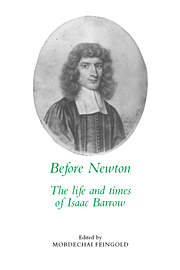
- Before NewtonThe Life and Times of Isaac Barrow, pp. 291 - 302Publisher: Cambridge University PressPrint publication year: 1990
Accessibility standard: Unknown
Why this information is here
This section outlines the accessibility features of this content - including support for screen readers, full keyboard navigation and high-contrast display options. This may not be relevant for you.Accessibility Information
Accessibility compliance for the PDF of this book is currently unknown
and may be updated in the future.
- 5
- Cited by