

In an Appeal, speakers use speech to solicit verbal or non-verbal actions from listeners. In the simplest case, acoustic pointing signals in a sympractical field control verbal interaction with receivers or induce them to act in response to this pointing. This Istic Deixis Appeal is discussed in 4.1.
In another type of Appeal, the speaker solicits a communicative response, commonly verbal, to a proposition with an unknown, which the speaker constructs with linguistic signs in a synsemantic field, and addresses to the listener to solve the unknown. The unknown is either the truth value or a semantic constituent of the proposition, such as Agent, Goal, Place, Time, Manner. The response may be gestural rather than verbal, such as nodding or shaking one's head for ‘Yes’ or ‘No’, or shrugging one's shoulders for ‘I don't know’, but the response is still a communicative action. The Appeal may take place in a sympractical instead of a synsemantic field, when gesture and facial expression are essential accompaniments of verbal communication, as in the examples quoted in 1.2.1.3, or when they replace it altogether, as in the following constructed communicative interaction.
Father and son are working in the garden. The father says to the boy, ‘Go and get me a flower-pot from the far end.’ The boy goes and finds two different sizes. As there is visual contact across a large distance, the boy does not shout but lifts one pot up with one hand and points to it with the index finger of the other hand. The father sees this and nods. The boy sends a sympractical visual Appeal signal that conveys the meaning of the synsemantic verbal message ‘Do you want this size?’, and the father responds with a sympractical visual signal meaning ‘Yes.’
These types of communicative interaction are instances of the Question Appeal. Its synsemantic manifestations are discussed in 4.2.
In a third type of Appeal, speakers also perform speech actions with linguistic signs in a synsemantic field, directed to receivers, yet they solicit actions of body and mind, rather than a communicative response to an unknown in Referential Representation. There are two subtypes, depending on the speaker's attitude towards the listener. It may be considerate or dominant. The Appeal may again be accompanied by gesture, for example ordering a person to leave by shouting ‘Out!’ and pointing to the door at the same time. These Request or Command Appeals are discussed in 4.3.
The three types of Appeal are defined as different communicative functions. By the side of these functions, there are different syntactic forms – declarative, interrogative, imperative, vocative and non-sentential (‘elliptic’) structures. There is no strict correlation between any particular function and any one of the syntactic structures. In German and English, each of the three Appeal functions can be coded in different syntactic structures, and, together with specific intonation patterns, they yield subcategories in each function. The links of communicative functions with syntactic and prosodic forms are outlined under the headings of each Appeal function. In Kohler (Reference Kohler2013b), declarative and interrogative structures were differentiated from declarative and interrogative functions. The conceptual distinction is maintained, but now Interrogativity is placed in a network of Appeal functions, and the function-form distinction is given a more stringent terminology: Deixis Appeal, Question – Command – Request Appeals, Statement (Asserting Representation) versus vocative, non-sentential (‘elliptic’), interrogative, imperative, declarative and exclamatory structures, in conjunction with distinctive prosody patterns.
4.1 The Deixis Appeal
4.1.1 Types of Formal Patterns
While there are special linguistic signs for hic and illic deixis in German and English, as in other languages (‘hier’, ‘dieser’ – ‘dort’, ‘der’; ‘here’, ‘this’ – ‘there’, ‘that’), istic deixis relies on attention-getting signals, like ‘he’, ‘hallo’ / ‘hey’, ‘hello’, or naming vocatives, to point to the receiver and prepare them for the sender's message. For example, the speaker addresses the listener with a personal name to rouse attention to an upcoming Statement, Question, Request/Command:
&2^Angela &2. &PG1 das können wir so nicht &2^machen &2. &PG4
&2^Angela &2. &PG1 we can't &2^do it like this &2. &PG4
&2^Robert &2. &PG1 wie sollen wir das denn &2^machen &2. &PG4
&2^Robert &2. &PG1 how shall we &2^do it then &2. &PG4
&2^Sarah &2. &PG1 &2^gib mir bitte mal das &0. &2^Salz rüber &2. &PG4
&2^Sarah &2. &PG1 &2^pass me the &0. &2^salt &2. &1]please &, &PG4
In German, the 2nd person personal pronouns, informal ‘du’ or formal ‘Sie’, may also be used to address the receiver in this way, either by themselves or preceding a personal name to reinforce the deixis.
&2^du/Sie &2. &PG1 das können wir so nicht &2^machen &2. &PG4
&1 du &2.&2^Peter/&PG1 Sie &2.&2^Herr Schmidt &2. &PG1 das können wir so nicht &2^machen &2. &PG4
&2^Peter/Mr Smith &2. &PG1 we can't &2^do it like this &2. &PG4
Since the personal name is the deictic trigger, it has to be accented. Being tightly linked to the following message the prosodic phrase boundary after it is weak (see 2.12) but will be more strongly marked in reinforced deixis. The vocative can also be appended to the speaker's message but can then no longer be accented, because it does not direct the listener to an upcoming message. It becomes a deictic suffix in a Statement, a Question or a Request/Command:
&2X &0Angela/Robert &2. &PG4
German pronouns, either on their own or together with vocative naming, cannot be post-positioned because their forms would have to be elaborated, which runs counter to suffixation.
Instead of by a naming vocative, the Deixis Appeal may be signalled by such phrases as ‘hör/hören Sie mal (zu)’, ‘listen’, to point to the listener's ear for attention, or ‘sag/sagen Sie mal’, ‘tell me’, to point to the listener's mouth for verbal response. They are signals controlling interaction, linked to a following Statement or Question. They are not self-sufficient Request Appeals, in spite of their imperative form. For example:
&2^Hör/Hören Sie mal &2. &PG1 das &2^geht so nicht &2. &PG4
&2^Listen &2. &PG1 this won't &2^do &2. &PG4
&2^Sag/Sagen Sie mal &2. &PG1 ist das dein/Ihr &2^Ernst &2. &PG4
&2^tell me &2. &PG1 are you being &2^serious &2. &PG4
The accentual and phrasing features are the same as for naming vocatives. In German, ‘hör/hören Sie mal’ may be reinforced to &2^Hör/Hören Sie mal &2^zu &2. &PG1, and both ‘hör/hören Sie mal’ and ‘sag/sagen Sie mal’ may be prefixed by an accented naming vocative, and/or by informal ‘du’ or formal ‘Sie’, either unaccented as part of the deixis, or accented as a separate, reinforced address; this introduces an offensive note, which in the case of the formal address violates a social code and sounds rude. The ear- and the mouth-directed deictic signals may also be appended to the Statement or Question as unaccented suffixes:
&2X &0hör mal/sag mal &2. &PG4
This is not possible with reinforced ‘hör/hören Sie mal zu’. In English, the equivalent deictic signal cannot be integrated as an unaccented deictic suffix in the message. Its occurrence in German seems to be linked to the use of the modal particle ‘mal’, which gives the verbs ‘hör’ and ‘sag’ the meaning of the general faculty of ‘hearing’ or ‘speaking’, and thus removes the function of a specific Request or Command from the imperative form. The English translation lacks a corresponding modal particle.
If the general German verbs for ‘hearing’ and ‘speaking’ are replaced by more specific ones, such as ‘pass mal auf’ [pay attention] and ‘erzähl mal’ [let's have the story], the function of Request or Command stays, and the phrase does not become a Deixis Appeal. This means that the phrase can precede or follow in accented form, and suffixation is excluded. For example:
&2^erzähl mal &2. &PG4 was ist denn &2^gestern &0. &2^pass'iert &2. &PG4
&2^tell me &2. &PG4 what &2^happened &0. &2^yesterday &2. &PG4
was ist denn &2^gestern &0. &2^pass'iert &2. &PG4 &2^erzähl mal &2. &PG4
what &2^happened &0. &2^yesterday &2. &PG4 &2^tell me &2. &PG4
A Question with an unknown object can be integrated into a Request, resulting in what is traditionally termed an indirect question:
&2^erzähl mal was &0. &2-gestern &0. &2^pass'iert ist &2. &PG4
&2^tell me what &0. &2-happened &0. &2^yesterday &2. &PG4
Besides these lexical istic pointers, communicators use stepping, instead of continuous, pitch patterns as acoustic interaction control signals (see 1.2.1.2 and 2.14). In such exchanges, social and personal attitudes between acting partners, emotional expressiveness of speakers, and propositions about the world and the communicative setting play a minor role. This results in stepping patterns becoming less forceful than their continuous counterparts. Thus, compared with ‘↓good ↑mor↓ning, Anna’, the same sentence with a high-low medial peak contour on ‘morning’ is more categorical and superior sounding, and may even be taken as a reproach when the person comes to the breakfast table rather late, whereas the down-stepping pattern would not, least so with a small step-down interval of a minor third. Similarly, ‘your tickets, please’ with a high-low medial peak contour on ‘tickets’ has a commanding tone, compared with the down-stepping pattern ‘↓your ↑tick↓ets, please’.
The discussion in the following sections develops a functional network of distinct types of interaction control by stepping as the most elementary Appeal function. The primary division is between controlling connection with a receiver and inducing action in a receiver.
4.1.2 Controlling Connection with a Receiver
A sender signals the wish or the readiness to connect with a receiver. This may be done in three different ways: (1) calling someone to connect, or giving one's position in response; (2) initiating, sustaining and closing an interaction; (3) re-establishing connection. Whenever a sender considers it necessary to control sender-receiver channel connection for these communicative acts, stepping pitch patterns are used.
(1) Calling
This ‘calling contour’, usually across a spatial distance between speaker and listener, is a stepping pattern going down from high pitch by a variety of intervals – the larger the interval, the more dominant the summoning appeal. Duration and energy are further variables that distinguish different types, depending, for example, on distance or indoors/outdoors. The pattern may be a mother's call to a child to stop playing or watching television, or anything else the child may be doing, because it is dinner-time or bedtime, or just time to come home, e.g. ‘↑John↓. ↑Lunch↓’, with high-mid stylised medial peaks, turning the words into disyllables. If the child does not respond, the mother will repeat her call more loudly and eventually revert to continuous pitch with increased loudness, pitch excursion and non-modal phonation, adding strong expression and commanding appeal to the call. Down-stepping may also be used to call someone to disclose their whereabouts and thus to enter the speaker's action field, e.g. ‘↑Ro↓bert. ↓Where ↑are ↓you?’ Likewise, in the example quoted in 1.2.1.1 (1), Speaker A may use a down-stepping pattern on both ‘↑An↓na’ and ‘↓where ↑are ↓you?’ to get the addressee to establish contact. Disyllabic ‘↑Here↓’ in the answer, over and above signalling hic deixis, also signals istic deixis with a stepping pattern, to connect with the caller. The same applies to ‘↓It's ↑me↓’ in 1.2.1.1(2).
A special case of this calling contour is its use to rouse the attention of someone who has fallen asleep, or is otherwise occupied, or just does not take part in a communicative interchange, e.g. ‘↑John↓, ↑wake ↓up’ (with down-stepping on ‘John’ and on ‘wake up’). This sounds more friendly than the use of a continuous falling contour. The latter is a Command to act, the former is a receiver-directed control signal to enter communicative interaction.
A receptionist in a doctor's surgery calling the next patient in the waiting-room to come forward to see the doctor is another instance of istic deixis: ‘↓Mister ↑Mil↓ler’/‘↑Next one, ↓please.’ In this case, up-stepping is also possible: ‘↓Mister ↑Miller’/ ‘↑Next one, please.’ The difference between down-stepping and up-stepping in calls is one of Summoning versus Inviting, reflecting the distinction between Command and Request in synsemantic speech. With downward pitch movement, a speaker signals terminality in a speech action and authority towards the listener, the more so the larger the interval; upward pitch movement signals continuation and compliance. This applies to both continuous and stepping pitch patterns. Due to this function-form link, mothers calling their children will be more likely to use down-stepping, whereas receptionists will prefer up-stepping.
(2) Initiating, Sustaining, Concluding Interactions
Stepping patterns in greetings, or in leave-taking, or in answering the telephone, or in routine selling–buying interactions have the function of controlling the communicative connection. At the check-out in supermarkets, the cashier may open, sustain and conclude a selling–buying interaction in this fashion, as in the following example observed in a German supermarket:: ‘Hal↑lo. – ↑Vierzehn Euro ↓dreißig. – ↑Siebzig Cent zu↓rück, ↑und der ↓Bon. ↑Schönen ↓Tag noch’ [with the English equivalent ↓Hel↑lo. – ↑Fourteen pounds thirty ↓pence. – ↑Seventy pence ↓change, ↑and the re↓ceipt. ↑Have a nice ↓day]. Answering the telephone will usually be up-stepping ‘↓Hel↑lo’ to signal ‘Who's calling? Identify yourself!’, but it may also be ‘↑Hel↓lo’, very short, and with a very small interval to convey, ‘I'm busy, what do you want, whoever you are?’ If, after an opening ‘↓Hel↑lo’, there is no response, the sender tries to establish connection with down-stepping ‘↑Hul↓lo.’
The completion of an interaction may be signalled with ‘Thank you’, either high-level, up-stepping or down-stepping, for example to a clerk, bank teller or waiter. Ladd (Reference Ladd1978, p. 524) points out that these stepping patterns would be totally inappropriate ‘to someone who had just returned our lost wallet to us’, because it lacks an expressive component, which is inherent in continuous contours. A special case are perfunctory answers to polarity-question calls, e.g. (‘↓are you coming ↑with us?’) ‘↑Yes (↓)/↑No (↓)’ or ‘↓Per↑haps (↓), ↓don't ↑know (↓)yet.’
(3) Re-connecting with a Receiver
Re-establishing connection may be illustrated by the following example:
At a barbecue in the garden, the husband is having a bit of trouble getting the fire going. After some time, he calls out to his wife, who has gone into the house: ‘↓It's ↑bur↓ning’ with a down-stepping pattern on ‘burning’. In this way, he signals to his wife that she can now bring the steaks, the burgers and the sausages for grilling.
If, on the other hand, the husband suddenly discovers that his garden shed is ablaze, he will not call to his wife in the same way but will use a continuous falling contour, with pressed phonation and intensified loudness and pitch excursion.
Another case of re-connecting with a receiver is the use of a stepping pattern as a reaction to being reminded, or reprimanded, for having contravened a social code. Wichmann (Reference Wichmann2004, p. 1540) provides the following example of a parent–child interaction in a British middle-class family:
| A | Robert doesn't want any yet |
| Z: | Yes (I do ? unclear). I'd like some of that and some strawberry ice cream. |
| D: | What |
| A: | Please (loudly on fall-rise tone) |
| Z: | Please (quietly on level tone) |
The parent admonishes the child for not observing the code of saying ‘please’ after a request. The child knows the code and re-connects with the parent by giving an extracommunicative citation of the code word on mid-level pitch.
An example of the same genre comes from a German conversation I once overheard in the departure lounge of Hamburg airport between a father and his approximately 5-year-old daughter, who was wrapped up in playing games on a small computer. (I am translating the conversation into English since the patterns can be exactly the same.) The father was going to buy something to drink for himself and asked the daughter whether she would like some water. The daughter said ‘yes’, and a few minutes later the father put the glass in front of her, saying ‘Here's your water.’ This was greeted with silence. The father asked, ‘What does one say?’ – ‘↑Thank you’ on mid-level pitch was the answer.
Niebuhr (Reference Niebuhr2013) quotes the example of a teenager having his hi-fi on full blast, so the neighbours complain about the noise, and his mother tells him to turn it down. The teenager complies with the code of neighbourly behaviour: ‘↓mach ich eben ↑leiser’, [OK. I'll turn it ↑down then]. Here the up-stepping pattern conveys irritation at being reminded, due to the strengthening of high pitch in a stylisation of an early valley. Complying with the code might also be signalled by ‘↓mach ich eben ↑lei↓ser’ or ‘↑mach ich eben ↓leiser’, with the stylisations of a medial or an early peak respectively (see 2.7, 2.8). In these cases, the irritation is absent, and the early high-mid drop into the accented syllable signals Finality and thus adds a connotation of resignation.
In all these examples of a speaker re-connecting with a receiver in order to correct previous behaviour, e.g. the infringement of a social code, the speaker does not express concern for the recipient, but verbalises the required action as a citation removed from the symbolic field of communication. They all have the connotation of ‘reluctantly giving in’, especially the third example. This is not due to the formal feature of pitch stylisation per se. Social demands enforce behavioural codes on the speaker, who re-connects with the listener, using receiver-directed acoustic pointing. The use of the particle ‘eben’ (which may be rendered in English by prefixed ‘OK’ and suffixed ‘then’) in the third example expresses reluctance lexically. The meaning of the utterance keeps this connotation even when a continuous pattern replaces stepping. Niebuhr takes the surface meaning of the utterance, which is the result of lexical as well as prosodic coding, as the meaning of the stepping pattern, and calls it ‘resistance is futile’, barring prosodic research from semasiological understanding.
4.1.3 Inducing Action in a Receiver
In this set of Istic Deixis, receiver-directed pointing is meant to stimulate receivers into action. They may be (1) specific proximate or distant receivers or (2) anonymous receivers.
(1) Specific Proximate or Distant Receivers
Ladd (Reference Ladd1978, p. 123) quotes an example from Bolinger:
| A. | Where's the phone book |
| B. | ↓on the ↑tab↓le (… right where it belongs) |
Here the response to a question for place information contains an acoustic pointing signal telling the receiver to look for the thing in the place where it always is.
In the following example, Ladd (Reference Ladd1978, p. 523) illustrates the use of stepping to induce action in a pointing field, and contrasts it with the use of a continuous pattern in a symbolic field to transmit information:
| A. | [from a distance, pointing to the car from which B has just emerged] |
| Y’ ↑left your lights ↓on. | |
| B. | [who had been jangling keys getting ready to lock the car] |
| What? | |
| A. | [louder, and with a rising intonation pattern up to the final accent, which is followed by an abrupt low fall on the last syllable] |
| You left your lights on. |
’When an utterance is called with stylised intonation and the addressee does not understand, the speaker will repeat with normal intonation’ (p. 523).
In this case, A's interactive trigger signal was not successful in inducing B to act appropriately. So, B asks for referential information, which A provides with a continuous pitch pattern. But, contrary to Ladd's interpretation of the use of stepping, I believe that his example does not demonstrate a stylisation of the meaning of a plain contour; rather, stepping patterns have a different function of their own, i.e. controlling interaction and getting dialogue partners to act in stereotypical ways. This contrasts with continuous patterns, which provide referential information, speaker attitudes and emotional expression.
Another example from Ladd (Reference Ladd1978, p. 524) illustrates the lack, in an action-triggering stepping pattern, of attitudinal and expressive meaning, which would have to be transmitted by a continuous pattern:
we can squeeze past people in a crowd, with either ↑Xcuse ↓me, or ↑’Xcuse ↘me, [high on the first syllable, falling on the second]
But when we bump into people in the supermarket causing them to drop a dozen eggs all over the floor, it will not do to say ↑’Xcuse ↓me.
In this situation, an attitude of being sorry and an apology are asked for, which the interactive trigger signal cannot give. If this pattern were used nevertheless, it would be a downright rude remark, signalling to the other person, ‘Look where you are going – be more careful next time.’
Ticket collectors on trains commonly ask passengers with stepping patterns to show their tickets, signalling that this is a formal act, not the initiation of a conversation with the traveller. The use of continuous falling contours turns the ticket collector's matter-of-fact ticket-checking into a communicative act, i.e. into a Command, and therefore sounds less customer-friendly.
(2) Anonymous Receivers
In public announcements, a stepping pattern draws anonymous receivers’ attention to certain constellations in the environment and points to actions they should take. For example, at Schiphol Airport in Amsterdam, passengers are reminded with high-mid down-stepping ‘↑Mind your ↓step’ from a female voice that they should pay attention on the travellators. This is stylisation of an early peak contour. Its function is to give general advice to all passengers, the passenger in the abstract, to adapt their walking to the demands of the circumstances in the action field: the meaning of Finality of an early peak (see 2.7, 2.8). If the downward step were to occur on the vowel of ‘step’, breaking it up into two syllables, the function changes to an admonition of the individual passenger who may not be walking cautiously: the meaning of Openness of a medial peak (see examples in 4.1.4).
By such a stylised pattern the speaker gives a friendly warning, which is neither a Command nor a Request, and which it is in the passenger's interest to follow. A high-falling medial peak pattern on ‘step’ would signal a Command ‘watch where you are going’, a low-rising early valley a Request ‘please comply with my wish’. The latter would be out of place in this situational context. Since the Schiphol announcement does not address a particular passenger in a speaker–listener communicative interaction, the speaker detaches the information from speaker-oriented expressiveness and from listener-oriented attitudes, apart from getting listeners’ attention. Rather than being an act in communicative interchange, the prime purpose of the message is to point to aspects in an action field considered relevant for the receiver, and to control the addressee's actions in it.
A different example is provided by announcements in London Underground stations that have curved platforms. When a train stops, a gap forms between the carriage and the platform. Passengers’ attention is drawn to this hazard so that they may act to avoid it. ‘Mind the gap’ is announced when the doors open. At some stations, the announcement is made in synsemantic form with continuous pitch movement: ‘Please, mind the gap between the train and the platform.’ It becomes a Request to pay attention to a hazardous constellation of objects, which is described with linguistic form. At other stations, the announcement is in sympractical form, with rising and falling pitch on ‘mind’ and ‘gap’ respectively, pointing to an object in a deictic field the anonymous passenger is expected to be part of. Understanding the announcement presupposes that the passenger knows what ‘gap’ points to. It is a Warning, appealing to the passenger to be careful. This is more than simply drawing their attention to their action in a deictic action field, as is the case at Schiphol Airport. The announcement could, of course, be reduced to simple pointing, and would then also be realised as a stepping pattern. But none of the male and female voices that have recorded the announcement use it. London Transport opted for addressing the potential passenger with a personal appeal in addition to pointing.
A third example refers to market criers offering their goods with stepping patterns to attract anonymous listeners’ attention and induce them to buy: ‘↓fresh ↑vegetables’, ‘↓tasty ↑sausages’. The typical pattern is up-stepping to raise the pitch level for a heightened stimulating effect. Down-stepping weakens the stimulatory force of the speaker's appeal to the listener. It turns an interaction inducement into an interaction offer by supplementing the appeal with information about the content of the interaction, i.e. it becomes more speaker- and fact-oriented. This gets the more prominent the larger the downstep. The high-mid stepping in a market crier's call ‘↓tasty ↑sau↓sages’, instead of ‘↓tasty ↑sausages’, is not confined to controlling an interaction by attracting attention and stimulating the receiver into buying, but also puts more weight on the produce offered.
4.1.4 Naming and Pointing in Sympractical Fields
Stepping is also used when synsemantic naming is added to sympractical pointing, for instance in reminder calls:
| ↑Don't forget your ↓lunch. [with a step down to ‘lunch’] | |
| or | ↓Don't forget your ↑lunch↓. [with a high-mid step on ‘lunch’] (Ladd Reference Ladd1978, p. 520) |
The former points to the packed lunch that has been prepared as usual, whereas the latter points to the packed lunch that is waiting to be taken, e.g. sitting visibly on the kitchen table. This is again the difference between early peak Finality and medial-peak Openness (see 3.3), now with stepping patterns pointing to the generally given or the specifically selected in the action field, respectively. If the continuous contours
Don't forget your &2)/^lunch &2. &PG
are used instead, the utterances lose their pointing and become synsemantic references to a packed lunch, with an appeal to the receiver not to forget it. The early peak may be contextualised as ‘and before you go, pick up your packed lunch’, the medial peak as ‘you've packed everything else’.
The example
↑Daddy forgot his brief↓case. (Ladd Reference Ladd1978, p. 521)
with high-mid stylised medial peak down-stepping on ‘briefcase’ also belongs to this category. The speaker observes an item in the pointing field which the person it belongs to forgot to take with him, and verbalises this observation in a structured sentence addressed to some listener in the action field. However, the main goal of the utterance is not the transmission of information but drawing attention to an action field, and to trigger the same observation in the listener by a stimulating signal. If down-stepping occurs early
↑Daddy forgot his ↓briefcase.
the stimulating signal is absent: the speaker simply points to the established fact in the field, possibly also suggesting that Daddy is generally forgetful. If, on the other hand, the speaker wants to pass on important information to a nearby listener, also expressing concern and appealing to the listener to see that Daddy gets his briefcase, pitch is continuous in a raised medial peak:
&HP Daddy forgot his &3^briefcase &2. &PG
Ladd illustrates the use of such a continuous contour with the example (in PROLAB notation)
&HP Daddy fell &3^downstairs &2. &PG (Ladd Reference Ladd1978, p. 521).
It shows a raised medial peak on ‘stairs’ (together with other acoustic properties for intensification) in a naming field, transmitting factual information, expressive concern and an appeal to the addressee(s) to come and help. If ‘downstairs’ were to have low-high-mid stepping
↓Daddy fell down↑stairs↓. [a stylised medial peak]
the speaker would point to a quite common event: ‘Not the first time it has happened, we were only talking about the problem the other day, and we now have to do some serious thinking.’ If there is stepping from high ‘down’ to mid ‘stairs’
↓Daddy fell ↑down↓stairs. [a stylised early peak]
the soliciting signal to the addressee(s) is absent, and the utterance only refers to the common occurrence in the pointing field.
Ladd (Reference Ladd1978, p. 526f) links the early down-stepping pattern to a stylisation of the continuous low rise. He contrasts the meanings of the two patterns as follows: ‘in statements [the low rise] often conveys belligerence or defensiveness, or some special involvement of the speaker … In many cases the stylized connotation emerges as tiredness, resignation, or “I-been-there-before”. He quotes ‘I'm coming’ with both patterns in a Bolinger-type annotation, marking ‘I'm’ high level in both cases, and ‘coming’ either as a low rise or as low down-stepping. As to their meanings, the former ‘in answer to a parent's call could come out as belligerent or insolent’, the latter ‘puts up only broken (= stylized?) resistance to parental authority, and conveys resignation to the inexorable approach of bedtime or dinnertime’. Apart from having some feature of low pitch in common, the two patterns are formally very different: one rises, the other falls. On the other hand, the down-stepping pattern has early, preaccentual synchronisation of high pitch, and low pitch on the accented vowel, in common with continuous early peak patterns. This gives early down-stepping the function of Finality, which is different from the function of a low rise. Thus, neither the formal nor the functional aspect justifies a stylisation relationship between the two patterns. Dombrowski (Reference Dombrowski2013) demonstrated conclusively in his semantic-differential experiment that the early downstep pattern is the stylisation of the continuous early peak. A continuous early valley establishes a rapport with a caller, a continuous late valley includes friendliness in the reaction to being called. To sound ‘belligerent or insolent’ other acoustic properties must be added, especially greater pitch range in the drop from a high prehead to the start of a rise that is accompanied by non-modal phonation.
Down-stepping may also be pointing to a hazard in the action field of which the individual receivers should be aware in order to adapt their behaviour in their own interests. Ladd (Reference Ladd1978, p. 520f) gives two examples:
↑Look out for the broken ↑step↓.
with a stylised medial peak on ‘step’ is directed towards the individual listener, possibly as a reminder to the listener's previous experience of the hazard, also referring to the step having been broken for some time. This meaning is absent when the downward step occurs in a stylised early peak from high-level ‘broken’ to ‘step’. As in the Schiphol announcement (see 4.1.3(2)), the speaker just points to the hazard. If the utterance is meant as a warning, with the speaker's expressive concern added, it would have continuous pitch movement and a medial peak on ‘step’:
&2^Look out for the &0. &2-broken &0. &3^step &2. &PG
The same applies to Ladd's second example in a mountaineering scenario.
&2^Look out for the &0. &3^crev'asse &2. &PG
However, if the two mountaineers have done their climb before, the one behind may shout to the one ahead with early peak down-stepping to ‘v'asse’
↑Look out for the cre↓v'asse.
telling him that he must be close to the previously encountered hazard. Or the one ahead may shout to the one behind with medial-peak high-mid down-stepping on disyllabic ‘v'asse’:
↑Look out for the cre↑v'asse↓.
and the meaning ‘this is where the hazard is’.
Naming and pointing in a sympractical field of calls may be illustrated by the following constructed communicative exchanges.
A couple have discussed a family outing with their children. Some time later, the father calls to Jeannette, who is out of sight, either somewhere else in the house or outside:
↓Jean↑n’ette, ↓we're ↑going now, ↓are you ↑coming?
There is high-level up-stepping on each of the three accented syllables, stylising early valleys. The high levels in the father's calls (vocative – declarative – interrogative structures) signal the father's openness to Jeannette's response. If he expects the answer to be ‘I'm coming’, in full agreement with the previous discussion, he will use high-mid stylised medial peaks in all three calls:
↓Jean↑nette↓, ↓we're ↑go↓ing now, ↓are you ↑com↓ing?
In both cases, Jeannette may answer
↑Yes, ↓I'm ↑com↓ing.
with high-level pitch on the first accent, a stylised early valley and high-mid down-stepping on the second accent, a stylised medial peak, signalling an open-action response: ‘OK. I'll get on my way.’ Synchronisation of high pitch with the accented vowel conveys argumentative Openness in stepping as well as in continuous contours.
But Jeannette may also answer
↑I'm ↓coming.
with high-level ‘I'm’ followed by mid-level ‘coming’, a stylised early peak, signalling a forced-action response and an undertone of resignation: ‘OK, I'll get on my way then.’ Here synchronisation of lowered pitch with the accented vowel conveys argumentative Finality, as in continuous contours.
A third possibility for Jeannette's answer is
↓I'm ↑coming.
a stylised early valley, signalling readiness to comply with the action call. It may be called the ‘compliance function in the sympractical field’.
In these cases, acoustic pointing to the receiver (Jeannette or the father) occurs with reference to the discussion among the family, and the communicative exchanges take place within this frame of phaniasma deixis (cf. 1.2.2). The father picks up information available to all family members from the previous discussion, and Jeannette answers accordingly. If the information exchange does not precede, the father's speech action with Jeannette may run like this:
↓Jean↑nette. &2^Mum and I are &1. &2^going down to the &1. &2^beach &2. &PG Are you &2]coming &? &PG
starting with high-level pitch, a stylised early valley, on the vocative to get Jeannette's attention from a distance, followed by a sequence of three medial peak contours with terminal falls on the next three accents, and finally a high-rising early valley, expecting an open response. Jeannette may respond
&2^Yes, I'm &1. &2^coming &2. &PG
with medial peaks and terminal falls at both accents. The absence of a mutual information base prevents a pointing field from being set up for an interaction in relation to this base. The exchanges between the father and Jeannette are still distance calls, and will be marked as such by increased loudness, but they are no longer istic deixis calls. They are now exchanges of new information, for which stepping patterns are no longer adequate: continuous contours take their place.
4.1.5 Explaining the Use of Stepping Pitch Patterns for Deixis Appeal
The typical explanation of the use of stepping pitch in calling contours, the originally analysed data set, referred to a greater distance from the receiver requiring greater acoustic energy which can be better generated on sustained pitch (Abe Reference Abe1962). Apart from the fact that calls are adjusted to the distance estimated, which may be quite small, the occurrence in, e.g. greetings, cannot be explained by a need to raise the energy of the transmitted signal. Rather, for a successful control of connection with a receiver, the sender wants to ensure a high degree of signal intelligibility by reducing its acoustic variability. Therefore the stability of key prosodic properties – syllable nucleus sonority, rhythmic structure and pitch – is heightened. Pike (Reference Pike1945, p. 71) mentions durational restructuring of syllable timing in speech chant, under which he subsumes calling. Syllable nuclei as pitch carriers are lengthened, and pitch is levelled to transmit two basic patterns, (higher-)lower or (lower-)higher, depending on whether the sender signals readiness or expectation to connect, or whether the sender stimulates connection. If the higher-lower readiness/expectation signal is transmitted on a final accented syllable, the nucleus is lengthened irrespective of the vowel quantity (‘↑Jane↓’, ‘↑Jen↓’) and perceptually splits into two syllables to accommodate the two level pitches (cf. also Gussenhoven Reference Gussenhoven1993).
The low-high step-up presupposes an unaccented syllable before the accented one, e.g. ‘↓Ni↑cole, ↓come ↑here’, but in ‘↑Jane/Jenny, ↓come ↑here’ the corresponding pattern is high. When in a step-up pattern the unaccented syllable precedes an accent initiated by a voiceless obstruent, as in ‘Okay’, the whole syllable may lose its periodicity and therefore its periodic pitch level, but low aperiodic pitch perception persists. The articulatory movement for the unaccented syllable may, in turn, be eliminated altogether, resulting, e.g., in ‘↑kay’, with possible reinforcement (lengthening) of the initial obstruent. When the word ‘Danke’ or the phrase ‘Thank you’ occurs with this step-up pattern it may become an unaccented-accented syllable sequence, although the first syllable is lexically stressed. It can then follow the same path as ‘Okay’, resulting in ‘↑ke’, or ‘↑kyou’. This will not happen in the high-mid step-down on these phrases. It leads to increased distinctiveness between the two step patterns. The perceptual separation, by pitch as well as duration and syllabification, of the stepped level-pitch sequences in, e.g., ‘↑Jane↓’ and ‘↑Jane’ is also more clearly marked than the one between the continuous contours of, e.g., falling ‘\Jane’ and rising ‘/Jane?’ Stepping patterns are thus more adequate signals for interaction control. Furthermore, as pitch stylisation reduces Appeal and Expression features, stepping becomes a specific signal for the pointing, as against the symbolic, function of speech communication.
The difference between appeal signals in the deictic and the symbolic field may be illustrated by the following interchange between a driver and a passenger as the car is approaching a red traffic light rather fast. At a fair distance away, the passenger may point to the light being red and draw the driver's attention to its meaning ‘Stop!’ by issuing the gentle appeal ‘↑Red↓’, or ‘↑Red’ with greater stimulatory force to act. But if the car is already dangerously close to the lights, suggesting that the driver might not have seen it, this pointing reminder is not strong enough: the passenger issues a high-key Command Appeal with an expression of fear by using an expanded continuous pitch fall, pressed phonation and intensified loudness to get the driver to stop in time. The linguistic sign ‘red’ is no longer simply a pointer to the traffic signal and the Highway Code, and to the need to act, but it has become a symbol of Danger with a signal of Warning and a symptom of Fear.
4.1.6 Stepping Patterns in Ritual, Liturgy, Children's Chant and Nursery Rhymes
The use of level pitch in religious ritual, such as the Lord's prayer in the Christian church or the liturgy of Holy Mass, is another manifestation of descaling the linguistic sign of Bühler's Organon Model for routine interaction. Communication with Spirits and God(s) isolates the speaker from human communication; the speaker bows to the superior forces and tones down all features that mark interaction between speakers and listeners. In the Catholic church, the use of Latin texts removes a substantial part of referential meaning. Here again, the use of stepping is the obvious choice for this special type of communicative situation. But being a calling scenario, the worshipper only uses the down-stepping pattern, with different intervals, the largest to mark the end of the spiritual interaction, for example in ‘↑Amen↓.’ Children's chant (see 2.14) and nursery rhymes are further examples of the use of stepping pitch patterns for specific interactive functions. They use a greater number and a greater variety of stepping levels than the more monotonous routines in prayers and liturgy. All these uses differ from stepping in istic deixis as they feature in entire spoken texts, whilst stepping in Deixis Appeal is pointing interspersed in sympractical and synsemantic communication.
4.2 The Question Appeal
4.2.1 Overview
Whilst the function of the Istic Deixis Appeal is to attract a listener's attention and to control interaction, the Question Appeal solicits a communicative response to an unknown in a proposition, which the speaker constructs with linguistic signs and addresses to the listener in a synsemantic speaker–listener action field. There are two types of unknowns (with illustrations from German and English):
| (a) | the truth value of the proposition, for example | |
| Kannst du Spanisch? | Can you speak Spanish? | |
| <TruthX>: Du kannst Spanisch. | <TruthX>: You can speak Spanish. | |
| (b) | a semantic constituent<SemCon>of the proposition – <Agent> <Goal> <Place> | |
| < Time> <Manner>, for example | ||
| Wer kann Spanisch? | Who can speak Spanish? | |
| <AgentX>: kann Spanisch | <AgentX>: can speak Spanish | |
The speaker constructs the proposition, with the unknown inserted, in two different ways:
| (_1) | making the proposition without reference to one already available in the interaction | |
| (_2) | picking up a proposition made by a dialogue partner, or deducing it from the speaker–listener common ground in their action field, for example | |
| A: | Alex hat ein Haus gekauft. | |
| Alex has bought a house. | ||
| B: | &HR &2^Alex hat ein &0. &2^Haus gekauft&2. &PG | |
| &HR &2^Alex has bought a &0. &2^house &2. &PG | ||
| A: | Wir treffen uns morgen früh um sieben im Labor. | |
| We are meeting in the lab at seven tomorrow morning. | ||
| B: | Um &2[wieviel Uhr treffen wir uns im Labor &? &PG | |
| At &2[what time are we meeting in the lab &? &PG | ||
| B: | Wir treffen uns um &2[wieviel Uhr im Labor &? &PG | |
| We are meeting in the lab at &2[what time &? &PG | ||
The constellations (a_1) and (b_1) are Polarity Question and Information Question with propositional structures ‘<TruthX>: proposition’ and ‘<SemConX>: in proposition’, respectively; the constellations (a_2) and (b_2) are Confirmation Questions about the validity of a proposition already available, or about semantic constituents of information already provided in it, with propositional structures ‘<CTruthX>: proposition’ and ‘<CSemConX>: in proposition’. In Kohler (Reference Kohler2013b) these questions were called Repeat Questions (see also Cruttenden Reference Cruttenden1986), with reference to questioning a proposition by repeating it. Since this term leads to misunderstanding, it has now been replaced by Confirmation Questions. Another commonly used term is ‘echo question’ (Ladd Reference Ladd1996), which is not clearly separated from an interrogative-form echo of a preceding question (Question Quote, see 4.2.2.7).
If the proposition that is picked up is itself contained in a Question asked previously by the speaker or by the dialogue partner, we are dealing with a Question Quote of the propositional content of the preceding Polarity or Information Question; for details in German and English, see 4.2.2.7. In the literature, Polarity Questions are commonly referred to as ‘yes’–‘no’ questions, which is a misnomer, because they may be responded to in a great variety of ways. The lexical items ‘yes’ and ‘no’ may even be excluded in alternative questions, such as ‘Do you want the white bowl or the brown bowl?’ But they are still Polarity Questions, because they enquire as to whether X or Y is true, and, if one is true, the other is not.
The coding of Polarity Questions in the languages of the world relies on a variety of formal means, including syntactic structure (initial verb position in the West Germanic languages), question particles, e.g. ma in Mandarin Chinese (Liu Reference Liu2009; Liu and Xu Reference Liu and Xu2005), li in literary Russian, kya in Hindi, or prosodic patterns on declarative syntax, e.g. in spoken Russian (Bryzgunova Reference Bryzgunova1977, Reference Bryzgunova and Shviedova1980, Reference Bryzgunova1984; Khromovskikh Reference Khromovskikh2003), or in Neapolitan Italian (d'Imperio Reference d'Imperio2000). But irrespective of the coding of the polarity function by syntactic or lexical means in a language, prosody always intervenes and codes subcategorisations. This prosody effect also applies to Information Questions. In Confirmation Questions, prosodic patterns are of prime importance, in combination with a variety of formal structures, ranging from question-word to declarative syntax to non-sentential phrases.
Information Questions are coded uniformly across the languages of the world by lexical interrogative elements, e.g. English who, what, where, when, at what time, why, for what reason, how, what for, German wer, wen, was, wo, wann, um wieviel Uhr, warum, aus welchem Grund, wie, wozu. Languages differ as to the position of the lexical question marker in syntactic structure (Dryer Reference Dryer, Haspelmath, Dryer, Gil and Comrie2013). In European languages, they have a sentence-initial position by default, for example in German and English
| Wer hat das gemacht? | Who did that? |
| Wann/Wo/Wie ist es passiert? | When/where/how did it happen? |
Other languages, such as Mandarin Chinese, Japanese or sub-Saharan African, do not have this default initial-position rule. For example, Chinese sentences have the basic semantic frame <Agent> <Action> <Goal>. <Time> and <Place> can either precede or follow <Agent>, together or separately, but cannot occur before or after <Goal>. The sequencing of <Time> and <Place> is such that <Time> always comes first. This semantic frame applies both to Statements and Information Questions. In the Question, the respective Statement slot is filled by the <Time>, <Place>, <Agent> or <Goal> interrogative word. The interrogative stays in the corresponding structural place of the Statement, which may vary according to accentuation, communicative contextualisation and speaking style. Here are some examples showing the principle (I thank Wentao Gu, Nanjing, for providing them):

Deviation from default initial position is possible in German or English for specific communicative functions, especially turn sequencing in dialogue. The principle is the same as in Mandarin Chinese: a question-word phrase is inserted in the appropriate slot of declarative syntax. In German declaratives, the ordering of propositional constituents is
<Agent> <Action> < Goal> <Time> <Manner> <Place>,
whereas in English it is
<Agent> <Action> <Goal> <Place> <Manner> <Time>.
The following examples illustrate the interrogative insertion into declarative structure:

(For further details, see 4.2.2.3)
The Question Appeal in human communication across languages is conceptualised as a proposition with semantic unknowns sent to a receiver to be verbally resolved. Statements and Questions are thus postulated in parallel as either Asserting or Enquiring Representation.
In a Polarity Question, the unknown truth value is formally realised by:
a particle, initial or final in the sentence, or before the focused element
sentence-initial position of the inflected verb
pitch patterns that boost high frequency, e.g. in colloquial Russian, Neapolitan Italian, colloquial French (beside word order and paraphrase).
Initial particle or verb placement identifies an utterance immediately as a Polarity Question against a Statement. A later position in the sentence, such as the final ma in Mandarin Chinese, is usually coupled with raising pitch level early on. Alongside sentence-initial verb position, there are also post-statement question tags in English (‘He's in Rome, is he/isn't he?’), or post-statement particles in German (‘Er ist in Rom, ja/nicht (wahr)?’), see 4.2.2.6. This reverses the semantic structure from a unitary ‘<TruthX>: proposition’ to a theme-rheme sequence ‘proposition: <TruthX>’ and moves the utterance more in the direction of a Statement.
In an Information Question, the unknown semantic constituent is formally realised by an interrogative pronoun or adverb referring to the corresponding structural element of the declarative syntax, and is either put in sentence-initial position by default or is inserted in the appropriate slot of the declarative syntax.
In a Confirmation Question, an already available proposition is queried with regard to its truth value or with regard to a semantic component in the proposition by raising pitch in one form or another in all languages.
4.2.2 Question Functions and Interrogative Forms in German and English
4.2.2.1 Interrogative Structures and Prosodies in Polarity and Information Questions
Over and above word order and lexical interrogatives, there are also prosodic differentiators between Polarity and Information Questions in German and English. Textbooks on these languages have been proposing a tight correspondence between syntactic form and prosodic patterning for a long time: word-order interrogatives have final rising, lexical interrogatives final falling intonation (Armstrong and Ward Reference Armstrong and Ward1931; von Essen Reference Essen1964). Von Essen codified this postulated syntax–prosody link terminologically by coining the term question intonation to refer to a high-rising pitch pattern, which he associated with word-order interrogatives. The London School of Phonetics described deviations from these patterns as attitudinal overlays on basic form determined by sentence type (Halliday Reference Halliday1967, Reference Halliday1970; O'Connor and Arnold Reference O'Connor and Arnold1961). Even as recently as 2012, Xu and Liu (p. 16) maintain that the ‘pitch target of a stressed syllable is [rise] in a yes/no question’ – in the opening paper of a collection under the title ‘Understanding prosody’, which the editor (Niebuhr Reference Niebuhr2012) praises as ‘incredible progress in our understanding of prosodic patterns’ (p. vii).
Fries (Reference Fries, Abercrombie, Fry, MacCarthy, Scott and Trim1964) questioned this tight syntax–prosody link of word-order interrogatives and tested it with the analysis of an extensive American English corpus of thirty-nine television–radio programmes in which a panel of four persons, using, in turn, only yes-no questions, attempted to identify the precise vocation, occupation or special activity of each of several ‘contestants’. He found, across all speakers, 61.7% of examples with falling and 38.3% with rising intonation. This result was contrary to the textbook statement. He comments on it as follows:
The circumstances in which the programmes were carried on made the speech forms used by these panellists the actual live conversation of language actively fulfilling its communicative function. The speed and spontaneity of the language activity of these panellists reduced to practical zero the chance that the intonation forms of that language activity could have been premeditated or deliberately chosen.
In the structuralist tradition, Fries only provides the empirical data, without attempting to explain them. He concludes:
The facts seem to support the conclusion that in English (at least in American English) there is no question intonation pattern as such … when one compares the intonation patterns of all yes-no questions with the intonation patterns of all other types of questions, he will find that, even with the ratio 3 to 2 in favour of falling intonation patterns for yes-no questions, which the evidence here supports, there will be a higher proportion of rising intonation patterns on yes-no questions than on other questions. But there seem to be no intonation sequences on questions as a whole that are not also found on other types of utterances, and no intonation sequences on other types of utterances that are not found on questions.
Fries leaves unexplained
(a) why his data show the opposite trend to what the textbooks say
(b) why yes-no questions still have more rising contours.
As regards (a), the key lies in the communicative situation. Panellists word their questions in a way to get the highest possible number of ‘yes’ responses in order to win the game: they expect the answer ‘yes’ and indicate prosodically that they prejudge the contestant's decision. It is a typical case of fact and speaker orientation, which is associated with falling pitch. This does not, of course, mean listener orientation does not occur; it is quite common in Fries's corpus when questions are repeated immediately by the same panellist because they were not heard clearly or not understood. The repetition is listener-directed after the factual question has been asked, i.e. rising pitch is very likely. There are also cases where a first repetition has rising intonation, signalling listener orientation, and a second repetition has falling pitch turning factual.
As regards (b), the explanation points to a default link between question functions and formal exponents. Fries is right in rejecting a question intonation as such, determined solely by syntactic form. However, the probability of listener orientation, coded by rising pitch, is higher in word-order than in lexical interrogatives because commonly the speaker does not prejudge the listener's polarity decision, or, contrariwise, because the speaker generally enquires about facts, without concern for the listener. The actual pitch manifestation in dialogue depends on the interaction of the basic functions of Polarity and Information Questions and their pragmatic placing in the communicative situation.
Kohler (Reference Kohler, Fant, Fujisaki, Cao and Xu2004) investigated the use of falling and rising pitch in both word-order and lexical interrogatives in the Kiel Corpus of Spontaneous Speech, Appointment Scenario (IPDS 1995–7). Table 4.1 gives the distribution of absolute and relative frequencies of falling (f), high-rising (hr), low-rising (lr) and other (o) pitch patterns in word-order and question-word interrogatives. It may be summarised in three statements:
Falling and rising patterns occur with both interrogatives.
Word-order interrogatives have predominantly rising patterns, lexical interrogatives predominantly falling ones.
There is a negligible proportion of high-rising contours in lexical interrogatives, whereas this pattern dominates in word-order interrogatives.
Among the corpus data there are examples of all four syntax–prosody combinations spoken by one and the same female speaker (ANS) in appointment-making dialogue session g09a. They are presented graphically in Figure 4.1. Below they are given in orthographic form with PROLAB prosodic annotation and interpreted semantically in their contextual settings. In a complementary step, they were resynthesised, changing the pitch pattern from falling to rising or vice versa in each case, using Praat. They will be interpreted in the same naturally produced context with regard to contextual compatibility and pragmatic and attitudinal change of meaning.
Aa word order + final rising intonation – g091a13l
&1[Würde Ihnen das &, &2[passen &? &PG
[Would that suit you?]

Figure 4.1. 2x2 syntax–prosody display of four Questions from one speaker in the Kiel Corpus of Spontaneous Speech. A word order B lexical a rising b falling F0. Spectrograms with F0 traces (log scale) of complete original utterances: Aa late-valley ‘Würde Ihnen das passen?’ Ba late-valley ‘An welchen Tagen hätten Sie Zeit?’ Ab early peak ‘Haben Sie denn ein’ Termin noch im Mai frei?’ Bb medial peak ‘Was würden Sie denn davon halten?’ More clearly marked F0 dip into the accented vowel of Ba also transferred to Aa (dotted line). Four synthetic changes of F0 in the final accent section: in panel a–s reversal to three falling patterns (early, medial, medial-to-late peaks) and early valley; in panel b–s reversal to two rising patterns (early, late valleys) and two falling patterns (Ab–s medial, medial-to-late Bb–s early, medial-to-late); valleys thin lines (early plain, late dotted), peaks thick lines (early plain, medial dashed, medial-to-late dotted). Standard German, female speaker (ANS).
Two turns back; ANS asked about the possibility of arranging a two-day workshop meeting in December. Dialogue partner FRS replies that it may be arranged from the 14th onwards. ANS picks this up with the suggestion ‘vierzehnter und fünfzehnter Dezember’ [14 and 15 of December], followed by her question. In this dialogue context, ANS stimulates FRS to give an answer whether she really can fit these two dates into her calendar. The stimulation signal is a final &? high rise. By using a low dip into a high rise in a late valley, the speaker signals personal concern to find a suitable date, and thereby makes the stimulation more demanding. An early valley, without a low dip, on the other hand, signals detached matter-of-fact stimulation. When the dip into the accented vowel is increased, the personal concern becomes more prominent.
Resynthesised with a final fall, the utterance suggests that the speaker prejudges the answer ‘yes’. This effect is strongest with an early peak, by which the speaker concludes that the two dates she has mentioned are settled, because they agree with the boundary date already established by the dialogue partner. The early peak interrogative may be paraphrased as ‘I'm sure you will agree.’ In a medial-peak resynthesis, the speaker asks for a decision on her proposal and expects it to be ‘yes’. This may be paraphrased as ‘What about these two dates?’
Finally, a medial-to-late peak resynthesis adds irritation to prejudging the answer: ‘I hope you are not going to turn this offer down!’ This is in keeping with the semantics of the medial-to-late peak, i.e. ‘pointing to some contrast to one's expectation’. It is out of place in the context created here by the dialogue partners.
Ab word order + final falling intonation – g092a00l
&2^-(Haben Sie denn einen &1. &2)Term'in noch im &0. &2)Mai frei &2. &PG
[Have you still got a free date for an appointment in May?]
This question is preceded by ANS thanking FRS for the invitation to meet. With the final early peak fall, she concludes with confidence that the dialogue partner will be able to offer a date in May.
The resynthesis with a final &? high rise stimulates the listener to suggest a date. A late-valley rise signals personal concern and makes the stimulation more demanding; an early-valley rise is detached matter-of-fact. The resynthesis with a medial peak also prejudges the answer ‘yes’, but gives ‘May’ greater weight, singling it out as the month when ANS would like to have the meeting. Resynthesis with a medial-to-late peak puts the speaker's expectation in contrast to what the listener might propose, and thus introduces a note of ‘irritation’. This is inappropriate in a cooperative appointment-making context.
Ba question word + final rising intonation – g095a02l
An &2^-(welchen &0. &1-Tagen hätten Sie &1. &2[Zeit &, &PG [On which days are you free?]
This turn was preceded by two turns in which an appointment was discussed in general terms and where the dialogue partner mentioned that her timetable was very tight. ANS refers back to this with ‘Das heißt’ [That means] and then asks the question with a late-valley. The final rise ends considerably lower than in g091a13l, and at the same time has a larger F0 dip into the accented vowel. These features signal request rather than stimulation, categorised as &, low rise, rather than &? high rise. The speaker expresses personal concern for the listener's scheduling problems and requests her to give more specific information. This personal concern makes the utterance more subdued, polite and friendly. A final early-valley rise turns the question into a routine request without personal concern.
The resynthesis with a final fall lacks the effects of stimulation and consideration; it becomes entirely factual. The early peak conveys the meaning of restricting the discussion to a closed set of dates available to the dialogue partner: ‘Let me have your free dates then, and we will see what we can do.’ The medial peak conveys the meaning of opening a discussion of mutually suitable dates: ‘Let's discuss how your free dates fit in with mine.’ The medial-to-late peak adds a note of irritation, expressing opposition to the dialogue partner's vagueness and limitation in the appointment-making: ‘When, after all, WOULD you be free?’
The valley patterns are the best fit in the cooperative context the dialogue partners create in three turns. The medial-to-late peak is not contextually compatible with cooperative appointment-scheduling. The medial peak would be more appropriate in an opening turn, when the speaker expresses the wish to arrange a meeting and then asks for a suggestion of dates. The early peak can occur in the setting of g095a02l because it refers back to pre-established facts, in this case to the limited availability previously mentioned by the dialogue partner. But it would be incompatible with an opening turn, because there is no pre-established reference, unless the speaker offers a restricted list and then asks which of these dates are suitable. For example: ‘Wir müssen uns zu einer Besprechung treffen. Ich kann nächste Woche anbieten. An welchen Tagen hätten Sie Zeit?’ [We need to meet for a discussion. I can offer next week…]
Bb question word + final falling intonation – g094a00l
Was &2^würden Sie denn davon &1. &2^halten &2. &PG
[What do you think of that?]
The question ends in a medial-peak fall and concludes the opening dialogue turn, in which the speaker proposes a meeting to prepare a trip they will have to do together. The speaker's intention is not to sound out the other person's attitude towards such an arrangement but to hand over the turn for a concrete statement about a date for a preparatory meeting.
The resynthesis with final &? high-rising pitch stimulates the addressee to convey how she feels about a preparatory meeting. The effect is stronger with a late valley, which adds the expression of personal concern. An early peak resynthesis supports turn conclusion. A medial-to-late peak resynthesis adds contrast, suggesting that the dialogue partner might not be in favour. This is not contextually compatible with cooperative appointment-scheduling.
The context-rooted discussion of the data from speaker ANS in dialogue g09a of the Kiel Corpus and of the systematic synthetic derivations, presented graphically in Figure 4.1, leads to the following statements about intonation in German Questions.
All four combinations of word-order versus lexical interrogative, and rising versus falling pitch on the final accent, differentiate types of Polarity and Information Questions.
The basic semantics of Polarity Questions is listener-oriented, and in this function they use word-order interrogative syntax with final &? high-rising pitch, stimulating the listener to make a polarity decision.
The basic semantics of Information Questions is fact- and speaker-oriented, and in this function they are lexical interrogative with falling pitch.
Falling pitch in word-order interrogatives moves the orientation to the facts and to the speaker, as it focuses on the speaker's expectation that the answer to the question will occur at one pole, ‘yes’ in the case of positive, ‘no’ in the case of negative phrasing.
Final &? high-rising pitch in lexical interrogatives moves the orientation to the listener, as it stimulates the listener to provide information.
The falling pitch in both question functions may be an early, a medial or a medial-to-late peak. With an early peak, the speaker signals that a final judgement or a piece of information is required from the receiver to conclude the preceding interaction: this is the Finality function. With a medial peak, the speaker signals that the question opens a new interaction: this is the Openness function. The medial-to-late peak introduces Contrast into Openness. These functions of the different peak synchronisations are discussed for Statements in 3.3. The late peak for Expressive Unexpectedness, superimposed on Contrast, is also part of the Statement pattern set, but was not found in the Question data of the corpus, because the Expressive Function is alien to more matter-of-fact appointment-scheduling. Its occurrence in Questions is discussed in 4.2.2.2/3.
The final &? high-rising pitch in both question functions may be an early or a late valley. Both pitch patterns function as Response Stimulation signals to the listener, either to make a polarity decision or to provide information. With an early valley, Response Stimulation is Matter-of-Fact; with a late valley, the speaker adds Expression of Personal Concern to Stimulation, making it more demanding.
In the corpus data, there are also final &, low rises, with which the speaker signals Response Request, i.e. Subordination to, rather than Stimulation of, the listener, thus swapping the active and passive roles in the interaction between sender and receiver, compared with the high rise. The question becomes a polite enquiry, which is Matter-of-Fact with an early valley; a late valley adds Expression of Personal Concern to Request, making it more subdued, polite and friendly. This type of Question comes under Ohala's Frequency Code (Reference Ohala1983, Reference Ohala1984); see 6.2.
There is a considerable proportion of final low rises, but only very few final high rises, in lexical interrogatives in the corpus. But if the speaker stimulates the listener with a Confirmation Question, i.e. the repetition of what the addressee has already said, a high rise on the interrogative word is obligatory. On the other hand, if the speaker makes a polite enquiry for more specific information than the addressee has given, this additional Information Question has a low rise on the interrogative word; see 4.2.2.3.
The re-interpretation of Fries's English data under a functional perspective shows that, given the appropriate communicative context, falling pitch is the accompaniment of interrogative syntax in American English Polarity Questions. It may be assumed that this pattern is widespread across varieties of L1 English (but see 3.1.3 for Urban North British). Furthermore, it may be hypothesised that the patterning found in the German corpus data and in their resynthesised derivatives can also be postulated for the network of interrogatives and prosodies in Polarity and Information Question functions in English. Corresponding data need to be collected and analysed equally systematically.
The German data demonstrate that corpus analyses that are approached only from a descriptive statistical point of view, like Fries's, miss important explanatory aspects, which come into focus when the data are investigated in their contextual setting. This is considered the key to the understanding of the use of pitch patterns in speech communication. But prosody also needs to be modelled theoretically as an independent constitutive determinant of meaning that goes beyond the concrete environment found hic et nunc in a corpus. This approach thus follows Selting (Reference Selting1995) as far as focus on the communicative setting is concerned, but goes beyond the individual corpus data to arrive at generalisations about Representation, Appeal and Expression in Bühler's communication triangle. The following sections develop a comprehensive framework of functions and forms of Questions for German and English.
4.2.2.2 Polarity Questions
To enquire about the unknown truth value of a proposition, Polarity Questions, with Listener or Fact and Speaker Orientation, combine interrogative word-order syntax with accentuation and intonation patterns.
(1) Syntactic Structures
A German or English Polarity Question like
Trifft Martin seinen alten Kumpel heute Nachmittag in der Stadt?
Is Martin meeting his old pal in town this afternoon?
enquires about the truth value of a proposition that contains the following semantic constituents:
| <Truth x>: | <Action> | <Agent> | <Goal> | <Time> | <Place> |
With the default syntactic structures for the semantic constituents of propositions in Statements (see 3.1), we get
in German

in English

In a Polarity Question in German, the inflected auxiliary or finite verb changes places with the constituent in the first structural slot; the syntactic order of the remaining constituents stays the same for Question and Statement, including the sentence-final position of the uninflected verb of the verbal phrase. In English, the auxiliary part of a verb form, or the placeholder ‘do’ in case the verbal phrase does not contain an auxiliary, is assigned to the new initial position, and the verb representing the <Action> fills the same slot as in the Statement:
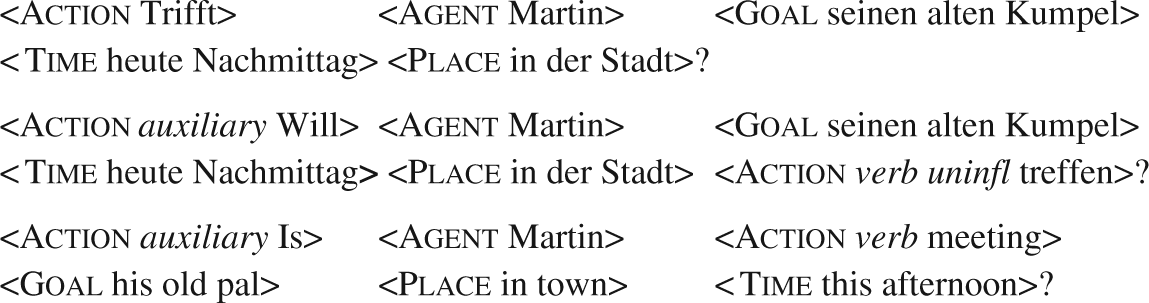
If, in German, <Agent>and <Goal>are filled by pronouns (e.g. ‘er’ [he], ‘ihn’ [him] in the above examples), they are enclitic to the verb:

The German flexibility of syntactic ordering in Statements is replicated when the verb is fronted for Polarity Questions:
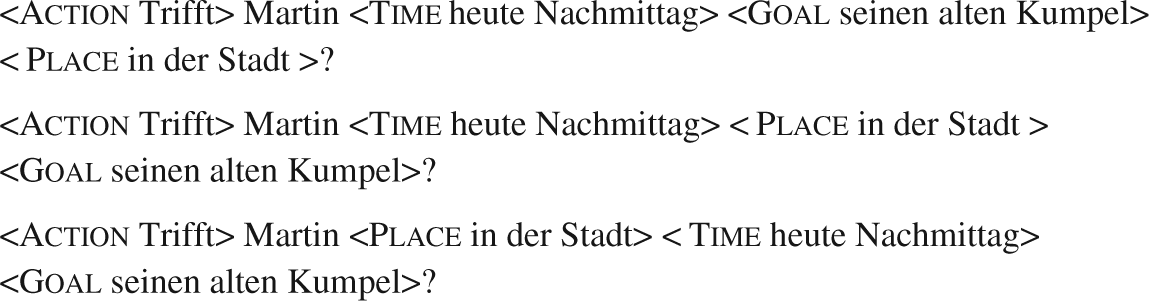
The only flexibility of structural ordering in English Statements occurs when the <Time> or <Place> coordinates for an <Action> are set as the theme for the proposition. A Polarity Question cannot have such a theme-rheme structure because it enquires about the truth value of the whole proposition (but see 4.2.2.6 for question tags). Therefore, <Time> or <Place> have to stay in their propositional structural slots, unless they form a separate Confirmation Question (see 4.2.2.4) and are picked up by unaccented anaphoric deixis in the Polarity Question following it, as in:
| A: | &2What are &2Martin's &2plans for this &2afternoon? |
| Has he got anything &2on in &2town this &0afternoon? | |
| B: | This &3afternoon? Isn't he &2meeting his old &2pal in &2town for &2coffee &1then? |
| In &3town? Isn't he &2meeting his old &2pal &1there for &2coffee? |
Either <Time> or <Place> can also be put initially in a German Statement, but, as in English, the theme-rheme structure is excluded from a Polarity Question, except when a tightly linked preceding Confirmation Question functions as the theme:
| A: | Was für &2Pläne hat &2Martin für heute &2Nachmittag? |
| Hat er irgend was &2vor in der &2Stadt heute &0Nachmittag? | |
| B: | Heute &3Nachmittag? &2Trifft er &1dann nicht seinen alten &2Kumpel in der &2Stadt zum &2Kaffee? |
| In der &3Stadt? &2Trifft er &1da nicht seinen alten &2Kumpel zum &2Kaffee? |
In both languages, Polarity Question structures are derived in the same way from any Statement structure when the proposition is based on <Event Occurrence>. The inflected verb is put in first position, which removes the need for a <subject> placeholder ‘es’ in German. For example:

In certain contexts of situation, a Polarity Question may be limited to asking for the truth value of the predicate of a proposition, or of one of the semantic predicate components. In that case, declarative structure is reduced to various elliptic forms, with a declarative intermediary in English, moving meaning from linguistic to situational context. For example, at a business meeting, assistants may go round serving coffee, asking:
‘Would you like some coffee?’ or
‘D'you like some coffee?’ or
‘(You) like some coffee?’ or
‘(Some) coffee?’
with high-rising valleys.
All these forms are Polarity Questions, enquiring as to the truth value of ‘coffee wanted’.
In German, the options are more restricted:
‘Möchten Sie ’ne Tasse Kaffee?’ or
‘((’ne) Tasse) Kaffee?’,
with high-rising valleys.
‘Sie möchten Kaffee?’
is not possible because the content verb swaps structural positions with the subject. It is thus not a step in a linear curtailing of interrogative form, as it can be in English. It becomes a Confirmation Question, enquiring the truth value of the speaker's presupposition of common ground in the speaker–listener action field (see 4.2.2.4):
‘You've seen me serving coffee, and from your looking towards me I assume that you might like some. Confirm.’
Another instance of ellipsis in Polarity Questions is addressing someone by their name without being absolutely certain. ‘Michael Smith?’ means ‘Are you Michael Smith?’ The intonation may be either a high-rising valley, or a medial peak in high register when the speaker is fairly confident of being right.
(2) Accent Patterns
In both German and English Polarity Questions, the same accentuation patterns hold as in Statements (see 3.1).

Any part of the syntactic structure representing a semantic constituent of the proposition may be put in focus by deaccenting all other structural elements; in addition, the focus may be reinforced to accent &3. In communicative interaction, a speaker decides on how many of these backgrounded elements may be omitted because their semantic referents can be inferred by the listener. In a Polarity Question, the unknown truth value of an <Event> may be put in focus by reinforcing either the uninflected non-initial part of the verbal phrase, as in
<&0Findet> <der &1jährliche &1Bauernmarkt><am &1Wochenende>
<auf &1Gut &1Emkendorf> <&3statt>?
<&0Will> <&1the annual &0farmers’ &1market> <&0take &3place>
<on the &1Enkendorf &1Est'ate> <this &0week&1end>?
or the initial inflected part, as in
<&3Findet> <der &1jährliche &1Bauernmarkt><am &1Wochenende>
<auf &1Gut &1Emkendorf> <&0statt>?
<&3Will> <the &1annual &0farmers’ &1market> <&0take &1place>
<on the &1Enkendorf &1Est'ate> <this &0week&1end>?
The former enquires in an intensified fact-oriented way as to whether the ‘annual market’ specified for <Time> and <Place> will actually be on; the latter adds the expression of doubt about the <Event Occurrence> being true.
(3) Intonation Patterns
In addition to the accentual scalings, various peak and valley pitch patterns may be linked to the accents, producing a great variety of prosodic realisations with fine semantic differentiation. The pitch pattern at the last full accent = >&2 in the prosodic phrase, the nucleus, determines the question subcategory. The system of Polarity Questions comprises the following terms:

The pitch patterns associated with these question categories are illustrated by the displays of the possible intonations in the German sentence ‘Ist er in Rom?’ in Figure 4.2. The utterance is contextualised in the following dialogue, with English function and form equivalents, followed by the functional descriptions of the peak and valley patterns at ‘&2Rom’.

Figure 4.2. Speech waves, F0 traces (log scale), segmental transcriptions, grouped into prehead and nucleus, and nucleus classifications in the German Polarity Questions of ‘Ist er in Rom?’ PQ-1 Speaker Orientation a Finality b Openness c Contrast d Unexpectedness; PQ-2 Listener Orientation a Response Request, Matter-of-fact b Response Request, Expressive c Response Stimulation, Matter-of-fact d Response Stimulation, Expressive. Standard German, male speaker (KJK).
4.2.2.3 Information Questions
For enquiring about an unknown semantic constituent of a proposition, Information Questions, with Fact or Listener Orientation, combine lexical interrogative structures with accent and intonation patterns.
(1) Syntactic Structures and Accent Patterns
Taking the German and English Statements

as points of departure, any one of the propositional constituents may become an unknown, coded by the corresponding interrogative pronominal or adverbial in an Information Question:

The interrogative is put in sentence-initial position, and, for other than <AgentX> (or <Event X>), subject> and <infl verb> (which in English is an auxiliary or the placeholder ‘do’) are inverted, but the syntactic ordering of the other constituents is retained, for example

When <Action> or <Event Occurrence> is the unknown, the question is whether the action takes place or the event occurs, i.e. whether they are true, which is coded by a Polarity Question.
It follows from the structural parallelism of Information Questions and Statements that the default accent pattern is the same for both: each propositional constituent, including the unknown, receives an accent, which is &1 associated with <Action/Event Occurrence>, &2 in all other cases. Any constituent, including the unknown, may be put in focus with a default &2 or a reinforced &3 accent, and deaccentuation of all the others. As in Statements and Polarity Questions, the speaker decides what can be inferred from the communicative situation and may thus be omitted. Backgrounding is also achieved by unaccented pronominal reference. In the following dialogue, Speaker A leaves out the <Time> information, which Speaker B then enquires about, with a peak accent on the interrogative word and at least partial deaccentuation of all the other propositional constituents, and with pronominal anaphoric <Agent> and <Goal> references.

This lexical interrogative structure is commonly curtailed by leaving out the non-pronominal referents, and, in a second step, also the pronominal ones, retaining only the interrogative word, successively replacing linguistic context by situational context.
It was mentioned in 4.2.1 that Information Questions formed with interrogative words in declarative slots in e.g. Mandarin Chinese are also found in German and English as a deviant structure from sentence-initial position for specific semantic purposes. An unknown propositional constituent is singled out for information retrieval and is put, in its lexical interrogative form, in the appropriate declarative slot. This type of Information Question asks for more information than has already been given, for instance to supply <Time> or <Place> when only one, or neither, was provided by a dialogue partner in a preceding statement. The focused internal interrogative word receives a peak accent &2^ or &3^, followed by at least partial deaccentuation of all subsequent propositional constituents in the utterance and by pronominal anaphoric reference, as in the case of the initial lexical interrogative. Thus, Speaker B may produce the following turn in the above statement-question dialogue frame:

This internal lexical interrogative differs functionally from its initial counterpart; it sets a theme for the question by introducing it with an explicit reference to the proposition of the preceding statement. Deaccentuation of all the propositional constituents after the interrogative word continue the question theme and embed the question rheme in it. The theme-rheme structure in an internal lexical interrogative is also the reason the German question is still regular when <&2^TimeX wann> is moved from its default declarative slot to the end of the utterance. With this theme-rheme structure the speaker signals that s/he not only wants more specific information but also has to ask for it specially because the dialogue partner did not provide it. This insistence on missing information is absent from the initial lexical interrogative since it does not set a theme that explicitly links the question to the preceding statement. The internal lexical interrogative can also be curtailed, but the theme part before the focused interrogative word stays to maintain coding of this type of Information Question.
If the <Time> or <Place> information that Speaker A gives is not considered precise enough by Speaker B, s/he may ask for more detail by putting the known broad <Time> or <Place> frame in its declarative slot, and the unknown narrow <TimeX> or <PlaceX> before it or initially in the utterance:

Speaker B may also eliminate thematic information from the question and reduce the enquiry to the narrow <Time>or <Place> frame, with or without the broad one, thus moving thematic information from the linguistic context to the context of situation set by Speaker A:

(2) Intonation Patterns
The system of Information Question categories and of the peak and valley pitch patterns associated with them at the last full accent = >&2 in the prosodic phrase parallels the one outlined for Polarity Questions:
| IQ-1 | Fact Orientation: obtaining information about a propositional constituent |
| IQ-1a | Finality |
| IQ-1b | Openness |
| IQ-1c | Contrast |
| IQ-1d | Expression of Unexpectedness |
| IQ-2 | Listener Orientation: adding appeal to information enquiry |
| IQ-2.1 | Response Request |
| IQ-2(.1)a | Matter-of-fact |
| IQ-2(.1)b | Expressive |
| IQ-2.2 | Response Stimulation |
| IQ-2(.2)c | Matter-of-fact |
| IQ-2(.2)d | Expressive |
The pitch patterns associated with these question categories are illustrated by the displays of the possible intonations in the German sentence ‘Wo?’ in Figure 4.3. The utterance is contextualised in the dialogues below, with English function and form equivalents, followed by the functional descriptions of the peak and valley patterns at ‘&2wo’.
| (I) | A: | Martin trifft seinen alten Kumpel heute Nachmittag zum Kaffee. |
| Martin is meeting his old pal for coffee this afternoon. | ||
| B: | &2Wo? | |
| &2Where? | ||
| (II) | A: | Martin trifft seinen alten Kumpel zum Kaffee in der Stadt. |
| Martin is meeting his old pal in town for coffee. | ||
| B: | &2Wo in der &0Stadt? | |
| &2Where in &0town? | ||
| (III) | A: | Martin trifft seinen alten Kumpel zum Kaffee in der Stadt. |
| Martin is meeting his old pal in town for coffee. | ||
| B: | &2Wo? | |
| &2Where? |

Figure 4.3. Speech waves, F0 traces (log scale), word segmentations and pitch classifications in the German Information Questions ‘Wo?’ IQ-1 Speaker Orientation a Finality b Openness c Contrast d Unexpectedness; IQ-2 Listener Orientation a Response Request, Matter-of-fact b Response Request, Expressive c Response Stimulation, Matter-of-fact d Response Stimulation, Expressive. Standard German, male speaker (KJK).
In (I), Speaker A does not give any <Place> information, so Speaker B asks for it. In (II), Speaker A provides a <Place> frame that Speaker B does not consider sufficiently detailed, so Speaker B asks for a more specific narrow frame explicitly by adding Speaker A's broad frame to the unknown. In (III), Speaker A gives the same information as in (II), but Speaker B refers to a single <Place> frame. Speaker B's intention may be either to obtain information in a narrow <Place> frame, against the broad frame set by Speaker A, or to appeal to Speaker A to confirm the given <Place> information, (Confirmation Question – see 4.2.2.4). Syntactic structure and accentuation cannot distinguish between these two possibilities in (III): intonation solves the ambiguity.
In all three dialogues, ‘wo/where’ receives one of the peak or valley patterns of Figure 4.3. In (II), the fall of a peak trails off on low pitch, or the rise of a valley continues monotonically across ‘in der Stadt/in town’. Since the single accent on an initial or an internal interrogative word puts the <Place> enquired about in focus, the question appeals to the receiver for <Place> information. In dialogue (I), the question solicits altogether new information, because there is no preceding <Place> reference; in dialogue (II), it solicits more specific information with explicit reference to the broad <Place> frame given in the preceding statement. In dialogue (III), the question does not solicit altogether new <Place> information because the statement context provided a frame. What it does solicit depends on the intonation pattern used on the focused constituent. With peak patterns and with Response Requesting low-rising valley patterns, the question solicits more specific information in a narrower <Place> frame. But Response Stimulating high-rising valley patterns add insistence to the enquiry, appealing to Speaker A to confirm the given <Place> information. Below are the detailed functional descriptions of the eight formal patterns.
| IQ-1a | With an early peak, B asks for (more detailed) <Place > information, which is missing but needed to complete the information exchange: Finality – ‘That's all I still need to know.’ |
| &2)Wo &2. &PG | |
| IQ-1b | With a medial peak, B asks for (more detailed) <Place> information – as in IQ-1a – but without indicating that this will complete the information exchange: Openness – ‘I need to know more.’ |
| &2^Wo &2. &PG | |
| IQ-1c | With a medial-to-late peak, B asks for (more detailed) <Place> information – as in IQ-1b – but with a note of annoyance, superimposing Contrast on Openness – ‘I need to know, but you did not tell me.’ |
| &2^-(Wo &2. &PG | |
| IQ-1d | With a late peak, B asks for (more detailed) <Place> information – as in IQ- 1c – but adds Expression of Unexpectedness to Openness and Contrast – ‘Where on earth are they meeting?’ |
| &2(Wo &2. &PG | |
| IQ-2(.1)a | With an early low-rising valley, B requests <Place> information from A which is either missing in dialogue (I), or not detailed enough in dialogues (II) and (III). The low F0 end point precludes interpretation as a Confirmation Question in dialogue (II). This is a Matter-of-Fact Response Request. |
| &2]Wo &, &PG | |
| IQ-2(.1)b | With a late low-rising valley, B still requests <Place> information from A as in IQ-2a, but adds Expression of Personal Concern, which makes the request more subdued, polite and friendly. |
| &2[Wo &, &PG | |
| IQ-2(.2)c | With an early high-rising valley, B sends Matter-of-Fact Response Stimulation to A, to provide the missing <Place> information in dialogue (I), or to fill a narrow <Place> frame within A's broad frame in (II). But since in dialogue (III) B's <Place> frame is not formally marked as narrow, versus a broad frame from A, the early high-rising valley stimulates A to Confirm the <Place> Information already given: Confirmation Question (see 4.2.2.4). |
| &2]Wo &? &PG | |
| IQ-2(.2)d | With a late high-rising valley, B stimulates A to provide <Place> information in the same three different ways as in IQ-2c, but adds Expression of Personal Concern, which in dialogues (I) and (II) may be impatience to get the information; in dialogue (III), it may be disbelieving the information received, therefore needing confirmation: Confirmation Question (see 4.2.2.4) |
| &2[Wo &? &PG |
To round off this section on Information Questions, here are some selective original data from English, illustrated in Figure 4.4 and functionally interpreted in the context:
| A: | We'll meet in Auchterarder tomorrow. |
| B: | &2Where? |
| IQ-1a | With a medial peak, B asks for more information about the location of the venue in the town. |
| &2^Where &2. &PG | |
| IQ-1b | With a medial-to-late peak, B stresses the need for more information about the venue against the insufficiency of the information so far given by A. The utterance has a tone of irritation and impatience: ‘But where? Your information is rather imprecise.’ |
| &2^-(Where &2. &PG | |
| IQ-2b | With a late low (falling-)rising valley, where the rise starts in the accented vowel, B still asks for more information about the venue, but makes a request appeal to the listener. The fall adds contrast, but the utterance sounds less categorical and more friendly than with a peak pattern. |
| &2^Where &,. &PG &2[Where &, &PG | |
| IQ-2c | With an early high-rising valley, B stimulates confirmation of the <Place> information A has already given, because B disbelieves what s/he has perceived due to the strangeness of the name and the unfamiliarity with the small Scottish town: Confirmation Question (see 4.2.2.4) |
| &2] Where &? &PG |

Figure 4.4. Speech waves, F0 traces (log scale), word segmentations and pitch classifications in the English Information Questions ‘Where?’ IQ-1 Speaker Orientation a Openness b Contrast; IQ-2 Listener Orientation b Response Request, Expressive c Response Stimulation. Standard Southern British English, female speaker (RMB).
4.2.2.4 Confirmation Questions
Two types of Confirmation Question were distinguished in 4.2.1, depending on whether a semantic component, or the truth value of a proposition, already available in the interaction, is questioned for confirmation. This makes it necessary to relate Confirmation Questions to Information Questions on the one hand, and to Statements and Polarity Questions on the other.
(1) Lexical Interrogative Structure in Information versus Confirmation Questions
Lexical interrogative structures do not just code one type of Information Question. There is a fourfold functional opposition among lexical interrogative structures, cutting across the categories of Information Questions and Confirmation Questions, and subcategorising them. The functional reference is determined by context of situation and is manifested by prosodic patterns of accent and intonation. The function-form system is organised as follows:
(a) Information Question with the propositional relation ‘<SemComX>: in proposition’ and lexical interrogative structure, which may be reduced to the interrogative word
-
(a1) asking about a propositional constituent that is missing from the preceding interchange
The lexical interrogative is in structure-initial position and there are accents on constituents that are to be foregrounded, with either a peak or a low-rising valley pattern at the last accent, depending on whether the sender just enquires about facts or requests them (see 4.2.2.3). The interrogative word may be accented in addition to other accents; in elliptic form, it receives accent and intonation patterns.
(a2) asking for more detail of a propositional constituent that has already been provided
The lexical interrogative is in the appropriate slot of declarative syntax, which receives the last default accent in the utterance, and, like (a1), is combined with either a peak or a low-rising valley. In the case of an elliptic interrogative, (a2) is distinguished from (a1) by context of situation, and (b2) from (a2) by a high-rising valley in addition to context of situation.
(b) Confirmation Question with the propositional relation ‘<CSemComX>: in proposition’ and lexical interrogative structure, which may be reduced to the interrogative word, eliminating the formal distinction between (b1) and (b2)
It stimulates repetition and confirmation of a propositional constituent when the sender wants to make sure that s/he has perceived the message correctly, for example in poor transmission, or when the sender cannot believe what s/he has heard or understood.
(b1) with initial-lexical interrogative structure
The lexical interrogative gets a single focus accent, and high-rising intonation starting there, either as an early valley for Matter-of-fact (CQ-1), or as a late valley for Expressive (CQ-2), Response Stimulation (see below).
(b2) with internal-lexical interrogative structure, picking up a previous theme for the receiver to provide the confirmation rheme.
The interrogative has a single focus accent with a high-rising valley as for (b1).
The following two sets of dialogues between a wife and a husband illustrate the association of lexical interrogative structure with Information Questions and Confirmation Questions, respectively, and another two subcategorisations within each. The two sets differ in that in (I) the wife does not specify the length of time her mother wants to stay, but does so in (II), and the husband asks for information to be expanded upon or confirmed, respectively.

In dialogue (I), the husband simply enquires as to how long his mother-in-law wants to stay. In (a2), as against (a1), he picks up the theme of ‘Mother wanting to come and stay again’, and focuses the precise length in the question rheme. In dialogue (II), he is taken aback by the extended length mentioned by his wife, compared with previous occasions, and hesitates to believe what he has understood her to say. Therefore, he stimulates a confirmation response.
If he wants to add Expressive personal concern over having his mother-in-law around the house for an extended period because her previous, shorter visits were already taxing, he uses a late valley and may add Negative Intensification (see 5.1.2). In version (b2), ‘Mother wants to visit us again’ is taken up as the theme of the question. Instead of commenting on it, the husband questions the expected length of the stay in an internal rheme with a high-rising valley from the rheme accent to the end of the question.
(2) Declarative Structure in Statement versus Confirmation Question
Declarative form is to be distinguished from the functions of Statement and Confirmation Question, which state the truth value of a proposition, or stimulate a receiver to confirm it. In German and English, there is a fourfold opposition among declarative structures, cutting across the functions of Statement and Confirmation Question, and subcategorising them. The functional reference is determined by context of situation and manifested by prosodic patterns of accent and intonation. The function-form system is organised as follows:
(a) Statement in declarative or non-sentential (‘elliptic’) syntax
It is a proposition about <Actions>, <Events> and <States> in the world of objects and relations. In its non-sentential form, for example in answer to an Information Question, individual propositional constituents are selected.
(a1) In speaker- and fact-oriented Argumentation (FactOri)
It states a general truth, such as ‘two times two is four’, or a scientific or historical fact, such as ‘Bernoulli's principle is the basis of vocal cord vibration’, or ‘The Roman Emperor Hadrianus built Hadrian's Wall to protect the northern limit of Britannia’, or it makes a proposition in a communicative situation, such as answering a Question asked by another communicator, or stating facts, also following social rituals in phatic communion (Malinowski Reference Malinowski, Ogden and Richards1923). The exponents are accents on propositional constituents that are to be foregrounded, and peak patterns at accents, at least at the last one.
(a2) In listener-oriented Argumentation (ListOri)
It makes a proposition, called for in a communicative situation, such as answering a Question asked by another communicator. This is achieved with accents on constituents that are to be foregrounded, and with a low-rising valley pattern at the last accent to express a subdued attitude towards the receiver. On the other hand, high pitch is used to stimulate the receiver to pay attention to the facts and accept them. High pitch is manifested as a high-rising valley pattern at the last accent to express Surprise (StimSur), or as a falling pattern in high register to express Irritation (StimIrr).
(b) Confirmation Question with the propositional relation ‘<CTruthX>: proposition’ in declarative or elliptic syntax
It is an appeal to the dialogue partner for confirmation: it picks up a proposition from a preceding Statement, or deduces it from the common ground in the speaker–listener action field, and stimulates the dialogue partner to confirm its truth value.
(b1) asking for confirmation of the truth value
With a high-rising valley pattern at the last accent and early synchronisation the speaker makes a Matter-of-Fact enquiry, but expresses Surprise with late synchronisation.
(b2) expecting confirmation of the truth value
With a peak pattern in high register, the speaker expresses Surprise on a scale from listener-directed Confirmation Question to speaker-centred Exclamation; a response is optional. Depending on the dialogue context, Question or Exclamation may be more prominent. To strengthen the Question function the speaker may use interrogative, instead of declarative, syntax with a peak pattern in high register
The following two sets of dialogue turns illustrate the association of declarative structure with Statements and Confirmation Questions, respectively, and further subcategorisations within each. The two sets differ in that, in turn (I), Speaker B answers Speaker A's question in a number of possible distinctive ways, but, in turn (II), Speaker A asks for confirmation of Speaker B's answer to Speaker A's initial question.


In turn (Ia1), Speaker B provides the <Place> information fact-oriented with a peak pattern (FactOri); or listener-oriented with low-rising valley patterns (ListOri), either early to express a casual, or late to express a friendly, attitude towards the listener.
In turn (Ia2), Speaker B gives the <Place> information in a stimulating listener-oriented way with high pitch. This high pitch stimulates attention and introduces the expression of Surprise or Irritation at Speaker A asking or not knowing. It is a late high-rising valley pattern at the last accent to express Surprise (StimSur), e.g. to remind Speaker A: ‘Have you forgotten that he told us some time ago?’ Or the whole utterance, with a peak pattern at the last accent, is in high register to express Irritation (StimIrr), e.g. telling Speaker A pointedly: ‘Everybody knows that and so should you!’
In turn (IIb1), Speaker A signals being open to receiving confirmation or correction (CQ-2.1), but, in turn (IIb2), confirmation is taken for granted (CQ-2.2), if it is solicited at all in an Exclamation (see 4.2.2.5). StimSur in turn (I) of Speaker B and CQ-2.1b in turn (II) of Speaker A coalesce phonetically (see 4.2.2.5).
(3) The System of Confirmation Questions
After delimiting the Question Appeal function of the Confirmation Question in its own right, against the functions of Information Question and Statement, we can now draw up its systemic organisation, and illustrate some of its categories with displays of signal data from German and English. With a Confirmation Question, a speaker picks up the verbalised or deduced theme of a preceding interaction and stimulates the dialogue partner to confirm a propositional constituent in it or its truth value. There are various subtypes, which form the following system:

Confirmation Questions CQ-1 have already been introduced in the discussion of IQ-2(.2)c in 4.2.2.3(2), with reference to German ‘Wo?’ in Figure 4.3 and to English ‘Where?’ in Figure 4.4. Figure 4.5 displays additional data for German and English, contrasting Matter-of-Fact and Expression of Surprise in CQ-1a and CQ-1b.
| CQ-1a | lexical interrogative structure and high-rising valley pattern, starting on the interrogative word with early synchronisation for Matter-of-Fact Stimulation |
| &2]Wo &? &PG | |
| &2]Where &? &PG | |
| CQ-1b | late synchronisation adds the Expression of Surprise; it may be further heightened by pressed phonation, increased duration, increased F0 rise and increased energy for Negative Intensification (NI – see 5.1.2) |
| (&NI) &2[Wo &? &PG | |
| (&NI) &2[Where &? &PG |

Confirmation Questions CQ-2 in German and English are illustrated by the following dialogue (adapted from the one discussed in 4.2.2.4(2), and displayed in Figure 4.6:
| (I) | B: | Er ist nach &2Rom gefahren. | ||
| He has gone to &2Rome. | ||||
| (II) | A/2: | Er ist in &2Rom? / Nach &2Rom? | ||
| He is in &2Rome? / To &2Rome? | ||||
| CQ-2(.1)a | declarative or elliptic syntax and a high-rising valley pattern with early synchronisation on the last accent, asking for confirmation of a queried truth value and soliciting an answer | |||
| Er ist in &2]Rom &? &PG | Nach &2]Rom &? &PG | |||
| He is in &2]Rome &? &PG | To &2]Rome &? &PG | |||
| CQ-2(.1)b | late synchronisation for the additional Expression of Surprise; it may be further heightened for Negative Intensification (NI, see 5.1.2) | |||
| (&NI) Er ist in &2[Rom &? &PG | (&NI) Nach &2[Rom &? &PG | |||
| (&NI) He is in &2[Rome &? &PG | (&NI) To &2[Rome &? &PG | |||
| CQ-2(.2)c | peak pattern in high register: the high register signals the question, and the peak pattern in declarative syntax points to the expected confirmation; the | |||
| formal devices signal that confirmation of the truth value of what was said previously is taken for granted, and that an answer is optional | ||||
| &HR Er ist in &2^Rom &2. &PG | &HR Nach &2^Rom &2. &. &PG | |||
| &HR He is in &2^Rome &2. &PG | &HR To &2^Rome &2. &. &PG | |||

Figure 4.6. Spectrograms, F0 traces (log scale) and segmental transcriptions, grouped into prehead and nucleus of German ‘Er ist in Rom?’ (upper panel, Standard German, male speaker (KJK)) and English ‘He is in Rome?’ (lower panel, Standard Southern British English, female speaker (RMB)) in Confirmation Questions CQ-2a, CQ-2b, NI_ CQ-2b and CQ-2c.
4.2.2.5 Communicative Function and Linguistic Form in Context of Situation
It can be concluded from the preceding discussion of German and English data that the communicative functions of Polarity, Information and Confirmation Questions, and of Statement and Exclamation are categories of speech interaction that are manifested by overlapping syntactic structures and prosodic patterns. This, in turn, means that the interaction context contributes to the interpretation of an occurring linguistic form as the exponent of a particular function.
In the dialogue of 4.2.2.4(2), utterances StimSur of Speaker B in turn (I) and CQ-2.1b of Speaker A in turn (II) coalesce phonetically, but the former is a Statement in the context after a Question, the latter a Confirmation Question in the context after a Statement. The same applies to utterances StimIrr of Speaker B in turn (I) and CQ-2.2 of Speaker A in turn (II). When a dialogue is opened by a Statement such as
Ich hab heute &2^Post von &2^Peter bekommen &2. &PG er ist in &2^Rom &2. &PG
I've received a &2^letter from &2^Peter today &2. &PG he's in &2^Rome &2. &PG
the response in the form of CQ-2.2c is more likely to be intended and interpreted as a Surprise Exclamation. However, when declarative structure in high-register CQ-2.2c is replaced by high-register interrogative word order the questioning function is strengthened, signalling a Surprise Confirmation Question. This applies even more when Speaker A asks back in this form after the original question A/1.
Since CQ-2 Confirmation Questions take up a dialogue partner's Statement as a whole and enquire about its truth value, ‘He is in Rome?’ would only follow the Statement ‘He has gone to Italy’ if the speaker assumes high probability or even certainty that the person would be in Rome when in Italy. If the speaker wants to get the truth value of more specific <Place> information, s/he asks a Polarity Question ‘Is he in Rome?’, e.g. PQ-1b, PQ-1c. Contrariwise, since the Listener-Oriented Polarity Question PQ-2c stimulates a yes-no decision, it is unlikely to be used when the answer is already in a dialogue partner's previous assertion. So, ‘Is he in Rome?’ with an early high-rising valley may not be expected to follow ‘He has gone to Rome.’
But a late high-rising valley is quite possible in this context for the Expression of Surprise, also with Negative Intensification. This is a Surprise Confirmation Question in the same form as a Polarity Question PQ-2d. It differs functionally from a late high-rising valley with declarative syntax CQ-2(.1)b by strengthening the Question function, whereas the latter strengthens the Exclamation function. Interrogative syntax can also occur in the same context with a peak pattern in high register, asking for Confirmation of ‘Are you really saying he is in Rome?’ (see CQ-2.2c above). A late peak pattern with neutral register in this context is a Polarity Question PQ-1d, in which Speaker A constructs a new proposition ‘he is elsewhere’ and enquires about the truth value of Speaker B's proposition with Unexpectedness and Contrast to the new one.
The strengthening of high pitch by raised register in peak patterns or by high-rising F0 in valley patterns is crucial for signalling Confirmation Questions. If ‘He is in Rome’ has a peak pattern in a non-high register it can no longer be a Confirmation Question and therefore is unlikely to follow a dialogue partner's Statement ‘He has gone to Rome’, because restating what has already been stated by a dialogue partner is no longer listener-oriented but self-reflecting, and is usually reinforced by some such introduction as ‘Aha’, ‘I see’. In English, the Confirmation function may be taken up again by a constant-polarity question tag with a low rise on the tag after a fall on the declarative ‘He is in Rome, is he?’ (see 4.2.2.6). Similarly, ‘He is in Rome’ with an early or late low-rising valley pattern is a Statement with listener orientation and does not become a Confirmation Question, and so is excluded from the Statement context ‘He has gone to Rome’, unless a constant-polarity question tag follows (‘He is in Rome, is he?’), continuing the rise of the declarative (see 4.2.2.6). Both types of question tag add an Appeal to confirm the Statement that the speaker picked up from the dialogue partner.
The use of the same prosodic forms for different functions – Question and Statement, Question and Exclamation – in different verbal and situational contexts, and the exclusion of interrogative forms that violate function in communicative interaction, show that Question, Statement and Exclamation cannot be defined by form but need to be referred to functional-semantic categories, which, together with the communicative setting of Representation, Appeal and Expression, determine their phonetic (prosodic and segmental) as well as gestural exponency. Bolinger (Reference Bolinger and Greenberg1978, p. 503f) highlights this function-form relationship and situation dependency:
It is not by any means certain that ‘question’ is a grammatical category at all to the extent that it is marked only by intonation. And if it is not, then we need to ask what the intonations mean, independently of any grammatical type. An utterance such as

can be a question, a statement, or an exclamation, depending on context and gesture. But the intonation is just as conclusive one way or another. As a question the sentence is incurious, it probably calls for confirmation of what is already assumed. With fuller descriptions, we may find the same variety prevailing everywhere.
In this communicative function-form frame, Question and Statement are defined as semantic propositions in the speaker–listener interaction. They are either made as propositions about objects and factual relations in Statements, or their truth value or a propositional component is enquired about in Questions. In the case of a Question, the speaker may either make a new proposition or refer to one already introduced as valid in the communicative interaction, asking for confirmation. The former is a Polarity or an Information Question, the latter a Confirmation Question. Instead of referring to a proposition made by a communicative partner in the interaction, the speaker may refer to a presupposition of common ground for both speaker and listener. For example, in a long discussion on prosodic matters between Speakers A and B, A may feel like having a break: he looks at his watch, realises that it is coffee time, and assumes that B feels the same way and also knows that it is coffee time. A may then ask the Confirmation Question, ‘We'll have a coffee break now (, shall we)?’ [Wir machen jetzt ’ne Kaffeepause (,ja)?] with a high-rising early valley. Or, B looks at his watch, and A interprets it as B wanting a break and so, assuming that they both know it is coffee time, asks the same Confirmation Question. On the other hand, when A is paying no attention to common ground and feels concentration is flagging, s/he may set a new proposition by asking the Polarity Question, ‘Shall we have a coffee break?’ [Machen wir mal ’ne Kaffeepause?] with either a high-rising early valley for an open decision, or with a medial peak expecting agreement.
This shows that a Confirmation Question is not just triggered by the availability of a proposition made by another person or implied in the common ground of the communicative situation, but also by the speaker's decision to pick it up and have it confirmed. There is the possibility of the speaker just using the proposition as a trigger not to have it confirmed but to enquire about its independent truth value. Thus, the speaker may ask a Polarity Question in a situation that looks like a Confirmation Question context when the speaker's decision-taking is excluded. The speaker is free to passively refer to observed signals in common ground for a communicative act, or to actively construct a new proposition, i.e. to ask either a Confirmation Question (‘Is that so? Please confirm’) or a Polarity Question (‘Is that so? Think about it again!’) in the same context of situation. The latter is dissociated from the other person's action and may therefore be regarded as less polite. So it may be inappropriate because the speaker either accidentally or deliberately infringes a social code. This view takes degrees of freedom in interaction into account for the shaping of linguistic form by communicative function.
A nice example illustrating the speaker's passive or active role in the two types of question comes from Wes Anderson's film The Grand Budapest Hotel. In a breakfast-table scene between Madame D., one of the elderly, female, very rich and upper-class but insecure clientele, and M. Gustave, the hotel's concierge, the original English screenplay gives the following dialogue:
M. Gustave: Dear God. What've you done to your fingernails?
This diabolical varnish. The color's completely wrong.
Madame D: Really? You don't like it?
The two successive Confirmation Questions are realised as ‘You really don't like it?’ with high-register falling intonation by English actress Tilda Swinton in the original English version, accompanied by her examining her hands. The English sound version on DVD is also supplied with English subtitles, which render the question as ‘Don't you like it?’ It would have to be sounded either as falling pitch in high register or as high-rising pitch to fit the situation. It is no longer a passive Confirmation but an active Polarity Question, which is out of keeping with the subdued-dominant relationship that the film wants to depict between the woman and the man.
Freedom of interrogative form selection is exemplified by the following dialogue interchanges in English and German (cf. the data collection of Mandarin Chinese in 6.1.2):
| A: | He &1^wants to go to the &1. &2^beach &2. &PG | |
| Er &1^will zum &1. &2^Strand &2. &PG | ||
| B/1: | He &1^wants to go to the &1. &2]beach &? &PG | |
| Er &1^will zum &1. &2]Strand &2? &PG | ||
| continued with | B/2a: | (Does) &2^not (want to go) to the &2. &2]zoo &? &PG |
| (Will) &2^nicht zum &2. &2] Zoo &? &PG | ||
| or followed by | B/2b: | &2^Doesn't he want to go the &1. &2(zoo &2. &PG |
| &2^Will er nicht zum &1. &2(Zoo &2. &PG |
The two declarative forms with high-rising early valley in B/1 and B/2a combine to one Confirmation Question, querying A's proposition and asking to confirm its negation. But when interrogative B/2b follows declarative B/1, there are two utterances. The first is an exclamatory Surprise Confirmation Question referring to A's proposition; the second changes this proposition to B's own new one ‘He wants to go to the zoo’ and, in a late peak pattern, asks about its truth value with Unexpectedness of, and Contrast to, A's proposition. So it is a Polarity Question. B/1 and B/2a most probably follow each other without a pause, or with just a short one, whereas some pausing is highly likely between B/1 and B/2b.
After A's Statement, the interrogative form
| B/1' | Does he &2^want to go to the &1. &2^beach &2. &PG |
| &2^Will er zum &1. &2^Strand &2. &PG |
with accents on both ‘want’ [will] and ‘beach’ [Strand] would be situationally inappropriate because it has just been stated by A ‘He wants to go to the beach.’ So only the declarative Confirmation Question is possible. But if B changes A's proposition from ‘He wants to go to the beach’ to the new proposition ‘He doesn't want to go to the beach’, B may enquire about its truth value in the Polarity Question
| B/2c: | &2[does he (really) want to go to beach &? &PG |
| &2[Will er (wirklich) zum Strand &? &PG |
with focus accent on the first word, and no further accent.
Thus, both Question functions can occur in the same context of situation, depending on how the speaker constructs the communicative interaction in this context. In speech communication, speakers mould the interchange by introducing their perspectives at any point, either making a new proposition or referring to someone else's proposition or to a presupposition in the speaker–listener common ground. Reference to propositions and presuppositions in Confirmation Questions is by default made in the syntactic structure of Statements, thus expressing what is set as valid. Deviations from declarative to interrogative structure in Confirmation Questions strengthens the Question over the Exclamation function under Surprise conditions with specific prosodic patterns.
It has already been pointed out in 4.2.2.2(1) that elliptic interrogatives are another formal device to be considered in the discussion of Question functions by leading to the formal coincidence of Polarity with Confirmation Questions in different situational settings. This may be illustrated by the following two examples from English, which have exact German equivalents:
(a) and (b) may be formally identical. However, each will be properly understood as one or the other functionally in their respective situational contexts. In (b) an alternative is possible – falling pitch in high register, which is excluded from (a).
The two forms may be identical, but their functions are different and are decoded as such in the different contexts. Confirmation Question A2 may also be falling in high register, expecting agreement; this form is impossible in Polarity Question B.
For successful communication the listener has to take all the syntactic, lexical, prosodic and gestural forms in their situational setting into account, since there is no one-to-one correspondence singly between any of these and communicative functions. Polarity Questions commonly have interrogative syntax, and interrogative syntax commonly codes Polarity Questions; Confirmation Questions commonly have declarative syntax, and declarative syntax commonly codes Confirmation Questions. But, due to ellipsis, non-interrogative form can also code Polarity Questions, and in order to strengthen the Question over the Exclamation function interrogative form can also code Confirmation Questions. Since, in addition, both question functions can occur in the same context of situation if speakers construct one or the other in it, listeners need to globally assess the total formal and situational embedding to decide which function is communicatively relevant at any moment, and they generally tune in very acutely.
4.2.2.6 Theme-Rheme Questions: Tag Questions in English and Modal Particles in German
It was pointed out in the discussion of English Confirmation Questions in 4.2.2.5 that the request of confirmation may be strengthened by the addition of a constant-polarity question tag in the rising pitch movement of the repeated assertion: ‘He is in Rome, is he?’ The tag ‘reinforces verbally the questioning intonation’ (O'Connor Reference O'Connor1955, p. 102). Neither a peak pattern on the tag nor a reversed polarity of the tag would be possible in this Confirmation Question context. ‘The [constant-polarity] tag question refers back to a fact already and recently established by the listener, whereas it is precisely the listener's view the reversed tag question seeks to elicit … This difference of background explains why it is impossible with the [constant-polarity] tag question to have the pitch pattern of fall plus fall except with a violent disjunction’ (p. 102); ‘a falling tone would demand agreement from the listener, but demanding agreement when the listener has already himself presented the information is pragmatically inappropriate’ (Cruttenden 1997, p. 98). The reversed-polarity question tag ‘He is in Rome, isn't he?’ does not refer back to a dialogue partner's proposition; rather, the speaker makes a new one of his/her own, and asks for its truth value with a tag. This Polarity Question either prejudges agreement, with falls on both the declarative structure and the tag (O'Connor Reference O'Connor1955, p. 98), or expresses increasing doubt as to the truth value of the declarative, with a low or high rise on the tag (p. 99), thus leaving the answer open in ‘a normal conducive question’ (Bolinger Reference Bolinger1986, p. 389).
The functions of Questions with declarative syntax + tag differ from those of the Confirmation Question (‘He is in Rome?’) and of the Polarity Question (‘Is he in Rome?’) discussed so far, in that they set a proposition in a Statement Theme and then either ask for confirmation or enquire about the truth value of the Theme in a Question Rheme. English tag questions are an ordered formal system of constant versus reversed-polarity syntactic structures and a set of falling or rising pitch patterns as the exponents of a fine-grained set of communicative functions in speech interaction. This function-form system is particularly characteristic of spontaneous English dialogue in England. With constant polarity (I), the speaker makes a proposition referring to the receiver's previous speech action (the Statement Theme) and asks the receiver for Confirmation (the Question Rheme). This is the Theme-Rheme Confirmation Question. Its proposition may be of two different kinds, (a) or (b):
| (I) | (a) | The speaker picks up a preceding proposition from the receiver: | |
| (1) | ‘He's gone to Rome.’ | ||
| ‘He's in Rome, is he?’ (falling or rising declarative, rising tag) | |||
| (b) | The speaker deduces a proposition from the receiver's preceding actions, including gestures and facial expression: | ||
| (2) | The receiver looks washed out on returning from jogging. | ||
| ‘You've overdone it again, have you?’(falling or rising declarative, rising tag) | |||
| (3) | Father and 10-year-old son are working in the garden. The son picks up a bag of garden refuse and says ‘Oof.’ | ||
| Father: ‘It's heavy, is it?’ (falling or rising declarative, rising tag) | |||
| Father did not know that the bag was heavy. | |||
| (4) | Speaker A: | ‘We have not heard anything from Claudia for some time. I wonder how she's getting on. We should get in touch with her.’ | |
| Speaker B: | ‘I'll send her an e-mail, shall I?’ (falling or rising declarative, rising tag) | ||
Speaker B makes a proposition to act in response to Speaker A's proposition, either as a categorical Statement with falling intonation or as a receiver-oriented one with rising intonation. With the constant-polarity question tag, the proposition becomes a Confirmation Question Appeal: ‘Do you agree with my proposition?’
With reversed polarity (II), the sender makes a new proposition in a sender-receiver action field and asks for a Polarity Decision. This is the Theme-Rheme Polarity Question:
| (II) | (5) | ‘He's gone to Italy.’ |
| ‘He's in Rome, isn't he?’ (falling declarative, falling tag) | ||
| The speaker is certain that the proposition ‘He is in Rome’ is true. | ||
| (6) | ‘He's gone to Italy.’ | |
| ‘He isn't in Rome, is he?’ (falling declarative, rising tag) | ||
| The speaker assumes that the proposition ‘He is not in Rome’ may be true but is not sure. | ||
| (7) | The jogger looks worse for wear. | |
| ‘You've overdone it, haven't you?’ (falling declarative, falling tag) | ||
| The speaker expects the reply ‘Yes, I have.’ | ||
| (8) | Son lifting the bag: ‘Oof.’ | |
| Father: ‘It's heavy, isn't it?’ (falling declarative, falling tag) | ||
| The father knew that the bag was heavy, and he is certain that his interpretation of his son's expression is true. |
In a Theme-Rheme Question the speaker turns a listener-related propositional theme into an explicit Statement for truth evaluation in a Question rheme. Theme-Rheme Questions are integrated, as Enquiring Statements, into a system of <Truth> propositions beside Statements, Polarity Questions and Confirmation Questions.
The Polarity Questions ‘Is he in Rome?’ / ‘Have you overdone it again?’ / ‘Is it heavy?’ / ‘Shall I send her an e-mail?’ have the propositional representation:
<TruthX>: proposition (p)
He's in Rome. / You have overdone it again. / It's heavy. / I shall send her an e-mail.
The speaker solicits a Polarity Decision <TruthX> on the proposition (p).
The Confirmation Questions ‘He's in Rome?’ / ‘You have overdone it again?’ / ‘It's heavy?’ / ‘I shall send her an e-mail?’ (high-rising) have the propositional representation:
<CTruthX>: proposition (p)
He's in Rome. / You have overdone it again. / It's heavy. / I shall send her an e-mail.
The speaker asks for Confirmation <CTruthX> of the proposition (p) picked up from the receiver. This introduces an element of Statement into the Question.
The Theme-Rheme Confirmation Questions (1), (2), (3), (4) have the propositional representation:
proposition (p): <CTruthX>
(1) / (2) / (3) / (4)
The recipient has signalled a proposition (p), which the speaker presents as a Statement for Confirmation <CTruthX>. The Question function is weakened further in comparison with the Confirmation Question, resulting in an Enquiring Statement.
The Theme-Rheme Polarity Questions(5), (6), (7), (8) have the propositional representation:
proposition (p): <TruthX>
(5) / (6) / (7) / (8)
The speaker makes a proposition (p) as a Statement Theme and solicits a Polarity Decision <TruthX> on it in a Question Rheme, expecting agreement with the truth value of the Statement in the falling-falling pattern, but expressing doubt in the falling-rising pattern. These are Enquiring Statements. With the falling-falling pattern the Theme-Rheme Polarity Question comes closest to a Statement.
In German, a very complex system of modal particles with intonation patterns is used to cover some of the functions of English question tags. The particles establish the link to the preceding dialogue turn and signal the communicative transition from Propositional Representation to Question Appeal derived from it. Without the particles, the utterances are either Statements or Confirmation Questions, depending on intonation. The division into Statement theme and Question rheme is not systematically and sequentially organised as it is in English, but it is still there. The modal particles take over the Question Rheme function. Here are possible equivalents of the eight English examples discussed above:
(1) ‘Er ist in Rom, ja?’ (falling declarative, rising modal particle)
(2) ‘Du hast dich wohl wieder übernommen (, ja)?’ (falling declarative, including modal particle (+ rising modal particle))
(3) ‘Der Sack ist schwer, ja?’ (falling declarative, rising modal particle)
‘Ist der Sack etwa schwer?’ (falling or rising interrogative, including modal particle)
‘The sack is not heavy, is it?’ (falling declarative, rising modal particle) may be rendered by ‘Der Sack ist doch nicht (etwa) schwer (,oder)?’ (falling declarative, including modal particles (+ rising modal particle))
(4) ‘Ich schick ihr dann mal ’ne Email (, ja)?’ (falling or rising declarative, including modal particles (+ separate or continuing rising modal particle))
(5) ‘Er ist in Rom, nicht (wahr)?’ (falling declarative, rising modal particle)
(6) ‘Er ist doch nicht etwa in Rom (, oder)?’ (falling or rising declarative, including modal particles (+ rising modal particle))
(7) ‘Du hast dich übernommen, nicht (wahr)?’ (falling declarative, rising modal particle)
(8) ‘Der Sack ist schwer, nicht (wahr)?’ (falling declarative, rising modal particle)
The correspondences between the systems of English question tags and German modal particles are only approximate because the modal particles introduce further interaction aspects that are absent from tag questions. For further detail, see Kohler (Reference Kohler1978).
The account of tag questions given here relates their formal system to their communicative functions in speech interaction, a perspective that is absent from a recent corpus analysis (Dehé and Braun Reference Dehé and Braun2013). The factors tested in this study were:
polarity, position in the sentence and the turn as well as verb type. Generally, prosodic phrasing and intonational realization were highly correlated: separate QTs were mostly realized with a falling contour, while integrated QTs were mostly rising. Results from regression models showed a strong effect of polarity: QTs with an opposite polarity were more often phrased separately compared to QTs with constant polarity, but the phrasing of opposite polarity QTs was further dependent on whether the QT was negative or positive (more separate phrasing in negative QTs). Furthermore, prosodic separation was more frequent at the end of syntactic phrases and clauses compared to phrase-medial QTs. At the end of a turn, speakers realized more rising contours compared to QTs within a speaker's turn. Verb type also had an effect on the phrasing of the tag. Taken together, our results confirm some of the claims previously held for QTs, while others are modified and new findings are added.
It may be of some interest to learn something about the distribution of these formal patterns in a fairly limited corpus, but they do not tell us anything about the functional conditions of their occurrence in dialogue interaction, and the authors do not even cite O'Connor's (Reference O'Connor1955) seminal paper on the subject, which gives all the basics on the strength of acute phonetic and semantic observation. The 2013 investigation simply follows the mainstream paradigm of doing linguistic and prosodic corpus research: it is fixed on form and frequency without semantic anchoring in speech communication.
4.2.2.7 Question Quotes
With a (Theme-Rheme) Confirmation Question a speaker repeats a proposition or a semantic constituent of a proposition which has been established through communicative interaction and wants to have it confirmed. This differs from another type of interrogativity: the repetition of an immediately preceding question that was asked either (1) by the same speaker or (2) by another speaker. In (1), the speaker's own original enquiry is not answered, due to transmission problems or because of incredulity; the other speaker asks for repetition instead; in (2), the speaker repeats the other speaker's original enquiry as a theme for a rheme comment. These are Question Quotes, which pick up any type of Question Appeal – Polarity, Information, Confirmation Question – and report its propositional content. They are no longer Questions, as defined here, because they lack the Appeal function. In (1), they transmit the content of the original enquiry and may be paraphrased by introducing them with ‘I'm asking …’ or ‘I asked …’. In (2), they set the theme for a reflective or an exclamatory Statement from the speaker; they may be paraphrased by introducing them with ‘You're asking …’
In German Question Quotes of both contextual types, a special interrogative form of an indirect question is used, with the inflected verb in final position in subsidiary clause structure that is introduced either by the subordinate conjunction ‘ob’ to report on a proposition enquiry or by a lexical interrogative in the case of a propositional constituent. These stand-alone interrogative forms are derived from the syntactic structures introduced by ‘Du fragst / Ich fragte, ob / wo, wann…’. Since word order is identical in main and subsidiary clauses in English, Question Quotes cannot have a special interrogative form in the same way, but fall back on word order or lexical interrogative syntax, as in Polarity or Information Questions, unless the speaker introduces type (2) with ‘You're asking … ’. But there are also prosodic features that can mark Question Quotes in both languages. For a start, stimulating rising intonation patterns of preceding questions are replaced by fact-oriented falling ones in the content-reporting repeats in both types (1) and (2) and in both languages (cf. the discussion of Fries Reference Fries, Abercrombie, Fry, MacCarthy, Scott and Trim1964 in 4.2.2.1). This is the formal exponent that distinguishes a Question Quote from a Question Appeal. It represents a communicative act that is centred reflexively on the speaker: type (1) is a repetition of what the speaker has said, type (2) sets the theme for the speaker's comment. This differs from the listener-directed Appeal. The listener knows from context that the speaker is repeating question content and is not sending a Question Appeal.
In type (1), the speaker may want to make sure that the content of the question, which was missed, gets across to the dialogue partner the second time: high register and increased loudness serve this communicative function. In type (2), on the other hand, the repeat either becomes a reflective Statement to oneself, spoken in low register and with reduced loudness, because the speaker is uncertain and verbalises it by adding a phrase such as ‘I have not decided yet.’ Or the repeat becomes an Exclamation in high register and with increased loudness, because the speaker is absolutely certain and expresses it emphatically by adding a phrase such as ‘Of course!’, ‘On no account!’
The following examples illustrate the use of Question Quotes in German and English, picking up Polarity, Information or Confirmation Questions in the situational contexts (1) and (2). Since a Question Quote only reports content it does not preserve the characteristic communicative reference of a Confirmation Question to a preceding Statement, for example in dialogue type (1) B/1-B/2 below:
Speaker B's long Question Quote ‘Ob …’ and affirmative comment in (2) may be reduced to the short reinforced affirmative Exclamation ‘Und &3^ob &2. &PG’. This shows the relationship between type (2) Question Quotes and Exclamations. Since ‘ob’ repeats are reflexively centred on the speaker, the syntactic structure may also be used for stand-alone deliberative Statements of the type ‘I wonder if …’. For example:
Ob &2^Helga darüber wohl &1. &2^Besch'eid weiß &2. &PG
I &2^wonder if &1. &2^Helga &0. &2^knows about this &2. &PG
Ob ich &2^diesmal vielleicht &1. &2^mehr Glück habe &2. &PG
I &2^wonder if I'll have &1. &2^better luck &0. &2^this time &2. &PG
With utterances like these, the speaker does not send an Appeal to a listener for a verbal response concerning their <Truth> value. Therefore, they are not Questions, as defined here.
4.3 The Request and Command Appeals
When, instead of soliciting a communicative response to a Question, a speaker appeals to a listener to carry out some action, this Appeal varies along a scale from Request to Command, depending on the speaker's considerate or dominant attitude towards the listener. The scale is continuous rather than discrete, ranging from a very polite, subdued Request to a forceful, expressively heightened Command. The recipient may or may not perform the requested or ordered action, and may accompany or replace it by a communicative response, in an apology for having failed to act, or in a rude refusal to act. Both Appeals use interrogative, imperative, or even declarative, syntax, with the addition of positive or negative lexical intensifiers, question tags or modal particles, rising or falling pitch, and modal/breathy-voice or pressed phonation. Interrogative syntax, rising pitch and breathy-voice phonation are indices of Request; imperative and declarative syntax, falling pitch, overaccentuation on every syntactic component or even word and pressed phonation are indices of Command. The more of the features in each group are bundled in an utterance, the more the Request or Command Appeal gets strengthened. High-rising pitch has greater stimulatory force than low-rising pitch in the Request Appeal, and an early peak as against a medial one strengthens the Command Appeal. The combination of an imperative with a question tag in English may have a single rise starting in the imperative phrase, or a fall ending the imperative phrase and a partially deaccented rise in the question tag. The single rise is more requesting than the fall + rise (see O'Connor Reference O'Connor1955).
The following examples from German and English illustrate the functional scale and the use of the syntactic, lexical and prosodic means:
Request with decreasing semantic strength
Wärst du (bitte) so gut, die &2[Tür zuzumachen &?/, &PG
Wärst du (bitte) so gut, die &2^/)Tür zuzumachen &2. &PG
Would you mind shutting the &2[door (, please) &?/, &PG
Would you mind shutting the &2^/)door (, please) &?/, &PG
Würdest du (bitte) / Könntest/Kannst du (bitte) die &2[Tür zumachen &?/, &PG
Würdest du (bitte) / Könntest/Kannst du (bitte) die &2^/)Tür zumachen &2. &PG
Would/Could/Can you shut the &2[door (please) &?/, &PG
Would Could/Can you shut the &2^/)door (please) &?/, &PG
imperative
Sei so gut und mach die &2[Tür zu &?/, &PG
Sei so gut und mach die &2^/)Tür zu &2. &PG
Be so good and shut the &2[door will you &, &PG
Be so good and shut the &2^/)door &2. &1[will you &, &PG
Mach bitte die &2[Tür zu &?/, &PG
Mach bitte die &2^/)Tür zu &2. &PG
Shut the &2[door please &, &PG
Shut the &2^/)door please &2. &PG
Command with increasing semantic strength
imperative
Mach die &2^/)Tür zu &2. &PG
Shut the &2^/)door &2. &PG
Mach &2^endlich die &0. &2^Tür zu &2. &PG
&2^Do &1. &2^shut that &0. &2^door &2. &PG
Machst du &2^endlich die &0. &2^Tür zu &2. &PG
&2^Will you &1. &2^shut that &0. &2^door &2. &PG
Bist du &2^endlich &0. &2^fertig &2. &PG
Are you &2^going to be much &0. &2^longer &2. &PG
imperative with lexical and accentual intensification
&2^Mach &1. &2^die &1. &2^Tür &2. &1^zu’&2. &PG
&2^Will &1. &2^you &1. &2^shut &2. &2^that &1. &2^door &2. &PG
&2^verflucht noch mal &2. &PG &2^mach die &0. &2^Tür zu &2. &PG
&2^damn it &2. &PG &2^shut the &0. &2^door &2. &PG
declarative with accentual intensification
&2^Du &2. &2^machst &2. &2^jetzt die &2. &2^Tür &2. &1^zu &2. &PG
&2^You 2. &2^are 2. &2^going to 2. &2^shut that 2. &2^door 2. &2^now 2. &PG
On the basis of this preliminary function-form data classification, future research can devise experiments to investigate the semantic scaling of Request and Command in relation to formal bundles of syntax, lexicon and prosody, using the Semantic Differential Technique, for example.


