Acknowledgments
As co-principal investigators of a research project of this scope and duration, we have numerous colleagues and friends to thank. Forgive us if this list of acknowledgments is incomplete. We have enjoyed and benefited from the advice, support, and encouragement of many people along the way, in and outside of academia.
The Gender and Multicultural Leadership (GMCL) Project would not have come to fruition without a generous grant from the Ford Foundation. We express special thanks to our program officers, not only for the funding that made this project possible, but also for their genuinely enthusiastic support. We begin by acknowledging Jacqueline Berrien, Ford Program Officer for Participation and Representation in American Politics, who passed away in 2015. We especially appreciated the warm relationship we developed with Jackie along the way; we are greatly saddened by her untimely death.
Program officers also instrumental in providing foundation support include Gertrude Fraser, Higher Education; Sara Ríos, Racial Justice and Minority Rights; and Barbara Y. Phillips, Women’s Rights and Gender Equity. Initial conversations with Ford Foundation officers extend to years preceding the grant. Marcia Smith, June Zeitlin, and Srilatha Batliwala deserve thanks for encouraging us to move forward with the initial proposals.
Origins of this project are traceable to the early 1990s, when several of us as colleagues and scholars brainstormed on how to further the study of women of color in politics, within and across our respective disciplines. On the ground floor of these discussions were Adaljiza Sosa-Riddell (University of California Davis) and Paule Cruz-Takash (University of California San Diego and Los Angeles). Folded into this mix was Linda F. Williams (University of Maryland and the Congressional Black Caucus, Inc., in Washington, DC), who encouraged a cross-racial study of Black and Latina women in national politics. With support from the Inter-University Program for Latino Research (IUPLR) and the Chicana/Latina Research Center at UC Davis, Ada and Paule invited Christine to launch the “Gendered Politics Working Group,” focused on the study of Latina politics in the United States. The crystallization moment for a national study of elected officials of color came from a conference in 1994 sponsored by the Center for American Women and Politics (CAWP) at Rutgers University, where Carol Hardy-Fanta joined the group. Subsequently, Dianne Pinderhughes and later Pei-te Lien accepted invitations to join, bringing complementary expertise and talent to this research initiative. The GMCL Project team was subsequently formalized with funding from the Ford Foundation.
Early on we benefited from collaboration with Cathy Cohen, Karin Stanford, and Luis Fraga. Paige Ransford, senior research associate at the University of Massachusetts Boston, deserves special thanks: she played a central role in developing the National Database, coding and carrying out analyses, and dedicating more than nine years to the GMCL Project. Joining our team as program associates were Wartyna Davis, who assisted in the design of the survey, and Lorrie Frasure, who offered her many talents in coordinating and assisting us through the project’s final phases. Sharing their own data with us were Becki Scola (on state legislators) and Carlos Cuéllar for data on Latino/a mayors. Kira Sanbonmatsu responded generously when asked for information on CAWP studies.
Equally important are our colleagues at the Joint Center for Political and Economic Studies, the National Association of Latino Elected and Appointed Officials (NALEO), and the Asian American Studies Center at UCLA for providing us with lists of Black, Latino/a, and Asian American elected officials at the start of our project and with subsequent updates. Special thanks go to David Bositis and Richard Hart formerly of the Joint Center and Rosalind Gold and Martha Recio at NALEO; they consistently responded in a timely fashion to our many requests. We also appreciate the contributions of the Asian American Studies Center at UCLA. We thank James Lai and the late Don Nakanishi from the Center for their invaluable assistance and sharing with us their directories. Thanks also to the Institute for Public Policy (IPP) at the University of New Mexico. Amelia Rouse, IPP deputy director, and Amy Sue Goodin, associate director for research, assisted in the construction of the survey and supervised its implementation in the field.
Assisting in the development of the GMCL Project were members of our advisory board, acknowledged here with their institutional affiliations at the time of their service to the project: Lawrence D. Bobo, professor of Sociology and of Afro-American Studies, Harvard University; Susan J. Carroll, professor of political science and women’s and gender studies, senior scholar, Center for American Women in Politics, Rutgers University; Michael Dawson, professor of government and Afro-American studies, Harvard University; John A. Garcia, professor of political science, University of Arizona; James Jackson, professor, Department of Psychology, University of Michigan; James Jennings, professor of environmental policy and planning, Tufts University; Laughlin McDonald, director, Southern Regional ACLU; Gwendolyn Mink, professor in the Women’s Studies Program, Smith College; Don Nakanishi, professor, social sciences and comparative education and director, Asian American Studies Center, University of California, Los Angeles; and Kay Lehman Schlozman, J. Joseph Moakley Professor of Political Science, Boston College.
Philippa Strum, director of the US Studies Division at the Woodrow Wilson International Center for Scholars in Washington, DC, extended support by hosting two events: the GMCL Project’s National Interest Group Meeting in 2004, a forum that included a number of women’s and civil rights/ethnic organizations to consult with us on the project, and the public release of the GMCL Survey in 2007. The GMCL Project team also held meetings at the University of Chicago (thank you Cathy Cohen, then director of the Center for Race, Politics and Culture) and at the national headquarters of the American Political Science Association (APSA) in Washington, DC (thank you Michael Brintnall and Rob Hauck). Thanks also to the Kroc Institute at the University of Notre Dame, led by interim director Ruth Abby, which hosted a September 2014 meeting, as well as faculty assistant Cathy Laake, and Andre Ratasepp, senior technical support consultant. Appreciations to Charles, Bob, Ellen, Rick, and Howard Pinderhughes, who accommodated our meeting on Martha’s Vineyard in their wonderful house a block from the Inkwell.
We thank our affiliated institutions: the John W. McCormack Graduate School of Policy and Global Studies and Center for Women in Politics and Public Policy at the University of Massachusetts Boston, who hosted us many times; the Political Science Departments at the University of Utah and the University of California Santa Barbara; the Department of Political Science and the African American Studies Program at the University of Illinois, Urbana Champaign; the College of Arts and Letters, the Department of Political Science, and the Department of Africana Studies at the University of Notre Dame; and the Political Science Department at the University of New Mexico. Christine is also grateful to Mexican American Studies at the University of Arizona and the Center for American Women and Politics (CAWP), Eagleton Institute of Politics, Rutgers University, for hosting her as a visiting scholar during the development of this project. The University of Notre Dame, through the Institute for Scholarship in the Liberal Arts (ISLA) in the College of Arts and Letters, provided funding for the Index.
We are extremely grateful for the research associates and assistants who worked with us over the years: besides Paige Ransford, we thank Jennifer Lambert and Jeong Park, who went through the early directory information with a meticulous eye; and Katie Swain, Jeanette Yih Harvie, Rebecca Loya, Marla Aufseeser, and Rhoanne Esteban. Thanks also to staff at the Center for Women in Politics and Public Policy at UMass Boston for their support during data collection and analysis.
Thanks to Dianne Pinderhughes’ graduate students Rosalind Fielder (University of Illinois, Urbana Champaign) and Maryann Kwakwa (University of Notre Dame) and undergraduate research assistants at the University of Notre Dame: Garren Bryant, class of 2011; Sarafina Joseph, class of 2018; and Asha Barnes, class of 2018. University of New Mexico research assistants include Lisa Bryant, Angelina Gonzalez-Aller, Julia Marin Hellwege, Rongal Nikora, and Albert Palma. Special thanks also to Carol Brown and Joann Buehler, political science administrators at UNM, who assisted with the Ford Foundation grant.
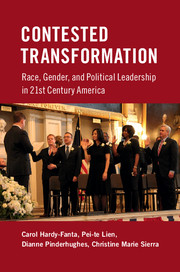
Those who helped with data and technical aspects of the project include Rose Hessmiller, CEO of Ferguson Lynch, who developed and implemented the GMCL Project website: www.gmcl.org. We also thank Joan Gardner, founder and past president of Applied Geographics, Inc. (AGI), and David Merwin, PhD, associate professor and chair of geography, Framingham State University, for their generosity and skill in creating the Environmental Systems Research Institute (ESRI) maps featured in Chapter 1; and Anthony Roman of the Center for Survey Research at the University of Massachusetts Boston for his top-notch technical assistance – always provided with a smile and chocolate. Rose-Anne Coveney, of UMass Boston, was gracious and demonstrated her design talents when we turned to her for assistance in developing the book’s cover.
Thank you to Cambridge editors Ed Parsons and Robert Dreesen, and the editorial team, who were a pleasure to work with, for their patience, insightful advice, and encouragement. We are also especially grateful for the anonymous reviewers for Cambridge whose feedback helped to strengthen and bring this book to fruition. Thank you to Katherine Tengco, content manager at Cambridge; as well as Theresa Kornak, copyeditor; and the team at Newgen Knowledge Works Pvt. Ltd. who provided excellent edits and comments for drafts of this manuscript.
On a more personal note, Carol would like to thank her husband Christopher and daughters Allison and Caroline, as well as friends María Luisa, Sue, Sara, and Ken and Gail, for listening and providing support during the “blood, toil and tears”Footnote 1 that produced this book. Christine gives special thanks to Ellie for her constant support from the project’s start to end. Christine’s only regret is that her mom is not with her to celebrate the book’s publication. Dianne appreciates her sister Gayle’s support and patience on this project over the years. Pei-te wants to thank her entire family for being patient and understanding of the extraordinarily long and often grueling research schedule to gather and analyze data for this project.
Finally, and most importantly, we would like to thank the many elected officials who participated in our survey. We hope we did you justice in giving voice to your experiences, hopes, and the issues you care so much about.
1 This phrase, which originated with Winston Churchill during World War II, appeared in a Boston Globe article discussing the impact of computers on the quality of writing (Muro 1992): “Good writing requires blood, toil and tears.”