
Skip to main content Accessibility help
×
  • Cited by 20
    • Show more authors
    • You may already have access via personal or institutional login
    • Select format
    • Publisher:
      Cambridge University Press
      Publication date:
      10 December 2009
      19 September 2002
      ISBN:
      9780511484049
      9780521772433
      9780521120357
      Dimensions:
      (228 x 152 mm)
      Weight & Pages:
      1.077kg, 598 Pages
      Dimensions:
      (229 x 152 mm)
      Weight & Pages:
      0.87kg, 600 Pages
    You may already have access via personal or institutional login
  • Selected: Digital
    Add to cart View cart Buy from Cambridge.org

    Book description

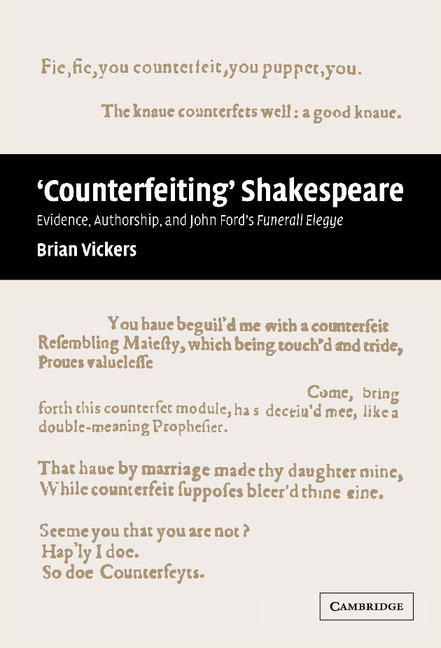
    'Counterfeiting' Shakespeare addresses the fundamental issue of what Shakespeare actually wrote, and how this is determined. In recent years his authorship has been claimed for two poems, the lyric 'Shall I die?' and A Funerall Elegye. These attributions have been accepted into certain major editions of Shakespeare's works but Brian Vickers argues that both attributions rest on superficial verbal parallels; both use too small a sample, ignore negative evidence, and violate basic principles in authorship studies. Through a fresh examination of the evidence, Professor Vickers shows that neither poem has the stylistic and imaginative qualities we associate with Shakespeare. In other words, they are 'counterfeits', in the sense of anonymously authored works wrongly presented as Shakespeare's. He argues that the poet and dramatist John Ford wrote the Elegye: its poetical language (vocabulary, syntax, prosody) is indistinguishable from Ford's, and it contains several hundred close parallels with his work. By combining linguistic and statistical analysis this book makes an important contribution to authorship studies.

    Reviews

    Review of the hardback:‘The reader of this long book, which largely consists of close stylistic analysis, is swept along by the power of its indignation … this battleship of a book delivers what are likely to be the final salvos of a hard-fought literary engagement.’

    Source: The Times Literary Supplement

    Review of the hardback:‘No one doing attribution work can ignore this book … Vickers has set out a programme and an example for authorship studies …’

    Jonathan Hope Source: Literary and Linguistic Computing

    Review of the hardback:‘Brian Vickers, a scholar brilliantly suited in intellectual acumen and feisty temperament for such a controversy … [has produced] a very valuable study, and one that justifies its length and attention to technical detail … This book is a tour de force of considerable beauty’.

    David Bevington Source: Renaissance Quarterly

    Review of the hardback:‘Marshalling a fearsome array of stylometric tables and statistical charts Vickers demonstrates in detail that every one of the linguistic, prosodic and rhetorical features that supposedly stamp the Funerall Elegye as 24-carat Shakespeare prove nothing of the sort … Counterfeiting Shakespeare [is] a major contribution to the arcane domain of attribution studies, which has wider implications for our understanding of Shakespeare’s poetry and plays. For, in the course of confuting misattributions … Vickers equips us with the means of identifying more confidently than was previously possible, the unmistakable music of Shakespeare’s mind at play in language …’

    Kiernan Ryan Source: Timer Higher Education Supplement

    Review of the hardback:‘Counterfeiting’ Shakespeare … demolishes the case for including either poem in Shakespeare’s canon. The book would be impressive if it did only that, but it is also a teach-by-example on how to correctly do authorship studies to an exacting standard … It is an important work about the Ford canon’.

    Michael P. Jensen Source: The Shakespeare Newsletter

    Review of the hardback:‘Vickers is a well-informed and sympathetic reviewer of quantitative work in attribution, and has emerged as a notable practitioner … His book is a profoundly interesting one and thoroughly justified as an essay on method and good practice in scholarship. It also includes valuable and persuasive evidence about revising the Ford canon …’.

    Hugh Craig Source: Shakespeare Quarterly

    Review of the hardback:'Counterfeiting Shakespeare is an admirable book, erudite, witty, incisive and vigorous in its narrative thrust. It makes important contributions to authorship studies as well as to Ford and Shakespeare scholarship and it authoritatively dispose once and for all of the 'counterfeit' claims of ‘Shall I die?’ and A Funerall Elegye.'

    Source: Shakespeare in Southern Africa

    Refine List

    Actions for selected content:

    Select all | Deselect all
    • View selected items
    • Export citations
    • Download PDF (zip)
    • Save to Kindle
    • Save to Dropbox
    • Save to Google Drive

    Save Search

    You can save your searches here and later view and run them again in "My saved searches".

    Please provide a title, maximum of 40 characters.
    ×

    Contents

    Bibliography
    Abbott, E. A., 1886, A Shakespearian Grammar. An Attempt to illustrate some of the differences between Elizabethan and modern English, London; rev. edn (first edn 1869)
    Abrams, Richard, 1995, ‘Breaching the Canon. Elegy by W. S.: the State of the Argument’, Shakespeare Newsletter, The, vol. 45, no. 226: 51–2, 54
    Abrams, Richard, 1996a, ‘In Defence of W. S. Reasons for Attributing A Funeral Elegy to Shakespeare’, Times Literary Supplement, 9 February, pp. 25–6
    Abrams, Richard, 1996b, ‘W[illiam] S[hakespeare]'s “Funeral Elegy” and the Turn from the Theatrical’, Studies in English Literature, 1500–1900, 36: 435–60
    Anderson, Donald K., Jr, 1972, John Ford, New York
    Aristotle, 1984, Rhetoric, tr. W. R. Roberts, in Jonathan Barnes (ed.), The Complete Works of Aristotle. The Revised Oxford Translation, 2 vols., Princeton, N J.
    Bajetta, Carlo, 1996, ‘Ralegh's Early Poetry and Its Metrical Context’, Studies in Philology, 93: 399–411
    Baldwin, T. W., 1944, William Shakspere's ‘Small Latine and Lesse Greeke’, 2 vols., Urbana, IL
    Ball, Catherine N., 1996, ‘A Diachronic Study of Relative Markers in Spoken and Written English’, Language Variation and Change, 8: 227–58
    Bang, W. (ed.), 1906, John Ford, The Queen in Materialien zur Kunde des älteren Englischen Dramas, vol. ⅩⅢ, Louvain
    Barber, Charles, 1976, Early Modern English, London; rev. edn, Edinburgh, 1997
    Barker, Richard H., 1945, ‘The Authorship of The Second Maiden's Tragedy and The Revenger's Tragedy’, Shakespeare Association Bulletin, 20: 51–62, 121–33
    Barker, Richard H., 1958, Thomas Middleton, New York
    Bately, Janet M., 1964, ‘Dryden's Revisions in the Essay of Dramatic Poesy: the Preposition at the End of the Sentence and the Expression of the Relative’, Review of English Studies, 15: 268–82
    Bately, Janet M., 1965, ‘Who and Which and the Grammarians of the 17th Century’, English Studies, 46: 245–50
    [Bathurst, Charles], 1857, Remarks on the Differences in Shakespeare's Versification in Different Periods of his Life, London
    Baugh, Albert C., 1959, ‘A Medieval Survival in Elizabethan Punctuation’, in J. W. Bennett, O. Cargill, and V. Hall, Jr (eds.), Studies in the Elizabethan Drama (London), pp. 1–15
    Beal, Peter, 1986a, Letter to the Editor, Times Literary Supplement, 3 January, p. 13
    Beal, Peter, 1986b, Letter to the Editor, Times Literary Supplement, 24 January, p. 88
    Bennett, A. L., 1954, ‘The Principal Rhetorical Conventions in the Renaissance Personal Elegy’, Studies in Philology, 51: 107–26
    Bentley, Gerald Eades, 1941–68, The Jacobean and Caroline Stage, 7 vols., Oxford
    Bevington, David (ed.), 1997, The Complete Works of Shakespeare. Updated Fourth Edition, New York
    Booth, Stephen, 1997, ‘A Long, Dull Poem by William Shakespeare’, Shakespeare Studies, 25: 229–37
    Booty, John E. (ed.), 1976, The Book of Common Prayer 1559. The Elizabethan Prayer Book, Charlottesville, VA
    Bradbrook, Muriel, 1986, Letter to the Editor, Times Literary Supplement, 31 January, p. 115
    Brooke, C. F. Tucker, 1908, The Shakespeare Apocrypha. Being a Collection of Fourteen Plays Which Have Been Ascribed to Shakespeare, Oxford; repr. 1918
    Burelbach, Frederick M. Jr, 1966, ‘John Ford's Style: the Apprentice Years’, McNeese Review, 17: 58–73
    Burrow, Colin, 1998, ‘Life and Work in Shakespeare's Poems’, Proceedings of the British Academy, 97: 15–50
    Butler, Christopher S., 1985, Statistics in Linguistics, Oxford
    Butler, Martin, 1988, ‘Love's Sacrifice: Ford's Metatheatrical Tragedy’, in Neill 1988, pp. 201–32
    Byrne, M. St C., 1932, ‘Bibliographic Clues in Collaborate Plays’, Library 4th s, 13: 21–48
    Cantor, Paul A., 1987, ‘John Ford’, in F. Bowers (ed.), Jacobean and Caroline Dramatists (Dictionary of Literary Biography, vol. ⅬⅧ), Detroit, MI, pp. 91–106
    Capell, Edward, 1783, ‘A brief Essay on Verse, asof Shakespeare's modeling: its Principles, and its Construction’, Notes and Various Readings to Shakespeare, 3 vols.; excerpts in Brian Vickers (ed.), Shakespeare: The Critical Heritage. Volume Ⅵ, 1774–1801, London and Boston, 1981, pp. 253–72
    Chadwyck-Healey, 1995, English Poetry 900–1900, the full text database
    Chadwyck-Healey, 1995, English Verse Drama, the full text database
    Chalker, Sylvia and Weiner, Edmund (eds.), 1994, The Oxford Dictionary of English Grammar, Oxford
    Chambers, David L., 1903, The Metre of Macbeth. Its Relation to Shakespeare's Earlier and Later Work, Princeton, N J.
    Chambers, E. K., 1930, William Shakespeare. A Study of Facts and Problems, 2 vols., Oxford
    Crain, Caleb, 1998, ‘The Bard's Fingerprints’, Lingua Franca July/August: 28–39
    Davison, Peter, 1988, review of S. Wells and G. Taylor, et al. (eds.), William Shakespeare. The Complete Works and Textual Companion, Library,6th s., 10: 255–67
    Davril, Robert, 1954, Le Drame de John Ford, Paris
    Davril, Robert, 1958, ‘Shakespeare and Ford’, Shakespeare Jahrbuch, 94: 121–31
    Dekker, Thomas, 1953–61, The Dramatic Works, ed. F. Bowers, 4 vols., Cambridge
    Deloney, Thomas, 1912, The Works of Thomas Deloney, ed. F. O Mann, Oxford
    Du Vair, Guillaume, 1951, The Moral Philosophie of the Stoicks, tr. T. James (1598), ed. R. Kirk, New Brunswick NJ
    Duncan-Jones, Katherine, 1983, ‘Was the 1609 Shake-speares Sonnets Really Unauthorized?’, Review of English Studies, n. s., 34: 151–71
    Duncan-Jones, Katherine, 1997, ‘Who Wrote A Funerall Elegie?’, Shakespeare Studies 25: 192–210
    Eliot, T. S., 1932, ‘John Ford’, Selected Essays, London, pp. 193–204; rev. edn 1951, pp. 193–204
    Elliott, Ward E. Y., and Valenza, Robert J., 1991, ‘A Touchstone for the Bard’, Computers and the Humanities, 25: 199–209
    Elliott, Ward E. Y., and Valenza, Robert J., 1996, ‘And Then There Were None: Winnowing the Shakespeare Claimants’, Computers and the Humanities, 30: 191–245
    Elliott, Ward E. Y., and Valenza, Robert J., 1997, ‘Glass Slippers and Seven-League Boots: C-Prompted Doubts About Ascribing A Funeral Elegy and “A Lover's Complaint” to Shakespeare’, Shakespeare Quarterly 48: 177–207
    Elliott, Ward E. Y., and Valenza, Robert J., 1998, ‘The Professor Doth Protest Too Much, Methinks: Problems with the Foster “Response”’, CHum 32: 425–90
    Elliott, Ward E. Y., and Valenza, Robert J., 2000, ‘So much hardball, so little of it over the plate. Conclusions from our “debate” with Donald Foster’, posted online at http://govt.claremontmckenna.edu/welliott/hardball.htm, pp. 1–25. A much-shortened version is forthcoming in Computers and the Humanities
    Elliott, Ward E. Y., and Valenza, Robert J., 2001, ‘Smoking Guns and Silver Bullets. Could John Ford Have Written the Funeral Elegye?’, Literary and Linguistic Computing, 16: 205–32
    Ellis, John M., 1997, Literature Lost. Social Agendas and the Corruption of the Humanities, New Haven and London
    Ellis-Fermor, Una, 1958, The Jacobean Drama, London; rev. edn (first edn 1936)
    Empson, William, 1947, Seven Types of Ambiguity, London (first edn 1930)
    Evans, G. Blakemore (ed.), 1997, The Riverside Shakespeare. Second Edition, Boston
    Farr, Dorothy M., 1979, John Ford and the Caroline Theatre, London
    Fellowes, E. H., 1967, English Madrigal Verse 1588–1632, 3rd edn, revised and enlarged by Frederick W. Sternfeld and David Greer, Oxford
    Fischer, O., 1992, ‘Syntax’, in Norman Blake (ed.), The Cambridge History of the English Language, Volume Ⅱ. 1066–1476, Cambridge, pp. 207–408
    Foster, Donald W., 1986a, Letter to the Editor, New York Times Book Review, The, 19 January, p. 4
    Foster, Donald W., 1986b, Letter to the Editor, Times Literary Supplement, 24 January, pp. 87–8
    Foster, Donald W., 1986c, Letter to the Editor, Times Literary Supplement, 7 March, p. 247
    Foster, Donald W., 1987, ‘“Shall I Die” Post Mortem: Defining Shakespeare’, Shakespeare Quarterly 38: 58–77
    Foster, Donald W., 1989, Elegy by W. S. A Study in Attribution, Newark and London
    Foster, Donald W., 1995, ‘Shaxicon 1995’, Shakespeare Newsletter, The 45: 1, 30, 32
    Foster, Donald W., 1996a, ‘A Funeral Elegy: W[illiam] S[hakespeare's] “Best-speaking Witnesses”’, Publications of the Modern Language Association of America, 111: 1080–105
    Foster, Donald W., 1996b, ‘Response to Elliott and Valenza, “And Then There Were None”’, Computers and the Humanities, 30: 247–55
    Foster, Donald W., 1997, ‘Attributing A Funeral Elegye: Reply’, Publications of the Modern Language Association of America, 112: 432–4
    Foster, Donald W., 1998, ‘The Claremont Shakespeare Authorship Clinic: How Severe are the Problems?’, Computers and the Humanities, 32: 491–510
    Foster, Don, 2000, Author Unknown: On the Trail of Anonymous, New York
    Franz, Wilhelm, 1939, Shakespeare-Grammatik, 4th edn: Die Sprache Shakespeares In Vers und Prosa, Halle (earlier edns 1898–1923)
    Frost, David L., 1968, The School of Shakespeare, Cambridge
    Garner, Bryan A., 1987, ‘Shakespeare's Latinate Neologisms’, in Salmon and Burgess 1987, pp. 207–28; fromShakespeare Studies, 15 (1982): 149–70
    Gayley, Charles Mills (ed.), 1937, Representative English Comedies … Volume Ⅲ. The Later Contemporaries of Shakespeare, New York; The Spanish Gypsy, pp. 119–203
    Gibson, Colin A., 1988, ‘“The Stage of My Mortality”: Ford's Poetry of Death’, in Neill 1988, pp. 55–80
    Giroux, Robert, 1986, Letter to the Editor, New York Times Book Review, The, 19 January, pp. 4, 24
    Graham-White, Anthony, 1995, Punctuation and its Dramatic Value in Shakespearean Drama, Newark, N J, and London
    Greenblatt, Stephen, Cohen, Walter, Howard, Jean E., Maus, Katharine Eisaman (eds.), 1997, The Norton Shakespeare. Based on the Oxford Edition, New York
    Greg, W. W., 1955, The Shakespeare First Folio. Its Bibliographic and Textual History, Oxford
    Greg, W. W., 1966, ‘An Elizabethan Printer and his Copy’, in Greg, Collected Papers, ed. J. C. Maxwell (Oxford, 1966), pp. 95–109; originally in Library, 4 (1923): 102–18
    Haack, Susan, 1999, ‘Staying for an Answer. The Untidy Process of Groping for Truth’, Times Literary Supplement 9 July, pp. 12–14
    Hannemann, Eduard, 1888, ‘Metrische Untersuchungen zu John Ford’, Inaugural-Dissertation der vereinigten Friedrichs-Universität Halle-Wittenberg, Halle a. S
    Harbage, Alfred (ed.), rev. Schoenbaum, S., 1964, Annals of English Drama 975–1700, London; Supplements 1–2 (1966 and 1970)
    Harner, James L. (ed.), 2000, The World Shakespeare Bibliography 1980–1996 on CD-ROM, Cambridge
    Hart, Alfred, 1934a, Shakespeare and the Homilies. And Other Pieces of Research into the Elizabethan Drama, Melbourne and London; repr. New York, 1970, 1977
    Hart, Alfred, 1934b, ‘Shakespeare and the Vocabulary of The Two Noble Kinsmen’, in Hart 1934a, pp. 242–56; fromReview of English Studies 10 (1934): 278–87
    Hart, Alfred, 1943a, ‘The Vocabularies of Shakespeare's Plays’, Review of English Studies, 19: 128–40
    Hart, Alfred, 1943b, ‘The Growth of Shakespeare's Vocabulary’, Review of English Studies, 19: 242–54
    Hart, Dominick J., 1985, ‘The Fancies, Chast and Noble’ by J. Ford. A Critical Edition, New York and London
    Herdan, Gustav, 1965, ‘Discussion on the Paper by Mr Morton’, following A. Q. Morton, ‘The Authorship of Greek Prose’, Journal of the Royal Statistical Society Series a, 128: 169–233
    Hieatt, A. Kent, 1997a, ‘Attributing A Funeral Elegye’, Letter to the Editor, Publications of the Modern Language Association of America, 112: 430–1
    Hieatt, Charles W., 1997b, ‘Attributing A Funeral Elegye’, Letter to the Editor, Publications of the Modern Language Association of America, 112: 429–30
    Hirsh, James, 2000, ‘A Funeral Elegy, Shakespeare, and Elizabeth Cary’, The Ben Jonson Journal 7: 567–87
    Honigmann, E. A. J., 1990, review of Foster 1989, Notes and Queries, 235: 465–7
    Hope, Jonathan, 1994, The Authorship of Shakespeare's Plays. A Socio-Linguistic Study, Cambridge
    Horden, John (ed.), 1980, Samuel Halkett and John Laing, A Dictionary of Anonymous and Pseudonymous Publications in the English Language. Third (revised and enlarged) edition, 1475–1640, London
    Houston, John Porter, 1988, Shakespearean Sentences. A Study in Style and Syntax, Baton Rouge, LA
    Hoy, Cyrus, 1959, ‘The Shares of Fletcher and his Collaborators in the Beaumont and Fletcher Canon (Ⅳ)’, Studies in Bibliography, 12: 91–116
    Hoy, Cyrus, 1960, ‘The Shares of Fletcher and his Collaborators in the Beaumont and Fletcher Canon (Ⅴ)’, Studies in Bibliography, 13: 77–108
    Hoy, Cyrus, 1980, Introductions, Notes, and Commentaries to Texts in ‘The Dramatic Works of Thomas Dekker’, 4 vols., Cambridge
    Huebert, Ronald, 1977, John Ford. Baroque English Dramatist, Montreal and London
    Ingram, John K., 1874, ‘On the “weak endings” of Shakspere, with some account of the history of the verse-tests in general’, Transactions of the New Shakspere Society, 1: 442–64
    Jackson, MacDonald P., 1979, Studies in Attribution. Middleton and Shakespeare, Salzburg
    Jackson, MacDonald P., 1991, review of Foster 1989, Shakespeare Survey 43: 258–61
    Jackson, MacDonald P., 1995, ‘Function Words in the Funeral Elegy’, Shakespeare Newsletter, The, vol. 45, no. 227: 74, 78
    Jentoft, C. W., 1976, ‘Surrey's Five Elegies: Rhetoric, Structure, and the Poetry of Praise’, Publications of the Modern Language Association of America, 91: 23–32
    Johnson, Gerald D., 1992, ‘Thomas Pavier, Publisher, 1600–25’, Library 6th s., 14: 12–50
    Joseph, Sister Miriam, 1947, Shakespeare's Use of the Arts of Language, New York; repr. 1966
    Kenny, Anthony, 1982, The Computation of Style. An Introduction to Statistics for Students of Literature and Humanities, Oxford
    Kerl, Erich, 1922, ‘Das Hendiadyoin bei Shakespeare’, PhD Diss., Universität Marburg
    Krüger, Alfred, 1929, ‘Studien über die Syntax des englischen Relativpronouns zu Beginn der spätenglischen Zeit’, PhD Diss., Universität Giessen
    Lake, David J., 1975, The Canon of Thomas Middleton's Plays, Cambridge
    Lass, Roger (ed.), 1999, The Cambridge History of the English Language, Volume Ⅲ. 1476–1776, Cambridge
    Leech, Clifford, 1957, John Ford and the Drama of His Time, London
    Leishman, J. B. (ed.), 1949, The Three Parnassus Plays, London
    Lipsius, Iustus, 1939, Two Bookes of Constancie Written in Latin by Iustus Lipsius, Englished by Sir John Stradling, ed. R. Kirk, New Brunswick, N J
    Littledale, Harold, and Greg, W. W. (eds.), 1920, The Welsh Ambassador, Oxford (Malone Society Reprint)
    Lloyd, Bertram, 1945, ‘The Authorship of The Welsh Embassadour’, Review of English Studies, 21: 192–201
    Lomax, Marion (ed.), 1995, John Ford: The Lover's Melancholy, The Broken Heart, 'Tis Pity She's a Whore, and Perkin Warbeck, Oxford (Oxford Drama Library)
    Lucas, F. L. (ed.), 1927, The Works of John Webster, 4 vols., London
    Maule, Jeremy, 2000, ‘“To the Memory of the Late Excellent Poet John Fletcher”: a New Poem by John Ford’, English Manuscript Studies 1100–1700 8: 136–59
    Maxwell, Baldwin, 1956, Studies in the Shakespeare Apocrypha, New York; repr. New York, 1969
    Monsarrat, Gilles D., 1971, ‘John Ford's Authorship of Christes Bloodie Sweat’, English Language Notes 9: 20–5
    Monsarrat, Gilles D., 1975, ‘Les Thèmes Stoïciens dans la littérature de la Renaissance Anglaise’, Thèse, Université de Lille
    Monsarrat, Gilles D., 1980, ‘The Unity of John Ford: 'Tis Pity She's a Whore and Christ's Bloody Sweat’, Studies in Philology, 77: 247–70
    Monsarrat, Gilles D., 1984, Light from the Porch. Stoicism and English Renaissance Literature, Paris
    Monsarrat, Gilles D., 2002, ‘A Funeral Elegy: Ford, W. S., and Shakespeare’, Review of English Studies vol. 53, no. 210
    Müller, C. F. W., 1852, ‘Ueber das sogenannte hen dia dyoin im lateinischen’, Philologus 7: 297–318
    Neill, Michael (ed.), 1988, John Ford. Critical Re-Visions, Cambridge
    Ness, Frederic W., 1941, The Use of Rhyme in Shakespeare's Plays, New Haven, CT
    Oates, Joyce Carol, 1999, ‘The Mystery of Jon Benét Ramsey’, New York Review of Books 24 June, pp. 31–2, 34–6
    Oliphant, E. H. C., 1926, ‘The Authorship of The Revenger's Tragedy’, Studies in Philology, 23: 157–68
    Oliphant, E. H. C., 1927, The Plays of Beaumont and Fletcher. An Attempt to Determine Their Respective Shares and the Shares of Others, New Haven, CT, 1927; New York, 1970
    Oliver, H. J., 1955, The Problem of John Ford, Melbourne
    Oras, Ants, 1960, Pause Patterns in Elizabethan and Jacobean Drama. An Experiment in Prosody, Gainesville, FL
    Obortello, Alfredo, 1949, Madrigali Italiani in Inghilterra. Storia, Critica, Testi, Milan
    Parkes, M., 1993, Pause and Effect. An Introduction to the History of Punctuation in the West, London, Berkeley, and Los Angeles
    Partridge, A. C., 1964, Orthography in Shakespeare and Elizabethan Drama. A Study of Colloquial Contractions, Elision, Prosody and Punctuation, London
    Partridge, A. C., 1976, A Substantive Grammar of Shakespeare's Nondramatic Texts, Charlottesville, VA
    Peacham, Henry, 1954, The Garden of Eloquence (1593), ed. W. G. Crane, Gainesville, FL; repr. Delmar, NY, 1977
    Pendleton, Thomas A., 1986, Letter to the Editor, New York Times Book Review, The, 19 January, p. 24
    Pendleton, Thomas A., 1989, ‘The Non-Shakespearian Language of “Shall I Die?”’, Review of English Studies, n. s. 40: 323–51
    Peters, Hans, 1996, ‘Early Modern English Who: Discourse Function and Standardization’, North-Western European Language Evolution, 27: 67–185
    Pierce, Frederick E., 1909, The Collaboration of Webster and Dekker, New Haven
    Pierce, Frederick E., 1912a, ‘The Collaboration of Dekker and Ford (Ⅰ). The Authorship of The Sun's Darling’, Anglia n. f. 34: 141–68
    Pierce, Frederick E., 1912b, ‘The Collaboration of Dekker and Ford (Ⅱ). The Authorship of The Witch of Edmonton’, Anglia n. f. 34: 289–312
    Prestin, Terry, 1997, ‘From Sonnets to Ransom Notes. Shakespeare Sleuth Helps Police in Literary Detection’, New York Times, 19 November, p. a24
    Proudfoot, Richard, 1990, review of Foster 1989 inTimes Literary Supplement, 8–14 June, p. 420
    Puttenham, George, 1936, The Arte of English Poesie, ed. G. D. Willcock and A. Walker, Cambridge; repr. 1970
    Quirk, Randolph, Greenbaum, Sidney, Leech, Geoffrey, and Svartvik, Jan, 1972, A Grammar of Contemporary English, London
    Ringler, William A. Jr (ed.), 1962, The Poems of Sir Philip Sidney, Oxford
    Rissanen, Matti, 1999, ‘Syntax’, in Lass 1999, pp. 187–331
    Robbins, Robin, 1985, ‘A New Shakespeare Poem? … The Counter-Arguments’, Times Literary Supplement, 20 December, pp. 1449–50
    Rowntree, Derek, 1981, Statistics Without Tears. A Primer for Non-mathematicians, Harmondsworth
    Rydén, Mats, 1966, Relative Constructions in Early Sixteenth-Century English. With Special Reference to Sir Thomas Elyot, Uppsala
    Salmon, Vivien and Burgess, Edwina (eds.), 1987, A Reader in the Language of Shakespearean Drama, Amsterdam and Philadelphia
    Sampley, Arthur M., 1933, ‘“Verbal Tests” for Peele's Plays’, Studies in Philology, 30: 473–96
    Sargeaunt, M. Joan, 1934, ‘Writings Ascribed to John Ford by Joseph Hunter in Chorus Vatum’, Review of English Studies, 10: 165–76
    Sargeaunt, M. Joan, 1935, John Ford, Oxford; New York 1966
    Schäfer, Jürgen, 1973, Shakespeares Stil. Germanisches und romanisches Vokabular, Frankfurt
    Schäfer, Jürgen, 1980, Documentation in the OED Shakespeare and Nashe as Test Cases, Oxford
    Schoenbaum, S., 1966, Internal Evidence and Elizabethan Dramatic Authorship, London
    Sedge, Douglas, 1963, ‘An Edition of The Queen; or, The Excellency of her Sex’, MA thesis, the Shakespeare Institute, University of Birmingham
    Shaheen, Naseeb, 1987, Biblical References in Shakespeare's Tragedies, Newark and London
    Shaheen, Naseeb, 1989, Biblical References in Shakespeare's History Plays, Newark and London
    Shaheen, Naseeb, 1993, Biblical References in Shakespeare's Comedies, Newark and London
    Shapiro, I. A., 1985, Letter to the Editor, Times Literary Supplement, 27 December, pp. 1481, 1492
    Sheen, Erica and Maule, Jeremy, 1986, Letter to the Editor, Times Literary Supplement 17 January, p. 61
    Spevack, Marvin, 1973, The Harvard Concordance to Shakespeare, Hildesheim
    Stock, L. E., Monsarrat, Gilles D., Kennedy, Judith M., and Danielson, Dennis (eds.), 1991, The Nondramatic Works of John Ford, Binghamton, NY
    Sutfin, Joe Andrews, 1964, ‘Ford's Love's Sacrifice, The Lady's Trial, and The Queen. Critical, Old-spelling Editions of the Texts of the Original Quartos’, PhD Diss., Vanderbilt University (University Microfilms, 64–10, 565)
    Sykes, H. Dugdale, 1924, Sidelights on Elizabethan Drama. A Series of Studies Dealing with the Authorship of Sixteenth and Seventeenth Century Plays, Oxford; repr. London, 1966
    Tarlinskaja, Marina, 1987, Shakespeare's Verse. Iambic Pentameter and the Poet's Idiosyncrasies, New York
    Taylor, Gary, 1985a, ‘Shakespeare's New Poem: a Scholar's Clues and Conclusions’, New York Times Book Review, The, 15 December, pp. 11–14
    Taylor, Gary, 1985b, ‘A New Shakespeare Poem? The Evidence …’, Times Literary Supplement, 20 December, pp. 1447–8
    Taylor, Gary, 1986, ‘“Shall I Die” Immortalized?’, Times Literary Supplement 31 January, pp. 123–4
    Taylor, Gary, 1988, ‘Poem by Shakespeare! Read All About It!’, New York Times Book Review, The, 26 June
    Thomas, Steve, 2000, JonBenét. Inside the Ramsey Murder Investigation (with Don Davis), rev. edn, New York
    Ure, Peter, 1951, ‘A Note on “Opinion” in Daniel, Greville, and Chapman’, Modern Language Review, 46: 331–8
    Vickers, Brian, 1968, The Artistry of Shakespeare's Prose, London; repr. 1979
    Vickers, Brian, 1971, ‘Shakespeare's Use of Rhetoric’, in K. Muir and S. Schoenbaum (eds.), A New Companion to Shakespeare Studies, Cambridge, pp. 83–98, 266–7 (repr. in Salmon and Burgess 1987, pp. 391–406)
    Vickers, Brian., 1984, ‘Rhetoric and Feeling in Shakespeare's Sonnets’, in Shakespeare Today: Directions and Methods of Research, ed. K. Elam, Florence, pp. 53–98
    Vickers, Brian, 1988, In Defence of Rhetoric, Oxford; rev. edn, 1997
    Vickers, Brian, 1989, review of S. Wells and G. Taylor (eds.), William Shakespeare. The Complete Works and A Textual Companion, Review of English Studies, 40:402–11
    Vickers, Brian, 1993, ‘Shakespearian Consolations’, Proceedings of the British Academy, 82: 219–84
    Vickers, Brian (ed.), 1996, Francis Bacon, Oxford
    Vickers, Brian, 1999, English Renaissance Literary Criticism, Oxford
    Vickers, Brian, 1996b, ‘Whose Thumbprints? A More Plausible Author for A Funeral Elegy’, Times Literary Supplement, 8 March, pp. 16–18
    Vickers, Brian, 2002, Shakespeare, Co-author. A Historical Study of Five Collaborative Plays, Oxford
    Möllendorf, Peter, 1996, ‘Hendyiadyoin’, Historisches Wörterbuch der Rhetorik, Tübingen, vol. III, cols. 1344–50
    Warren, Michael J., 1977, ‘Repunctuation as Interpretation in Editions of Shakespeare’, English Literary Renaissance, 7: 155–69
    Wells, Stanley and Taylor, Gary, with Jowett, John and Montgomery, William, 1987, William Shakespeare. A Textual Companion, Oxford
    Wells, Stanley, 1996a, ‘In Memory of Master William Peter. The Difficulties of Attributing A Funeral Elegy to Shakespeare’, Times Literary Supplement, 26 January, p. 28
    Wells, Stanley, 1996b, ‘Shakespeare and the Funeral Elegy’, Letter to the Editor, Times Literary Supplement, 16 February, p. 17
    Wells, Stanley, 1997, ‘A Funeral Elegy: Obstacles to Belief’, Shakespeare Studies 25: 186–91
    Williams, C. B., 1970, Style and Vocabulary: Numerical Studies, London
    Williams, Franklin B. Jr, 1957, ‘An Initiation into Initials’, Studies in Bibliography, 9: 163–78
    Wood, Thomas A., 1965, ‘John Ford: Three Studies’, PhD Diss., University of Birmingham
    Wright, George T., 1981, ‘Hendiadys and Hamlet’, Publications of the Modern Language Association of America, 96: 168–93
    Wright, George T., 1986, ‘The Meter of “Shall I die?”’, Eidos. The International Prosody Bulletin, 3: 6, 11, 12
    Wright, George T., 1988, Shakespeare's Metrical Art, Berkeley and Los Angeles

    Metrics

    Full text views

    Total number of HTML views: 0
    Total number of PDF views: 0 *
    Loading metrics...

    Book summary page views

    Total views: 0 *
    Loading metrics...

    * Views captured on Cambridge Core between #date#. This data will be updated every 24 hours.

    Usage data cannot currently be displayed.

    Accessibility standard: Unknown

    Why this information is here

    This section outlines the accessibility features of this content - including support for screen readers, full keyboard navigation and high-contrast display options. This may not be relevant for you.

    Accessibility Information

    Accessibility compliance for the PDF of this book is currently unknown and may be updated in the future.
