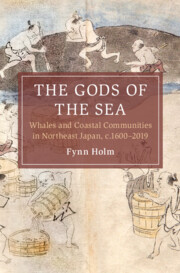

Japan is often imagined as a nation with a long history of whaling. In this innovative new study, Fynn Holm argues that for centuries some regions in early modern Japan did not engage in whaling. In fact, they were actively opposed to it, even resorting to violence when whales were killed. Resistance against whaling was widespread especially in the Northeast among the Japanese fishermen who worshiped whales as the incarnation of Ebisu, the god of the sea. Holm argues that human interactions with whales were much more diverse than the basic hunter-prey relationship, as cetaceans played a pivotal role in proto-industrial fisheries. The advent of industrial whaling in the early twentieth century, however, destroyed this centuries-long equilibrium between humans and whales. In its place, communities in Northeast Japan invented a new whaling tradition, which has almost completely eclipsed older forms of human-whale interactions. This title is also available as Open Access.
Winner, 2024 John R. Lyman Book Awards, North American Society for Oceanic History
Winner, 2025 10th Professor Josef Kreiner Hosei University Award for International Japanese Studies, Hosei University
‘Holm provides a thoroughly researched, engaging, and welcome new perspective on northeastern Japan's relationships with whales, from respect and not hunting them in the Tokugawa period (when whaling was practiced in western Japan) through the human and ecosystem-level changes that transformed the region into a base for modern industrial whaling.'
Jakobina Arch - Whitman College
‘Gods of the Sea is a masterful and eloquent account of Japan's neglected northeast and that region's fascinating historical relationship with whales. Holm goes beyond standard whaling histories to engage creatively and movingly with the larger oceanic ecosystems and human cultures that give this whale story deep meaning and wide resonance.'
Ryan Tucker Jones - University of Oregon
‘This study is equally ambitious in design and argument and offers fertile ideas for both Japanese and environmental history. Holm’s book does what every good book should do, which is to think imaginatively with history in ways that lead readers toward productive new questions.’
Charlotte Ciavarella Source: H-Net Reviews
‘This is a notable addition to maritime and environmental history, and while it is a microhistory of Japan’s often-forgotten northeastern region, it will prove accessible and engaging to a wide array of readers. Well organized with clear and concise arguments, the text will prove engaging and accessible to both seasoned scholarly readers and more general audiences, who will almost certainly walk away more informed and with new lines of questioning and thought.’
Michael Tóth Source: H-Net Reviews
Loading metrics...
* Views captured on Cambridge Core between #date#. This data will be updated every 24 hours.
Usage data cannot currently be displayed.
This section outlines the accessibility features of this content - including support for screen readers, full keyboard navigation and high-contrast display options. This may not be relevant for you.
Accessibility compliance for the PDF of this book is currently unknown and may be updated in the future.
