Preface
Published online by Cambridge University Press: 05 February 2015

Summary
The concept of human dignity has a 2,500 year history. As it has moved through history, the concept has been influenced by different religions which held it as an important component of their theological approach. It was also influenced by the views of philosophers who developed human dignity in their contemplations. In the twentieth century, the concept encountered a new phenomenon. The atrocities of the Second World War, and particularly the Holocaust of the Jewish people, brought human dignity into the forefront of legal discourse. As a result, constitutional and international legal texts began to adopt the concept, and jurists appeared alongside the theologians and the philosophers. Legal scholars were called upon to determine the theoretical basis of human dignity as a constitutional value and as a constitutional right. Judges were required to solve practical problems created by the constitutionalization of human dignity, as a value or as a right.
This book discusses the legal-constitutional aspect of human dignity. It makes no theological or philosophical contribution. I do not argue with Jewish or Christian religious sages; I have no dispute with Kant. I attempt, through legal analysis, to explain human dignity as a constitutional value and as a constitutional right. Of course, law is not detached from life. Legal understanding is influenced by theological and philosophical views. It is not, however, identical to them. Aquinas and Kant were not dealing with the interpretation of a constitutional bill of rights in which the value of human dignity, or the right to human dignity, is entrenched. Of course, the legal solutions for practical problems at times overlap the solutions that theologians or philosophers promote. This is the Rawlsian phenomenon of “overlapping consensus.” However, the theoretical points of departure are different: the point of departure for understanding human dignity in a constitutional bill of rights is the constitution, not theological or philosophical considerations.
Information
- Type
- Chapter
- Information
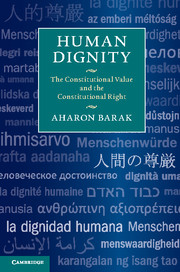
- Human DignityThe Constitutional Value and the Constitutional Right, pp. xvii - xxvPublisher: Cambridge University PressPrint publication year: 2015
References
, ‘An Ordering of Constitutional Values’ (1979–80) 53 Southern California Law Review703Google Scholar
, ‘Human Dignity and Constitutional Rights’, in and (eds.), The Constitution of Rights: Human Dignity and American Values (Ithaca, NY: Cornell University Press, 1992), 228Google Scholar
, ‘Human Dignity in Supreme Court Constitutional Jurisprudence’ (2006) 84 Nebraska Law Review740Google Scholar
, Dignity Rights: Courts, Constitutions, and the Worth of the Human Person (Philadelphia: University of Pennsylvania Press, 2012)Google Scholar
, ‘Concurring Visions: Human Dignity in the Canadian Charter of Rights and Freedoms and the Basic Law of the Federal Republic of Germany’ (2003) 3 Global Jurist Frontiers1CrossRefGoogle Scholar
, Facing Judicial Discretion: Legal Knowledge and Right Answers Revisited (Dordrecht: Kluwer, 2001)CrossRefGoogle Scholar
, Die Menschenwürde in der Verfassungsordnung: zur Dogmatik des Art. 1 GG (Tübingen: Mohr Siebeck, 1997), 501Google Scholar
, Dignity, Rank, and Rights, ed. by Meir Dan-Cohen (Oxford University Press, 2012)CrossRefGoogle Scholar
, Dignity and Liberty: Constitutional Visions in Germany and the United States (Santa Barbara: Praeger, 2002)Google Scholar
and (eds.), The Constitution of Rights: Human Dignity and American Values (Ithaca, NY: Cornell University Press, 1992)
and (eds.), The Concept of Human Dignity in Human Rights Discourse (The Hague: Kluwer Law International, 2002)
, and (eds.), Dignity and Human Rights: The Implementation of Economic, Social and Cultural Rights (Antwerp: Intersentia, 2002)
and (eds.), In Defense of Human Dignity: Essays for our Times (University of Notre Dame Press, 2003)
and (eds.), Perspectives on Human Dignity: A Conversation (Dordrecht: Springer, 2007)CrossRefGoogle Scholar
, , and (eds.), Humiliation, Degradation, Dehumanization: Human Dignity Violated (Dordrecht: Springer, 2011)CrossRef
, , and (eds.), The Cambridge Handbook of Human Dignity: Interdisciplinary Perspectives (Cambridge University Press, 2014)CrossRefGoogle Scholar
Accessibility standard: Unknown
Why this information is here
This section outlines the accessibility features of this content - including support for screen readers, full keyboard navigation and high-contrast display options. This may not be relevant for you.Accessibility Information
Accessibility compliance for the PDF of this chapter is currently unknown
and may be updated in the future.