Skip to main content Accessibility help
×
  • Cited by 2
    • Show more authors
    • Open Access
      You have digital access to this book
    • Select format
    • Publisher:
      Cambridge University Press
      Publication date:
      February 2024
      February 2024
      ISBN:
      9781009373913
      9781009373906
      Creative Commons:
      Creative Common License - CC Creative Common License - BY Creative Common License - NC Creative Common License - ND
      This content is Open Access and distributed under the terms of the Creative Commons Attribution licence CC-BY-NC-ND 4.0.
      https://creativecommons.org/creativelicenses
      Dimensions:
      (229 x 152 mm)
      Weight & Pages:
      0.91kg, 528 Pages
      Dimensions:
      Weight & Pages:
    Open Access
    You have digital access to this book
    Selected: Digital
    View content
    Add to cart View cart Buy from Cambridge.org

    Book description

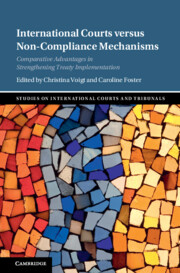
    This book explores the best mechanisms for helping bring about compliance with international treaties. In recent years, many international treaties have included non-compliance mechanisms (NCMs) to facilitate implementation and promote parties' compliance with their obligations. These NCMs exist alongside the formal dispute resolution processes of international courts and tribunals. The authors bring together a wide legal and geographical spectrum of views from different parts of the world representing novel insights into NCMs' contribution to treaty implementation and compliance. The research has cast important light on how procedural innovations may help render NCMs more effective, as well as on the circumstances in which they may be needed, including particularly where nations share common interests, populations are interdependent, and implementation makes significant administrative, regulatory and political demands. This title is also available as Open Access on Cambridge Core.

    Reviews

    ‘The book … highlights the comparative advantages of NCM s over ICT s, particularly in terms of ensuring greater compliance by States with their treaty obligations. NCM s coexist and complement the role of ICT s. As masterfully demonstrated in the book, they contain an unexplored potential and could effectively activate and strengthen treaty regimes.’

    Jingkun Liu Source: The Law & Practice of International Courts and Tribunals

    Refine List

    Actions for selected content:

    Select all | Deselect all
    • View selected items
    • Export citations
    • Download PDF (zip)
    • Save to Kindle
    • Save to Dropbox
    • Save to Google Drive

    Save Search

    You can save your searches here and later view and run them again in "My saved searches".

    Please provide a title, maximum of 40 characters.
    ×

    Contents

    Full book PDF

    Page 1 of 2


    • International Courts versus Non-Compliance Mechanisms
      pp i-i
    • Studies on International Courts and Tribunals - Series page
      pp ii-iv
    • Copyright page
      pp vi-vi
    • Contents
      pp vii-ix
    • Contributors
      pp x-xviii
    • Foreword
      pp xix-xx
    • When Weakness Is Strength: Why Non-Compliance Mechanisms Are Not Just Second Best
    • Introduction
      pp 1-12
    • Part I - General and Conceptual Issues
      pp 13-96
    • 2 - Lessons from the Paris Agreement for International Pandemic Law and Beyond
      pp 15-48
    • Part II - Specific Procedures
      pp 97-168
    • 7 - Compliance with Science-Based Treaties
      pp 145-168
    • Part III - Trade, Finance and Investment
      pp 169-236
    • 8 - Trade’s Enforcement Conundrum
      pp 171-186
    • 10 - IMF Surveillance as a Non-Compliance Mechanism
      pp 217-236
    • Part IV - Environment
      pp 237-284
    • Part V - Human Rights
      pp 285-382
    • 14 - The UK’s Compliance with the ICCPR and ECHR: A Tale of Two Treaties
      pp 314-333
    • Part VI - Criminal Law and Disarmament Law
      pp 383-442

    Page 1 of 2


    Metrics

    Altmetric attention score

    Full text views

    Total number of HTML views: 0
    Total number of PDF views: 0 *
    Loading metrics...

    Book summary page views

    Total views: 0 *
    Loading metrics...

    * Views captured on Cambridge Core between #date#. This data will be updated every 24 hours.

    Usage data cannot currently be displayed.

    Accessibility standard: Unknown

    Why this information is here

    This section outlines the accessibility features of this content - including support for screen readers, full keyboard navigation and high-contrast display options. This may not be relevant for you.

    Accessibility Information

    Accessibility compliance for the PDF of this book is currently unknown and may be updated in the future.

