


International courts have risen in prominence over the past few decades. Their numbers have increased, and their jurisprudence has expanded. Many current regional and global problems find their way onto the dockets of these institutions. The ECtHR, for example, has been asked to weigh in on climate change.Footnote 1 The ICC and ICJ have been ports of call following the outbreak of war and conflict, like in Ukraine and Gaza. The CJEU has been called upon to consider whether practices of some of the world’s largest companies, including Google (Alphabet), Microsoft, and Facebook (Meta), undermine business competition. Closer to the focus on this book, the EACJ has considered whether presidents can run for reelection, and the ACtHPR has been asked to rule on state responsibility for corporate-based human rights abuses. Faced with these questions, among many others, ICs decide whether to accept a state’s (or an international organization’s) exercise of authority and thereby defer.
This book has examined what factors shape deference by international courts. It has argued that deference is determined by an IC’s strategic space – understood as the scope of possible decisions that a court could deliver that would satisfy both legal and political imperatives. The broader this strategic space is, the less inclined a court will be to defer. Moreover, I have hypothesized that two structural factors constitute a court’s key political constraints and, thus, its strategic space. These are: (1) formal independence, or the formal rules that safeguard a court’s isolation from political interference; and (2) political fragmentation, conceived of as the heterogeneity in member states’ preferences. These two factors have the capacity to alter an international court’s strategic space because they condition a court’s legitimacy and the feasibility and credibility of collective state resistance. Both are expected to have a positive effect on a court’s strategic space, and therefore a negative relationship with deference. I have also suggested that additional factors play a role over time, including past episodes of resistance and the practices that courts develop.
The previous three chapters explored deference by the EACJ, CCJ, and ACtHPR. They revealed each court defers to varying degrees and in different ways. Moreover, the chapters analyzed the evidence in support of the argument. They showed that each court has a unique set of formal rules that enhance or hamper independence, which together affect how stakeholders view the courts and the potential of collective state resistance. These chapters also showed how each court’s temporal and cross-sectoral variation in deference corresponds with patterns in political fragmentation among member states – the more homogeneous states’ preferences are at any given time or on any given issue, the more deference is observed. Additionally, deference increased following episodes of resistance when they occurred. The analysis also indicates that each court relies on practices of persuasive argumentation and public legitimation to expand their strategic space and enable nondeference, but these practices differ depending on each court’s political constraints. Overall, the previous three chapters rely on within-case comparison and empirically support the core argument of the book.
This chapter shifts gears and has two aims. First, it puts the EACJ, CCJ, and ACtHPR into dialogue with each other. Specifically, it draws on the findings of the previous three chapters for the purpose of a cross-case comparison. This provides an opportunity to review the main findings and to offer a final empirical test of the argument. Second, this chapter situates the argument and findings within broader scholarly debates and identifies potential avenues for future research.
Comparing the EACJ, CCJ, and ACtHPR
Chapters 4–6 provided empirical support for the core argument based on within-case comparison. The theoretical framework, however, purports not only to explain variation in deference within a single court’s jurisprudence but to also provide an account of how deference varies across courts. This section therefore compares the EACJ, CCJ, and ACtHPR by drawing on the empirical findings of the previous chapters to assess whether the explanation developed in this book accounts for the differences observed in these courts’ deference.
In view of this aim, I recall that the book’s core argument consists of five theoretical expectations, which are summarized by the following hypotheses.
H1: The higher an IC’s formal independence is, the less it will defer.
H2: The more politically fragmented the membership of an IC is, the less it will defer.
H3: The narrower an IC’s strategic space is (as a result of either formal independence or political fragmentation), the more it will rely on persuasive argumentation to facilitate nondeference.
H4: The narrower an IC’s strategic space is (as a result of either formal independence or political fragmentation), the more it will rely on public legitimation to facilitate nondeference.
H5: All else equal, an international court will defer more when it has experienced past resistance.
I also speculated – although more tentatively – two additional expectations. First, persuasive argumentation may depend more on domestic citations when an international court has a relatively narrow strategic space. Second, ICs to which states can unilaterally exit or enter a court’s jurisdiction (or part thereof) may be especially inclined to rely on people-oriented public legitimation narratives.
To determine whether the evidence is congruent with these expectations, I develop observable implications – or claims about what we can expect to see if the hypotheses hold – to guide the comparison of the three ICs. For this purpose, I begin by describing each court’s relative level of formal independence and political fragmentation. Chapter 3 measured formal independence and showed that among the three courts analyzed here the EACJ has the lowest formal independence followed by the ACtHPR, while the CCJ has the highest.
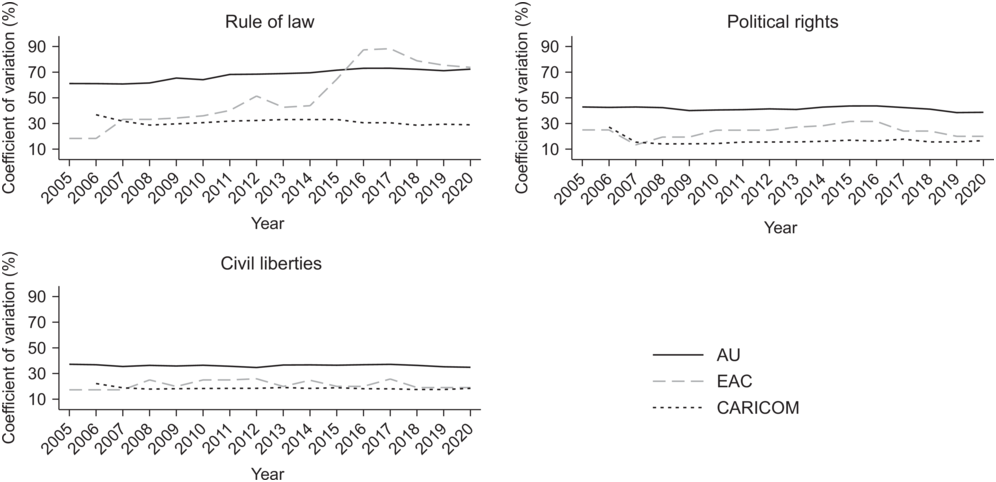
To measure political fragmentation, I look at the variability in the EAC, AU, and CARICOM member states’ preferences using Freedom House data – assuming state practices reveal preferences.Footnote 2 I then calculated the coefficient of variation for each court’s membership from 2005 to 2020 on three indicators relating to issues covered within the courts’ jurisprudence.Footnote 3 Higher values imply greater preference heterogeneity or fragmentation. Figure 7.1 depicts the yearly coefficient of variation for the memberships on the rule of law, civil liberties, and political rights. It reveals that the AU tends to have the highest levels of fragmentation, while CARICOM has the lowest and the EAC lies between.
Political fragmentation of EAC, CARICOM, and AU.
Note: Calculations and illustration by author.
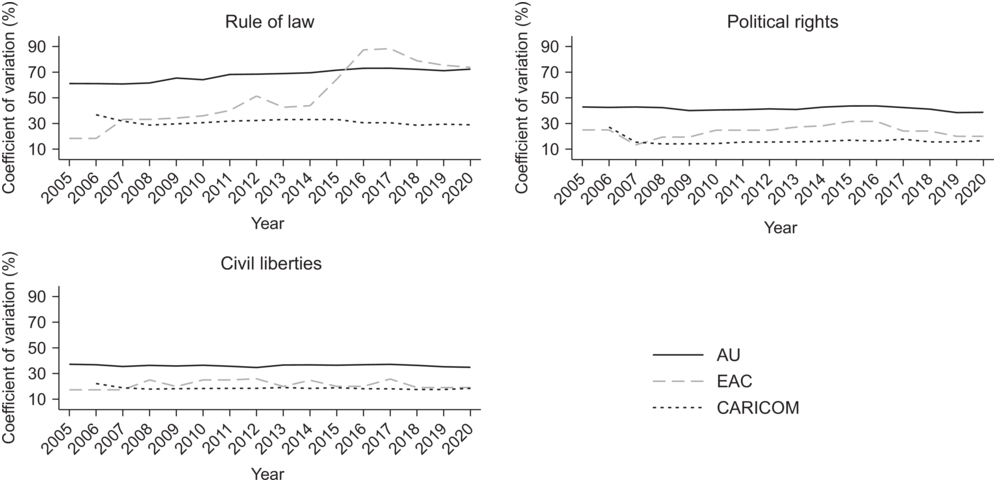
Figure 7.1 Long description
Three line graphs read the same vertical axis labeled coefficient of variation (percent), ranging from 0 to 90 in increments of 20. The horizontal axis spans from 2005 to 2020. Top left graph, Rule of law: A U line trends upward from about 60 to 70. E A C rises steeply from around 30 in 2010 to nearly 80 by 2015, then stabilizes. CARICOM stays flat near 20. Top right graph, Political rights: A U remains around 40 to 45. E A C rises slightly and peaks around 35 in 2015. CARICOM stays near 15. Bottom left graph, Civil liberties: A U fluctuates near 45. E A C and CARICOM remain steady below 30. Legend indicates A U as solid, E A C as dashed, and CARICOM as dotted.
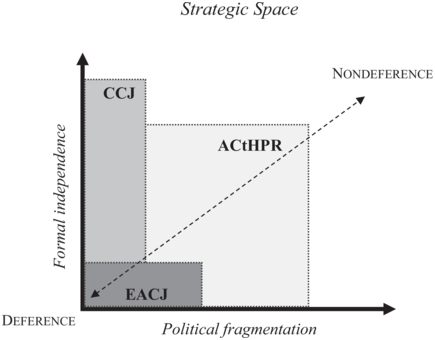
Taking this information together, Figure 7.2 positions the three ICs within a two-dimensional space to reflect where they reside based on their formal independence and political fragmentation. Each IC’s strategic space roughly corresponds to its surrounding shaded box. The EACJ has the smallest strategic space because of its comparatively low formal independence and low-to-midrange political fragmentation. The CCJ has the next largest strategic space, which is a product of high formal independence alongside homogenous preferences among CARICOM states. In contrast, the ACtHPR has both relatively high formal independence and political fragmentation, and consequently has the largest strategic space. The smaller the shaded box, the more deference we expect to observe. This provides the first observable implication. We expect the EACJ to defer the most, followed by the CCJ, and the ACtHPR to defer the least.
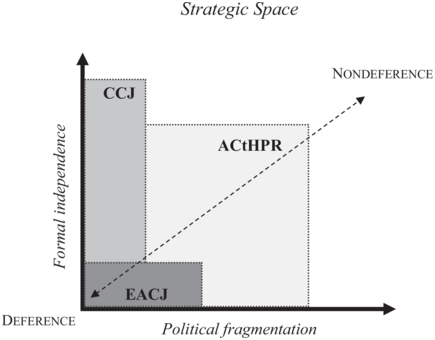
Figure 7.2 Long description
A diagram with the vertical axis labeled formal independence and the horizontal axis labeled political fragmentation. The bottom left corner is labeled deference; the top right is nondeference. A dashed arrow runs diagonally from deference to nondeference across the labeled strategic space. Three courts are positioned within this space: E A C J occupies the lower left with low independence and low fragmentation, C C J is in the upper left with high independence and low fragmentation, and A C t H P R is centered with moderate independence and high fragmentation.
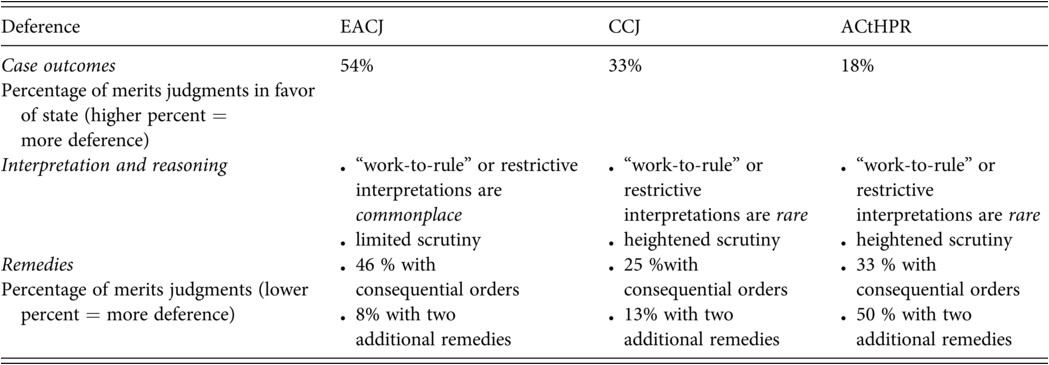
The empirical findings closely align with the first observable implication. Table 7.1 summarizes the aggregate patterns of deference of each court, presented in Chapters 4–6. During the period under analysis, the EACJ’s case outcomes display more deference than the other two courts. It ruled in favor of states in 54 percent of its merits judgments. The CCJ found in favor of states in 33 percent of cases, while the ACtHPR decided in favor of states the least, or in 18 percent of its merits judgments. This pattern matches the observable implication.
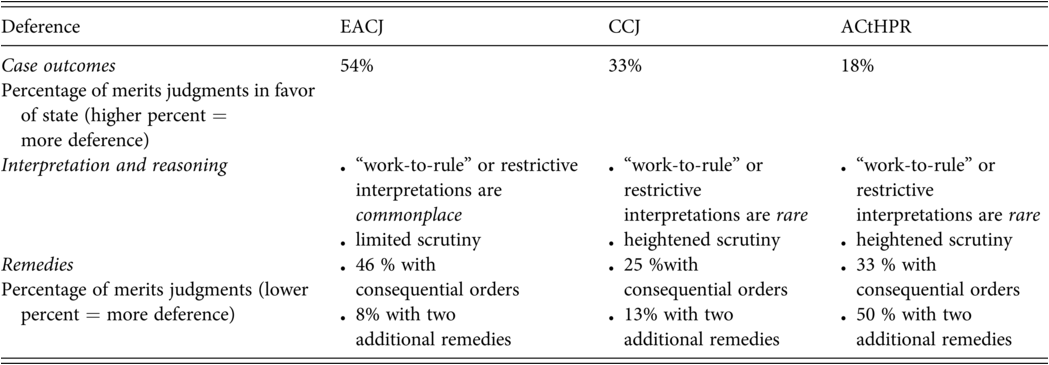
Table 7.1 Long description
The table features a comparison of deference by the East African Court of Justice, the Caribbean Court of Justice, and the African Court on Human and Peoples’ Rights.
Regarding case outcomes, the percentage of merits judgments in favour of the state, where a higher percentage indicates more deference, is 54% for the E A C J, 33% for the C C J, and 18% for the A C t H P R.
Concerning interpretation and reasoning, for the E A C J, work-to-rule or restrictive interpretations are commonplace, and there is limited scrutiny. For the C C J, work-to-rule or restrictive interpretations are rare, and there is heightened scrutiny. For the A C t H P R, work-to-rule or restrictive interpretations are rare, and there is heightened scrutiny.
Regarding remedies, the percentage of merits judgments with consequential orders, where a lower percent indicates more deference, is 46% for the E A C J, 25% for the C C J, and 33% for the A C H P R. The percentage with two additional remedies is 8% for the E A C J, 13% for the C C J, and 50% for the A C t H P R.
Note: Percentages exclude cases where EAC organs or CARICOM organs are the respondents.
Case outcomes provide an imperfect picture of deference, and a more complete picture of an international court’s acceptance of the state’s exercise of authority would also include the court’s legal interpretation and reasoning and remedial orders. However, comparing courts’ interpretation and reasoning is challenging. I have not proposed a quantitative indicator of deference based on interpretation and reasoning. My qualitative assessment of the courts’ jurisprudence, however, found that typically (or despite some notable exceptions) the EACJ adopts “work-to-rule” or restrictive interpretations, and it applies limited scrutiny when accessing states’ actions or decisions. The CCJ and ACtHPR are the opposite: work-to-rule or restrictive interpretations and limited scrutiny tend to be the exception, not the rule, with these two courts. The observed patterns in interpretation and reasoning, as with case outcomes, closely align with my argument’s first observable implication.
The courts’ remedial orders also shed light on deference. Deference based on remedies is high when a court abstains from delivering a consequential order. Conversely, it is low when consequential orders are issued. Table 7.1 shows that the CCJ and ACtHPR’s deference based on consequential remedies conforms to expectations: The ACtHPR issued consequential orders more often than the CCJ. However, 46 percent of the EACJ judgments include a consequential order, which is higher than both the CCJ and ACtHPR and therefore is at odds with the first observable implication. That said, as Chapter 4 discussed, many of the EACJ’s consequential orders intruded less on state sovereignty than would seem at first glance, suggesting that the percentage of decisions with consequential orders overestimates the EACJ’s nondeference. Also, deference as seen by consequential orders of the CCJ and ACtHPR might underestimate nondeference as these two courts often make strong recommendations or tie the hands of states without explicitly issuing a consequential order (see discussion on remedies in Chapters 5 and 6).
For these reasons, I also consider how the courts combine remedies. Chapter 2 suggested that nondeference is greater when there is a combination of remedies, as opposed to a single remedy, within a decision. For example, if a court orders both restitution and compensation, it defers less than if it were to only require compensation. Table 7.1 provides data on the portion of disputes that included at least two orders in addition to the declaratory judgment. Based on these data, the empirical results align with the first observable implication. The EACJ rarely issues multiple remedies in cases. Only 8 percent of its judgments extended two remedies after declaring a violation by a state. This contrasts with the CCJ which combined remedies slightly more often (in 13 percent of its cases), and the ACtHPR which combined remedies the most. Half of all ACtHPR’s decisions included at least two remedies in addition to a declaratory judgment.
In sum, across all three measures of deference, the ACtHPR defers the least, followed by the CCJ, and the EACJ the most. These findings are congruent with the first observable implication (which corresponds to H1 and H2). They also align with H5, as the EACJ is the only court to have previously faced collective resistance and it displays the most deference.
Adaptive Practices
I have also argued that over time ICs can exercise agency over their strategic space by adopting practices that help to improve their legitimacy while reducing the plausibility of state resistance. I have focused on two adaptive practices: persuasive fragmentation and public legitimation. According to H3 and H4, when a strategic space is narrower, these adaptive practices are likely to be more prominent. I measured persuasive argumentation as unanimous judgments and references to external jurisprudence. A second and third observable implication is thus derived from H3. I begin with the second observable implication, specifically the EACJ should issue more unanimous judgments than the ACtHPR. The evidence is congruent with this expectation. Ninety-eight percent of the EACJ’s judgments were unanimous, in contrast to 75 percent of the ACtHPR’s judgment. Of the two instances of expressed dissent by the EACJ, one included a dissent by the national judge of the respondent state, which was found by the majority to be in violation of its obligations. On the face of it, this dissent reflects strategic voting on the part of the dissenting judge. The ACtHPR did not have such striking examples of strategic voting because the African Court’s judges are required to recuse themselves from presiding over disputes involving their national state. The CCJ is not permitted to issue split decisions (within its original jurisdiction), so there are no expectations for the CCJ related to unanimous judgments.
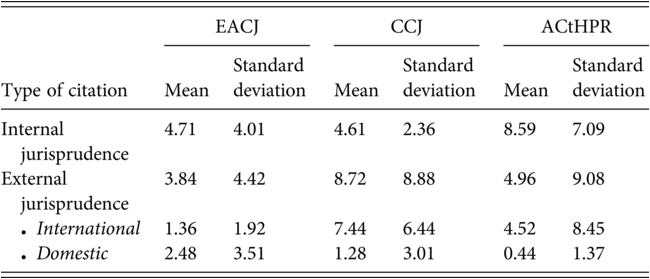
A court’s citations practices can also reveal persuasive argumentation. While all courts will cite authoritative sources to make their judgments compelling, a court’s strategic space will inform what types of sources will boost legitimacy and mitigate state resistance. I have argued that external citations, especially references to domestic jurisdictions, will be more central to judicial decisions the narrower an IC’s strategic space is. This leads to the third observable implication: the EACJ should cite external jurisprudence the most, followed by CCJ and then the ACtHPR. Table 7.2 summarizes the descriptive statistics for each court’s citation practices. It confirms that each court’s practice of citing domestic jurisprudence corresponds to the respective size of their strategic space. On average, the EACJ cites domestic jurisprudence the most often, while the ACtHPR does the least. This suggests that the EACJ boosts the persuasiveness of its judgments by signaling its respect for domestic law. It cites domestic jurisprudence nearly twice as often as the CCJ and nearly five times that of the ACtHPR. One might speculate that this has something to do with the nature of the EACJ’s jurisdiction as a regional integration court, where domestic law may be more central to resolving disputes. If this were the case, the EACJ’s and CCJ’s citation practices should be similar. Yet, not only does the CCJ cite domestic jurisprudence much less than the EACJ, but the CCJ cites international jurisprudence more than the other two courts. This suggests that domestic jurisprudence is not inherently more central to disputes relating to regional integration than international jurisprudence. Looking at domestic and international citations combined, the EACJ cites external jurisprudence the least (as expected). However, the CCJ cites external jurisprudence on average more than the ACtHPR. The ACtHPR might cite external jurisprudence less than the CCJ because the former has much more internal jurisprudence upon which to construct its arguments. Regardless, it seems that references to domestic jurisprudence appear to be the type of persuasive argumentation most closely aligned with the courts’ respective strategic spaces. Also, it is worth recalling that Chapters 4–6 showed that when a judgment represents either a loss for state(s) or includes intrusive remedies, external jurisprudence is typically cited. This suggests that references to external jurisdictions are associated with less deference, as expected. Interviews also confirmed that judges view the quality of their judgments, including how they are reasoned and embedded within broader jurisprudence, as essential to having well-regarded decisions that will be respected. In other words, citation patterns are determined not only by a court’s legal constraints, but its political constraints also play a role in shaping how a court presents persuasive arguments.
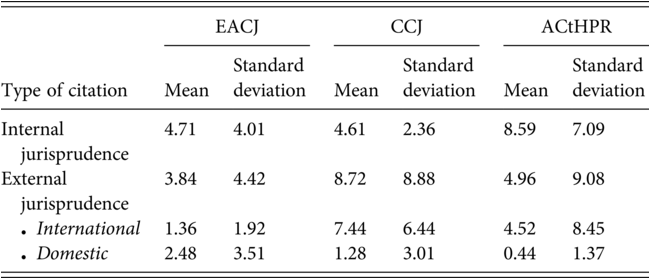
Table 7.2 Long description
The table presents descriptive statistics on citation practices by court, comparing the East African Court of Justice, the Caribbean Court of Justice, and the African Court on Human and Peoples’ Rights. For each court and type of citation, the table shows the mean and standard deviation.
For internal jurisprudence, the E A C J has a mean of 4.71 and a standard deviation of 4.01. The C C J has a mean of 4.61 and a standard deviation of 2.36. The A C t H P R has a mean of 8.59 and a standard deviation of 7.09.
For external jurisprudence, the E A C J has a mean of 3.84 and a standard deviation of 4.42. The C C J has a mean of 8.72 and a standard deviation of 8.88. The ACHPR has a mean of 4.96 and a standard deviation of 9.08. Within external jurisprudence, for international citations, the E A C J has a mean of 1.36 and a standard deviation of 1.92. The C C J has a mean of 7.44 and a standard deviation of 6.44. The A C t H P R has a mean of 4.52 and a standard deviation of 8.45. Also, within external jurisprudence, for domestic citations, the E A C J has a mean of 2.48 and a standard deviation of 3.51. The C C J has a mean of 1.28 and a standard deviation of 3.01. The A C t H P R has a mean of 0.44 and a standard deviation of 1.37.
Last, H4 expected more public legitimation the narrower a court’s strategic space is. This leads to a fourth observable implication: the EACJ presents public legitimation the most, followed by CCJ and then the ACtHPR. I also posited that unilateral exit options might impact the use of public legitimation, leading to a preference for people-centered narratives.
Interview material, official publications, and speeches for each court make clear that all three courts show concern for their public image, and they have adopted many initiatives to build public awareness and confidence. Most of the data I presented on public legitimation is qualitative. Quantitatively comparing the courts’ “off-the-bench” activities is not useful because many of these activities are contingent on financial resources (sometimes from external donors). Moreover, some activities are by invitation (e.g., a judge might be invited as a keynote speaker), and thus are not entirely within the control of the courts themselves. All three courts, however, use social media as part of their public communication strategies. I therefore compare public legitimation based on the courts’ communication over Facebook. As described in Chapters 4–6, I used a web-scraping tool to extract each court’s posts on their own Facebook pages and then analyzed the texts of the posts for key words and phrases that reflect their respective people-centered and political purpose narratives.Footnote 4 With this data I compare the relative prominence of these narratives in the courts’ public communication.Footnote 5
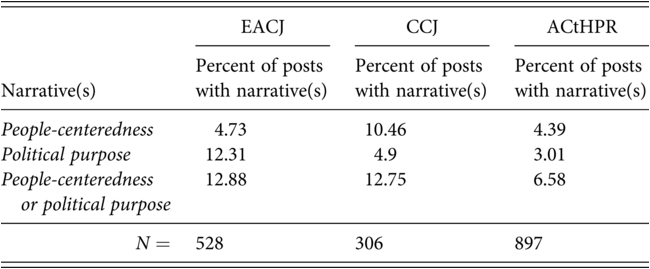
Table 7.3 depicts the extent to which the courts’ social media posts feature either of the public legitimation narratives. The findings corroborate H4. The EACJ presents either of the public legitimation narratives slightly more than the CCJ. In contrast, the ACtHPR conveys one of the two narratives the least.
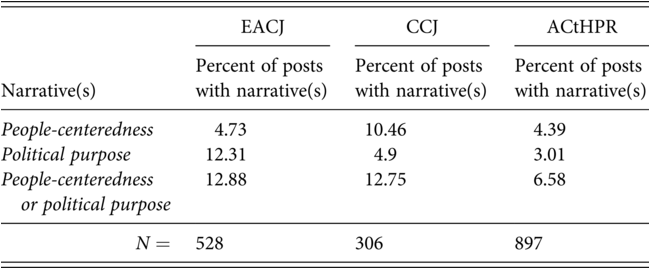
Table 7.3 Long description
The table features the prominence of public legitimation narratives on the Facebook pages of the East African Court of Justice, the Caribbean Court of Justice, and the African Court on Human and Peoples’ Rights. The table shows the percentage of posts with each type of narrative for each institution. The total number of posts analyzed for each institution is also provided.
For people-centeredness, 4.73% of E A C J posts included this narrative, 10.46% of C C J posts included this narrative, and 4.39% of A C t H P R posts included this narrative.
Regarding political purpose, 12.31% of E A C J posts included this narrative, 4.9% of C C J posts included this narrative, and 3.01% of A C t H P R posts included this narrative.
Concerning people-centeredness or political purpose, 12.88% of E A C J posts included either of these narratives, 12.75% of C C J posts included either of these narratives, and 6.58% of A C t H P R posts included either of these narratives.
The total number of Facebook posts analyzed is 528 for the E A C J, 306 for the C C J, and 897 for the A C t H P R.
While the EACJ and CCJ are roughly similar in the overall portion of their communication that features public legitimation narratives, they favor different narratives. The EACJ emphasizes its political purpose while the CCJ, as well as the ACtHPR, highlights its people-centeredness. These differences reflect the varied sources of political constraints. The CCJ and ACtHPR are both constrained by the politics of states’ unilateral acceptance (or withdrawal) to parts of their jurisdiction. In contrast, the EACJ places greater emphasis on its political purpose – unilateral exit is not an option as the EACJ’s jurisdiction is compulsory for EAC members, and it has a narrow strategic space. Thus, the EACJ focuses on portraying itself as central to the process of integration, while the CCJ and ACtHPR signal their ties to the Caribbean peoples and African peoples, respectively.
Alternative Accounts
The above comparison shows that the evidence is largely consistent with the theoretical framework advanced by this book. The argument was developed against the backdrop of two other perspectives – support networks, and political norms and legal culture. The preceding chapters also assessed these two perspectives within the context of each court. In the following, I briefly apply them comparatively.
Existing literature attributes aspects of judicial decision-making to ideational factors, especially political norms and legal culture. As illustrated in Chapters 4–6, the EACJ, ACtHPR, and CCJ share important similarities regarding their ideational setting. Colonial legacies shaped the normative environments in which these courts were created and operate. First, the origins for the EACJ, ACtHPR, and CCJ are connected to the colonial pasts of their member states. Impulses toward regional unity, regionalism, and cooperation existed alongside strong norms of noninterference and sovereignty. Both the EAC and CARICOM were rooted in failed experiments of integration under their colonial oppressors. In the case of the OAU, colonialism spurred sentiments of solidarity and cooperation, but largely led states to favor norms of noninterference. For all three of these ICs, they were created at a time when ideas supportive of regional cooperation were spreading but coexisting with principles of sovereignty and noninterference. This tension has had lasting impacts on the courts and broader regional organizations within which they are embedded.
Also related to their colonial histories, the EACJ, CCJ, and ACtHPR function within legal cultures that are characterized by pluralism and fragile faith in state (or formal) law and courts. Pluralism arises from the mix of civil and common law systems both within and across the members of all three courts. In addition, customary and religious law operates alongside state law, and alternative dispute resolution is widespread. Legal culture in most member states is also shaped by public distrust or a lack of faith in state law and courts. Finally, as newer courts, their sui generis legal cultures are mutable and evolving.
A comparison of these three courts, therefore, reveals strong similarities based on ideational factors. In methodological terms, the research design and selection of ICs aimed to hold these considerations constant. Thus, my argument complements theoretical perspectives that highlight the role of ideational factors, and it suggests additional factors are instrumental to international judicial deference. Also, the analysis revealed that colonial legacies had both political and legal impacts. This sits comfortably with the view that a court’s decision-making will be informed by both political and legal imperatives.
Previous research has pointed to the pivotal role of judicial support networks. If a strong and active support network were crucial to explaining why an international court forgoes deference, we would expect ICs that typically defer to feature few channels of access for its supporters, to minimally mobilize its supporters, or for its support network to be inactive or lack political influence. Conversely, ICs that demonstrate less deference would have various opportunities for access and demonstrate efforts to mobilize their supporters and for the support network to be strong and active. Knowing that the EACJ is the most deferential court of the three ICs studied, while the ACtHPR is the least deferential followed by CCJ, we would expect the EACJ to have a weak or inactive support network. Conversely, the ACtHPR should have the most active and strongest support. Similarly, we should also observe variation in access opportunities and efforts to mobilize supporters.
Chapters 4–6 demonstrated that the EACJ, CCJ, and ACtHPR alike have established practical (legal aid schemes, sub-registries, etc.) and extensive “off-the-bench” activities to mobilize their would-be supporters. Moreover, the three courts feature access for private actors, substate actors, and/or supranational actors. Substate actors (i.e., national courts) and supranational actors have been reluctant supporters of all three courts as they have rarely made use of their available access channels. National courts can refer cases to the EACJ and the CCJ, but except for one referral to the EACJ, this channel has not been utilized. Supranational actors can make referral in all three courts, although this is more limited in the case of the CCJ, but this opportunity has not generated much, if any, litigation for the EACJ, CCJ, or ACtHPR. Thus, these courts are roughly similar in their opportunities and use by substate and supranational actors.
Private actors, whether individual, NGOs, or for-profit organizations, can access all three courts. Nonetheless, private access varies to some degree among the EACJ, CCJ, and ACtHPR. For example, the hurdles for private access to the ACtHPR are significant because many states have not submitted Article 34(6) declarations and the two-month time limit on filing makes a successful petition to the EACJ challenging. The restrictiveness of access to these two courts is difficult to reconcile with their very different approaches to deference.
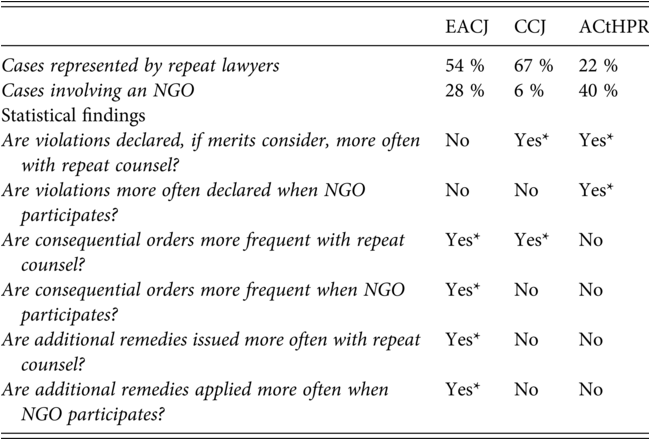
Also, the strength and activeness of private actors does not align with how much each court defers. Table 7.4 summarizes the empirical findings on support networks. It shows that the ACtHPR has had the fewest portion of its cases represented by repeat lawyers, as one measure of the strength and activity of a judicial support network, yet it has been the least deferential of the three courts. On the other hand, the most deferential court, the EACJ, has a large portion of applications represented by repeat lawyers. Also, the CCJ had the largest portion of cases represented by repeat lawyers, yet deference by this court has not been the lowest. A second measure for the relative strength and activity of a support network is the proportion of cases involving an NGO. As the support network logic would expect, the ACtHPR is the least deferential court and had the largest portion of cases with NGO participation. However, the EACJ had a relatively high portion of cases involving NGOs, even though it was the most deferential among the three courts. Also, NGO participation at the CCJ has been limited, yet this court is less deferential than the EACJ.Footnote 6
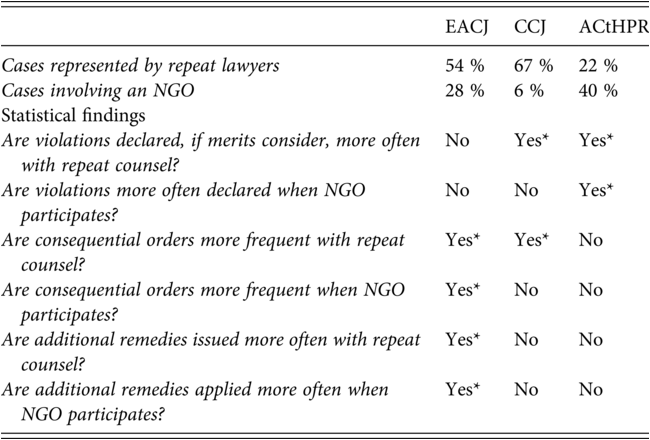
Table 7.4 Long description
The table summarizes findings on support networks for each court, comparing the East African Court of Justice, the Caribbean Court of Justice, and the African Court on Human and Peoples’ Rights.
The percentage of cases represented by repeat lawyers is 54% for the EACJ, 67% for the C C J, and 22% for the A C t H P R.
The percentage of cases involving an N G O is 28% for the EACJ, 6% for the C C J, and 40% for the A C t H P R.
Regarding statistical findings, for the question of whether violations are declared more often with repeat counsel if merits are considered, the finding is No for the E A C J, Yes for the C C J, and Yes for the A C t H P R. For the question of whether violations are more often declared when an N G O participates, the finding is No for the E A C J, No for the C C J, and Yes for the A C t H P R. For the question of whether consequential orders are more frequent with repeat counsel, the finding is Yes, Yes for the C C J, and No for the A C t H P R. For the question of whether consequential orders are more frequent when an N G O participates, the finding is Yes for the E A C J, No for the C C J, and No for the A C t H P R. For the question of whether additional remedies are issued more often with repeat counsel, the finding is Yes for the E A C J, No for the C C J, and No for the A C t H P R. For the question of whether additional remedies are applied more often when an N G O participates, the finding is Yes for the E A C J, No for the C C J, and No for the A C t H P R.
Note that an asterisk indicates statistical significance at p-value less than 0.05.
* Findings are congruent with theoretical expectations of the support network logic.
Last, Table 7.4 summarizes the findings related to whether deference in legal outcomes and remedies is associated with the involvement of repeat lawyers or NGOs. This shows that these relationships are not systematically congruent with the expectations of the support network logic. For instance, the EACJ does not declare violations more often when repeat lawyers or NGOs are involved in disputes than when they are not. Similarly, nondeferential remedies occur less often in the CCJ and ACtHPR when these actors are involved in the litigation.
Overall, the analysis suggests that support networks provide an incomplete account – a court’s supporters do not systematically predict deference. This is not to say they are insignificant to the development of international courts. Indeed, individuals, NGOs, and lawyers have been essential to the litigation before the EACJ, CCJ, and ACtHPR. Thus, my argument and findings do not reject that support networks have an important function for international courts and their performance. Rather, it complements this perspective in a few ways. First, my argument assumes that court’s need proponents to ensure a broad strategic space. This includes litigants – as would be the case for the support network logic – but it also includes the broader public, as I have argued. Second, I have focused on two adaptive practices that ICs employ to expand their strategic space. An IC’s mobilization of its support networks is another type of adaptive practice that could have bearing on a court’s strategic space. Third, time is an important element of my argument. That is, the structural factors I have highlighted are crucial in the early years of a court, or at t0 (see Figure 2.3). A court’s support network – even if civil society and the legal profession were key to its creation – is likely to also be in a nascent stage at t0. My argument does not exclude the possibility that support networks may be capable of empowering a court, and thus altering its strategic space, with time.
Summarizing the Argument
Taken together, the empirical record supports the core argument advanced in this book. Judicial deference is shaped by an international court’s strategic space. Two political constraints – formal independence and political fragmentation – are key to structuring this strategic space. Formal independence and political fragmentation have bearing on how a court takes decisions because they interact to shape a court’s legitimacy, or how it is perceived by stakeholders, and affect the plausibility of state resistance. Higher formal independence and a more fragmented membership provide ICs with a broader strategic space, leading them to defer less. However, even with a generous strategic space, ICs will defer at times, often due to legal constraints. To extend the strategic space and enable nondeference that a court might not otherwise feel secure in executing, it will lean into practices of persuasive argumentation and public legitimation. These will take unique forms depending on the nature of the court’s underlying political constraints. Courts with narrower strategic space will favor unanimous judgments and highlight the compatibility of their decisions with external (especially domestic) jurisprudence. They will also be more inclined to integrate legitimation narratives into their public communications, especially by conveying commitment to their political purpose if there are no unilateral exit options for states. Those with a broader space will be more at ease expressing dissent on the bench (when permitted by the formal rules) and external jurisprudence will be less central to the reasoning of their decisions. While not neglectful of public perceptions, their public communications will focus less on legitimation narratives.
The empirical findings are congruent with this argument. Namely, I have shown that the EACJ has the narrowest strategic space of the three ICs studied, due to pervasive constraints arising from its low formal independence and moderate political fragmentation among the EAC members. At the same time, it has been the most deferential. Unlike the other courts, the EACJ’s strategic space has also been affected by past collective resistance. Given its narrow strategic space, the EACJ leans into the practice of publishing unanimous judgments and citing domestic law to construct compelling arguments. Also, its public communication portrays the Court as dutiful to its intended political purpose, signaling the Court’s respect for state sovereignty and the limits of its mandate. These practices help to buttress the Court’s nondeference. Even with these practices in place, however, the EACJ overall displays substantial deference.
The CCJ’s strategic space is larger than the EACJ’s. It enjoys high formal independence yet minimal political fragmentation, constituting intermediate constraints and leading the CCJ to be moderately deferential. The CCJ defers especially when it perceives states as likeminded and likely to reject its preferred position. Regardless, to make nondeference palatable to states and other audiences, the CCJ cites external jurisprudence (especially international case law) to make arguments compelling. Public legitimation also benefits nondeference and helps the Court to gain public acceptance of its appellate jurisdiction. Given past reluctance of states (and their voting public) to join the appellate jurisdiction, the CCJ’s public communication emphasizes legitimation narratives that illustrate its people-centeredness and representation of the Caribbean people.
Of the three courts, the ACtHPR has the broadest strategic space, due to its robust formal safeguards to independence and marked political divisions among member states, and it deferred the least among the three courts studied. In other words, the ACtHPR’s subtle constraints enable minimal deference. The Court’s nondeference has been facilitated additionally by persuasive argumentation that emphasizes international jurisprudence as well as its own case law, and public legitimation that highlights people-centered narratives. Yet, state resistance, especially their reluctance to accept private actors’ right to petition the Court and withdrawals of Article 34(6) declarations, has affected the Court’s strategic space. This is made evident by an increase in deference.
Scope of the Argument
While my theoretical framework may generalize to a broad set of ICs, the argument was developed and tested within a specific set of conditions. First, this argument is a story of new international courts and the early years of their development. In the early years of an institution, institutional design is likely to have a heightened importance as relationships between states, societal actors, the public, and courts are in formation. Appearances make stronger impressions on legitimacy beliefs in the absence of prior performance, states have not yet shown resistance, and the resilience of a court is not yet proven. In other words, courts and their judges are growing into their relationship with states, and states are navigating new terrain. The early years for international courts are not necessarily determinative of their future trajectories. While there is some evidence from previous scholarship that sui generis cultures, practices, and path dependencies can set in, for which formative years may be pivotal, the argument assumes that the political environment can change, and the empirical evidence supports this assumption. Political fragmentation is not static. Fragmentation fluctuates due to factors such as changes in memberships and governments. Also, resistance, if it arises, can also alter the strategic space. In the end, additional research is needed to understand if and how an international court’s early years are formative and constrain their future trajectories. Put differently, looking back at the nascent stages of older courts – like the ECtHR – could offer new perspectives on where they are today.
Second, the argument has been evaluated in the context of international courts that operate in the Global South and mostly low- and middle-income countries. The relationship between development and how international courts engage with their stakeholders is not entirely clear. Socioeconomic considerations have previously been shown to have an impact on engagement with international courts and tribunals. For instance, development has been the focus of research on legal outcomes in international investment arbitration,Footnote 7 legal representation before the ICJ,Footnote 8 and whether states launch litigation at the WTO,Footnote 9 to name a few. Development and wealth could have a range of potential effects, including state legal capacity and expertise, and societal access to courts and capacity to litigate. It might also affect legal consciousness, and therefore how courts perceive their political constraints. Moreover, research that questions the impact of formal independence of domestic judiciaries finds a contrast between developing and developed states.Footnote 10 Yet, this study has by and large set these issues aside by looking only at courts among primarily low- and middle-income countries. Thus, the argument is linked to this context, even though the book may raise questions about how far the argument travels beyond these boundaries.
Third, the argument has not been developed to apply to interstate jurisdictions and disputes. Admittedly, other factors might affect an international court’s legitimacy and the credibility of state resistance within its interstate jurisdiction. For example, the distribution of power may affect deference in interstate disputes. Also, the threefold measure of deference used here may not fit interstate disputes. Thus, further theoretical and empirical analysis would most likely be necessary to modify the approach presented by this book for it to apply to interstate adjudication.
Thus, the generalizability of the argument beyond these conditions requires further research. Many readers, nonetheless, will want an indication of how my argument applies to the international courts they know best. Thus, I offer a brief interpretation of the WTO Appellate Body (AB) and the ECtHR, but with two important caveats. First, I have not measured deference for these courts and can only rely on previous scholarly descriptions of their jurisprudence and existing data as a preliminary indicator of their deference. Second, these interpretations are tentative.
The WTO AB seemingly presents a challenging case for my argument. It began operating within a midrange strategic space, due to its limited formal independence (see Figure 3.2) and a politically fragmented membership.Footnote 11 Yet, by many accounts the WTO AB has typically been nondeferential. Many scholars suggest that “it has shown a strong inclination for gap-filling and ambiguity clarification, which is often achieved through considerable judicial creativity.”Footnote 12 Also, most cases (or 89 percent of disputes) resulted in a finding of at least one violation.Footnote 13 Does this undermine my argument, as the WTO AB deferred less than we would expect? I would suggest that the WTO AB needs to be interpreted in light of its predecessor – the General Agreement on Tariffs and Trade (GATT) dispute settlement system. In contrast to the WTO, GATT’s dispute settlement system was less independent and the membership less fragmented.Footnote 14 The WTO AB’s strategic space was broader than under GATT and its creation an endorsement of a stronger dispute settlement system. Armed then with a broader strategic space, the WTO AB demonstrated more “judicial lawmaking,” “filling of gaps,” or “agent slack” than had been seen under GATT’s dispute settlement.Footnote 15 Thus, seen in this light, the shift from the GATT to the WTO corresponds to my expectations: the expansion in formal independence and fragmentation meant that the WTO AB has comparatively wider strategic space, giving rise to less deference. Moreover, as fragmentation continued to grow with the expansion of membership, for example, with the membership of China, the WTO AB continued to not defer.
My argument brings out two additional points about the WTO Appellate Body. First, episodes of resistance are important. The WTO Dispute Settlement Understanding (DSU) did face attempted collective resistance in its first decade of operation. Member states tried to reform the WTO DSU when the AB determined that it would accept amicus submission.Footnote 16 This attempted reform signaled to the AB that collective resistance was unlikely to be successful as states could not find enough agreement.Footnote 17 In other words, these events effectively green-lighted nondeference. Second, courts can misread their political environment and miscalculate the plausibility of resistance as well as their legitimacy. That is, they may perceive their strategic space to be different from what it is. This would seem to have been the case for the WTO AB. The WTO AB did not anticipate the United States would use appointment procedures to paralyze it, even if the United States had previously blocked reappointments.Footnote 18 The WTO AB did not appear to appreciate that international courts could indeed fall victim to such a strategy. Although under very different circumstances, the SADC Tribunal was also paralyzed through an intentional strategy of refusing to appoint judges.Footnote 19 It does not appear that the AB adopted practices to help alleviate political constraints either. For example, the WTO AB did little in the way of public legitimation,Footnote 20 even though it undoubtedly had developed a relationship with the legal community.Footnote 21 Thus, the WTO AB for all intents and purposes miscalculated or undervalued its evolving political environment and failed to recognize how intricacies of its institutional design, like the rules related to the selection and tenure of its judges, could be significant.
The ECtHR also presents an interesting case for my argument. Over the years, the ECtHR has seen many changes. The formal independence of the ECtHR increased at two points, first in 1998 when Protocol 11Footnote 22 entered into force; and again in 2010 when Protocol 14Footnote 23 entered into force. Political fragmentation has fluctuated over the years. It was moderate to high until the early 1970s, then declined and remained low until the early 1990s. It increased markedly in the mid-1900s and was relatively high. Since the early 2000s, fragmentation has increased modestly (see Figure A7.1). Based on my argument, we therefore expect the first ten to fifteen years of the Court to show some deference, the early 1970s until the early 1990s to be a period of relatively high deference, and for deference to decrease in the mid-to-late 1990s onward. Madsen’s summary of the ECtHR’s authority roughly corresponds to these expectations, although he does not speak in terms of deference. He argues that, even though the Court had few cases in its first decade, from its inception until the mid-to-late 1970s the Court “deploy[ed] a relatively restrictive and often state-friendly interpretation of the Convention.”Footnote 24 The first time it declared a violation was in 1968.Footnote 25 In the period of 1970 to 1990, he describes the ECtHR as having “narrow and intermediate authority, with flashes of expansive authority.”Footnote 26 These flashes were mostly in relation to the United Kingdom, and expansive authority toward other states did not arise until the 1990s.Footnote 27 The 1990s marked a new era for the Court, in which it spun “an expansive and tighter normative web of European human rights.”Footnote 28 Another measure of deference, which I have used in the previous chapters, is the portion of cases in which the respondent was found to have committed at least one treaty violation. Figure A7.2 depicts the ECtHR’s annual deference rate on merits judgments. This figure roughly corresponds to Madsen’s characterization of ebbs and flows in the ECtHR’s jurisprudence. Deference in the first fifteen years fluctuated significantly, but also there were few merits decisions. From the late 1970s to early 1980s, a clear pattern evolves. Deference was relatively high and steadily declined until the late 1990s. In the 2000s, deference steeply declined and was at an all-time low. This pattern also roughly aligns with the expectation mentioned above.
The ECtHR, however, has been more deferential throughout the 2010s, in what has been called its “procedural turn.”Footnote 29 Can my theoretical framework account for the procedural turn, viewed as deference? The Court’s formal independence was at its highest point from 2010 onward, and its fragmentation increased modestly, both of which are at odds with increased deference. I would suggest that the procedural turn and uptick in deference reflects how episodes of state resistance can affect a court’s strategic space, all else equal. Discontent was a growing reality for the ECtHR in the 2000s, ranging from outrage at the backlog to pesky noncompliance and pushback by key states, like the UK and Russia. The resistance came to a head around the Brighton Declaration of 2012, which incorporated a principle of subsidiarity and effectively narrowed the Court’s authority.Footnote 30 Thus, in the case of the ECtHR, resistance played an important role in shrinking the Court’s strategic space to affect its deference. At the same time, it was not until this time that the ECtHR became more attentive to its public legitimacy in my estimation. For instance, the Court’s 2013 Annual Report was the first to note its outreach activities.Footnote 31
As these two brief illustrations suggest, my argument has broader applications and could shed light on older and more widely known international courts. That said, a test of the generalizability outside the conditions outlined above requires analysis beyond what I can do here.
Implications for Scholarship on International Courts and International Organizations
This book contributes to interdisciplinary scholarship on international courts. It also offers new insights for IR research on international organizations in contemporary world politics. I conclude with a brief discussion of these implications.
Interdisciplinary Approaches to International Courts
This book contributes empirically to interdisciplinary research on international courts. While I am not the first to research the EACJ, CCJ, and ACtHPR, this book has uniquely presented the most comprehensive data to date on the judgments of these courts, as well as their broader political and normative context and practices. The book also introduced original data on the formal independence of twenty-six international courts, which revealed two important findings about the judicialization of world politics and the proliferation of ICs. First, the independence of these courts on average has declined over time. This contrasts with other trends in the design of international courts, which reflect a progression or expansion of liberal design elements. For example, elsewhere it has been shown that the expansion of private actor access has been part and parcel with the proliferation of courts.Footnote 32 Formal independence bucks this generally progressive trend. Second, rules defining the appointment and terms of office for international judges as well as the managerial autonomy of ICs drive most of the observed variation in formal independence. This finding is significant because comparative judicial politics research has shown these are the elements of de jure independence that have the largest impact on de facto independence.Footnote 33 It also supports the move toward better understanding the managerial aspects of international courts, ranging from the funding and control over resources as well as the influence of their registries and secretariats.Footnote 34
The book also contributes theoretically to literature on the performance of international courts, seen as the extent to which and how they resolve disputes, clarify law, and facilitate compliance in discrete instances as well as their broader impacts on peaceful settlement, a rule-based order, and international cooperation.Footnote 35 Some might refer to some of these broader impacts as judicial power.Footnote 36 This book shows that two factors interact to play a crucial role in understanding the performance or power of ICs: institutional design and preferences of states. Elsewhere it has been shown that the institutional rules by which an international court is governed affect various aspects of judicial performance, including capacity to generate compliance,Footnote 37 early dispute settlement,Footnote 38 and legal clarification (e.g., judicial activism or restraint).Footnote 39 Design has also been found to have links to the politicization of international courts as well as state exit,Footnote 40 both of which are likely to have profound consequences for if and how courts impact peaceful settlement, the rule-based order, and international cooperation. I add to this literature by highlighting formal independence as a design feature – distinct from de facto independence and other design elements like access – which has not been underscored by previous research. The book establishes that the formal independence of ICs contributes to their deference. While I did not examine if and how formal independence has bearing on other aspects of IC performance, such as compliance, this book provides the conceptual and empirical tools for future exploration into how sweeping the effects of formal independence are.
In addition, I have shown that state preferences, namely, in terms of how aligned states’ preferences are, have bearing on how international courts judge. While previous research suggests that preference heterogeneity among states affects international organizations, including their policy agendasFootnote 41 and autonomy,Footnote 42 it has received less attention by scholars of ICs.Footnote 43 This book gives credence to its impact on adjudication. At the same time, it leaves room for future theoretical advances. However, it remains unclear exactly how courts ascertain states’ preferences. I have assumed that courts gather information from various sources, like existing domestic law and practices, intergovernmental decisions, or states’ third-party participation during legal proceedings (e.g., observations). If political fragmentation is indeed important to understanding international judicial decisions, additional research is needed to understand how courts come to know of their political environments, especially the preferences of states. Participation in legal proceedings, which is relatively common in the WTO dispute settlement or before the CJEU, is not necessarily widespread practice in other courts. In these circumstances, researchers might ask what information on states’ preferences is available to courts, what information do they regard as credible information, and under what conditions are courts likely to misread information signals.
The empirical analysis reveals two additional implications for future research. First, I observed a somewhat surprising lack of engagement by national courts and supranational organs. I speculated that the absence of these partners is not reducible to legal constraints – substate and supranational actors face their own political constraints.Footnote 44 For example, the underusage of the preliminary references to the EACJ could reflect the vulnerabilities of domestic courts to their executives. Referring cases to the EACJ could exacerbate these vulnerabilities, rather than empower them in the absence of strong domestic political opposition. Similarly, delegation to CARICOM organs is minimal and intergovernmentalism is the modus operandi. CARICOM organs formally have limited capacity to refer cases to the CCJ and their inclination to act independently of states is restricted. The African Commission on Human Rights also has its own constraints that make it less likely to refer cases to the ACtHPR. Thus, the extent to which substate and supranational actors do make referrals is likely shaped by political constraints that are not yet fully understood, opening new avenues for research: under what conditions are national courts or supranational institutions likely to engage with international courts? Recent research on the European Commission and its referrals (infringement proceedings) to the CJEU suggest that the Commission’s relationship with national governments, and its efforts to stand in their good graces and maintain intergovernmental support, affect how the Commission acts as an enforcer and its referrals to the CJEU.Footnote 45 These dynamics are more likely when pressures against supranationalism are greater. The cases examined here suggest that such dynamics may extend to other international courts.
Moreover, the case studies raise questions about the role of hierarchy in international judicial politics. Some scholars have argued that hierarchy, not anarchy, structures international judicial politics, much like domestic judicial politics.Footnote 46 They claim that judicial politics is best understood through the perspective of a separation of power and call for researchers to avoid imposing strict divisions between domestic and international courts. I take the view that one can find traces of both anarchy and hierarchy,Footnote 47 and I draw from studies on comparative judicial politics and international relations. My examination of the EACJ, CCJ, and ACtHPR, however, points to another dynamic – the potential effects of “global hierarchies.”Footnote 48 Global hierarchies are akin neither to the separation of power nor to anarchy. Rather, they refer to informal inequalities that often crosscut interstate boundaries and are distinct from sights of formal political authority (e.g., legislature, executives, judiciaries).
I observed impacts on the creation of ICs, on their judicial decisions and practices, and the accessibility of international justice. In terms of creation, legacies of colonialism and the inequalities they imbue shaped the origins of these courts. Inequalities enabled external actors to influence decision to create new courts.Footnote 49 The EACJ, CCJ, and ACtHPR cite external jurisprudence, especially the European courts and courts from the Global North – although there are also citations from other regions. In terms of public legitimation, while there is a history of African domestic courts engaging in such efforts,Footnote 50 foreign funders enable the EACJ, CCJ, and ACtHPR to engage in public legitimation. Both the German and Canadian development agencies, for example, have been crucial funders for the off-the-bench activities. Hierarchies and inequalities also seem to affect the accessibility of ICs. Most litigation before the EACJ, CCJ, and ACtHPR benefits from epistemic resources, common to repeat lawyers and NGOs. These actors have literacy and skills about how to translate grievances into legal complaints, and they have knowledge about the competencies and procedures of the relevant international court. All of this suggests that the accessibility of international justice is contingent not only on formal access but also on access to epistemic resources. In other words, global inequalities in terms of socioeconomic conditions play a role in whether individuals access justice mechanisms.Footnote 51 It further speaks to a broader understanding of how international law can be exclusionary and institutionalize global inequalities.Footnote 52 Overall, these findings point to a need to explore the processes through which global hierarchies and inequalities affect international law and courts.Footnote 53
International Organizations in Contemporary World Politics
This book also contributes to literature on international organizations in contemporary world politics. In recent years, observers of IOs, including international courts, point to two key developments. First, there is a heightened recognition that IOs are publicly salient and that IOs are aware of their public perceptions. Second, many are concerned that IOs are facing hard times, experiencing waves of noncooperation and contestation, and we are witnessing a crisis of multilateralism or the end of the liberal international order. International courts are part of these dynamics. This book contributes to IR literature by integrating these two realities of contemporary world politics into how we think about IOs.
There is a growing sense that the public is more attuned to international organizations, including international courts, and vice versa. This has led to an extensive body of literature on the legitimacy and legitimation of IOs.Footnote 54 This book has integrated the concepts of legitimacy and legitimation into theorizing the relationship between IOs and states. In other words, it adds an important nuance to rational institutionalist perspectives, especially in the tradition of principal-agent (PA) theory.Footnote 55 While I do not use the terminology common to PA theory, I draw extensively from it. Like PA theory, my argument assumes that states delegate responsibilities to international courts and that both ICs (agents) and states (principals) are self-interested actors. Moreover, the interests of states and ICs diverge. Institutional design, including the nature of institutional safeguards to independence, provides mechanisms of control that can disincentivize agency slack (or the agent’s pursuit of her interests that are contrary to the principal’s interests). Moreover, it is feasible for principals to utilize mechanisms to regain their control, but this may depend on fragmentation in instances of multiple principals. My framework, however, incorporates legitimacy into a theoretical account of how agents and principals interact, suggesting that legitimacy serves as a crucial mechanism shaping the behavior of agents.Footnote 56 In particular, I have argued that legitimacy can empower agents vis-à-vis their principals by making it politically costly for the latter to utilize the mechanism of controls available to them, and that agents can exercise agency over their legitimacy. Thus, my argument diverges from traditional PA theory and contributes more broadly to our understanding of the relationship between IOs and states because it conceives of legitimacy as the main source of power available to international organizations.Footnote 57 This not only distinguishes my argument from traditional PA theory, but it also suggests future research might explore which IO practices have the capacity to change public opinionFootnote 58 and under what conditions public opinion alters states’ preferences and their willingness to utilize mechanisms of control.
Second, the book contributes to current debates related to contestation and noncooperation, including backlash, pushback, delegitimation, and other forms of resistance. In recent years, observers of IOs have been struck by a wide range of examples of noncooperation and contestation, ranging from the paralysis of the WTO AB, protests against other international economic organizations or UN peacekeepers, or exit from key international institutions, like Brexit or the withdrawals from the ICC by Burundi and the Philippines. Scholars have developed conceptual tools for defining the various forms of contestation and noncooperation that have been observed in contemporary world politics. This research offers a variety of theoretical accounts about the causes and consequences of noncooperation and contestation. Among the causal explanations that have been offered are the role of ideology, like nationalism and populism,Footnote 59 geopolitical factors,Footnote 60 the expansion of authority,Footnote 61 the power and influence of institutional proponents or conversely institutional opponents,Footnote 62 and the domestic distributional impacts of IOs,Footnote 63 to mention some. Others have suggested that the consequences of noncooperation and contestation might include institutional death or paralysis, creation, and adjustments,Footnote 64 or contagion effects.Footnote 65 Yet, we know much less about how noncooperation and contestation affect the performance of IOs. In other words, how do they respond? Do they alter their decisions and policy outputs that they produce? Do we see impacts on legitimation practices? What factors condition their reactions to backlash, resistance, delegitimation, or politicization?
This book suggests that IOs might respond in terms of their decisions, outputs and practices, yet not always in expected ways. For instance, following the backlash experienced by the EACJ, deference increased. In the face of withdrawals of Article 34(6) declarations, the ACtHPR also seems to defer more frequently. This suggests that resistance can affect IOs’ decisions and outputs. The case studies reveal resilience and reactions we might not expect. For instance, the EACJ, CCJ, and ACtHPR’s legitimation practices do not necessarily become defensive in reaction to resistance or politicization. I observe no significant shift in how the three courts analyzed here portray themselves or the initiatives they adopt to gain additional support from stakeholders. This suggests that legitimation may be ordinary practices for institutions, and that explicitly defending them against attacks is rare – international judges and IO bureaucrats may think defensive legitimation is risky. Some previous work suggests that resilience comes from external factors.Footnote 66 The case studies here, however, suggest resilience may also come from within an IO. Changes in IO decision-making behavior and other practices may contribute to institutional resilience. While the jury is out on what factors determine IO resilience, this book contributes by looking at ICs in their early years to reveal aspects of how IOs navigate hard times.

 Open access