
Skip to main content Accessibility help
×
  • Cited by 13
    • Show more authors
    • You may already have access via personal or institutional login
    • Select format
    • Publisher:
      Cambridge University Press
      Publication date:
      February 2016
      February 2016
      ISBN:
      9781316282298
      9781107111875
      9781107530676
      Dimensions:
      (228 x 152 mm)
      Weight & Pages:
      0.77kg, 448 Pages
      Dimensions:
      (229 x 152 mm)
      Weight & Pages:
      0.66kg, 448 Pages
    You may already have access via personal or institutional login
  • Selected: Digital
    Add to cart View cart Buy from Cambridge.org

    Book description

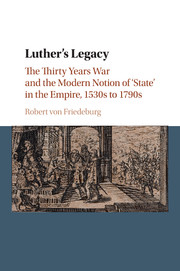
    In this new account of the emergence of a distinctive territorial state in early modern Germany, Robert von Friedeburg examines how the modern notion of state does not rest on the experience of a bureaucratic state-apparatus. It emerged to stabilize monarchy from dynastic insecurity and constrain it to protect the rule of law, subjects, and their lives and property. Against this background, Lutheran and neo-Aristotelian notions on the spiritual and material welfare of subjects dominating German debate interacted with Western European arguments against 'despotism' to protect the lives and property of subjects. The combined result of this interaction under the impact of the Thirty Years War was Seckendorff's Der Deutsche Fürstenstaat (1656), constraining the evil machinations of princes and organizing the detailed administration of life in the tradition of German Policey, and which founded a specifically German notion of the modern state as comprehensive provision of services to its subjects.

    Reviews

    ‘This book offers an original and striking argument about the emergence of the German concept of the State from conflict and dialogue among princes and their subjects amidst the catastrophic circumstances of the Thirty Years War and its immediate aftermath. Friedeburg breaks new ground by shifting the discussion away from the unsteady development of German liberalism and the supposed uncritical and even enthusiastic embrace of monarchism, which allegedly pushed Germany along a deviant ‘special path' away from western democracy and towards Nazism.'

    Peter H. Wilson - University of Hull

    'This work is a tour de force on the development of the modern state in Germany, and a gift for all who are fascinated by the way ideas and passions can transform an empire. It is also a reminder of how voices from the past, and Luther’s in particular, continue to speak to critical issues of injustice today.'

    Brenden Bott Source: Renaissance and Reformation

    'This original interpretation makes the book a major intervention and provides a new way of thinking about the emergence of the state in the German lands.'

    Martin Christ Source: European History Quarterly

    Refine List

    Actions for selected content:

    Select all | Deselect all
    • View selected items
    • Export citations
    • Download PDF (zip)
    • Save to Kindle
    • Save to Dropbox
    • Save to Google Drive

    Save Search

    You can save your searches here and later view and run them again in "My saved searches".

    Please provide a title, maximum of 40 characters.
    ×

    Contents

    Metrics

    Altmetric attention score

    Full text views

    Total number of HTML views: 0
    Total number of PDF views: 0 *
    Loading metrics...

    Book summary page views

    Total views: 0 *
    Loading metrics...

    * Views captured on Cambridge Core between #date#. This data will be updated every 24 hours.

    Usage data cannot currently be displayed.

    Accessibility standard: Unknown

    Why this information is here

    This section outlines the accessibility features of this content - including support for screen readers, full keyboard navigation and high-contrast display options. This may not be relevant for you.

    Accessibility Information

    Accessibility compliance for the PDF of this book is currently unknown and may be updated in the future.
