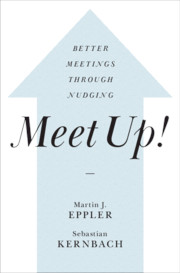
Book contents
Chapter 2 - Background
The Nudging Approach for Meetings
Published online by Cambridge University Press: 29 December 2020

Summary
Quiz question: What do small plates, pink prisons, flies painted on urinals and organ donation all have in common? And what does any of this have to do with meetings?
Well, all four cases are examples of nudging in action and the same mechanism at work here can also turn your meetings into productive meetings. The idea goes like this:
If we use smaller plates, then the portions appear larger and we feel full faster, meaning we eat less. In a US prison whose cells were painted pink, the number of aggressive attacks fell significantly. Since images of flies began appearing on the urinals in men’s toilets at Amsterdam Airport, the floors have been much cleaner (men, it seems, love aiming at something). Similarly, in countries where you are automatically registered as an organ donor and have to opt-out if you do not want to be one, the number of potential donors is much higher than in places where you have to opt-in.
Information
- Type
- Chapter
- Information
- Meet Up!Better Meetings Through Nudging, pp. 9 - 18Publisher: Cambridge University PressPrint publication year: 2021
Accessibility standard: Unknown
Why this information is here
This section outlines the accessibility features of this content - including support for screen readers, full keyboard navigation and high-contrast display options. This may not be relevant for you.Accessibility Information
Accessibility compliance for the HTML of this chapter is currently unknown
and may be updated in the future.