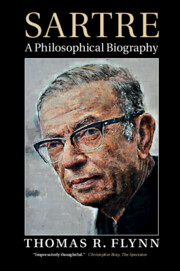
Book contents
- Frontmatter
- Dedication
- Contents
- Preface
- Acknowledgments
- Abbreviations
- 1 The childhood of a genius
- 2 An elite education: student, author, soldier, teacher
- 3 Teaching in the lycée, 1931–1939
- 4 First triumph: The Imagination
- 5 Consciousness as imagination
- 6 The necessity of contingency: Nausea
- 7 The war years, 1939–1944
- 8 Bad faith in human life: Being and Nothingness
- 9 Existentialism: the fruit of liberation
- 10 Ends and means: existential ethics
- 11 Means and ends: political existentialism
- 12 A theory of history: Search for a Method
- 13 Individuals and groups: Critique of Dialectical Reason
- 14 A second ethics?
- 15 Existential biography: Flaubert and others
- Conclusion: the Sartrean imaginary, chastened but indomitable
- Select bibliography
- Index
- References
14 - A second ethics?
Published online by Cambridge University Press: 18 December 2014

Book contents
- Frontmatter
- Dedication
- Contents
- Preface
- Acknowledgments
- Abbreviations
- 1 The childhood of a genius
- 2 An elite education: student, author, soldier, teacher
- 3 Teaching in the lycée, 1931–1939
- 4 First triumph: The Imagination
- 5 Consciousness as imagination
- 6 The necessity of contingency: Nausea
- 7 The war years, 1939–1944
- 8 Bad faith in human life: Being and Nothingness
- 9 Existentialism: the fruit of liberation
- 10 Ends and means: existential ethics
- 11 Means and ends: political existentialism
- 12 A theory of history: Search for a Method
- 13 Individuals and groups: Critique of Dialectical Reason
- 14 A second ethics?
- 15 Existential biography: Flaubert and others
- Conclusion: the Sartrean imaginary, chastened but indomitable
- Select bibliography
- Index
- References
Summary
As we continue our investigation of Sartre’s intellectual life, we must keep in mind that, despite the nearly life-long hovering of ethical concerns over his political commitments and written work, Sartre never produced an ethical theory. Rather, he offered “sketches” for what such a theory might entail, as he did with his Sketch for a Theory of the Emotions in the 1930s. But this was always done in a hypothetical, exploratory manner, and, as in the present case of the “dialectical” ethics, he was willing to pursue lines that did not seem to converge. One might object that a dialectician, a totalizer such as we saw at work in the two previous chapters, should be in search of convergence; that the acceptance of incompatible, if not outright contradictory claims, would be taken as a sign of defeat. But we should remember that this same author described the Hegelian insistence on unity as an implicit appeal to violence. In the case of Sartre’s first ethics, unity was achieved with explicit use of the phenomenological ontology formulated in Being and Nothingness: his ethics of authenticity.
As Sartre’s thought matured and his concept of freedom and responsibility “thickened,” his ethics and politics did so as well. We witnessed his four-year period of fellow-traveling with the French Communist Party – a period of “amoral realism,” as he admitted to his “Maoist” friends. With the help of the dialectical ontology elaborated in the Critique, Sartre developed a social ontology to accommodate his growing sense of socioeconomic conditioning, historical agency and collective responsibility. As we observed above in Chapter 13, this ontology supported an existentialist emphasis on free organic praxis, social wholes both positive and negative, and the practico-inert, which is both freedom’s birthplace and its grave. The historical and its conditions of possibility were missing in Sartre’s earlier attempt, which he set aside as idealist – “an ethic by a writer for writers.”
Information
- Type
- Chapter
- Information
- SartreA Philosophical Biography, pp. 355 - 381Publisher: Cambridge University PressPrint publication year: 2014
References
, “De l’Aliénation Morale à l’Exigence Éthique,” LTM, Témoins de Sartre nos. 531, 532, 533 (Oct.–Dec. 1990): 890
, “An Interview with Jean-Paul Sartre,” trans. George Berger, in Silverman and Elliston (eds.), Sartre. Contemporary Approaches, 233. Recorded Nov. 25, 1976
, Pouvoir et liberté, notebooks set out, presented and annotated by (Paris: Verdier, 2007)Google Scholar
, Une Philosophie de l’ambiguïté: l’existentialisme de Maurice Merleau-Ponty (Louvain: Béatrice-Nauwelaerts, 1967).Google Scholar
, interview with , Oblique nos. 18–19 (1979): 14b
and , “Making the Human in Sartre’s Unpublished Dialectical Ethics,” in (ed.), Sartre and Existentialism, vol. , Existentialist Ethics (New York: Garland, 1997), 274Google Scholar
, “Marxism and Subjectivity,” La Conference de Rome, 1961, ed. Michel Kail, LTM no. 560 (1993), 11–39
, Jean-Paul Sartre und Frantz Fanon: Antirassismus, Antikolonialismus, Politiken der Emanzipation (Vienna: Verlag Turia + Kant, 2012)Google Scholar
, Sartre on Violence: Curiously Ambivalent (University Park: Pennsylvania State University Press, 2003)Google Scholar
, Rethinking Ethics in the Midst of Violence: A Feminist Approach to Freedom (Lanham, MD: Rowman & Littlefield, 1993)Google Scholar
and in their informative and apt essay “The End as Present in the Means in Sartre’s Morality and History,” Sartre Studies International 10, no. 2 (2004): 2–3CrossRefGoogle Scholar
, “La Double posterité de Sartre,” in La Cérémonie de naissance (Paris: Verdier, 2005), 113–119Google Scholar
Accessibility standard: Unknown
Why this information is here
This section outlines the accessibility features of this content - including support for screen readers, full keyboard navigation and high-contrast display options. This may not be relevant for you.Accessibility Information
Accessibility compliance for the PDF of this chapter is currently unknown
and may be updated in the future.