Book contents
- Frontmatter
- Contents
- Foreword
- Preface
- 1 Introduction
- 2 Historical influence of Aristotle on the theory of human reproduction
- 3 Criteria for being a human individual
- 4 Fertilization and the beginning of a human individual
- 5 Implantation and the beginning of the human individual
- 6 The human individual begins after implantation
- Appendixes
- Notes
- Glossary
- Index
Preface
Published online by Cambridge University Press: 03 February 2010
Foreword by
Book contents
- Frontmatter
- Contents
- Foreword
- Preface
- 1 Introduction
- 2 Historical influence of Aristotle on the theory of human reproduction
- 3 Criteria for being a human individual
- 4 Fertilization and the beginning of a human individual
- 5 Implantation and the beginning of the human individual
- 6 The human individual begins after implantation
- Appendixes
- Notes
- Glossary
- Index
Summary
Why did I write this book?
As a lecturer in moral philosophy and in the philosophy of the human person, it has always been important for me to know when a human person begins. In cases of rape it was necessary to know how long after the attack it was morally permissible to attempt to prevent a human embryo originating as a result of violence. This knowledge was crucial in differentiating morally between actions that prevented conception and those whose effect was really abortifacient. It became more pressing for me to be sure of my grounds on this issue once the freezing of human embryos began in some programmes of in vitro fertilization. Community debates in the media on the moral status of the human embryo convinced me of the necessity to inquire further into this question. Living in Melbourne provided the motivation and opportunities to learn the relevant scientific facts of early human embryology for a proper philosophical consideration of the question.
I had always believed, and taught for over 15 years, the commonly held traditional view that a human person begins once the process of fertilization is completed, i.e. once the pronuclei of the sperm and egg mix together. This gives rise to a single-cell human embryo, a zygote, whose genetic individuality and uniqueness remain unchanged during normal development. From that point on, cell divisions and differentiation are programmed for the organization and growth of the same developing human individual already present in the zygote.
Information
- Type
- Chapter
- Information
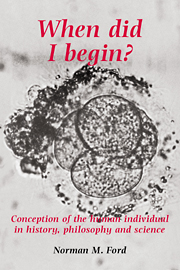
- When Did I Begin?Conception of the Human Individual in History, Philosophy and Science, pp. xi - xxPublisher: Cambridge University PressPrint publication year: 1988
Accessibility standard: Unknown
Why this information is here
This section outlines the accessibility features of this content - including support for screen readers, full keyboard navigation and high-contrast display options. This may not be relevant for you.Accessibility Information
Accessibility compliance for the PDF of this book is currently unknown
and may be updated in the future.