To save content items to your account,
please confirm that you agree to abide by our usage policies.
If this is the first time you use this feature, you will be asked to authorise Cambridge Core to connect with your account.
Find out more about saving content to .
To save content items to your Kindle, first ensure no-reply@cambridge.org
is added to your Approved Personal Document E-mail List under your Personal Document Settings
on the Manage Your Content and Devices page of your Amazon account. Then enter the ‘name’ part
of your Kindle email address below.
Find out more about saving to your Kindle.
Note you can select to save to either the @free.kindle.com or @kindle.com variations.
‘@free.kindle.com’ emails are free but can only be saved to your device when it is connected to wi-fi.
‘@kindle.com’ emails can be delivered even when you are not connected to wi-fi, but note that service fees apply.
Inner-party democracy was one response to growing social tensions and abuses of power. It was pioneered in Sichuan but spread to other provinces, although mostly to the poorer parts of those provinces where local leaders lacked resources to spur economic development. The developed areas along the east coast presented different challenges. More than any other province, Zhejiang developed around the private economy, minimizing the role of the state. Moreover, it was not long before entrepreneurs began forming business associations. This pattern of development suggests that Zhejiang could pioneer a turn toward civil society. Students of civil society have generally looked to various nongovernmental organizations (NGOs) to support their hope that democratizing trends are emerging in China. The emergence of NGOs is certainly an important story in contemporary China, but it is not clear precisely how they are expected to promote democratization: through the cultivation of civic values? Through resistance to the authoritarian state? Through the delegitimization of the state? Through the creation of a public sphere outside the control of the state, which would, in turn, impose constraints on the state and turn it, however incrementally, toward the rule of law and acceptance of citizen participation in political affairs? Furthermore, most students of NGOs do not focus on business associations, perhaps because such associations are thought to be too close to the state; “real” NGOs are presumed to be more independent of, and perhaps hostile to, the state.
However, business associations seem to be likely vehicles for building institutionalized state--society relations in China. Entrepreneurs have an interest in a predictable environment, and curbing the arbitrary actions of local state officials would generally benefit the private sector. In addition, from the state's point of view, entrepreneurs are a benevolent social force, providing the sort of growth that the state is encouraging. Despite debates about admitting entrepreneurs into the party – something that was done surreptitiously at first and then openly under Jiang Zemin's “Three Represents” policy – local political elites and entrepreneurs have accommodated one another quite well. Thus, if there is one social force the state is likely to feel relaxed about, it is the entrepreneurs.
Over the last three decades, a considerable body of English-language academic work has shed much light on Japan's empire-building project in Greater China during the first half of the twentieth century. At the same time, Japanese-language studies of the country's pre-war financial history have also grown in leaps and bounds. Yet, to date, neither body of literature seems to have fully examined what might appear to the naked eye as one of the critical pre-war junctures, where Japanese financial history converged on imperial policy and Chinese nationalist responses thereto.1 This paper will therefore aim to fill part of the gap by examining how the Yokohama Specie Bank, arguably the backbone of Japanese finance in China Proper, was affected by Chinese anti-foreign boycotts throughout the pre-war era (1842–1937).
This paper takes up the project of conceptualizing a new history of food in India through an exploration of conversations about food, digestion, desire, and embodiment that took place in Hindi-language publications in early-twentieth century North India. Through an exploration of cookbooks, guides to health and wellness, and food advertising spanning the 1920s to the 1940s, conversations about food preparation, consumption, and distribution come to be revealed as significant anchors of historical, political, economic, and cultural debates about the Indian nation in this period. The centrality of food to conversations that took up the reproduction and regeneration of the Hindu middle class helped to conceptualize an idealized Indian nation[A]. Subsequently, the focus on food advertising imagined the transformation of these citizens into consumers. Moving beyond the colonial fascination with native bodies and tropical constitutions, this paper demonstrates the ways in which the conversations that emerged out of a focus on food in popular culture did the work of envisioning new possibilities for post-colonial embodiment.
Most scholarly works on exhibitionary practices of the nineteenth and twentieth centuries have focused on the meaning and importance of display, and the cultural bases, and indeed biases, that supported various inclusions and exclusions. The exhibition has usually formed part of a larger narrative of new rituals that were enacted in the modern period to serve, variously, imperial, market or patriotic objectives. Can the persistence with which the Princely Mysore state organized its Dasara Exhibition from 1907 until well after independence be understood solely within these frames? In both its choice of location and its timing, the Dasara Exhibition was organized with dogged insistence, despite its obvious failures. This can only be understood in relation to the larger changes that were envisaged for the economy of the region, as the state attempted to build a supplement, even an alternative, to the princely splendour and pomp that was on conspicuous display. This paper looks at the subtle changes and shifts that occurred during the first half of the twentieth century in exhibitionary practices as they related to both real and envisaged changes within the economy that the Mysore bureaucracy was obliged to bring into being.
The objective of this article is to survey the abundance of primary source electronic data, and appropriate methods, which could be used to advance the study of elite politics in Taiwan. Research on public attitudes and voting behaviour has benefited enormously from open scholarly access to systematically collected, reliable data resources. Research on elite political behaviour in Taiwan could similarly benefit from the creation of supplementary datasets derived from electronic primary sources. I argue that the primary resources and methods needed are already in place, for instance, to produce quantitative estimates of the policy preferences and ideological positions of parties and individual political actors over time. A variety of political texts created by political actors at all levels of office (and indeed, in opposition) are readily accessible online. With a small degree of processing, these electronic texts can easily be rendered in machine-readable format for analysis by means of computer-assisted content analysis software. Despite successes in other contexts, these data and methods are currently underutilized in studies of elite political behaviour in Taiwan.
This paper compares the key arguments of ecological modernization theory (EMT) with the reality of recent environmental reform in China. Based on data gathered from a survey and in-depth interviews with executives from Hong Kong-based enterprises operating in Guangdong province, we examine the changing roles of government, market, and civil society actors in the reform process, focusing on various types of pressures these actors have exerted on business enterprises. Compatible with Mol's (2006) conjectures, ecological concerns have gradually gained a foothold in existing political, economic, and to a lesser extent, social institutions. Yet, the relevant actors and their patterns of interactions differ from what EMT generalizes from Western European experiences. Specifically, local governments are assuming a more formalized relationship with firms in regulatory enforcement. Among market actors, organizational buyers along the supply chain have exerted more noticeable pressures on manufacturing firms than industrial associations and individual consumers. Civil society, while remaining less of an institutionalized actor in the environmental policy process, appears to pose a perceptible threat to at least some firms.
The late-nineteenth century in India, usually scrutinized for the emergence of anti-colonial nationalist thought and politics, witnessed broader, and potentially more radical changes in the making and re-making of political subjectivities as articulated within burgeoning vernacular public spheres. Vernacular publics coalesced around the emergence of new communicative forms, the formation of voluntary and political associations, and the restructuring of literary communities. It is within this context I place the writings of Gidugu Venkata Ramamurti (1863–1940). He proclaimed at the turn of the twentieth century that Telugu as a language had to be reformed in order for it to become an appropriate medium for the newly emergent Telugu public spheres. Through his study of linguistics, his commitment to educational reform, and his study of Telugu language and literature, Ramamurti became the spokesperson for a new Telugu that would be able to traverse the boundaries of modern genres of writing that flourished in the colonial era. Fully immersed in linguistic theories of the day, Ramamurti's concerns were primarily with language reform and its centrality in the remaking of political subjectivities.
‘In this era there is an important challenge facing us. There is no Telugu word for ‘challenge,’ nevertheless, the word, ‘dhikaaramu’ or defiance, comes close. For that reason, I am calling this era, ‘dhikaara yugamu,’ the age of defiance. In the past, society was divided between free people and the enslaved. Soon, the enslaved defied the power of the free and freed themselves. In the past, women were not allowed to be educated nor were they allowed to work. Now they are asking themselves why they were not considered more productive in society? These days, women are performing all kinds of work. . . .Until recently, in most countries the wealthy held power. And now the poor are challenging the power of the rich’.1
In 1914, the Indian Army was deployed against the enemies of the British Empire. This paper analyses the administrative mechanism as well as the imperial assumptions and attitudes which shaped the recruitment policy of the Indian Army during the First World War. From the late nineteenth century, the Martial Race theory (a bundle of contradictory ideas) shaped the recruitment policy. With certain modifications, this theory remained operational to the first decade of the twentieth century. The construction of the ‘martial races’ enabled the British to play-off different communities against each other to prevent the emergence of a unified anti-British sentiment among the colonized. During the Great War, faced with the rising demands of manpower, the army was forced to modify the Martial Race theory. However, a conscript army did not emerge in British-India. This was due to imperial policies, the inherent social divisions of Indian society, and because the demands for military manpower remained relatively low in comparison to India's demographic resources. Due to innovations in the theory and praxis of recruitment, the volume of recruitment showed a linear increase from 1914 to 1918, with maximum intensification of recruitment occurring during 1917 and 1918. But as the war ended in November 1918, despite the entry of several new communities, the bulk of the Indian Army still came from the traditional martial races.
In Chinese public discourse, it has almost become a truism that the generation born after the mid-1980s is more selfish, individualistic, and materialistic than previous generations. Consequently, an important task for public moral education is to correct this behaviour and to generate compassion for others beyond the family, to strengthen nationalist sentiments and to imbue a sense of duty to the greater community. Schools provide the Chinese government with a key opportunity to achieve this. Based on fieldwork in a rural high school in China, this article demonstrates how the official visions of the learned individual portrayed in textbooks collide with a more powerful ideology of individualism that is implicitly promoted through activities within the school, and is reflective of an ongoing process of individualization, not only in Chinese society, but also within state institutions, such as the school.
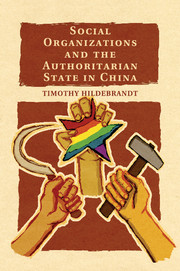
Received wisdom suggests that social organizations (such as non-government organizations, NGOs) have the power to upend the political status quo. However, in many authoritarian contexts, such as China, NGO emergence has not resulted in this expected regime change. In this book, Timothy Hildebrandt shows how NGOs adapt to the changing interests of central and local governments, working in service of the state to address social problems. In doing so, the nature of NGO emergence in China effectively strengthens the state, rather than weakens it. This book offers a groundbreaking comparative analysis of Chinese social organizations across the country in three different issue areas: environmental protection, HIV/AIDS prevention, and gay and lesbian rights. It suggests a new way of thinking about state-society relations in authoritarian countries, one that is distinctly co-dependent in nature: governments require the assistance of NGOs to govern while NGOs need governments to extend political, economic and personal opportunities to exist.
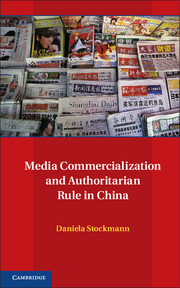
In most liberal democracies commercialized media is taken for granted, but in many authoritarian regimes the introduction of market forces in the media represents a radical break from the past with uncertain political and social implications. In Media Commercialization and Authoritarian Rule in China, Daniela Stockmann argues that the consequences of media marketization depend on the institutional design of the state. In one-party regimes such as China, market-based media promote regime stability rather than destabilizing authoritarianism or bringing about democracy. By analyzing the Chinese media, Stockmann ties trends of market liberalism in China to other authoritarian regimes in the Middle East, North Africa, sub-Saharan Africa and the post-Soviet region. Drawing on in-depth interviews with Chinese journalists and propaganda officials as well as more than 2000 newspaper articles, experiments and public opinion data sets, this book links censorship among journalists with patterns of media consumption and the media's effects on public opinion.
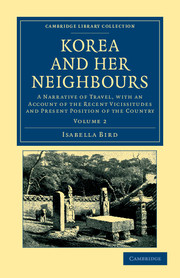
Isabella Bird (Mrs Bishop, 1831–1904) was recommended an open-air life from an early age as a cure for her physical and nervous difficulties. Her accounts of travel in America, Hawaii, Japan and Persia were best-sellers. This two-volume work, first published in 1898, was one of the books arising from Bird's visit to Korea and China between 1894 and 1897, the other being The Yangtse Valley and Beyond (1899), also available in this series. Korea was a battleground during the Sino-Japanese War of 1894–5, and subsequently became increasingly dominated by Japan, being annexed fully in 1910. Bird provides vivid descriptions of the Korean people, their way of life and customs at a time when the country had only recently opened up to the West. In Volume 2 she visits the Russian frontier, where many Koreans had settled, and discusses the effectiveness of Christian missionaries.
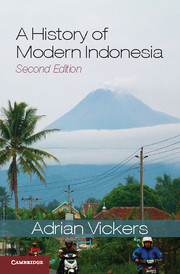
Since the Bali bombings of 2002 and the rise of political Islam, Indonesia has frequently occupied media headlines. Nevertheless, the history of the fourth largest country on earth remains relatively unknown. Adrian Vickers' book, first published in 2005, traces the history of an island country, comprising some 240 million people, from the colonial period through revolution and independence to the present. Framed around the life story of Pramoedya Ananta Toer, Indonesia's most famous and controversial novelist and playwright, the book journeys through the social and cultural mores of Indonesian society, focusing on the experiences of ordinary people. In this new edition, the author brings the story up to date, revisiting his argument as to why Indonesia has yet to realise its potential as a democratic country. He also examines the rise of fundamentalist Islam, which has haunted Indonesia since the fall of Suharto.
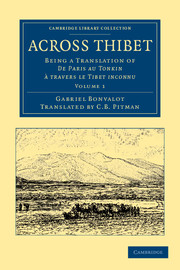
The French explorer, author and legislator Gabriel Bonvalot (1853–1933) travelled widely in Central Asia in the 1880s. This two-volume English translation by C. B. Pitman of the 1889–90 French original was published in 1891. It describes Bonvalot's expedition across Europe and Asia to French Indochina. Accompanied by Prince Henri d'Orléans whose father, the Duc of Chartres, financed the expedition, Bonvalot left Paris in July 1889. In Volume 1, the expedition crosses first Russia and then Siberia, making its way south to Tibet. The obstacles encountered are considerable, with temperatures reaching 40 degrees below zero (Bonvalot describes how the fat that the expedition eats for butter is so hard that it may be 'used as a projectile') and altitude sickness affecting many of the party. The volume ends as the party enters Tibet, but without being certain exactly where they are.
Clarke Abel (c.1780–1825) was Chief Medical Officer accompanying Lord Amherst's unsuccessful diplomatic embassy to China in 1816. Encouraged by Sir Joseph Banks, he acted as official naturalist to the expedition, which penetrated further into China than had been possible for previous western visitors. Although most of his large collection of botanical and mineralogical specimens was lost during the return voyage, survivals included several new species, some of which were named after him. This work, published in 1818, made Abel's reputation, and he was elected to the Royal Society the following year. His geological survey of the Cape of Good Hope, studied on the outward journey, is particularly impressive. Abel's account of Chinese society and culture is an important record of a country which was then largely inaccessible to Europeans. An appendix by Robert Brown (Banks' botanist) lists the specimens that survived the shipwreck, which is itself dramatically described.
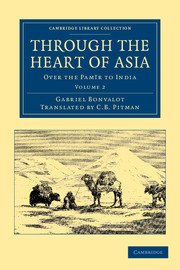
The French explorer, author and legislator Gabriel Bonvalot (1853–1933) received funding from the French government to lead two expeditions to Central Asia in the 1880s. This two-volume English translation by C. B. Pitman of the French original was published in 1889 and is a richly illustrated account of the second of the two Asian expeditions, in which Bonvalot and the scientist Guillaume Capus attempted to enter Afghanistan. Although the party was detained and sent back to Samarkand upon entering Afghanistan, they refused to concede defeat, as Bonvalot was determined to reach India via a trail believed to run across the Pamir and Hindu Kush mountains. In Volume 2 the party reaches the remote Kingdom of Chatral, but is imprisoned again. Bonvalot uses the confinement to study the customs of the local people, and eventually, with the help of the British authorities, they are released and allowed to continue to India.
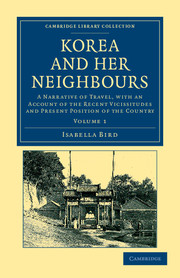
Isabella Bird (Mrs Bishop, 1831–1904) was recommended an open-air life from an early age as a cure for her physical and nervous difficulties. Her accounts of travel in America, Hawaii, Japan and Persia were best-sellers. This two-volume work, first published in 1898, was one of the books arising from Bird's visit to Korea and China between 1894 and 1897, the other being The Yangtse Valley and Beyond (1899), also available in this series. Korea was a battleground during the Sino-Japanese War of 1894–5, and subsequently became increasingly dominated by Japan, being annexed fully in 1910. Bird provides vivid descriptions of the Korean people, their way of life and customs at a time when the country had only recently opened up to the West. In Volume 1 she gives her first impressions of Seoul, and travels down the Han river, commenting especially on the lowly position of women.
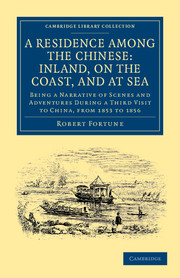
China was still largely alien territory for westerners in the mid-nineteenth century. In this book, first published in 1857, Robert Fortune (1813–80) describes his third visit there, but despite his relative familiarity with the country, his account is full of strange and bizarre sights and happenings. Beginning in Shanghai, where he was sent to collect tea samples for the East India Company, he describes an earthquake and the myths of its aftermath, along with his fears of becoming embroiled in the Taiping Rebellion. A keen botanist and entomologist in his own right, he also collected insects (a pastime that led him to become a figure of great hilarity among the locals) and explored the flora of the north. His account of his three-year expedition offers a glimpse of the Chinese language and culture through the lens of Victorian expectations, and is a fascinating resource for students and the general reader.