Refine search
Actions for selected content:
125517 results in Asian Studies
Economic Thought in Early Modern Japan. Edited by Bettina Gramlich-Oka and Gregory Smits. Leiden: Brill, 2010. Pp. xxii + 298. ISBN 10: 9004183833; 13: 9789004183834.
-
- Journal:
- International Journal of Asian Studies / Volume 10 / Issue 1 / January 2013
- Published online by Cambridge University Press:
- 18 January 2013, pp. 108-110
-
- Article
- Export citation
Carpets and Textiles in the Iranian World 1400–1700. Edited by Jon Thompson, Daniel Shaffer and Pirjetta Mildh. Oxford and Genoa: The May Beattie Archive at the Ashmolean Museum, University of Oxford, 2010. Pp. 260. ISBN 10: 1898113696; 13: 9781898113690.
-
- Journal:
- International Journal of Asian Studies / Volume 10 / Issue 1 / January 2013
- Published online by Cambridge University Press:
- 18 January 2013, pp. 94-96
-
- Article
- Export citation
CULTURAL CONSTRUCTION AND A NEW ETHNIC GROUP MOVEMENT: THE CASE OF THE SAKIZAYA IN EASTERN TAIWAN
-
- Journal:
- International Journal of Asian Studies / Volume 10 / Issue 1 / January 2013
- Published online by Cambridge University Press:
- 18 January 2013, pp. 47-71
-
- Article
- Export citation
EXILED TO THE ANCESTRAL LAND: THE RESETTLEMENT, STRATIFICATION AND ASSIMILATION OF THE REFUGEES FROM VIETNAM IN CHINA
-
- Journal:
- International Journal of Asian Studies / Volume 10 / Issue 1 / January 2013
- Published online by Cambridge University Press:
- 18 January 2013, pp. 25-46
-
- Article
- Export citation
TRANSFORMATIONS OF THĂNG LONG: SPACE AND TIME, POWER AND BELIEF
-
- Journal:
- International Journal of Asian Studies / Volume 10 / Issue 1 / January 2013
- Published online by Cambridge University Press:
- 18 January 2013, pp. 1-24
-
- Article
- Export citation
From the Indian Ocean to the Mediterranean: The Global Networks of Armenian Merchants from New Julfa. By Sebouh David Aslanian. Berkeley: University of California Press, 2011. Pp. 363. ISBN 10: 0520266870; 13: 9780520266872.
-
- Journal:
- International Journal of Asian Studies / Volume 10 / Issue 1 / January 2013
- Published online by Cambridge University Press:
- 18 January 2013, pp. 96-98
-
- Article
- Export citation
ASI volume 10 issue 1 Cover and Front matter
-
- Journal:
- International Journal of Asian Studies / Volume 10 / Issue 1 / January 2013
- Published online by Cambridge University Press:
- 18 January 2013, pp. f1-f4
-
- Article
-
- You have access
- Export citation
Brokers of Empire: Japanese Settler Colonialism in Korea, 1876–1945. By Jun Uchida. Cambridge, Mass.: Harvard University Asia Center, 2011. Pp. 481. ISBN 10: 080144926X; 13: 978-0801449260.
-
- Journal:
- International Journal of Asian Studies / Volume 10 / Issue 1 / January 2013
- Published online by Cambridge University Press:
- 18 January 2013, pp. 112-113
-
- Article
- Export citation
WAR, CAPITAL, AND WAGES: A NEW ECONOMIC THEORY OF “THE GREAT DIVERGENCE”
-
- Journal:
- International Journal of Asian Studies / Volume 10 / Issue 1 / January 2013
- Published online by Cambridge University Press:
- 18 January 2013, pp. 73-83
-
- Article
- Export citation
Early Interactions between South and Southeast Asia: Reflections on Cross-Cultural Exchange. Edited by Pierre-Yves Manguin, A. Mani, and Geoff Wade. Singapore: ISEAS Publishing, Institute of Southeast Asian Studies, 2011. Pp. xxxi + 514. ISBN 10: 9814345105; 13: 9789814345101.
-
- Journal:
- International Journal of Asian Studies / Volume 10 / Issue 1 / January 2013
- Published online by Cambridge University Press:
- 18 January 2013, pp. 87-90
-
- Article
- Export citation
Kumārila on Truth, Omniscience and Killing. A Critical Edition of Mīmāṃsā-Ślokavārttika ad 1.1.2 (Codanāsūtra). By Kei Kataoka. Vienna: Verlag der Österreichischen Akademie der Wissenschaften, 2011. Pp. xlvi + 97 (Part 1); 627 (Part 2). ISBN 10: 3700170017; 13: 9783700170013.
-
- Journal:
- International Journal of Asian Studies / Volume 10 / Issue 1 / January 2013
- Published online by Cambridge University Press:
- 18 January 2013, pp. 90-94
-
- Article
- Export citation
Planning for Empire: Reform Bureaucrats and the Japanese Wartime State. By Janis Mimura. Ithaca, N.Y.: Cornell University Press, 2011. Pp. 240. ISBN 10: 080144926X; 13: 978-0801449260.
-
- Journal:
- International Journal of Asian Studies / Volume 10 / Issue 1 / January 2013
- Published online by Cambridge University Press:
- 18 January 2013, pp. 110-111
-
- Article
- Export citation
Palmer and Company: an Indian Banking Firm in Hyderabad State
-
- Journal:
- Modern Asian Studies / Volume 47 / Issue 4 / July 2013
- Published online by Cambridge University Press:
- 16 January 2013, pp. 1157-1184
-
- Article
- Export citation
Remaking the past: Tamil sacred landscape and temple renovations
-
- Journal:
- Bulletin of the School of Oriental and African Studies / Volume 76 / Issue 1 / February 2013
- Published online by Cambridge University Press:
- 15 January 2013, pp. 21-47
- Print publication:
- February 2013
-
- Article
- Export citation
ASS volume 47 issue 1 Cover and Back matter
-
- Journal:
- Modern Asian Studies / Volume 47 / Issue 1 / January 2013
- Published online by Cambridge University Press:
- 10 January 2013, pp. b1-b2
-
- Article
-
- You have access
- Export citation
ASS volume 47 issue 1 Cover and Front matter
-
- Journal:
- Modern Asian Studies / Volume 47 / Issue 1 / January 2013
- Published online by Cambridge University Press:
- 10 January 2013, pp. f1-f2
-
- Article
-
- You have access
- Export citation
Mr Upjohn's Debts: Money and friendship in early colonial Calcutta
-
- Journal:
- Modern Asian Studies / Volume 47 / Issue 4 / July 2013
- Published online by Cambridge University Press:
- 09 January 2013, pp. 1185-1217
-
- Article
- Export citation
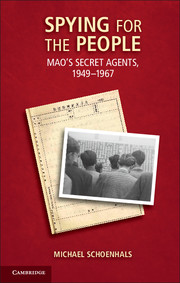
Spying for the People
- Mao's Secret Agents, 1949–1967
-
- Published online:
- 05 January 2013
- Print publication:
- 18 February 2013

Coming of Age in Nineteenth-Century India
- The Girl-Child and the Art of Playfulness
-
- Published online:
- 05 January 2013
- Print publication:
- 18 February 2013
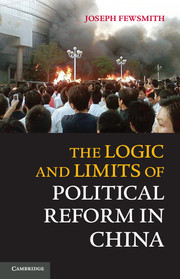
The Logic and Limits of Political Reform in China
-
- Published online:
- 05 January 2013
- Print publication:
- 18 February 2013
