To save content items to your account,
please confirm that you agree to abide by our usage policies.
If this is the first time you use this feature, you will be asked to authorise Cambridge Core to connect with your account.
Find out more about saving content to .
To save content items to your Kindle, first ensure no-reply@cambridge.org
is added to your Approved Personal Document E-mail List under your Personal Document Settings
on the Manage Your Content and Devices page of your Amazon account. Then enter the ‘name’ part
of your Kindle email address below.
Find out more about saving to your Kindle.
Note you can select to save to either the @free.kindle.com or @kindle.com variations.
‘@free.kindle.com’ emails are free but can only be saved to your device when it is connected to wi-fi.
‘@kindle.com’ emails can be delivered even when you are not connected to wi-fi, but note that service fees apply.
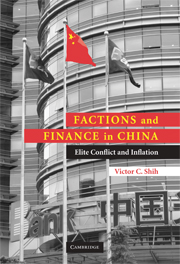
The contemporary Chinese financial system encapsulates two possible futures for China's economy. On the one hand, extremely rapid financial deepening accompanied by relatively stable prices are both manifestations of a vigorous growth trajectory that will one day make China the world's largest economy. On the other hand, the colossal store of non-performing loans in the banking sector augurs a troubling future. Factions and Finance in China inquires how elite factional politics has given rise to both of these outcomes since the reform in 1978. The competition between generalists in the Chinese Communist Party and politically engaged technocrats over monetary policies has time and time again prevented inflation from spinning out of control. Shih shows that elite politics has exerted a profound impact on monetary policies and banking institutions in contemporary China.
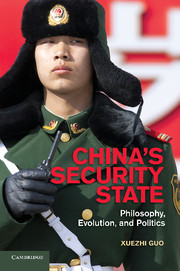
China's Security State describes the creation, evolution, and development of Chinese security and intelligence agencies as well as their role in influencing Chinese Communist Party politics throughout the party's history. Xuezhi Guo investigates patterns of leadership politics from the vantage point of security and intelligence organization and operation by providing new evidence and offering alternative interpretations of major events throughout Chinese Communist Party history. This analysis promotes a better understanding of the CCP's mechanisms for control over both Party members and the general population. This study specifies some of the broader implications for theory and research that can help clarify the nature of Chinese politics and potential future developments in the country's security and intelligence services.
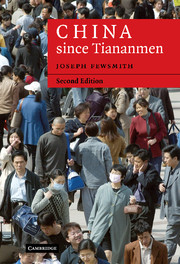
In this edition of his path-breaking analysis of political and social change in China since the crackdown in Tiananmen Square in 1989, Joseph Fewsmith traces developments since 2001. These include the continuing reforms during the final years of Jiang Zemin's premiership and Hu Jintao's succession in 2002. Here the author also considers social trends and how Chinese citizens are starting to have a significant influence on government policies. As Fewsmith - a highly regarded political scientist and a seasoned China-watcher - observes, China is a very different place since Tiananmen Square. In the interim, it has emerged from isolation to become one of the most significant players on the world stage. This book explains the forces that have shaped China since Tiananmen.
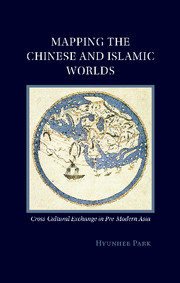
Long before Vasco da Gama rounded the Cape of Good Hope en route to India, the peoples of Africa, the Middle East, and Asia engaged in vigorous cross-cultural exchanges across the Indian Ocean. This book focuses on the years 700 to 1500, a period when powerful dynasties governed both regions, to document the relationship between the Islamic and Chinese worlds before the arrival of the Europeans. Through a close analysis of the maps, geographic accounts, and travelogues compiled by both Chinese and Islamic writers, the book traces the development of major contacts between people in China and the Islamic world and explores their interactions on matters as varied as diplomacy, commerce, mutual understanding, world geography, navigation, shipbuilding, and scientific exploration. When the Mongols ruled both China and Iran in the thirteenth and fourteenth centuries, their geographic understanding of each other's society increased markedly. This rich, engaging, and pioneering study offers glimpses into the worlds of Asian geographers and mapmakers, whose accumulated wisdom underpinned the celebrated voyages of European explorers like Vasco da Gama.
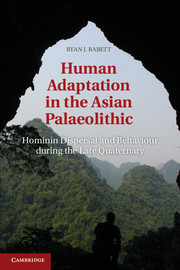
This book examines the first human colonization of Asia and particularly the tropical environments of Southeast Asia during the Upper Pleistocene. In studying the unique character of the Asian archaeological record, it reassesses long-accepted propositions about the development of human 'modernity.' Ryan J. Rabett reveals an evolutionary relationship between colonization, the challenges encountered during this process – especially in relation to climatic and environmental change – and the forms of behaviour that emerged. This book argues that human modernity is not something achieved in the remote past in one part of the world, but rather is a diverse, flexible, responsive and ongoing process of adaptation.
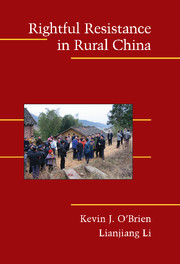
How can the poor and weak 'work' a political system to their advantage? Drawing mainly on interviews and surveys in rural China, Kevin O'Brien and Lianjiang Li show that popular action often hinges on locating and exploiting divisions within the state. Otherwise powerless people use the rhetoric and commitments of the central government to try to fight misconduct by local officials, open up clogged channels of participation, and push back the frontiers of the permissible. This 'rightful resistance' has far-reaching implications for our understanding of contentious politics. As O'Brien and Li explore the origins, dynamics, and consequences of rightful resistance, they highlight similarities between collective action in places as varied as China, the former East Germany, and the United States, while suggesting how Chinese experiences speak to issues such as opportunities to protest, claims radicalization, tactical innovation, and the outcomes of contention.
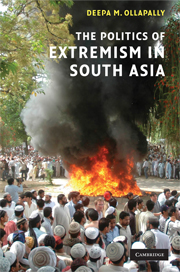
South Asia is home to a range of extremist groups from the jihadists of Pakistan to the Tamil Tigers of Sri Lanka. In the popular mind, extremism and terrorism are invariably linked to ethnic and religious factors. Yet the dominant history of South Asia is notable for tolerance and co-existence, despite highly plural societies. Deepa Ollapally examines extremist groups in Kashmir, Afghanistan, Northeast India, Pakistan, Bangladesh, and Sri Lanka to offer a fresh perspective on the causes of extremism. What accounts for its rise in societies not historically predisposed to extremism? What determines the winners and losers in the identity struggles in South Asia? What tips the balance between more moderate versus extremist outcomes? The book argues that politics, inter-state and international relations often play a more important role in the rise of extremism in South Asia than religious identity, poverty, and state repression.
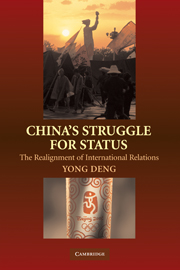
At the end of the Cold War the People's Republic of China found itself in an international crisis, facing severe problems in both domestic politics and foreign policy. Nearly two decades later, Yong Deng provides an original account of China's remarkable rise from the periphery to the center stage of the post-Cold War world. Deng examines how the once beleaguered country has adapted to, and proactively realigned, the international hierarchy, great-power politics, and its regional and global environment in order to carve out an international path within the globalized world. Creatively engaging with mainstream international relations theories and drawing extensively from original Chinese material, this is a well-grounded assessment of the promises and challenges of China's struggle to manage the interlacing of its domestic and international transitions and the interactive process between its rise and evolving world politics.
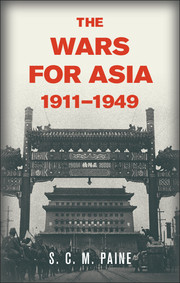
The Wars for Asia, 1911–1949 shows that the Western treatment of World War II, the Second Sino-Japanese War and the Chinese Civil War as separate events misrepresents their overlapping connections and causes. The Chinese Civil War precipitated a long regional war between China and Japan that went global in 1941 when the Chinese found themselves fighting a civil war within a regional war within an overarching global war. The global war that consumed Western attentions resulted from Japan's peripheral strategy to cut foreign aid to China by attacking Pearl Harbour and Western interests throughout the Pacific in 1941. S. C. M. Paine emphasizes the fears and ambitions of Japan, China and Russia, and the pivotal decisions that set them on a collision course in the 1920s and 1930s. The resulting wars together yielded a viscerally anti-Japanese and unified Communist China, the still-angry rising power of the early twenty-first century.
Reginald J. Farrer (1880–1920) was a traveller and plant collector who was an important influence on horticultural style in England. In 1902 he embarked on an expedition to Asia, where he was inspired by the rock gardens of Tokyo, Yokohama and Beijing, and discovered plant species such as Clematis macropetala, and the eponymous Geranium farreri and Viburnum farreri, which are now common in European gardens. In his first book, published in 1904, he records his experiences in Japan and other Asian countries, vividly recounting his impressions of, and his passion for, eastern landscape, terrain, plantations, forestry and flora, of which the aesthetic characteristics became central to the rockeries and shrubberies he created on his return home. Farrer died while on an expedition at the early age of forty, but the legacy of his highly influential writings and his wide-ranging plant introductions remains significant today.
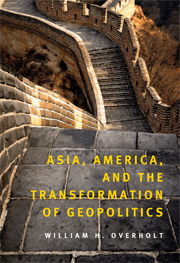
American security and prosperity now depend on Asia. William H. Overholt offers an iconoclastic analysis of developments in each major Asian country, Asian international relations, and US foreign policy. Drawing on decades of political and business experience, he argues that obsolete Cold War attitudes tie the US increasingly to an otherwise isolated Japan and obscure the reality that a US-Chinese bicondominium now manages most Asian issues. Military priorities risk polarizing the region unnecessarily, weaken the economic relationships that engendered American preeminence, and ironically enhance Chinese influence. As a result, US influence in Asia is declining. Overholt disputes the argument that democracy promotion will lead to superior development and peace, and forecasts a new era in which Asian geopolitics could take a drastically different shape. Covering Japan, China, Russia, Central Asia, India, Pakistan, Korea, and South-East Asia, Overholt offers invaluable insights for scholars, policy-makers, business people, and general readers.
Chinese is spoken by more people than any other language in the world, and has a rich social, cultural and historical background. This book is a comprehensive guide to the linguistic structure of Chinese, providing an accessible introduction to each of the key areas. It describes the fundamentals of its writing system, its pronunciation and tonal sound system, its morphology (how words are structured), and its syntax (how sentences are formed) - as well as its historical development, and the diverse ways in which it interacts with other languages. Setting the discussion of all aspects of Chinese firmly within the context of the language in use, Chinese: A Linguistic Introduction will be of great benefit to learners wishing to extend their knowledge and competence in the language, and their teachers. It will also be a useful starting point for students of linguistics beginning work on the structure of this major world language.
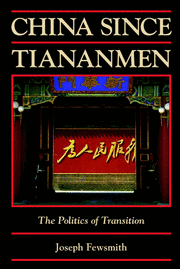
China Since Tiananmen is the first book to look comprehensively at the intellectual and political trends in the decade since the Tiananmen Incident (1989) to assess the ways in which China has changed. Fewsmith looks on the one hand at the intellectual critique of the enlightenment tradition, which had previously held a sacrosanct position in the thinking of liberal intellectuals since the May Fourth Movement of 1919, to explain the rise of neo-conservatism and nationalism over the past decade. On the other hand, he examines the maneuverings of elite political actors to understand the constraints they operate under and how the conduct of elite politics has changed since Tiananmen. Together, these two approaches give a more comprehensive and realistic assessment of the forces that drive China today. These trends are of great importance for anyone trying to understand Sino-US relations.
This essay challenges the widely held view of the CCP's purported “resilient authoritarianism,” which asserts that China's one-party political system is able to enhance the state capacity to govern effectively through institutional adaptations and policy adjustments. An analysis of the recent and still unfolding Bo Xilai crisis reveals the flaws in China's political system, including nepotism and patron–client ties in the selection of leaders, rampant corruption, the growing oligarchic power of state-owned enterprises, elites' contempt for the law and the potential failure to broker deals between competing factions in the Party leadership. The essay argues that the CCP's “authoritarian resilience” is a stagnant system, both conceptually and empirically, because it resists much-needed democratic changes in the country. The problems of the resilient authoritarianism thesis is traceable to the monolithic conceptualizing of China – the failure to appreciate seemingly paradoxical transformative trends in the country, which this essay characterizes as three paralleled developments, namely, 1) weak leaders, strong factions; 2) weak government, strong interest groups; and 3) weak Party, strong country. One should not confuse China's national resilience (in terms of the emerging middle class, new interest group politics, and dynamic society) with the CCP's capacity and legitimacy to rule the country. The essay concludes that if the CCP intends to regain the public's confidence and avoid a bottom-up revolution, it must abandon the notion of “authoritarian resilience” and embrace a systematic democratic transition with bold steps towards intra-Party elections, judicial independence and a gradual opening of the mainstream media.
In contrast to its decentralized political economy model of the 1980s, China took a surprising turn towards recentralization in the mid-1990s. Its fiscal centralization, starting with the 1994 tax reforms, is well known, but political recentralization also has been under way to control cadres directly at township and village levels. Little-noticed measures designed to tighten administrative and fiscal regulation began to be implemented during approximately the same period in the mid-1990s. Over time these measures have succeeded in hollowing out the power of village and township cadres. The increasing reach of the central state is the direct result of explicit state policies that have taken power over economic resources that were once under the control of village and township cadres. This article examines the broad shift towards recentralization by examining the fiscal and political consequences of these policies at the village and township levels. Evidence for this shift comes from new survey data on village-level investments, administrative regulation and fiscal oversight, as well as township-level fiscal revenues, expenditures, transfers (between counties and townships) and public-goods investments.