To save content items to your account,
please confirm that you agree to abide by our usage policies.
If this is the first time you use this feature, you will be asked to authorise Cambridge Core to connect with your account.
Find out more about saving content to .
To save content items to your Kindle, first ensure no-reply@cambridge.org
is added to your Approved Personal Document E-mail List under your Personal Document Settings
on the Manage Your Content and Devices page of your Amazon account. Then enter the ‘name’ part
of your Kindle email address below.
Find out more about saving to your Kindle.
Note you can select to save to either the @free.kindle.com or @kindle.com variations.
‘@free.kindle.com’ emails are free but can only be saved to your device when it is connected to wi-fi.
‘@kindle.com’ emails can be delivered even when you are not connected to wi-fi, but note that service fees apply.
The “what” is in constant flux, the “why” has a thousand variations.
Marcus Aurelius, Meditations
All civilizations seek to understand what awesome forces, rules, or laws drove the sequence of events from which the physical world materialized. By whom or by what canon is an entire universe created? In what language must the story be told? Can all of the questions ever be answered?
Leon M. Lederman, Nobel Laureate, Symmetry and the Beautiful Universe
All of the key concepts we will look at this chapter – Dao, qi, and Taiji, as well as the system of the Yi – remained at the core of Chinese metaphysics. They were used in a variety of ways to construct metaphysical systems of varying complexity, particularly through and in response to encounters with Buddhist philosophy.
The Huangdi Neijing (The Yellow Emperor’s Inner Classic) offers the most comprehensive definition of yinyang:
The Yellow Emperor claims that yinyang is the Dao of heaven and earth, the net (gangji 綱紀) of the ten thousand things, the parent (fumu父母) of transformations, the origin (benshi 本始) of life and death, and the residence (fu 府) of spirit and insight. To heal illness one must seek in this root.
In this passage, yinyang is taken as a pattern embedded in the nature of all beings, thus providing the foundation for a coherent view of the world. This worldview weaves together human beings, heaven, and the Dao 道 (the way) in a way that creates a reality of dynamic wholeness pervaded by and mediated through the interaction of yin and yang. That is why yinyang is called the “net” (gangji) of the ten thousand things. The term gangji comes from the image of silk fabric. Gang 綱 is the main strand to which all other threads are attached, whereas ji 紀 represents the mesh of the other threads. Together, they show that the ten thousand things are tied to an interrelated net or web through yinyang. This chapter will explore this gangji through four of the most significant concepts in Chinese cosmology: Dao (the way), qi 氣 (vital energy), yi 易 (change/ease/constancy), and taiji 太極 (great ultimate).
In 1772, determined at last to put an end to the chaos and fiscal disorder its intervention had precipitated in Bengal, the Company's directors appointed Warren Hastings, a man with a distinguished record of diplomatic and commercial service in India, as the first governor-general of the company's Indian territories. Subordinating the other presidencies to a new capital established in Calcutta, Hastings set about the task of creating an ordered system of government for British India. Hastings's thirteen years at the helm of government were far from untroubled. Indeed, throughout his years in office he had to contend with a divided council in Calcutta whose majority opposed his every move, while after his return to England his actions were made the subject of an embittered impeachment trial in the House of Commons. As a spectacle, for Hastings was ultimately acquitted, the trial dominated British public life for years. Nevertheless, Hastings laid an enduring foundation for the British Raj in India. This chapter will begin by examining the structures of governance established by Hastings, and his successor Lord Cornwallis (1785–93), in British-ruled Bengal. It will then ask how and why the British went on to conquer the entire Indian subcontinent in the first two decades of the nineteenth century, and it will conclude by assessing the relationships that grew up between what was known as the ‘Company Bahadur’, as though it were a Mughal grandee, and its Indian subjects in the years up to 1850.
Foundation of Colonial Rule
When Hastings took office, the East India Company's agents knew nothing about India apart from the requirements of trade, and they almost never ventured outside their coastal enclaves. With rare exceptions, among them Hastings himself, they knew no Indian languages. Within the existing British Empire, furthermore, rule over a vast indigenous population such as that of India was unprecedented. With the partial exception of Ireland, Britain's previous imperial expansion, in the West Indies and North America, had involved the dispossession of the native peoples in favour of settlers from Europe and Africa. Hence, as they confronted their new responsibilities in India, the British found themselves sailing in wholly uncharted waters. Their difficulties were further enhanced by the reluctance of the Company's agents in India to abandon their profitable trading activities for the uncertain advantages of government.
Imagine a time traveller standing in Mughal Delhi, amidst the splendor of the emperor Shah Jahan's (r. 1627–58) elegant, riverside city, in the year 1707 (plate 1.1). News had come of the death of Shah Jahan's long-ruling son, Aurangzeb (r. 1658–1707) in the distant Deccan, where he had been engaged in arduously extending his vast empire. The traveller, understandably wondering what the death of a mighty monarch would mean, might first have looked back in time a century, say to the death of Shah, Jahan's grandfather, Akbar (r. 1556–1605). Had he done so, he would have seen the key institutions in place that had made the Mughals, in the intervening century, the most powerful empire the subcontinent had ever known. It was far greater in population, wealth, and power than the contemporaneous Turko-Mongol empires with which the Mughals shared so much: the Persian Safavids and the Ottoman Turks. The Mughal population in 1700 may have been 100 million, five times that of the Ottomans, almost twenty that of the Safavids. Given the trajectory of continuity and growth that had taken place in the seventeenth century, our time traveller at the turn of the eighteenth century might legitimately have imagined a Mughal future to match the glorious past.
But if, Janus-faced, the traveller then looked ahead a century, say to 1803, he would have found not continuity but extraordinary change. He would have seen an empire existing only in name amidst a landscape of competing regional powers. Among these regional states was one which, in 1707 only a minor European trading body operating from coastal enclaves, was now transformed into a governing body based in the rich, eastern province of Bengal. The Mughal emperor, though still a symbolic overlord, was now confined to the area around Delhi, himself prey to Afghans, the western Deccan-based Marathas, and, in 1803, placed under the control of that very English Company which, as this new century turned, had lately come to a vision of creating an empire itself.
The first edition of A Concise History of India appeared in 2001, and covered events up to the end of the twentieth century in 2000. A second edition, titled A Concise History of Modern India, to more accurately reflect its coverage, appeared in 2006. That edition took the story of India up to 2005 and included the displacement of the BJP government by the Congress under Manmohan Singh the previous year. We are immensely grateful for the enthusiastic response this book has received over the last ten years from teachers, colleagues, and students. Although not meant as a textbook, to our pleasant surprise, A Concise History of Modern India has been widely adopted in college and university courses on South Asia.
The current third edition has left intact the material in Chapters 1 through 8, up to 1989. We revised these chapters extensively for the second edition, incorporating new perspectives and new research into our narrative. Even though a number of important studies have appeared over the last several years covering the colonial and early national periods, not to mention the eighteenth century, we did not consider revision necessary at this point. Chapter 9, however, and the Epilogue, had become seriously outdated and, to be useful, required a comprehensive revision amounting to a complete reorganization. The current Chapter 9 covers the twenty-year period from 1990 to 2010 as one continuous narrative. An attempt has been made, furthermore, to reorganize the chapter in a thematic rather than wholly chronological fashion. Its two major sections assess successively the changing nature of India's politics, with special attention given to the rise of Hindu nationalism, and the growth and consequences of economic liberalization over the twenty years since the coming into office in 1991 of the Narasimha Rao government. We reflect in particular on a troubling economic polarization, with growing affluence in the cities but profound disadvantage for others. Among the most depressed are the largely tribal populations of interior central and eastern India, where there has been endemic violence in recent years. The chapter concludes with a look at the fascinating question of the rivalry between India and China, the two Asian ‘giants’, as the locus of global economic power shifts eastward. In this section we have relied substantially on the writing of such experts as the distinguished economist Amartya Sen.
We are a free and sovereign people today and we have rid ourselves of the burden of the past. We look at the world with clear and friendly eyes and at the future with faith and confidence.
Prime Minister Jawaharlal Nehru, broadcast from New Delhi, 15 August 1947
The hopeful words of any nation's founding fathers are likely to be read with some degree of irony decades later. If the words of the founding fathers at times rang hollow, they also, in fact, predicted many successes, not least India's proud claim to be the world's largest democracy (Plate 9.1). By the turn of the millennium, more than a dozen general elections and hundreds of state elections had produced a high degree of politicization extending to those long outside the political system. In 1997, at the conclusion of free India's first half-century, K. R. Narayanan (1920–2005), Dalit by birth, was sworn in as the country's president, a powerful symbol of the progress and aspirations of ‘untouchables’. The role of president, importantly, had already earlier on three occasions been assumed by a Muslim and, most poignantly, at the time of Indira Gandhi's assassination, by a Sikh. The Supreme Court's activism – for example, indicting top government and political leaders for bribery and corruption as well as favouring public-interest litigation – strengthened the effective exercise of civil liberties. India's press continued to be renowned for its independence and vitality. Economic liberalization had stimulated the growth of a prospering urban middle class and brought about for India a major role in the global software industry. ‘Bollywood’ films and a culture increasingly open to the larger world, together with India's traditional role as a site of tourism and a producer of the arts, wisdom, and handicrafts, delighted ever-increasing numbers of consumers worldwide.
Yet the country continued to be weighed down by seemingly intractable poverty, in the countryside and in urban slums alike. The millennial years were also marked by substantial violence directed against Muslims as well as others, among them Christians, tribals, and Dalits. In 1992, the destruction of the Babri Masjid mosque by Hindu militants was followed by an anti-Muslim pogrom that left at least a thousand people dead; an orchestrated campaign of even greater violence followed a decade later in Gujarat.
Embedded in early twentieth-century discourses on modernity, feminism, and nationalism, and written for the newly emerging woman reader, Rameshwari Nehru's Hindi account of Burmese women was an experiment in ethnographic writing. Along with the speeches she delivered in Burma (all reprinted in the Hindi women's periodical Stri Darpan), she also used the ethnography to call for the social and political mobilization of Burmese and Indian women. Nehru revisited the relationship between India and Burma in the gendered and elite terms of Indian (mostly Hindu) nationalism and social feminism. In describing a supposed intact social structure found in Burma, her motive was to portray a woman subject that was not modeled on prevalent conceptions of “the Western woman,” but that originated in the neighborhood of the colonial present. In the process, as this paper argues, Nehru appropriated colonial discourses on Indian and Burmese womanhood, while she also absorbed Burma into her vision of Indian nationhood and imagined sisterhood.
About the time of the one-year anniversary of the March 2011 Tōhoku earthquake and tsunami, a conversation about the politics of nuclear power started up among Japanologists, mostly political scientists, on a listserv I read daily. The original discussion emerged from the question of whether Japanese political leaders would push for restarting a number of the offline nuclear power plants across the country in order to cover expected gaps in Japan's electricity supply. At first the debate's participants took up the countervailing pressures Japanese policymakers face: the need to provide affordable power to Japanese companies in order to spur economic recovery, the inevitable increase in greenhouse gas emissions that would be produced by a shift from nuclear to fossil fuels, the polling data suggesting an overwhelming majority of Japanese citizens are opposed to restarting the plants (Mainichi Shinbun 2012). Then the listserv debate broke away from scholarly assessments of the electoral and policy dilemmas faced by the ruling Democratic Party into thinly veiled arguments between proponents and opponents of nuclear power. Some assertions were made about the nuclear power “phobia” and “emotional” opposition of those who, it was suggested, do not understand the science of it, and a debate commenced over the question of how many people the Chernobyl accident of 1986 had really killed.
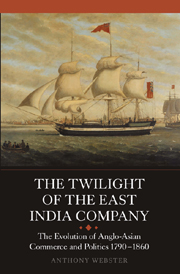
This book examines the development of British commercial, financial and political relations with India and the Far East during the final period of the East India Company's reign as the sovereign power in India. This was a most turbulent period for British commerce with India. The period began with the renewal of the East India Company's Charter and its component monopolies of trade with India and China, but this was quickly followed by the outbreak of the Napoleonic Wars, which spread to the east and saw the completion of Britain's assertion of power over India and much of Southeast Asia. However, the war also strengthened those political forces in Britain campaigning against the Company's monopolies of trade with India and China, which were consequently abolished under the Charter Acts of 1813 and 1833. The spectacular growth of the British economy following industrialisation brought new forces to bear upon India, with the rise of manufactured exports to the east. But the course of commercial relations did not run smoothly, and economic crises in Britain and India in 1833 and 1848 swept away commercial firms in both countries, and caused severe economic retrenchments. This instability severely hampered efforts to facilitate the export of capital to India during the first half of the century. Finally the rebellion of 1857 spelt the death knell for the Company, and ushered in a new phase of Anglo-Indian economic relations, in which British foreign investment grew substantially. Anthony Webster is Head of the History Department at Liverpool John Moores University.
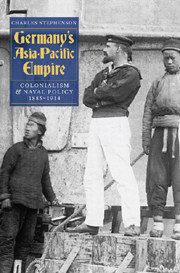
An overview of Germany's naval and imperial activities in East Asia and the Pacific in the years leading up to the First World War. This book examines German attempts to acquire colonial territories in East Asia and the Pacific, and discusses the huge impact this had on local and other international powers. It covers the German acquisition of Kiautschou in 1897, which had profound consequences for China, beginning a "scramble for concessions" by other western powers; the formation of the powerful German East Asiatic Cruiser Squadron which was seen by the British as a major threat, and which resulted in the advent of the Fleet-Unit concept and the birth of the Royal Australian Navy; the Japanese siege and capture of the key German base of Tsingtau in 1914, and the fate of the various former German colonies after Germany's defeat in 1918. The book contains many illustrations from the author's extensive private collection. Charles Stephenson is an extensively published military historian, whose books include: 'Moel Famau and the Jubilee Tower of King George III' (2008); 'Servant to the King for His Fortifications: Paul Ive and the Practise of Fortification' (2008); 'The Admiral's Secret Weapon', published by Boydell in 2006; 'Fortifications of the Channel Islands, 1941-45: Hitler's Impregnable Fortress' (2006); 'The Fortifications of Malta, 1530-1945' (2004); and 'Zeppelins: German Airships, 1900-1940' (2004).
This biography and business history of wealthy British merchant in India reveals much about the nineteenth-century Empire. John Palmer was the most influential and wealthiest British merchant in British India for the first three decades of the nineteenth century. He ran an 'agency house', a global commercial firm involved in banking, the opium trade, shipping, plantation agriculture and trade with Britain, Europe, China, south east Asia and the USA. When his firm went bankrupt in 1830, thousands of people, European and Indian, were ruined, triggering the worst commercial crisis in British India up to that time. This book, the first major study of a British agency house in India, presents an account of both of Palmer's business and personal life, showing how his personal relations and circumstances shaped his commercial strategies, with ultimately disastrous consequences for Anglo-Indian relations as well as his clients. ANTHONY WEBSTER is Head of Humanities at the University of Central Lancashire.
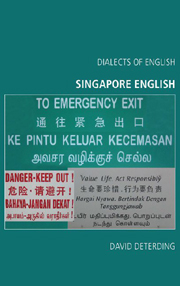
This book provides an overview of Singapore English in straightforward non-technical language. All the findings presented in the book are illustrated with extensive examples from one hour of recorded conversational data.
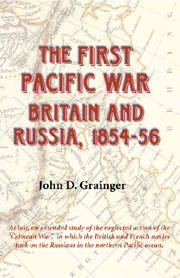
The 'Crimean War' was much more than a series of battles in the Crimea. One of the most neglected aspects has been the naval campaign in the Pacific Ocean - as highlighted in this full-scale survey, which brings out the involvement of China and Japan. The campaign took a joint British and French squadron from Chile to Kamchatka, to be defeated in battle at Petropavlovsk - where the British Admiral committed suicide. Despite their victory, the Russians withdrew from all their Pacific coastal settlements, and the British and French concentrated on searching for the mouth of the Amur River, thought to be a Russian base. The Russians in turn also concentrated there, in order to build a base, sending repeated expeditions along the river. Both China, who claimed to rule along the Amur, and Japan, only just `opened up' by Commodore Perry's expedition, were involved - indeed, the British used a Japanese port as their advanced base. The United States had only recently reached the Pacific coast and several Americans had their eyes on Russian Alaska and Hawaii as territories for future acquisitions. All this meant the Allies had to tread very delicately in Pacific waters. The war in Europe ended before a decisive action could take place in the Pacific. Ironically, having lost in the fighting, the Russians ended with a great advance in their territory.
This article examines the relationship between gender and Uyghur identity through the story of Nuzugum, the allegory of a Kashgar woman who kills an enemy outsider she is forced to marry rather than yield her chastity and bear his children. Tracing the story from its nineteenth-century roots to literary, artistic, and political incarnations in recent decades, the article argues that the story's prominence in the canon of Uyghur literature and its eponymous protagonist's place among Uyghur national heroes highlights the integral but overlooked role of gender in the construction of modern Uyghur identity. The resiliency of the story's gendered themes also underscores gender's importance in contemporary Uyghur political advocacy, especially advocacy about the transfer of Uyghur women to factories in China's coastal cities, an issue connected to the July 2009 protests and riots in the Xinjiang Uyghur Autonomous Region.
For more than 200 years, the Mughal emperors ruled supreme in northern India. How was it possible that a Muslim, ethnically Turkish, Persian-speaking dynasty established itself in the Indian subcontinent to become one of the largest and most dynamic empires on earth? In this rigorous new interpretation of the period, Munis D. Faruqui explores Mughal state formation through the pivotal role of the Mughal princes. In a challenge to previous scholarship, the book suggests that far from undermining the foundations of empire, the court intrigues and political backbiting that were features of Mughal political life - and that frequently resulted in rebellions and wars of succession - actually helped spread, deepen and mobilise Mughal power through an empire-wide network of friends and allies. This engaging book, which uses a vast archive of European and Persian sources, takes the reader from the founding of the empire under Babur to its decline in the 1700s.