To save content items to your account,
please confirm that you agree to abide by our usage policies.
If this is the first time you use this feature, you will be asked to authorise Cambridge Core to connect with your account.
Find out more about saving content to .
To save content items to your Kindle, first ensure no-reply@cambridge.org
is added to your Approved Personal Document E-mail List under your Personal Document Settings
on the Manage Your Content and Devices page of your Amazon account. Then enter the ‘name’ part
of your Kindle email address below.
Find out more about saving to your Kindle.
Note you can select to save to either the @free.kindle.com or @kindle.com variations.
‘@free.kindle.com’ emails are free but can only be saved to your device when it is connected to wi-fi.
‘@kindle.com’ emails can be delivered even when you are not connected to wi-fi, but note that service fees apply.
Lieutenant-Colonel William Henry Sleeman (1788–1856) spent his entire career in India as an army officer and later as a magistrate and resident. He was best known for his fight to suppress the activities of 'thugs', bands of criminals who attacked, robbed and often murdered innocent travellers. By the time of the publication of this two-volume work in 1844, Sleeman had lived in India for more than thirty years. In Volume 1, he draws on his travels and experiences, and over 48 chapters he discusses myriad aspects of Indian life, including Hinduism, local festivals and folklore, the 'thugs' he tried to eradicate, disease and famine, and the natural world. He also details the lives of a wide range of Indians, from key historical figures such as Aurungzebe, the Mogul emperor, to the ordinary people he encountered, such as washerwomen and elephant-drivers.
H. R. Davies (1865–1950) was an English army officer and member of the British intelligence service. Between 1894 and 1900 he was asked by the British government to lead survey expeditions into the modern Chinese province of Yunnan to discover possible routes for a railway connecting British-occupied Burma with the upper Yangtze river and through to Sichuan. This book contains an account of his travels though Yunnan province, written as a travelogue and first published in 1909. The region had been little explored by westerners before Davies' expeditions, and this is the first detailed description of Yunnan from a European traveller. The society, diverse indigenous cultures, geography, economy and political situation of the province are described in detail, with an introductory three chapters on the political context of the expeditions, and on railway construction in south-east Asia in the late nineteenth century.
This work of 1868 is a revised and expanded version of a series of articles contributed by G. B. Malleson (1825–1898) to the Calcutta Review. The author served in India for thirty years from 1847, retiring finally with the honorary rank of major-general. Drawing on his wealth of first-hand experience of Anglo-Indian military history, he wrote prolifically and with an accessible, vigorous style. This work on the history of the French in India from 1674 to 1761 reassesses the career and contribution of Joseph François Dupleix and other major figures in this period of the Franco-Indian empire. He sees the decline in French power as the result of a few extremely able persons being let down by their mother-country's lack of support. In this he contrasts the French with the English in terms of their Indian colonial history.
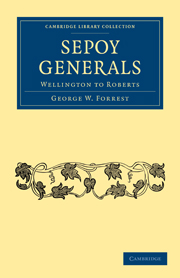
George W. Forrest (1845–1926) was born in India, the son of an army captain who had won the Victoria Cross during the Indian Mutiny. Forrest became an historian and journalist, who also created and ran the Imperial Record Office in Calcutta. He produced many editions of state papers and historical memoirs on governors of India, providing primary material on British India to scholars of imperial history. First published in 1901 on Forrest's retirement to England due to ill health, Sepoy Generals is a study of British generals who played a significant role in India during the nineteenth century. The term 'sepoy general' was coined as an insult to Wellington, the first subject, insinuating that his important military successes in India were insignificant and would not equip him to defeat Napoleon. Forrest's nine subjects spanned the whole nineteenth century, ending with Lord Roberts of Kandahar, who died in 1900.
Citizenship and Statelessness in Sri Lanka analyses the context of the agreement between the Sri Lankan and Indian government that led to the loss of citizenship of Indian Tamil estate workers in Sri Lanka.
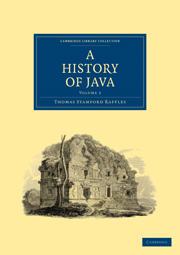
Thomas Stamford Raffles (1781–1826) was a British civil servant and statesman best known for his founding of the city (now Republic) of Singapore. After the capture of Java by the British in 1811, Raffles was appointed Lieutenant Governor of the island, a position he held until 1815. After a two-year interlude in England, he sailed back to the East, and established the city of Singapore in 1819. These volumes, written during his governorship and first published in 1817, contain his monumental survey and history of the island state. Raffles provides a comprehensive ethnographic description of the island's society, describing its economy, trade, languages and dialects, and religious and social customs, together with a detailed history of the island, including a discussion of the introduction of Islam. These volumes provide invaluable information of the study of contemporary Javanese society and history. Volume 2 contains Raffles's historical study.
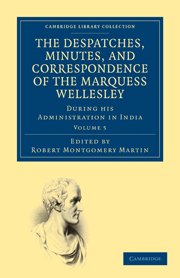
Richard, Marquess Wellesley (1760–1842) became one of the most controversial politicians of his generation during his time as Governor-General of Bengal (1798–1805). Although this period saw him achieve territorial gains and military victories in India - including the defeat of Tipu Sultan, the ruler of Mysore - the financial cost was considered too high. The East India Company Court of Directors in London disagreed with many of the changes he made, and Wellesley was forced to return to England. This five volume collection of papers, edited by the political activist and historian Robert Montgomery Martin (1800–1868), was published in 1836–1837 and documents Wellesley's period of office in India. Volume 5 contains materials that supplement those in the four earlier volumes. They focus on large undertakings such as the Mysore and Maratha Wars, as well as topics including the East India Company's finances during Wellesley's tenure.
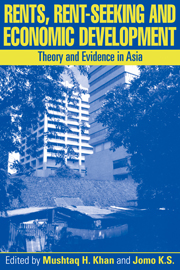
The concepts of rents and rent-seeking are central to any discussion of the processes of economic development. Yet conventional models of rent-seeking are unable to explain how it can drive decades of rapid growth in some countries, and at other times be associated with spectacular economic crises. This book argues that the rent-seeking framework has to be radically extended by incorporating insights developed by political scientists, institutional economists and political economists if it is to explain the anomalous role played by rent-seeking in Asian countries. It includes detailed analysis of Thailand, Malaysia, the Philippines, the Indian sub-continent, Indonesia and South Korea. This new critical and multidisciplinary approach has important policy implications for the debates over institutional reform in developing countries. It brings together leading international scholars in economics and political science, and will be of great interest to readers in the social sciences and Asian studies in general.
'South Asian Media Cultures' examines a wide range of media cultures and practices from across South Asia, using a common set of historical, political and theoretical engagements.
Dr Moore's enterprising book focuses on an apparent paradox: the failure of Sri Lanka's highly politicized smallholder electorate to place on the national political agenda issues relating to the public distribution of material resources. Sri Lanka has more than fifty years' history of pluralist democracy and such issues directly affect the interests of the smallholder population. Yet successive Sri Lankan governments have pursued economic policies favouring food consumers and the state itself at the expense of agricultural producers. In exploring the features of Sri Lanka's history, geography, politics and economy which explain this paradox, the author looks in detail at some of the dominant features of contemporary Sri Lanka: the political consequences of the plantation experience; the persistence of elite political leadership; and the causes and consequences of ethnic conflict.
Wilhelm von Humboldt (1767–1835) was a German philologist, diplomat and philosopher. While Minister of Education he was responsible for reforming the Prussian education system. His pioneering achievements in linguistics influenced many later scholars including Chomsky. Written in 1830–3, this monumental three-volume study of Kawi, a traditional formal and literary language of Java belonging to the Austronesian language family, was published posthumously in 1836–9. The manuscript was prepared for the press by J. K. E. Buschmann, a protégé of Humboldt's friend and colleague Bopp, whose work is also reissued in this series. Humboldt considered Kawi, which includes many Sanskrit loan-words, to be the common ancestor of all the Malayo-Polynesian languages, though this view is no longer accepted. Volume 2 analyses the roots and grammatical structures of Kawi as attested in religious texts and heroic epics, and provides cross-linguistic data to demonstrate its relationship with other languages of the region.