To save content items to your account,
please confirm that you agree to abide by our usage policies.
If this is the first time you use this feature, you will be asked to authorise Cambridge Core to connect with your account.
Find out more about saving content to .
To save content items to your Kindle, first ensure no-reply@cambridge.org
is added to your Approved Personal Document E-mail List under your Personal Document Settings
on the Manage Your Content and Devices page of your Amazon account. Then enter the ‘name’ part
of your Kindle email address below.
Find out more about saving to your Kindle.
Note you can select to save to either the @free.kindle.com or @kindle.com variations.
‘@free.kindle.com’ emails are free but can only be saved to your device when it is connected to wi-fi.
‘@kindle.com’ emails can be delivered even when you are not connected to wi-fi, but note that service fees apply.
The schism between our admiration of the artefacts of the great architectural practices of the twentieth century, and our lack of knowledge as to how those achievements were manifest, is one of the most enduring characteristics of modern architecture. Modern architectural practice and its sustaining historiography has typically focused on the image of the designed object at the expense of the skills and conditions that shaped it; a focus on reputation rather than comprehension. Indeed those constituting contingencies of design are more often seen as obstructing the architectural vision and true reality of experience; hence the fixation on a singular (and possibly post-rationalised) first ‘spark’ of conception and the photogenic qualities of the realised, and usually uninhabited, object. Dalibor Veseley is right to state that ‘instrumentality (techne) must always be subordinated to symbolic representation (poiesis), because techne refers only to a small segment of reality, while poiesis refers to reality as a whole'. Nevertheless, in the current climate the statement is likely to be understood as further legitimising the continuing neglect of what architects actually do.
In the context of the maturation of traditional concepts of identity into ‘new forms of plurality and spatiality’, this paper aims to explore the role of genius loci, memory, and ultimately identity in a particular gallery: the Pier Arts Centre in Stromness, Orkney.
Initially, it considers ways in which regional and vernacular identities have informed and enriched the architectural project, instilling it with tangible and intangible traces of place, and the past and present people of that place. Formal and material influences from the abstract but poetic idea of north, the local topography and town, and the existent buildings on site, are revealed.
Mole Architects was set up by Meredith Bowles in 1997, and has become known for well-crafted, contextually responsive and ecologically sensitive projects. One of the claims that Mole make in their practice brochure is that their work is identified by a consistency of attitude rather than a ‘house style’. This claim emphasises thinking, analysis and process but this is balanced by the evidence presented in their realised work, which demonstrates an undeniable interest and delight in the materiality and making of buildings. Reflecting on the enduring influence of his architectural education, Bowles acknowledges this balance: ‘What I think these formative experiences refer to is a belief in the importance of things rather than ideas, or rather that ideas reside in the thing itself’.
Robert Hooke and Christopher Wren's interest in ancient buildings has been noted by historians of architecture and natural philosophy alike. The two men used to meet to discuss descriptions – both verbal and visual – and models of ancient buildings that had long since disappeared and were known only through ancient accounts, or that remained only in a ruined or altered form. These included the Temple of Solomon, described at different places in the Bible, Porsenna's tomb, cited as an example of extravagance by Pliny the Elder, and the Hagia Sophia. In 1675, Hooke recorded such a meeting in his diary: ‘With Sir Chr. Wren. Long Discourse with him about the module [model] of the Temple at Jerusalem’.
Squeezed into the narrow confines of a parasitic Mumbai dwelling; gathered around a ceramic tea-set in an elevated tea-house; trapped in the transparent void of a tree; and nestled in a vertical tower of fur, books and timber the 1:1 – Architects Build Small Spaces exhibition offered a tactile and intimate encounter with the intense experiences and emotions evoked by a series of small architectural spaces. Installed throughout the Victoria and Albert Museum, the exhibition ran from 15 June – 30 August 2010.
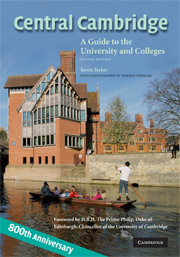
The fully revised and updated second edition of this best-selling guidebook is intended for all visitors to Cambridge, and for anyone with an interest in the University. Combining an accessible style with accuracy of fact and a wealth of historical detail, it can be used to accompany a walking tour or read at leisure as an authoritative introduction. The second edition is packed with newly commissioned colour photographs by Japanese artist and photographer Hiroshi Shimura, as well as fresh maps and added information about the buildings and developments of recent years. Central attractions receive full entries, and the book also offers historical descriptions of all the outer-lying colleges, making it a comprehensive survey of the collegiate University. There is an informative introduction, a list of colleges with foundation dates, a substantial glossary and index, and a list of further reading material, all extended and updated for this edition.
Geophysical and geoarchaeological surveys were carried out at the Bishop’s Palace, Wells in 1998 and 2003–04 by staff and students of King Alfred’s College, Winchester (now the University of Winchester) at the request of the Bishop’s Palace Archaeological Research Committee. The main objectives in undertaking this work were, firstly, to determine whether buried archaeological features beyond those identifiable in historic cartographic sources exist below the present ground surface and, secondly, to assess whether medieval archaeological remains are buried by thick alluvial or made ground deposits. Resistivity and magnetometer surveys were carried out on the lawns that surround the palace in June and July 1998 to address the first objective, while nineteen boreholes were drilled during two phases of fieldwork in April 2003 and June 2004 to address the second. Here we present the results of the surveys, focusing particularly on the information that the survey data provides with regard to the layout of the eighteenth- century garden and the survival of buried medieval archaeological stratigraphy.
Methodology: geophysics
The survey covered 0.16 hectares; the available area being laid out with a total station and tapes as a series of 20m x 20m squares. The magnetometer survey was conducted with a Geoscan FM36 fluxgate gradiometer in a series of parallel traverses while the resistance survey was carried out using a Geoscan RM15 with a twin electrode configuration. Each grid was surveyed using zigzag traverses at 0.5m spacings, giving a sub-surface penetration of between 0.75m and 1.0m and a resolution of 1,600 readings per 20m x 20m square. Figure 6 maps the resistivity survey onto a plan of the Bishop’s Palace, Figure 7 does the same for the magnetometry data, while Figures 8 and 9 interpret the resistivity and magnetometry results respectively.
Resistivity relies on the ability of materials to conduct an electrical current passed through them. This is linked to moisture content and therefore porosity. Stony features such as walls are recognised as a high response (displayed on Figure 6 in black) while ditches and pits which retain moisture tend to show up as low responses (here in grey or white).
The sequence of Decorated buildings associated with Robert Burnell, chancellor of England 1274–92 and bishop of Bath and Wells 1275–92, including the chapter house and staircase in his cathedral at Wells and the monumental additions to Bishop Jocelin’s palace there, together with related buildings at Acton Burnell in Shropshire and Nantwich in Cheshire, have been justly celebrated as ‘one of the most coherent and interesting’ sequences in English Decorated architecture. These buildings have hardly gone unnoticed by scholars of medieval architecture, but to date the majority of attention has focused upon Acton Burnell castle and the additions to the cathedral, leaving Burnell’s additions to the palace largely unstudied. Yet Burnell transformed that palace into a monumental fortified residence that included a new aisled hall, a chapel and a range of outbuildings, the whole probably surrounded by crenellated murage.
Burnell’s work at the palace is admittedly fragmentary as compared with the chapter house and its staircase but the significance of the palace buildings is not in doubt: they are among the ‘most impressive English domestic buildings of the Middle Ages’, and Jean Bony awarded them a seminal role in the development of the Decorated style and in the introduction of a fortified vocabulary of architectural design into English architecture (Plate 20). The purpose of this chapter is to survey for the first time the range of archaeological, documentary and antiquarian evidence for Burnell’s additions to the palace, beginning with a discussion of his patronage and motives. There follows consideration of form, function and sequence.
Patronage
Robert Burnell was by birth a member of a prosperous landholding family in Shropshire and he seems to have been more secular aristocrat than committed prelate. He had long served Edward I as prince and his preferment was sought by the king, twice to the archbishopric of Canterbury and once to the see of Winchester. In the event Burnell was only modestly rewarded in the form of the bishopric of Bath and Wells, which he seems to have secured against further opposition to promotion by resigning benefices and making over his secular landholdings. Perhaps in the light of his second failure for promotion to Canterbury in 1278, Burnell began in 1279–80 to repossess his estates.
As indicated in the Preface, the papers in this volume have their origin in a conference organised under the auspices of the Archaeological Research Committee of the Bishop’s Palace at Wells, held there on 11–12 September 2006. The date was chosen to commemorate Bishop Jocelin of Wells (bishop 1206–42) and to share current knowledge of his enormous contribution to the history of the present cathedral and diocese and of the buildings that he erected which still form the heart of the Bishop’s Palace. Not all the papers included here were actually delivered at the conference. The additional contributions represent work, most of it archaeological, which had been undertaken over several years to understand the origins of what is one of England’s most iconic collection of buildings; and more recently as necessary preliminaries in preparation for developments that will enable the palace to take its proper place among the accessible sites of our national heritage. The more traditional historical and architectural papers were mostly composed for the conference; some of those delivered on those two days have been modified by their authors, while others remain very much as they were heard and thus offer a flavour of a most enjoyable and significant occasion. Together they provide a wide-ranging examination of what Pevsner called ‘without doubt the most memorable of all bishop’s palaces in England’ and of the man who created its earliest surviving fabric and made of it, of the great collegiate church he was completing a few yards to the north and of the city adjoining to the west the heart of his developing diocese.
Jocelin, the local boy who had come to the centre of power in his native place and wielded considerable influence far beyond, achieved by the fifteenth century some kind of immortality. According to a note added to a copy of Higden’s Polychronicon in reference to Jocelin’s exile, the bishop had slain a dragon that lurked in his park near Wells. Four-legged, winged and with a face like a man’s, it was said to have been deadly; but Jocelin, dismissing his followers, attacked it single-handed and cut off its head.
This chapter seeks to consider Bishop Jocelin’s buildings in Wells from the point of view of buildings archaeology, concentrating on the two prime examples: the cathedral and the Bishop’s Palace. While there is probably surviving fabric from Jocelin’s period in the Old Deanery, and perhaps in other houses to the north of the cathedral, those remains are slight and have not been studied in detail. The other major survival, the fragments of Jocelin’s chamber and chapel at Wookey, lies outside the city. Therefore, what follows is a consideration of Jocelin’s work in the cathedral and palace, first by examining the sequence of construction and building styles in the cathedral, and then to see if anything can be learnt by applying a knowledge of those building styles to the thirteenth-century fabric of the palace.
Jocelin’s building campaign in the cathedral
Early commentators on the building of the cathedral were wont to credit Jocelin with the whole or the greater part of the building. James Thomas Irvine (whose observation was superb, but whose interpretation was seriously flawed) mistakenly believed the cathedral to have been rebuilt from west to east, and credited Jocelin with the quire, rather than the nave and the west front.
It is, however, salutary to realise that in the famous view of the cathedral from Tor woods to the east, hardly anything built during Jocelin’s episcopate can be seen. The east end, chapter house, central tower and Lady Chapel are of the fourteenth century; the western towers are of 1384–94 and 1424+; while the transepts and earliest part of the nave were complete by 1206, when Savaric’s obit was celebrated in St Martin’s chapel in the south transept.
Over the last twenty years the phases of construction of the cathedral have been clarified – though it is likely that Professor Robert Willis had identified them in the 1870s, but failed to record his observations in detail. In order to define Jocelin’s contribution to the building it is necessary first to look briefly at the constructional history of the church under his predecessors, Bishops Reginald and Savaric.
Rebuilding the church prior to Jocelin’s episcopate
Work on the new church must have begun at the east end soon after Reginald’s appointment in 1174, with the single-storey eastern retroquire – just as happened at Salisbury in 1220–25.