To save content items to your account,
please confirm that you agree to abide by our usage policies.
If this is the first time you use this feature, you will be asked to authorise Cambridge Core to connect with your account.
Find out more about saving content to .
To save content items to your Kindle, first ensure no-reply@cambridge.org
is added to your Approved Personal Document E-mail List under your Personal Document Settings
on the Manage Your Content and Devices page of your Amazon account. Then enter the ‘name’ part
of your Kindle email address below.
Find out more about saving to your Kindle.
Note you can select to save to either the @free.kindle.com or @kindle.com variations.
‘@free.kindle.com’ emails are free but can only be saved to your device when it is connected to wi-fi.
‘@kindle.com’ emails can be delivered even when you are not connected to wi-fi, but note that service fees apply.
THE MANOR HOUSE, MILDENHALL, STOOD TO THE NORTH OF THE PARISH CHURCH OF ST MARY, near the centre of the town. In the medieval period the manor of Mildenhall was, like many other manors in Suffolk, held by the Abbey of St Edmunds. After the Dissolution of the Monasteries it passed through a number of hands, including those of Sir Nicholas Bacon, Lord Keeper of the Great Seal, until it was acquired by Henry, son of Roger, second Lord North, in 1586. Thereafter it passed by descent until the final sale of the estate in 1933.
The date when the house was built is uncertain. One account of its history suggests that it was built about 1570 before its acquisition by the North family. However there is no record of Sir Nicholas Bacon (a prolific builder of large houses) erecting a house at Mildenhall, and in 1608 ‘the King Majesty's manor house called Mildenhall Hall’ was described as ‘ruined and in decay’. The Norths’ tenure of Mildenhall appears originally to have been in the nature of a lease, and it was not until 1614 that Sir Henry North obtained a grant of the ‘site of the Manor and Grange of Mildenhall’ from the Crown. It seems likely that the house was built shortly after Sir Henry North secured his tenure of the property. On the death of his son, the second baronet, the property passed to his sister, the wife of William Hanmer whose son, Sir Thomas Hanmer, was Speaker of the House of Commons. From him it passed to the Bunbury family whose other Suffolk seat was Barton Hall but who also had landed interests in Cheshire.
THE NORTHS’ original house was the subject of considerable alteration and extension over succeeding centuries. On what was originally its entrance front there were three gables, the right-hand one projecting forward of the other two and having a lower roof height and retaining its mullioned and transomed window on the first floor. This appears to have been the original building to which the other two gable-ended wings were added, probably later in the seventeenth century. The fenestration of these wings was subsequently changed to sashed windows and a gable was added to the flank of the left-hand wing. All three of these wings were of two principal storeys with garrets in the gabled roofs.
UFFORD PLACE, SITUATED THREE MILES NORTH OF WOODBRIDGE, stood in parkland, which, since the demolition of the house, has become the site of a housing development, a hotel and a golf course. Unlike many country houses, it was never the seat of the lord of the manor, there having been another hall elsewhere in the parish.
The house is said to have been the property of the Hammond family in the late 1620s and to have been rebuilt by William Hammond, who is recorded as having a house with six hearths in 1674. By the fourth decade of the eighteenth century it was owned by Samuel Thompson, who married Anne, a daughter of Sir Charles Blois, first baronet. It descended to their daughter, also Anne, who married Reginald Brooke. Ufford was to remain in the ownership of the Brooke and Blois families until the middle of the twentieth century, although its descent in those families was somewhat complex. Reginald and Anne Brooke's son, Francis Capper Brooke, who died in 1886 and his son (by his second marriage), Edward, owned the estate for over eighty years, and it was during their tenure that Ufford Place was considerably enlarged. Francis Capper Brooke was clearly concerned that his estate should eventually pass to male members of his family, and he provided that, although the estate passed on Edward's death to his sister Constance, it was thereafter (if he had no male descendants) to be inherited by the heir male of Sir Thomas Brook, who had died in 1418, failing whom to the second and succeeding sons of Sir John Blois, eighth baronet of Cockfield. This last provision took effect, and the estate passed in 1930 to Eustace Steuart Blois, who took the name of Brooke on inheriting Ufford.
THE DEVELOPMENT of the house is largely undocumented, but it is said to have been originally a timber-framed building with gables and mullioned and transomed windows. On an 1823 map of the Reverend Capper Brooke's lands it is shown as a rectangular U-shaped building with a substantial rectangular building abutting the left-hand wing. The rear of the building faced north, and on this side the cross-wing had a substantial canted bay in the centre. An 1828 map shows a similar configuration, but the projecting wings on the south side had been connected by a further cross-wing to create an internal courtyard.
This volume provides a concise, historical review of the methods of structural analysis and design - from Galileo in the seventeenth century, to the present day. Through it, students in structural engineering and professional engineers will gain a deeper understanding of the theory behind the modern software packages they use daily in structural design. This book also offers the reader a lucid examination of the process of structural analysis and how it relates to modern design. The first three chapters cover questions about the strength of materials, and how to calculate local effects. An account is then given of the development of the equations of elastic flexure and buckling, followed by a separate chapter on masonry arches. Three chapters on the overall behaviour of elastic structures lead to a discussion of plastic behaviour, and a final chapter indicates that there are still problems needing solution.
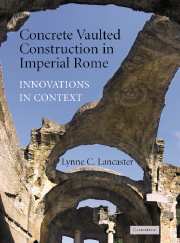
Concrete Vaulted Construction in Imperial Rome examines methods and techniques that enabled builders to construct some of the most imposing monuments of ancient Rome. Focusing on structurally innovative vaulting and the factors that influenced its advancement, Lynne Lancaster also explores a range of related practices, including lightweight pumice as aggregate, amphoras in vaults, vaulting ribs, metal tie bars, and various techniques of buttressing. She provides the geological background of the local building stones and applies mineralogical analysis to determine material provenance, which in turn suggests trading patterns and land use. Lancaster also examines construction techniques in relation to the social, economic, and political contexts of Rome, in an effort to draw connections between changes in the building industry and the events that shaped Roman society from the early empire to late antiquity. This book was awarded the James R. Wiseman Book Award from the Archaeological Institute of America in 2007.
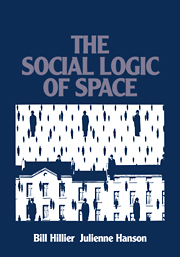
The book presents a new theory of space: how and why it is a vital component of how societies work. The theory is developed on the basis of a new way of describing and analysing the kinds of spatial patterns produced by buildings and towns. The methods are explained so that anyone interested in how towns or buildings are structured and how they work can make use of them. The book also presents a new theory of societies and spatial systems, and what it is about different types of society that leads them to adopt fundamentally different spatial forms. From this general theory, the outline of a 'pathology of modern urbanism' in today's social context is developed.
The spectacular surroundings of Kielder Water & Forest Park, in Northumberland, England, are a confluence of opposing states: the man-made and natural; the utilitarian and recreational; thebeautiful and isolated; shaped by weather converging from east and west. Kielder Castle was built in 1775 as the Duke of Northumberland's hunting lodge. In recent years the territory has gained notoriety for a series of innovative art and architectural commissions including Belvedere by Softroom Architects (1999), Kielder Skyspace by the American artist James Turrell (2000), Minotaur by architect Nick Coombe and artist Shona Kitchen (2003), and Kielder Observatory by Charles Barclay Architects (2008). This paper outlines one of Kielder's most recent additions – a shelter entitled 55/02 – the result of a collaboration between sixteen*(makers) and manufacturers Stahlbogen GmbH. The work rekindles the symbiotic relationship between design and making once central to the production of architecture. The reawakening of this tradition has been stimulated by the mainstream adaptation of CAD/CAM as an industrial and disciplinary medium which binds the protocols of drawing with those of fabrication. However, as this account of the project shows, the relevance of an increasingly digitised world extends beyond the production of 55/02 as an artefact – it forms the basis of the architecture's relationship with its locality as an industrial, historical, social, cultural and manufactured landscape [1].
The Galerie Goetz is a small art gallery built between 1989 and 1992, one of the early works of Herzog & de Meuron which helped to win them such commissions as Tate Modern and launched their spectacular international career. At first sight this box-like building standing at the far end of a villa garden in a Munich suburb seems rather dead-pan and understated: from the street [2] you register only the upper floor, a box measured out in five bays, for the ground level is perfectly obscured by the garden fence, an apparently banal element carefully remade by the architects.
The US housing market is infamous on at least two counts: implicated in the global financial crisis and notorious for its unsustainable consumption of resources and consequent discharge of carbon dioxide. Lately anything like good news regarding housing in the USA is scarce. However, the pause resulting from the collapse of the market, and increasing concern regarding building's agency in the environment, combine to provide an opportunity to reconsider the form and performance of housing. This may yet create an opening for design.
This theoretical paper addresses the persistence of architecture students in undergraduate design learning despite the considerable sacrifices that this frequently entails, and proposes a framework for some of the mechanisms that explain students' diligence in their love-hate relationship with the design studio. Such love-hate association is poorly understood, but is clearly a pervasive dilemma in architecture education. The proposed model includes a number of cognitive mechanisms that students may use to reconcile their idealised and romanticised self-image with the incoherent sacrifices of design studio.
A photograph by Robert Polidori, of a room within the city of Petra, shows a pristine cubic volume hewn out of the rock. The nature of the stone reveals different textural and figural qualities of the material when it becomes a floor, a wall or a ceiling. There is no need to ‘put’ the building together, to assemble it, because it is already exists. This, then, is the fantasy of the architect, to sculpt from a single substance that is both structure and surface, with the only remaining questions pertaining to shape and smoothness.
In this paper architectural Modernism is used to describe the unadorned flat-roofed houses constructed using modern materials such as concrete, reinforced concrete and steel, and built mainly in the period following the First World War. This is a sparse definition that fails to do justice to the much broader interpretation of Modernism, which affected not only architecture, but all the arts in the first quarter of the twentieth century, a movement that reached maturity around 1930. However, even though the definition fails to reflect the richness of the Modernist idiom, the houses have long been recognised as representing Britain's first inroads into Modernist architecture as acknowledged by, for example, Gould, Bentley, Collins and Bettley.
Traditionally, architecture mediates joints with mouldings whose qualities describe, like a human face, their character. In contrast, modern architecture uses a reveal or shadow to mark joints. This ubiquitous yet overlooked modern shadow has slipped between the cracks of architectural theory. Is the modern reveal, distained and beloved by architects, the sign of a building without quality?
This paper considers the problem of tradition in contemporary architectural practice in Turkey as well as in other countries of the world. When it is presented as the display of stylised historical images, tradition loses its relevance in the present and becomes perceived as something that always belongs to the past. In such a case tradition opposes itself against modernity as independent and sovereign. In her writings German-Jewish political theorist Hannah Arendt considers the problem of modernity as a problem of tradition which is mainly caused by the polarisation and particularisation between past and future. Addressing her writings, in the architectural realm, tradition becomes past orientated when it is perceived as something completed as appearances. However, perhaps tradition is more future directed and continuously attempts to actualise itself between past and future.