To save content items to your account,
please confirm that you agree to abide by our usage policies.
If this is the first time you use this feature, you will be asked to authorise Cambridge Core to connect with your account.
Find out more about saving content to .
To save content items to your Kindle, first ensure no-reply@cambridge.org
is added to your Approved Personal Document E-mail List under your Personal Document Settings
on the Manage Your Content and Devices page of your Amazon account. Then enter the ‘name’ part
of your Kindle email address below.
Find out more about saving to your Kindle.
Note you can select to save to either the @free.kindle.com or @kindle.com variations.
‘@free.kindle.com’ emails are free but can only be saved to your device when it is connected to wi-fi.
‘@kindle.com’ emails can be delivered even when you are not connected to wi-fi, but note that service fees apply.
This project began when one of my research colleagues, a civil engineer, pointed to his very thorough study of daylighting in buildings and said: ‘Here is all that architects need to know about light – why don't they use it?’ A discussion followed about what kind of knowledge is relevant, when, and for whom. It ended with the questions: ‘What kind of knowledge do architects really use in their design process?’ and ‘How can we as researchers provide the different kinds of knowledge that are useful for practice?’ These questions became the basis of a research project and this paper reports on its studies and discussions.
In a unique architectural style of the twentieth century, Ludwig Mies van der Rohe (1886–1969) realised a new type of modern space defined by an unobstructed clear volume enclosed by framed glass skin. This is generally referred to as Mies's universal space and this paper will attempt to interpret Miesian universal space in terms of the idea of tectonically defining space. Mies referred to the term ‘tectonic’, or ‘architectonic’, as constructive appearance exposing the skeleton structure. For Mies, the concept of tectonic was connected to a glassy materiality that permitted the unambiguously constructed appearance of a skeletal structure. He regarded the glass skin as a ‘tectonic means’ and the instrument of a new art of building.
In the interwar years European historians and critics of architecture tried to assimilate science into architecture and arts. For example Sigfried Giedion's Space, Time, and Architecture (1941) attempted to bring Einsteinian spacetime into architectural theory, while Nikolaus Pevsner's An Outline of European Architecture (c. 1943) used space as a criterion to differentiate architecture from other art forms. These brought to the idea of ‘space’ a distinctly modern meaning, making it a universal signifier; whereas in the last decade, architectural historians have argued for the historical specificity of space and a deeper examination of the social and spatial practices embedded in the making of space. This study inquires into the atemporal readings of space, using Lefebvre's theory on the production of space by ‘interested subjects’.
This paper involves an analysis of the role of architectural projects which can be defined as ‘catalysts’ to urban renewal. The aims of this paper are twofold and the paper is divided accordingly into two main parts. The first aim is to discuss, with reference to the work of a number of urban and architectural thinkers, a range of ways in which the term ‘urban catalyst’ has been both conceptualised and applied. Discussion is structured in relation to the Oxford English Dictionary's definition of a ‘catalyst’ in the field of chemistry as,
[a] substance that when present in small amounts increases the rate of a chemical reaction or process but which is chemically unchanged by the reaction; a catalytic agent. (A substance which similarly slows down a reaction is occas. called a negative catalyst.)
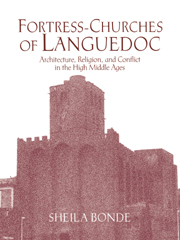
Fortress-Churches of Languedoc traces the changing relationship between military and religious realms as expressed in architecture across medieval Europe. The scholarship of medieval architecture has traditionally imposed a division between military and ecclesiastical structures. Often, however, medieval churches were provided with fortified enclosures, crenellations, iron-barred doors and other elements of defence, demonstrating the strong link between Church and state, and the military and religious realms. In her study of fortress-churches, Sheila Bonde focuses on three twelfth-century monuments in southern France - Maguelone, Agde and Saint-Pon-de-Thomière, which are among the earliest examples of the type. She analyses her archaeological surveys of these structures, and also re-examines their documentation, which is here presented both in the original Latin and in English translations. The book also explores the larger context of fortification and authority in twelfth-century Languedoc and examines the dynamics of architectural exchange and innovation in the Mediterranean at a moment of critical historical importance.
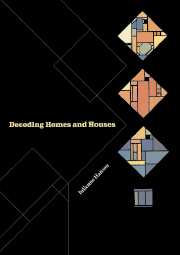
Houses are not just assemblages of individual rooms but intricate patterns of organised space, governed by rules and conventions about the size and configuration of rooms, which domestic activities go together, how the interior should be decorated and furnished and what kinds of household object are appropriate in each setting, how family members relate to one another in different spaces, and how and where guests should be received and entertained in the home. Decoding Homes and Houses introduces new, computer-based techniques designed to retrieve and interpret this wealth of social and symbolic information. The various representations and measures show how domestic space provides a shared framework for everyday life, how social meanings are constructed in the home and how different sub-groups within society differentiate themselves through their patterns of domestic space and lifestyles.
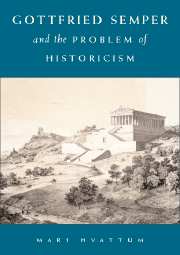
Using key texts by the German architect and theorist Gottfried Semper, Mari Hvattum offers a reinterpretation of historicism, which is here viewed both as a philosophical outlook and as an architectural problem. Hvattum focuses on Semper's two major concerns: an understanding of the ontological significance of art and architecture, and the rendering of art and architecture as the objects of scientific investigation and prediction. Hvattum investigates the background and implications of these conflicting concerns. By examining the historicist fusion of Romanticism and Positivism, the book seeks to understand the nature as well as the limits of the modern dream of a 'method of inventing'. More than an intellectual biography, Gottfried Semper and the Problem of Historicism explores historicism and its implications for modern architectural discourse and practice.
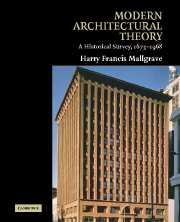
Modern Architectural Theory is the first book to provide a comprehensive survey of architectural theory, primarily in Europe and the United States, during three centuries of development. In this synthetic overview, Harry Mallgrave examines architectural discourse within its social and political context. He explores the philosophical and conceptual evolution of its ideas, discusses the relation of theory to the practice of building, and, most importantly, considers the words of the architects themselves, as they contentiously shaped Western architecture. He also examines the compelling currents of French rationalist and British empiricist thought, radical reformation of the theory during the Enlightenment, the intellectual ambitions and historicist debates of the nineteenth century, and the distinctive varieties of modern theory in the twentieth century up to the profound social upheaval of the 1960s. Modern Architectural Theory challenges many assumptions about architectural modernism and uncovers many new dimensions of the debates about modernism.
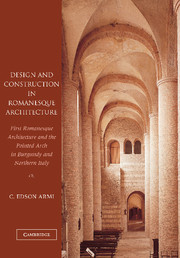
In this 2003 study, Edson Armi offers a fresh interpretation of Romanesque architecture. Armi focuses on buildings in northern Italy, Switzerland, southern France and Catalonia, the regions where Romanesque architecture first appeared around 1000 AD. He integrates the study of medieval structure with an understanding of construction, decoration and articulation in an effort to determine the origins and originality of medieval architecture and the formation of the High Romanesque style, especially in Burgundy, at sites such as Cluny III. Relying on a close analysis of the fabric of key buildings, Armi's in-depth study reveals a lot about design decisions in the early Middle Ages. It also demonstrates that the mature Romanesque of the twelfth century continues many of the applications created and perfected over the previous one hundred years.
The Ulster Museum is destined to remain a building that stands somewhat outside time and remote from its society. The building is in two parts that are merged into one: the first Classical, designed by James Wyness and built only in part by 1929, and the second, a transformative concrete extension designed by Francis Pym for a 1963 competition judged by Leslie Martin and opened in 1972 to the most violent year of the conflict in Northern Ireland. The extension is, as Paul Clarke, of the University of Ulster has written, ‘an icon to a period when architecture addressed at the very centre of its responsibility, the optimism of modern life, culture and public space’. Now, after decades of inept alterations and unimaginative curation, its doors are closed for a refurbishment that will disassemble its central ideas together with all the optimism that Clarke alludes to – and this at a time when Northern Ireland has the chance to build the open civil society that it never had and that the museum competition project symbolised in that brief period of opportunity for change forty-six years ago.
This edition of arq assembles a selection of papers presented at the Conference ‘Agency’ organised by the research group called ‘The Agency’ initiated in 2007 in the School of Architecture at the University of Sheffield. We offered to host the 5th AHRA International Conference, giving it the theme of ‘Agency’ and hoping that the submissions would energise the relationships between the humanities, the architectural profession, and society.
‘Agency’ is a beguiling word. It has the immediacy of a call-to-arms and the remoteness and anonymity of a bureaucratic function. Agency, as action in the world, underpins revolutionary social change, and the representation of someone else's interests – usually at a distance – in a governmental or business context. It is implicated in both the agitprop of the Reclaim the Streets network, or Brazil's Homeless Workers Movement, and in state bureaucracies such as the UK Border Agency, or commercial franchises such as the Western Union. The term encapsulates two quite distinctive forms of action: one individuated, collective and immediate; and the other systemic, anonymised and bureaucratic. It is no accident, then, that in academic literature ‘agency’ is often paired with ‘structure’, and in the binarised form, structure/agency, is used to refer to the tension between the creative actions of individuals and the social, political and economic structures that supposedly constrain them. The fact that architects are expected to exercise agency in both of these senses – as creative actors and as representatives of their clients' interests – gives the theme further significance.
‘Building Initiative’ is both the name adopted by a collaborative group of architects, urbanists and artists, and also the term they use to describe the ‘mode of agency’ chosen to inform and realise citizen-led urban regeneration in Belfast [1]. The necessity and forms of this praxis evolved in response to the city's spatial, social and policy environment, and the inability of conventional mechanisms of architectural practice to engage adequately with this context. Building Initiative explored and pursued specific modes of agency, which it termed ‘initiatives’, within a variety of sectors including architectural, planning, educational, academic and media, and at a range of scales from local to international. This created the opportunity to work with a diversity of partner organisations and to develop a correspondingly wide range of strategies. We will look briefly at the context of Belfast and Building Initiative's response to it, focusing specifically on the methods of working that were developed, before concentrating on one project to illustrate these methodologies and processes in application.
Recent criticisms in architectural pedagogy suggest that schools of architecture tend to privilege a narrow section of designers with limited skill-sets, neglecting individual differences. In order to encourage architectural pedagogy to become more inclusive, this paper revisits the value of multiple skill-sets in architectural design – following an original suggestion by Vitruvius – exploring it through the framework of multiple intelligences developed by cognitive psychologist Howard Gardner.
‘As it stands, the concept of popular culture is virtually useless, a melting pot of confused and contradictory meanings capable of misdirecting inquiry up any number of theoretical blind alleys’ […] popular culture is in effect an empty conceptual category, one which can be filled in a wide variety of often conflicting ways, depending on the context of use.
Tony Bennett [quoted] and John Storey in Cultural Theory and Popular Culture