To save content items to your account,
please confirm that you agree to abide by our usage policies.
If this is the first time you use this feature, you will be asked to authorise Cambridge Core to connect with your account.
Find out more about saving content to .
To save content items to your Kindle, first ensure no-reply@cambridge.org
is added to your Approved Personal Document E-mail List under your Personal Document Settings
on the Manage Your Content and Devices page of your Amazon account. Then enter the ‘name’ part
of your Kindle email address below.
Find out more about saving to your Kindle.
Note you can select to save to either the @free.kindle.com or @kindle.com variations.
‘@free.kindle.com’ emails are free but can only be saved to your device when it is connected to wi-fi.
‘@kindle.com’ emails can be delivered even when you are not connected to wi-fi, but note that service fees apply.
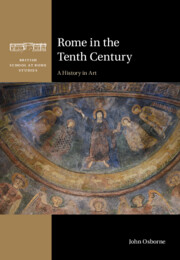
This is the third and final volume in a series examining the history of Rome in the early Middle Ages (700–1000 CE) through the primary lens of the city's material culture. The previous volumes examined the eighth and the ninth centuries respectively. John Osborne uses buildings (both religious and domestic), their decorations, other works of painting and sculpture, inscriptions, manuscripts, ceramics, metalwork, and coins as 'documents' to supplement what can be gleaned from more traditional written sources such as the Liber pontificalis. The overall approach is particularly appropriate for tenth-century Rome, which has traditionally been considered a 'dark age', given recent research on standing monuments and the large amount of new material brought to light in archaeological excavations undertaken over the last four decades. This magnificent and beautifully illustrated volume provides a triumphant conclusion to a series which will be indispensable for all those interested in early medieval Rome.
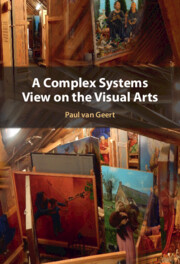
This book presents a comprehensive and unexpected approach to the visual arts, grounded in the theories of complexity and dynamical systems. Paul van Geert shows how complexity and dynamical systems theories, originally developed in mathematics and physics, offer a novel perspective through which to view the visual arts. Diverse aspects of visual arts as a practice, profession, and historical framework are covered. A key focus lies in the unique characteristics of complex systems: feedback loops bridging short- to long-term temporal scales, self-organizing into creative emergent properties; dynamics which may be applied to a wide range of topics. By synthesizing theory and empirical evidence from diverse fields including philosophy, psychology, sociology, art history, and economics, this pioneering work demonstrates the utility of simulation models in deciphering a surprisingly wide range of phenomena such as artistic (super)stardom and shifts within art historical paradigms.
This volume offers an overview of the state of the field, and shows the importance of Islamic inscriptions for disciplines such as art history, history and literature. The chapters range from surveys to detailed exploration of individual topics, providing an insight to some of the most recent cutting-edge work on Islamic inscriptions. It focuses on the period from the rise of Islam to the fifteenth century, ranging across the Islamic world from the Maghreb to India and Central Asia, and inscriptions in Arabic, Persian and Turkish.
The five sections of the book draw together some of the principal themes: 'Royal Power' investigates the role of sultanic patronage in epigraphy, and the use of inscriptions for projecting royal power. 'Piety' examines the relationship between epigraphy and religious practice. 'Epigraphic Style and Function' explores the relationship between the use of specific epigraphic styles and scripts and the function of a monument. 'Inscribed Objects' moves from monumental inscriptions to those on objects such as ceramics and pen-cases. The final section considers the interplay between inscriptions and historical sources as well as the utility of inscriptions as historical sources.
Conversion machines are apparatuses, artfully-fashioned preparations, arrangements and things that demonstrate processes of change. They are paradoxical - at once intent on verifying what was invisible, uncertain and even unknowable, while also acting as sowers of dissimulation.
This study does not seek to mechanise conversion. In many ways, conversion and the transformation of the convert will remain ineffable. Instead, this collection maintains that conversion of all kinds must unfold in ecologies that include politics, law, religious practice, the arts and the material and corporeal realms. Shifting the focus from subjectivity toward the operations of governments, institutions, artifices and the body, contributors consider how early modern Europeans suffered under the mechanisms of conversion, how they were sometimes able to realise themselves by dint of being caught up in the machinery of sovereignty, how they invented scores of new, purpose-built conversional instruments and how they experienced forms of radical transformation in their own bodies.
This book deals with the exploration and theorisation of Modern and Contemporary art of Iran through the examination of art movements and artistic practices in relation to other cultural, social and political discourses during the twentieth and twenty-first centuries. It focuses on discourses and their impact on art movements and practices and aims to selectively explore certain prevailing debates in action during this time. To come to grips with the way that artistic trends in Iran can be traced within the intellectual and political landscape of the country mainly from the 1940s to the present, the author has tried to articulate new ideas for relating art to its wider context - whether social, cultural or political - and to bring together critical and historical evidence in order to provide an insight into current artistic concerns. The book explores these underlying themes and discourses through a series of case studies, including through close scrutiny of works of artists.
Alberti was possibly in Rome by 1431; Mancini speculates by 1428. The Curia employed composers and authors and editors of papal bulls, and Alberti was employed as such. Recreated in visual topography by Poggio and Flavio, Rome’s surviving monuments would advance Alberti’s dynamic visual encounters. Giotto’s and Cavallini’s formative works in Rome further endowed the spatial avant-garde in the city of Gentile, Pisano, Masaccio, Masolino, Ghiberti, and Donatello. The textual and visual gifts gleaned from Padua, Bologna, and northern Europe would evolve into Rome’s validation of all prescriptions in De pictura.
University experience in the 1420s resulted in two nervous breakdowns. No document attests to Alberti’s having been graduated; records are lost, rendering precise knowledge of curricula impossible. Ironically, the university’s primary endowment would be his discontent. Subsequent movement is speculation. Nonetheless, after honing rhetoric and optics – begun in Padua – Alberti finished the play Philodoxeos fabula and his confessional De commodis litterarum atque incommodis – both germane to the pursuit of glory. Visual art exposure evolved with antique motifs of Nicola Pisano and Jacopo della Quercia. Employed by Cardinal Niccol Albergati, Alberti would thence travel to northern Europe and confront the pictorial-architectural innovation there, further impacting prescriptions in De pictura.
Accordingly, the inquiry endures as to what specific art galvanized the modern world’s original treatise on painting. How Alberti’s remarkable journey through the art of his past and present is both reflected and refracted in De pictura demands examination of the lines of transmission through education and career in Alberti’s decisive locales before Florence.
The civic-historical sweep of Padua – from late 1200s republican commune through Carrara domination in the 1300s to final subjugation by Venice in 1405 – delivered a cultural revival in classical text and pedagogy. As humanism would affect art, so Alberti would give that lexicon to an erudite audience. Examining Alberti’s education in Padua reveals the context of what he read that became the source for De pictura and how antique and medieval texts began to inform its vocabulary. Illustrious teachers imbued Alberti, firsthand, with humanism: his instructor from about 1412 to 1420, Gasparino Barzizza, and his exceptional school, as well as dynamic associates Guarino da Verona and Vittorino da Feltre attended to the classical literature, mathematical precepts, monuments, and painting that would engender De pictura.
Alberti never mentions Florence in De pictura. This is intentional as the tract not so much ignores as merely suggests previous periods of art, and Alberti’s refusal to specify those interludes, such as Romanesque, Gothic, or medieval, reflects the need for a humanist audience to have all precepts couched in the domain of antiquity. His cryptic indication of sources consequently demands forensic scrutiny of his visual paradigm before Florence. The text itself invites this. In the face of no hard evidence or documentation, Alberti’s claim in De pictura to be an ostensible painter begs the query as to where or with whom he began his study of draftsmanship, either in the studio or in practice. Although he had left Padua for Bologna by 1420, conjecture suggests that while in Padua he may have seen and even studied the art of genius before and contemporary to his age.
This chapter paints the political and intellectual backdrop of Padua in the 1300s, which sets the stage for Alberti’s education. While Rolandino, Lovato, and Mussato were intellectual giants of a commune, Petrarch, Conversino, and Vergerio were literary giants at a court – that of Francesco Il Vecchio da Carrara, a patron of classical medals, art, and humanist educators and antiquarians. Accordingly, five factors made Padua a center of early humanism: independent university faculty, accession of classical rhetoric, Petrarch and his library, Carrara’s support for educators and antiquarians, and the city’s absorption by Venice, allowing unfettered education to gift Alberti a literary and visual universe.
By 1434, Alberti was in Florence in employ of Pope Eugenius IV, who would also facilitate the return from exile of Cosimo de’ Medici. The art of Florence would ensure Alberti’s rhetorical high notes in De pictura. Alberti’s popularity lies in his invitation to art, not in its execution. Art theory has never perpetuated art process; organic continuum precedes intellectual reflection. The genesis of De pictura, our first modern book on painting, derives from the personal passion of Leon Battista Alberti in the humanist classroom and attendance before the visual majesty of Padua, Bologna, northern Europe, and Rome – witnessed by the acute eye of an illegitimate son, born in exile.