To save content items to your account,
please confirm that you agree to abide by our usage policies.
If this is the first time you use this feature, you will be asked to authorise Cambridge Core to connect with your account.
Find out more about saving content to .
To save content items to your Kindle, first ensure no-reply@cambridge.org
is added to your Approved Personal Document E-mail List under your Personal Document Settings
on the Manage Your Content and Devices page of your Amazon account. Then enter the ‘name’ part
of your Kindle email address below.
Find out more about saving to your Kindle.
Note you can select to save to either the @free.kindle.com or @kindle.com variations.
‘@free.kindle.com’ emails are free but can only be saved to your device when it is connected to wi-fi.
‘@kindle.com’ emails can be delivered even when you are not connected to wi-fi, but note that service fees apply.
Regina Everitt: Let's start with your experience of using academic libraries.
Neil Everitt: As a mature student at Birkbeck, University of London, I used the library spaces as the transition from work to study, to take time to breathe, to catch up, before evening lectures. This (precious) 45 minutes or so, three times a week, gave me the opportunity to have some ‘me time’, important to an introvert, and replenish my energy reserves before the evening lectures.
The library also created a connection with the University ‘space’. This may have been replaced by other spaces such as the Students’ Union if I had been studying full time perhaps – but the library was an important element of how I remember my Birkbeck experience. Another major element of that experience was the support provided to utilise the resources available through the library and aid my transition into academic study.
Later, studying at Cranfield University, the space in and around the library was used to collaborate as part of small study teams, as part of a larger cohort of students, designed to replicate the way teams operate in organisations. The study teams provided support to their members by dividing the workload, and working together on projects and case studies, and created natural competition between the study teams. The teams were given free rein to utilise the variety of spaces available at the University, but speed was needed to bag the most appropriate space for the task, to avoid five tired and over-caffeinated individuals huddling around a single laptop screen as a spreadsheet was analysed or last-minute tweaks to a presentation were agreed.
Dietterlin and other Renaissance artists supported an empirical approach to architectural image-making, one that emerged in treatises like Dietterlin’s Architectura. Such treatises became sites of conflict between rationalist and empirical mathematical traditions, with Dietterlin’s mixed arithmetic and geometrical design procedures marking a pivotal turn toward empiricism. The development of prints in architectural texts – from geometrical illustrations in masonic incunables to Dürer’s 1525 Lesson on Measurement and archaeological renderings by Sebastiano Serlio, Philibert De L’Orme, and Hans Blum – shows how Dietterlin and his contemporaries increasingly rejected received knowledge in favor of the empirical epistemology also practiced by period artists and natural philosophers. As architectural treatises shifted from rationalist to empirical approaches to architectural design, they aligned architecture with the empirical culture of Renaissance image-making exemplified in Dietterlin’s Architectura.
My son visited his mates in their first year of university. Upon his return, I was keen to hear what they thought about the campus. Having been to the University for a meeting, I was aware that it had a large, modern library with fantastic courtyard views over lush gardens. Although one of my university libraries has a wonderful view overlooking the Royal Albert Docks in London, I confess to having a bit of garden envy.
‘Good weekend?’ I asked. ‘Yeah, good,’ he said in near-monosyllabic detail. ‘They have a great library,’ I said, foraging for a more textured response. He is used to excitement about libraries from me. He has what I hope are fond memories of whiling away the time in the children's section in the local public library, flipping through picture books.
‘Oh, I don't even think they know where that is,’ he laughed.
Well, it's there when they discover they need it, I thought to myself. Unsurprisingly, in the heady, early days of university life, the ‘perceived value’ of the university library may not be obvious to some students. However, as course demands set in (such as the need for learning resources, study spaces and research skills development), the library's value comes to the fore. Bain & Company Inc. identify 30 elements of value for customers, and group them on a pyramid in four categories: functional, emotional, life changing and social impact – like Maslow's hierarchy of needs (Almquist et al., 2016). The functional or lowest rung of the ladder covers basic needs.
In his essay-manifesto of 1999, Zenon Fajfer defined liberature - a literary genre encompassing works whose authors intentionally design the shape of the book, so that it matches their textual message. Extending beyond the growing literary research on liberature, this book presents the theatrical contexts of the genre. Grounded in original archival research, it discusses the theatre practice of Zenon Fajfer and Katarzyna Bazarnik (Zenkasi), as well as the post-war British avant-garde author, B. S. Johnson, whom they see as a liberatic author avant la lettre. Tracking the connections between their work in different media, the monograph considers how their theatrical experience may be related to the invention of unconventional aesthetic solutions in literature.
Krzysztof Pleśniarowicz draws differences between Western and Eastern European absurdism, points out similarities and adjacencies, and emphasises the function fulfilled by the theatre of the absurd in Eastern Europe: the representation of the drama of a man deprived of freedom. The author of this important book shows absurdity in the dramas of the 1980s 'at the end of the Soviet bloc' as the only possibility of dramatic-theatrical embodiment of realism, as a metaphor for reality.
The contributors to this timely volume explore the philosophical underpinnings and cinematic techniques characteristic of contemporary Iranian film. Collectively, they demonstrate how the pervasive themes of Iranian cinema 'such as martyrdom and war, traditional gender roles and their recent subversion, as well as broader social policy issues' have been addressed and how various directors, including the acclaimed Abbas Kiarostami, have approached them using a variety of techniques. Capturing the unique poetic and mystical dimensions of Iranian cinema, these essays consider the effects of the Islamic Revolution on cinema's ethical and aesthetic aspects.
This agenda-setting volume disrupts conventional notions of time through a robust examination of the relations between temporality, infrastructure and urban society. With global coverage of diverse cities and regions from Berlin to Jayapura, this book re-evaluates the temporal complexities that shape our infrastructured worlds.
This book highlights the important creative work of Belarusian theatre and filmmakers seeking to raise awareness of the Pro-democracy movement and human rights abuses in Belarus and to build communities of care and mourning following the fraudulent 2020 presidential elections in Belarus. Examining the work of the Belarus Free Theatre, Andrei Kureichik, and the Kupalautsy Theatre, it demonstrates how documentary theatre, adaptation, and digital theatre have enabled displaced, dissident artists to form international communities to support Belarusian dissidents in these fraught times.
This work is a fascinating attempt to probe deep into the socio-cultural ramifications of the visual artefacts of ancient India, which has a rich heritage of iconographic treasures of varying sizes and styles. The art objects selected for analysis are mainly from the Mathura region of the Kushan era and belong to a period between 50 - 60 and 300 of the Common Era. This period is perceived as that of 'multicultural environment' enriched with different streams of tradition. According to the author they are directly related to the themes of abundance and fertility, its perceived cause. The author demonstrates how these distant fragments of visual imagery can yield rich insights of the world view of the communities which produced them. The work critically analyses the representation of 'spiritual deities' consisting of Ekanamsha, Hariti, Matrikas, Naigamesha, Shashthi and Skanda who were associated with the function of child protection. Understandably, they were the products of a belief in supernatural powers which could offer psychological protection to women cutting across different socio-economic classes at the times of great psychological stress like pregnancy, childbirth and puerperium. The artefacts are carved in stone. Sometimes they are projected as isolated individuals and at other times as belonging to multi-character panels. Depending on their size, they had different functions: bigger objects could be fixed at some places and smaller ones carried from place to place.
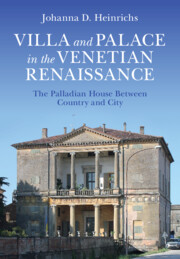
Designed by Andrea Palladio, the Villa Pisani at Montagnana was the country residence of a Venetian nobleman, Francesco Pisani. Unusually, its design combines features of both villa and palace architecture, and it challenges the conventional view of a villa as subsidiary to the urban palace, the true seat of an elite family. In this book, Johanna D. Heinrichs offers the first comprehensive study of the Villa Pisani, providing a critical analysis of Palladio's hybrid design, the villa's original setting and uses, and the preoccupations of its patron. Heinrichs argues that the Villa Pisani served as the owner's principal residence. She also shows how a microhistorical approach can provide new insights about a familiar Renaissance building type and about the theory and practice of a canonical architect. Based on scrutiny of original documents and visual sources, Heinrichs's study is supported by a rich illustration program composed of photographs, plans, maps, and digital reconstructions.
When the authors contacted me about writing an afterword for this volume, I was immediately excited to use the opportunity to take another glimpse into the rock art world of Australia – an area I am only peripherally involved in nowadays. It has been a while since I spent time in Gunbalanya in western Arnhem Land. With Injalak Hill as a backdrop, and a billabong out the back door, my time there was pleasurable and full of wonderment at the abundance of rock art and the community that nurtured the art and that was, in turn, nurtured by the art. It’s been much too long since I was ‘on Country’ – June 2009 was my last visit ‘up top’ to see Kojan and other friends and mates. To my Jawoyn relatives in Barunga and Beswick I am bangardi.
Academic disciplines, and especially history and archaeology, presume that a particular kind and experience of time is normal and universal. Although deeply concerned with history, rock art confounds ‘settler-time’ and the temporalities assumed by academic disciplines. This chapter considers the ‘re-appearance’ of ever-present buffalos in west Arnhem art, as well as the ever-presence of seemingly ‘disappeared’ art to reveal how the knowledge on the rocks points to alternative ways of experiencing time.