To save content items to your account,
please confirm that you agree to abide by our usage policies.
If this is the first time you use this feature, you will be asked to authorise Cambridge Core to connect with your account.
Find out more about saving content to .
To save content items to your Kindle, first ensure no-reply@cambridge.org
is added to your Approved Personal Document E-mail List under your Personal Document Settings
on the Manage Your Content and Devices page of your Amazon account. Then enter the ‘name’ part
of your Kindle email address below.
Find out more about saving to your Kindle.
Note you can select to save to either the @free.kindle.com or @kindle.com variations.
‘@free.kindle.com’ emails are free but can only be saved to your device when it is connected to wi-fi.
‘@kindle.com’ emails can be delivered even when you are not connected to wi-fi, but note that service fees apply.
The ambiguous relationship between wealth and morality had implications for the social and political role of the vir bonus. It took more than wealth to be a vir bonus; he also had to embody a number of other characteristics, including integrity and gravitas, and adhere to a particular dignified lifestyle. These demands meant that some men of substance did not count as proper boni in its full sense of ‘good’ and might find their status challenged. A passage in Cicero’s Pro Flacco sums up who qualified as a vir bonus and who did not. He contrasts ‘viros bonos gravisque homines’ with a ‘homini egenti, sordido, sine honore, sine existumatione, sine censu’, Flac. 52. His second, negative definition of bonus is revealing and shows that a combination of qualities was required. Wealth was the obvious precondition (census), but he also had to be satisfied with his resources (i.e. not being egens). In addition, he had to be a man of honour (honos) and enjoy general esteem and a good reputation (existumatio).
‘Boni’ is one of the most common terms in the political vocabulary of the Roman republic during the last century BCE. While this is also the period from which most of our surviving sources derive, Cicero – and his correspondents – employ ‘boni’ to describe this group, usually in political contexts, no fewer than 470 times – occasionally in variations such as boni viri or, more rarely, boni cives (see Appendix 1). This figure may be compared to the occurrence of the much–debated ‘optimates’, whom Cicero mentions just seventy-five times.1 In contrast to ‘optimates’ – and despite their prominence in the political discourse – ‘boni’ hardly feature in modern discussions of Roman society and politics. There has been little scholarly interest in the term itself or in the people it describes; no comprehensive study of this group is currently available.2 The scant attention paid to the boni may be explained by several factors, although two stand out as particularly significant. Chief among them is their common integration into the traditional ‘party model’ of Roman politics, which has provided the default framework for interpreting the boni.
The social role of the vir bonus explored in the previous chapter carried over into the public realm, where this figure was invested with moral qualities almost identical to those applied in the private sphere. Thus, being a bonus in the public domain involved a very similar set of expectations, with the only real difference being the setting in which the role was performed. The essential qualities of the public vir bonus were therefore entirely predictable and uncontentious. He was a decent and honest citizen, sound, reliable and responsible. Towards his fellow citizens and the common weal, he was innocens, never causing harm to either. As such he emerges as a figure who embodies trust, dependability and common good sense. As a responsible citizen, he is law-abiding, follows the rules and conventions and respects the authorities, temporal as well as divine. These fundamental characteristics were summed up in a fragment of one of Varro’s satires, which describes the duties of a civis bonus as ‘obeying the laws and honouring the gods’.1 The emphasis on adherence to the laws recurs in Horace’s portrayal of the vir bonus as one who ‘observes the senate’s decrees, the statutes and laws’, and in Cicero’s definition, presented in the De finibus, of the ‘good and wise man who obeys the laws and is aware of his civic duties’.2
The basic distinction in Roman politics between boni and improbi carried a distinctly material aspect; for despite its moralising nature, it remained firmly rooted in the socio-economic realities of late republican society. Improbitas was closely associated with cupiditas and egestas – ‘greed’ and ‘poverty’, which became standard charges against political opponents; indeed, almost all protagonists appear to have been accused of financial improprieties of some form or other.1 The disruptive actions of improbi were routinely presented as property-related – be it their own dwindling resources or the tempting estates of the viri boni. The result was two socio-political archetypes, neatly summed up in Cicero’s description of Naevius’ associate in the Pro Quinctio, who was not a ‘hominem egentem … improbum’, but an ‘eques Romanus locuples, sui negotii bene gerens’, a ‘rich Roman eques, who conducted his business well’, 62.
The elite in the Roman world was defined largely by financial criteria. It therefore comes as no surprise that ‘boni’ could be employed generically to describe the upper classes that held power by virtue of their superior wealth and resources. In this sense it was not confined to Roman contexts (let alone to its domestic politics) but could, as a purely social descriptor, be applied to the elites of any community past and present, whether in Italy, the provinces or further beyond. Already the elder Cato had described the local magistrates in Bruttium as boni, and in a letter from 46, Cicero asked M. Brutus to lend his patronage to the Arpinates, assuring him it would secure the support of the local boni viri.1 Later Cornelius Nepos referred to the leading men of Sparta as ‘viros bonos nobilesque’, implying it was a standard term for the elite of any society without specific connotations to the Roman republic, Them. 7.2. He also stated that the Athenian volunteer forces of Thrasybulus grew less than expected, ‘for even in those days the boni were readier to speak for liberty than to fight for it’.2
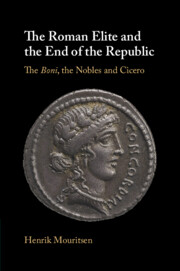
The boni, the wealthy, but largely non-political, section of the Roman elite, have hitherto escaped scholarly attention. This book draws a detailed and rounded picture of the boni, their identity, values and interests, also tracing their – often tense - relationship to the political class, whose inner circle of noble families eventually lost their trust and support. Concerns about property played a central part in this process, and the book explores key Roman concepts associated with property, including frugality, luxury, patrimony, debt and the all-important otium that ensured the peaceful enjoyment of private possessions. Through close readings of Cicero and other republican writers, a new narrative of the 'fall of the republic' emerges. The shifting allegiances of the wider elite of boni viri played an important part in the events that brought an end to the republic and ushered in a new political system better attuned to their material interests.
The introduction gives an overview of the book’s aim and the conceptual approach to its topic. The subject is the particular way in which the Greeks, in the context of their general project of understanding the world, have made sense of their past. That means it is about history as an element of Greek culture. The concept with which the subject is dealt with is that of intentional history, which is based on the theories of Maurice Halbwachs and Aleida and Jan Assmann on collective memory and social remembrance. With ‘intentional history’, I refer to that part of history that is relevant to the collective identity of social groups of all sizes. This concept allows statements to be made across cultures and epochs and thus makes it possible to draw a connection from antiquity to modernity.
This chapter synthesizes the book's arguments in a concluding discussion that brings the world of Archaic Cyprus into more substantive conversation on approaches to human-environment relationships writ large, from the horizons of eighth- and seventh-century BCE transformation across the Mediterranean to our contemporary struggles to conceptualize future triangulations of social and environmental change. It first summarizes the explanations for the settlement and land use patterns discernible in the material records from the Vasilikos and Maroni valleys, articulating local heterogeneities with signs of social inequality at the coastal town of Amathus. It then provides a hypothesis for the growth of social complexities during the Iron Age, driven by land management. Finally, Kearns contends that the Archaic countrysides of Cyprus also matter to conversations happening amongst scholars of the humanities, social sciences, and natural sciences, as well as broader public audiences, on the seemingly threatening mediations of society and inequality that our current climatic regimes, and the unruly Anthropocene, present.
The swift Arab conquest of Palestine, Syria, and Egypt, between 633 and 643 CE, triggered long-term processes of change in the region, among them the introduction of new settlement structures, architectural concepts, and patterns of commercial exchange. A gradual transformation in types of pottery, glass, and metal vessels has been observed, including the development of new types and technologies. The archaeological record indicates that large regions in the Near East benefited from the establishment of the new Muslim empire, which was also expressed in the intensification of commercial contacts, particularly between Egypt, Palestine, and Syria.1
This chapter addresses the intensified connectivity between Palestine and Egypt after the Arab conquests on two main levels. First, artifacts are presented as indicators of commercial contacts and of the movement of people. Numerous excavations in modern Israel, the Palestinian Authority, Jordan, and Syria have yielded artifacts manufactured in Egypt or presenting Egyptian influences in style and production, such as pottery, glass and metal vessels, jewelry, and textiles.
Until comparatively recently it was common for historians of the ancient and medieval periods to treat Egypt as a world unto itself which was only partially drawn into the broader political and cultural currents of the Mediterranean first by the “fiery genius of Alexander” (as Harold Idris Bell put it), and then by the imperial ambitions of Rome, which effectively treated it as a colony.1 Even for much of its Roman history, it was claimed, Egypt stood apart in terms of language, culture, religion, and social and economic institutions, inheriting a particularist legacy that placed it at some remove from the mainstream of Greco-Roman culture, and which would be bequeathed in the Islamic period to the haughty patriarchs of the Coptic Church.
In this chapter, Kearns traces the novel politics and communities developing in the neighboring Vasilikos and Maroni river valleys, to the east of the town of Amathus. Their commonly described position as a marginal hinterland provides an opportunity to explore rural dynamics at multiple registers. Survey data and rescue excavations form an evidentiary dataset with which to interrogate the generative ties between clusters of settlements and Amathus that produced unruliness across variable and interconnected scales. One critical theme is continuity and impermanence, and the differentiated patterns of access, appropriation, and management taken up by groups returning to sites of prehistoric and protohistoric occupation. Another is social stratification, which entails the development of local autonomous figures, potential community leaders, or members with elevated status. These actors advanced special relationships with Amathusian authorities and local groups through the construction of gathering places such as cemeteries and shrines. The chapter situates these dynamics in habitation, non-quotidian activity, and land use within a framework of a small near-shore world entangling rural sites with maritime economies.