To save content items to your account,
please confirm that you agree to abide by our usage policies.
If this is the first time you use this feature, you will be asked to authorise Cambridge Core to connect with your account.
Find out more about saving content to .
To save content items to your Kindle, first ensure no-reply@cambridge.org
is added to your Approved Personal Document E-mail List under your Personal Document Settings
on the Manage Your Content and Devices page of your Amazon account. Then enter the ‘name’ part
of your Kindle email address below.
Find out more about saving to your Kindle.
Note you can select to save to either the @free.kindle.com or @kindle.com variations.
‘@free.kindle.com’ emails are free but can only be saved to your device when it is connected to wi-fi.
‘@kindle.com’ emails can be delivered even when you are not connected to wi-fi, but note that service fees apply.
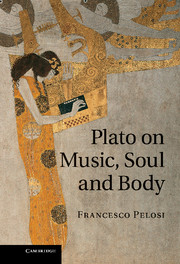
Plato's reflection on the relationship between soul and body has attracted scholars' attention since antiquity. Less noted, but worthy of consideration, is Plato's thought on music and its effects on human beings. This book adopts an innovative approach towards analysing the soul-body problem by uncovering and emphasising the philosophical value of Plato's treatment of the phenomenon of music. By investigating in detail how Plato conceives of the musical experience and its influence on intelligence, passions and perceptions, it illuminates the intersection of cognitive and emotional functions in Plato's philosophy of mind.
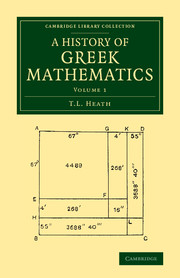
'If one would understand the Greek genius fully, it would be a good plan to begin with their geometry.' As early as the sixth century BCE, Thales of Miletus used geometrical principles to calculate distance and height. Within a few hundred years, Euclid had produced his seminal Elements, which was still used as a textbook when this two-volume work was first published in 1921. A distinguished civil servant as well as an expert on ancient Greek mathematics, Sir Thomas Little Heath (1861–1940) includes here sufficient detail for a modern mathematician to grasp ancient methodology, alongside explanatory sections aimed at classicists. This remains a rigorous and essential exposition of a vast topic. Volume 1 includes an introduction that touches on the conditions which made possible the rapid development of philosophy and science in ancient Greece. The coverage begins with Thales and ends with Euclid.
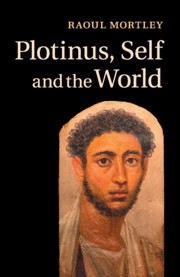
Plotinus, Self and the World addresses the question of the individual subject in its relationship with the world, the 'all'. It traces the self through its experience of memory and forgetfulness, looks at whether the idea of the subconscious exists in Plotinus, and notes the probable impact of Plotinus' thought on the development of the autobiography, in the form of Augustine's Confessions. Augustine historicises the Plotinian individual self. The book reinterprets the idea of to oikeion in Plotinus and places great emphasis on the importance of the idea of 'having', and the ability to possess is itself linked to being: thus we are close to the idea of personal authenticity. Lastly the book examines Plotinus' view of images and art, and notes his respect for the beauty of the human face. His positive view of the physical world is stressed.
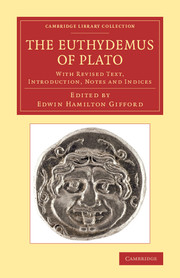
Headmaster of King Edward's School in Birmingham for fourteen years, Edwin Hamilton Gifford (1820–1905) also held a number of ecclesiastical posts, including select preacher at both Cambridge and Oxford. Better known for his biblical and patristic scholarship, he also prepared this edition of the Euthydemus, Plato's most comical dialogue. Thought to be an early work, depicting a discussion between Socrates and two sophists trained in eristic (argument for the sake of conflict), it is among the earliest-known treatises on logic, satirising various fallacies that were subsequently categorised by Aristotle. Published in 1905, a generation after Jowett's standard translation, this edition was intended for university and advanced school students. A thorough introduction is given in English, followed by the Greek text, extensive notes, and indexes of vocabulary and names. As such, this reissue illuminates the educational preoccupations of both early twentieth-century England and classical Athens.
One of the most widely studied texts of ancient philosophy and politics, Plato's Laws is his last and most substantial dialogue, debating crucial questions on the subject of law-giving and education. This two-volume edition of 1921 was prepared by the classicist Edwin Bourdieu England (1847–1936), who describes the dialogue as 'the treasury of pregnant truths which Plato in extreme old age left … as his last legacy to humanity'. Generally held to have been written after Plato's failed attempt to influence Syracusan politics, it concerns the just city and its constitution, including discussions of divine revelation, the role of intelligence in the creation of laws, and natural law itself. This edition comprises a short introduction, England's helpful analyses, the Greek text of the dialogue, and extensive notes. Volume 2 is devoted to Books 7–12. It also includes indexes of subjects and Greek words.
One of the most widely studied texts of ancient philosophy and politics, Plato's Laws is his last and most substantial dialogue, debating crucial questions on the subject of law-giving and education. This two-volume edition of 1921 was prepared by the classicist Edwin Bourdieu England (1847–1936), who describes the dialogue as 'the treasury of pregnant truths which Plato in extreme old age left … as his last legacy to humanity'. Generally held to have been written after Plato's failed attempt to influence Syracusan politics, it concerns the just city and its constitution, including discussions of divine revelation, the role of intelligence in the creation of laws, and natural law itself. This edition comprises a short introduction, England's helpful analyses, the Greek text of the dialogue, and extensive notes. Volume 1 is devoted to Books 1–6.
This is the first book to provide an account of the influence of Proclus, a member of the Athenian Neoplatonic School, during more than one thousand years of European history (c.500–1600). Proclus was the most important philosopher of late antiquity, a dominant (albeit controversial) voice in Byzantine thought, the second most influential Greek philosopher in the later western Middle Ages (after Aristotle), and a major figure (together with Plotinus) in the revival of Greek philosophy in the Renaissance. Proclus was also intensively studied in the Islamic world of the Middle Ages and was a major influence on the thought of medieval Georgia. The volume begins with a substantial essay by the editor summarizing the entire history of Proclus' reception. This is followed by the essays of more than a dozen of the world's leading authorities in the various specific areas covered.
'If one would understand the Greek genius fully, it would be a good plan to begin with their geometry.' As early as the sixth century BCE, Thales of Miletus used geometrical principles to calculate distance and height. Within a few hundred years, Euclid had produced his seminal Elements, which was still used as a textbook when this two-volume work was first published in 1921. A distinguished civil servant as well as an expert on ancient Greek mathematics, Sir Thomas Little Heath (1861–1940) includes here sufficient detail for a modern mathematician to grasp ancient methodology, alongside explanatory sections aimed at classicists. This remains a rigorous and essential exposition of a vast topic. Volume 2 focuses on post-Euclidian mathematics, beginning with the work of Aristarchus of Samos and extending to that of Diophantus of Alexandria. Heath had previously published separate studies on these two thinkers (also reissued in this series).
Published in 1879, this Latin dissertation was the first substantial work on Archimedes by the Danish philologist and historian Johan Ludvig Heiberg (1854–1928), who the following year embarked on editing the three-volume Archimedis Opera Omnia (also reissued in this series). Much later, in 1906, he discovered a palimpsest containing previously unknown works by the Greek mathematician. The Quaestiones includes chapters on the life of the famous scientist of Syracuse, a discussion of his works and explanations of his mathematical and scientific ideas, as well as a survey of the extant codices known to the author. It also contains the Greek text, edited and annotated by Heiberg, of Archimedes' Psammites (The Sand Reckoner), a mathematical enquiry into how many grains of sand would fit in the universe. This includes mention of a heliocentric solar system, speculation about the size of the Earth, and Archimedes' other views on astronomy.
Published in 1880–1, this three-volume edition of the extant works of the Greek mathematician Archimedes of Syracuse (c.287–c.212 BCE) was edited by the Danish philologist and historian Johan Ludvig Heiberg (1854–1928), whose Quaestiones Archimedeae (1879) is also reissued in this series. He later discovered a medieval palimpsest containing lost works by Archimedes, which significantly expanded the canon, but the present collection was produced long before this and therefore contains the works known at the time of publication. Heiberg consulted a Florentine codex, which he painstakingly compared with other sources to produce his edition. This third volume contains the editor's Latin prolegomena - his own extended essay on the works of Archimedes - followed by the commentaries on Archimedes by Eutocius of Ascalon (c.480–c.540) and indexes. The texts are given in the original Greek with parallel Latin translation, notes and introductory material.
The Greek mathematician Diophantos of Alexandria lived during the third century CE. Apart from his age (he reached eighty-four), very little else is known about his life. Even the exact form of his name is uncertain, and only a few incomplete manuscripts of his greatest work, Arithmetica, have survived. In this impressive scholarly investigation, first published in 1885, Thomas Little Heath (1861–1940) meticulously presents what can be gleaned from Greek, Latin and Arabic sources, and guides the reader through the algebraist's idiosyncratic style of mathematics, discussing his notation and originality. This was the first thorough survey of Diophantos' work to appear in English. Also reissued in this series are Heath's two-volume History of Greek Mathematics, his treatment of Greek astronomy through the work of Aristarchus of Samos, and his edition in modern notation of the Treatise on Conic Sections by Apollonius of Perga.