To save content items to your account,
please confirm that you agree to abide by our usage policies.
If this is the first time you use this feature, you will be asked to authorise Cambridge Core to connect with your account.
Find out more about saving content to .
To save content items to your Kindle, first ensure no-reply@cambridge.org
is added to your Approved Personal Document E-mail List under your Personal Document Settings
on the Manage Your Content and Devices page of your Amazon account. Then enter the ‘name’ part
of your Kindle email address below.
Find out more about saving to your Kindle.
Note you can select to save to either the @free.kindle.com or @kindle.com variations.
‘@free.kindle.com’ emails are free but can only be saved to your device when it is connected to wi-fi.
‘@kindle.com’ emails can be delivered even when you are not connected to wi-fi, but note that service fees apply.
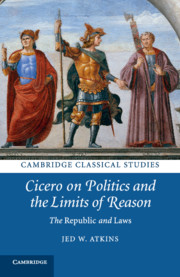
A prolific philosopher who also held Rome's highest political office, Cicero was uniquely qualified to write on political philosophy. In this book Professor Atkins provides a fresh interpretation of Cicero's central political dialogues - the Republic and Laws. Devoting careful attention to form as well as philosophy, Atkins argues that these dialogues together probe the limits of reason in political affairs and explore the resources available to the statesman given these limitations. He shows how Cicero appropriated and transformed Plato's thought to forge original and important works of political philosophy. The book demonstrates that Cicero's Republic and Laws are critical for understanding the history of the concepts of rights, the mixed constitution and natural law. It concludes by comparing Cicero's thought to the modern conservative tradition and argues that Cicero provides a perspective on utopia frequently absent from current philosophical treatments.
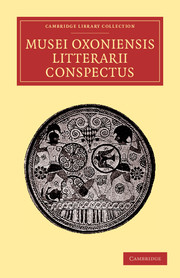
The idea for this periodical, first mooted by Thomas Burgess (1756–1837), who was then a classical scholar at Oxford, in correspondence with Thomas Randolph, the university's vice-chancellor, was initially rejected. Seemingly the inclusion of English text was too radical at a time when Latin was still standard. Nevertheless, two issues, reissued in this volume, were published between 1792 and 1797. Burgess had, however, curtailed his scholarly career in 1791, following his ecclesiastical patron, Shute Barrington, north to Durham. Henceforth he concentrated on his church work, becoming in 1803 bishop of St David's - where he promoted the use of Welsh in his parishes - and subsequently of Salisbury. This volume, which includes papers on both Ancient Greek and New Testament texts, illuminates the close relationship between classical scholarship and Anglicanism in the period, as well as the fitful early development of specialist academic journals - a genre not fully established until the late nineteenth century.
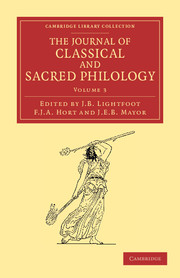
Contemporaries as Cambridge undergraduates in the late 1840s, Joseph Barber Lightfoot (1828–89), Fenton John Anthony Hort (1828–92), and John Eyton Bickersteth Mayor (1825–1910) all went on to distinguished careers. Mayor, a classical scholar, became President of St John's, while Lightfoot and Hort - members, along with Brooke Foss Westcott (1825–1901) of the 'Cambridge triumvirate' - were eventually appointed respectively Bishop of Durham and Lady Margaret Professor of Divinity at Cambridge. This short-lived triannual journal, which they founded and edited from 1854 to 1859, is interesting both for its combination of classical and patristic material, illuminating the close relationship between theology and classics in the period, and as an example from the early history of academic journals, an emerging genre which would develop into its current form over the following decades. Volume 3, published in 1857, contains the previous year's issues and two responses concerning 'the Route of Hannibal'.
Plato was central both to the genesis of Stoic theory and to subsequent debates within the Stoa. These essays provide new and detailed explorations of the complex relationship between Plato and the Greek and Roman Stoic traditions, and together they show the directness and independence with which Stoics examined Plato's writing. What were the philosophical incentives to consulting and then returning to Plato's dialogues? To what extent did Plato, rather than Xenophon or Antisthenes, control Stoic reconstructions of Socrates' ethics? What explains the particular focus of Stoic polemic against Plato, and how strong is the evidence for a later reconciliation between Plato and Stoicism? This book will be important for all scholars and advanced students interested in the relationship between a major philosopher and one of the most important philosophical movements.
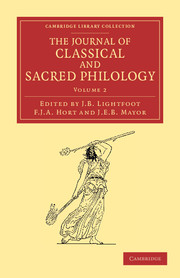
Contemporaries as Cambridge undergraduates in the late 1840s, Joseph Barber Lightfoot (1828–89), Fenton John Anthony Hort (1828–92), and John Eyton Bickersteth Mayor (1825–1910) all went on to distinguished careers. Mayor, a classical scholar, became President of St John's, while Lightfoot and Hort - members, along with Brooke Foss Westcott (1825–1901), later Regius Professor of Divinity, of the 'Cambridge triumvirate' - were eventually appointed respectively Bishop of Durham and Lady Margaret Professor of Divinity at Cambridge. This short-lived triannual journal, which they founded and edited from 1854 to 1859, is interesting both for its combination of classical and patristic material, illuminating the close relationship between theology and classics as disciplines in the period, and as an example from the early history of academic journals, an emerging genre which would develop into its current form over the following decades. Volume 2, published in 1855, contains the year's three issues.
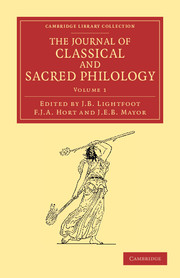
Contemporaries as Cambridge undergraduates in the late 1840s, Joseph Barber Lightfoot (1828–89), Fenton John Anthony Hort (1828–92), and John Eyton Bickersteth Mayor (1825–1910) all went on to distinguished careers. Mayor, a classical scholar, became President of St John's, while Lightfoot and Hort - members, along with Brooke Foss Westcott (1825–1901), later Regius Professor of Divinity, of the 'Cambridge triumvirate' - were eventually appointed respectively Bishop of Durham and Lady Margaret Professor of Divinity at Cambridge. This short-lived triannual journal, which they founded and edited from 1854 to 1859, is interesting both for its combination of classical and patristic material, illuminating the close relationship between theology and classics as disciplines in the period, and as an example from the early history of academic journals, an emerging genre which would develop into its current form over the following decades. Volume 1, published in 1854, contains the year's three issues.
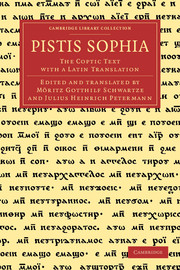
Published in 1851, this edition of an important second-century Gnostic work presents the Coptic text derived from codices held in the British Museum and originally ascribed to the authorship of a certain Valentinus. These manuscript sources were scrutinised and translated into Latin by the German scholar Möritz Gotthilf Schwartze (1802–48) at the behest of the king of Prussia, but he died before the book could be completed. The task of preparing Schwartze's work for publication fell to Julius Heinrich Petermann (1801–76), professor of oriental literature at the University of Berlin. The arcane and difficult text describes esoteric Gnostic teachings which - just as in the traditional Gospels - are delivered by Jesus to his disciples. At the beginning, he is said to have spent eleven years after the resurrection teaching them this mysterious higher knowledge. Both the annotated Coptic text and Schwartze's Latin translation are frequently interspersed with Greek.
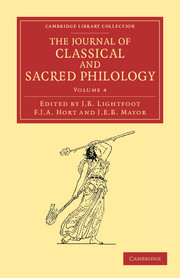
Contemporaries as Cambridge undergraduates in the late 1840s, Joseph Barber Lightfoot (1828–89), Fenton John Anthony Hort (1828–92), and John Eyton Bickersteth Mayor (1825–1910) all went on to distinguished careers. Mayor, a classical scholar, became President of St John's, while Lightfoot and Hort - members, along with Brooke Foss Westcott (1825–1901) of the 'Cambridge triumvirate' - were eventually appointed respectively Bishop of Durham and Lady Margaret Professor of Divinity at Cambridge. This short-lived triannual journal, which they founded and edited from 1854 to 1859, is interesting both for its combination of classical and patristic material, illuminating the close relationship between theology and classics in the period, and as an example from the early history of academic journals, an emerging genre which would develop into its current form over the following decades. Volume 4, published in 1859, contains the 1857–9 issues.