To save content items to your account,
please confirm that you agree to abide by our usage policies.
If this is the first time you use this feature, you will be asked to authorise Cambridge Core to connect with your account.
Find out more about saving content to .
To save content items to your Kindle, first ensure no-reply@cambridge.org
is added to your Approved Personal Document E-mail List under your Personal Document Settings
on the Manage Your Content and Devices page of your Amazon account. Then enter the ‘name’ part
of your Kindle email address below.
Find out more about saving to your Kindle.
Note you can select to save to either the @free.kindle.com or @kindle.com variations.
‘@free.kindle.com’ emails are free but can only be saved to your device when it is connected to wi-fi.
‘@kindle.com’ emails can be delivered even when you are not connected to wi-fi, but note that service fees apply.
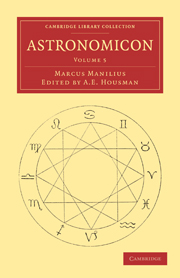
Both the author and the date of this five-volume poem, the first Western document to link the houses of the zodiac with the course of human affairs, are uncertain. The author's name may be Marcus Manilius, or Manlius, or Mallius, and the latest datable event mentioned in the books themselves is the disastrous defeat of Varus' Roman legions by the German tribes in 9 CE. The writing shows knowledge of the work of Lucretius, but the work is not referred to by any subsequent writer, suggesting that it was never widely disseminated. A manuscript was rediscovered by Poggio Bracciolini in 1416 or 1417, and editions were produced by Scaliger and Bentley, but this immensely erudite edition of 1903–1930 by the scholar and poet A. E. Housman (1859–1936) is regarded as authoritative. Volume 5 (which is unfinished) describes the non-zodiacal signs and their influence.
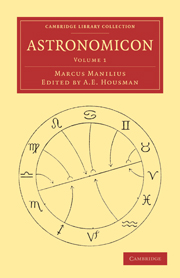
Both the author and the date of this five-volume poem, the first Western document to link the houses of the zodiac with the course of human affairs, are uncertain. The author's name may be Marcus Manilius, or Manlius, or Mallius, and the latest datable event mentioned in the books themselves is the disastrous defeat of Varus' Roman legions by the German tribes in 9 CE. The writing shows knowledge of the work of Lucretius, but the work is not referred to by any subsequent writer, suggesting that it was never widely disseminated. A manuscript was rediscovered by Poggio Bracciolini in 1416 or 1417, and editions were produced by Scaliger and Bentley, but this immensely erudite edition of 1903–1930 by the scholar and poet A. E. Housman (1859–1936) is regarded as authoritative. Volume 1 covers the creation and arrangement of the heavens and their division into spheres.
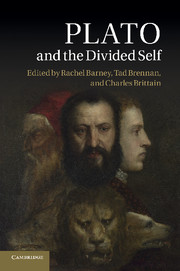
Plato's account of the tripartite soul is a memorable feature of dialogues like the Republic, Phaedrus and Timaeus: it is one of his most famous and influential yet least understood theories. It presents human nature as both essentially multiple and diverse - and yet somehow also one - divided into a fully human 'rational' part, a lion-like 'spirited part' and an 'appetitive' part likened to a many-headed beast. How these parts interact, how exactly each shapes our agency and how they are affected by phenomena like erôs and education is complicated and controversial. The essays in this book investigate how the theory evolves over the whole of Plato's work, including the Republic, Phaedrus and Timaeus, and how it was developed further by important Platonists such as Galen, Plutarch and Plotinus. They will be of interest to a wide audience in philosophy and classics.
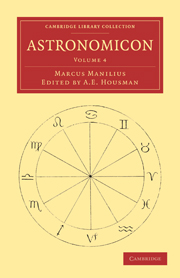
Both the author and the date of this five-volume poem, the first Western document to link the houses of the zodiac with the course of human affairs, are uncertain. The author's name may be Marcus Manilius, or Manlius, or Mallius, and the latest datable event mentioned in the books themselves is the disastrous defeat of Varus' Roman legions by the German tribes in 9 CE. The writing shows knowledge of the work of Lucretius, but the work is not referred to by any subsequent writer, suggesting that it was never widely disseminated. A manuscript was rediscovered by Poggio Bracciolini in 1416 or 1417, and editions were produced by Scaliger and Bentley, but this immensely erudite edition of 1903–1930 by the scholar and poet A. E. Housman (1859–1936) is regarded as authoritative. Volume 4 describes the influence of the zodiacal signs on the people born under them.
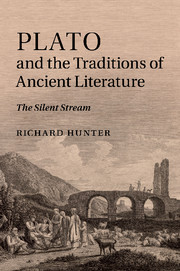
Exploring both how Plato engaged with existing literary forms and how later literature then created 'classics' out of some of Plato's richest works, this book includes chapters on such subjects as rewritings of the Apology and re-imaginings of Socrates' defence, Plato's high style and the criticisms it attracted, and how Petronius and Apuleius threaded Plato into their wonderfully comic texts. The scene for these case studies is set through a thorough examination of how the tradition constructed the relationship between Plato and Homer, of how Plato adapted poetic forms of imagery to his philosophical project in the Republic, of shared techniques of representation between poet and philosopher and of foreshadowings of later modes of criticism in his Ion. This is a major contribution to Platonic studies, to the history of Platonic reception from the fourth century BC to the third century AD and to the literature of the Second Sophistic.
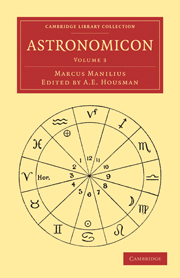
Both the author and the date of this five-volume poem, the first Western document to link the houses of the zodiac with the course of human affairs, are uncertain. The author's name may be Marcus Manilius, or Manlius, or Mallius, and the latest datable event mentioned in the books themselves is the disastrous defeat of Varus' Roman legions by the German tribes in 9 CE. The writing shows knowledge of the work of Lucretius, but the work is not referred to by any subsequent writer, suggesting that it was never widely disseminated. A manuscript was rediscovered by Poggio Bracciolini in 1416 or 1417, and editions were produced by Scaliger and Bentley, but this immensely erudite edition of 1903–1930 by the scholar and poet A. E. Housman (1859–1936) is regarded as authoritative. Volume 3 describes the working out of horoscopes.
Augustine's moral psychology was one of the richest in late antiquity, and in this book James Wetzel evaluates its development, indicating that the insights offered by Augustine on free-will have been prevented from receiving full appreciation as the result of an anachronistic distinction between theology and philosophy. He shows that it has been commonplace to divide Augustine's thought into earlier and later phases, the former being more philosophically informed than the latter. Wetzel's contention is that this division is less pronounced than it has been made out to be. The author shows that, while Augustine clearly acknowledges his differences with philosophy, he never loses his fascination with the Stoic concepts of happiness and virtue, and of the possibility of their attainment by human beings. This fascination is seen by Wetzel to extend to Augustine's writings on grace, where freedom and happiness are viewed as a recovery of virtue. The notorious dismissal of pagan virtue in 'The City of God' is part of Augustine's family quarrel with philosophers, not a rejection of philosophy per se. Augustine the theologian is thus seen to be a Platonist philosopher with a keen sense of the psychology of moral struggle.
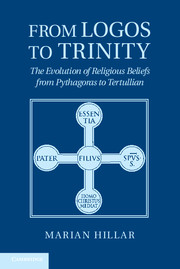
This book presents a critical evaluation of the doctrine of the Trinity, tracing its development and investigating the intellectual, philosophical and theological background that shaped this influential doctrine of Christianity. Despite the centrality of Trinitarian thought to Christianity and its importance as one of the fundamental tenets that differentiates Christianity from Judaism and Islam, the doctrine is not fully formulated in the canon of Christian scriptural texts. Instead, it evolved through the conflation of selective pieces of scripture with the philosophical and religious ideas of ancient Hellenistic milieu. Marian Hillar analyzes the development of Trinitarian thought during the formative years of Christianity from its roots in ancient Greek philosophical concepts and religious thinking in the Mediterranean region. He identifies several important sources of Trinitarian thought heretofore largely ignored by scholars, including the Greek middle-Platonic philosophical writings of Numenius and Egyptian metaphysical writings and monuments representing divinity as a triune entity.
Galen (Claudius Galenus, 129–c. 199 CE) is the most famous physician of the Greco-Roman world whose writings have survived. A Greek from a wealthy family, raised and educated in the Greek city of Pergamon, he acquired his medical education by travelling widely in the Roman world, visiting the famous medical centres and studying with leading doctors. His career took him to Rome, where he was appointed by the emperor Marcus Aurelius as his personal physician; he also served succeeding emperors in this role. A huge corpus of writings on medicine which bear Galen's name has survived. The task of editing and publishing such a corpus, and of identifying the authentic Galenic texts within it, is a hugely challenging one, and the 22-volume edition reissued here, edited by Karl Gottlob Kühn (1754–1840) and published in Leipzig between 1821 and 1833, has never yet been equalled.
Antiochus of Ascalon was one of the seminal philosophers of the first century BC, an era of radical philosophical change. Some called him a virtual Stoic, but in reality his programme was an updated revival of the philosophy of the 'ancients', meaning above all Plato and Aristotle. His significance lies partly in his enormous influence on Roman intellectuals of the age, including Cicero, Brutus and Varro, and partly in his role as the harbinger of a new style of philosophy, which thereafter remained dominant for the remainder of antiquity. Yet much remains controversial about his ideas. This volume, the first in English to be devoted entirely to Antiochus, brings together a team of leading scholars to discuss every major aspect of his life, work and significance. In addition, it contains the first full guide to his testimonia in any modern language.
Radical psychic contingency involves not just the moderate idea, present in Republic VIII-IX, that it is contingent how the parts of any given human soul are related to one another, but involves, more radical ideas: first, that with respect to at least some of the so-called parts, it is contingent what sort of internal structure each actually has in any given individual; and second, that it is contingent how many genuine parts actually belong to any given individual soul. Embracing contingency would allow Plato, to ventriloquize about differently constituted souls in different dialogues and even in different passages within the same dialogue. The ideal epithumêtikon seems to be something like a collection of the sort of necessary appetites that Socrates contrasts with unnecessary ones. The thumoeidos will rule the soul of a timocratic character, while the epithumêtikon will rule the souls of oligarchic, democratic, and tyrannical characters.
In Book Four of Plato's Republic, Socrates divides the soul. This chapter shows that according to Book Four's division of the soul, the soul's unearned unity must and can be complex. It identifies a Platonic account of complex unity that explains why the whole soul is a locus of moral responsibility and at least enables explaining the unity of consciousness. Although Socrates has left room for the soul to be a complex whole comprising multiple parts, he has also made it clear that the parts are separate sources of psychological activity. The unearned unity of the soul is, like earned unity, a function of agreement among its parts, but unearned unity does not require each part of the soul to recognize the aims that it shares with the other parts. So the moral responsibility of the whole soul is akin to the collective responsibility of a corporate agent.
The spirited part of the soul is best understood as a response to the introduction of appetitive souls into the world. All of its functions involve responding to and relating to appetitive souls. One must understand that spirit's roles divide sharply in two, corresponding to the fact that the rational soul is forced to confront appetitive souls in two venues: the appetitive souls in the bodies of other people that surround it, and the appetitive soul inside its own body. Since there are many souls in many bodies, and appetitive goods are finitely available, there is competition for them. Spirit is needed to help negotiate the distribution of appetitive goods among multiple agents. It is worth saying, that spirit's sensitivity to the oikeion is not in competition with its sensitivity to honor, but rather one of the preconditions of it.
This chapter discusses the Platonic origin of the treatise "On Free Will and the Will of the One". It presents an account of Plotinus' doctrine of inner and outer activity with a special focus on this doctrine's (by Plotinus' lights) Platonic origins. Plotinus replaces Plato's "external and internal action" with "external and internal activity". The notion of a twofold activity, one internal and another external is well known from metaphysical contexts in Plotinus. Plotinus evidently sees his two activities at work in the relationship between virtuous action and internal virtue. Indeed, he sees external human actions in relation to soul-states quite generally in the same way. Plato suggests that bad actions may bring ruin to a well-tempered soul. He also holds that some actions "preserve and help achieve" internal virtue.
This chapter focuses on the force of the analogy and Socrates' prescription for recognizing the soul. It discusses the condition of the embodied soul compared with that of Glaucus. To look at the god in his sea-bound condition, encrusted with all sorts of marine detritus is, says Socrates, to be prevented from glimpsing him as he really is. Soul's independence from body is given by its distinct ontological status: indestructible as opposed to destructible. This independence is built into the metaphysical framework that the immortality argument has purported to establish. So those elements are essentially add-ons to the soul that will come and go with the body. Socrates lays great emphasis, on the objective of viewing the soul in its pure form. If the soul's ideal state is incompatible with embodiment, one can still speak intelligibly, where the soul is embodied, of one component being the natural ruler.