To save content items to your account,
please confirm that you agree to abide by our usage policies.
If this is the first time you use this feature, you will be asked to authorise Cambridge Core to connect with your account.
Find out more about saving content to .
To save content items to your Kindle, first ensure no-reply@cambridge.org
is added to your Approved Personal Document E-mail List under your Personal Document Settings
on the Manage Your Content and Devices page of your Amazon account. Then enter the ‘name’ part
of your Kindle email address below.
Find out more about saving to your Kindle.
Note you can select to save to either the @free.kindle.com or @kindle.com variations.
‘@free.kindle.com’ emails are free but can only be saved to your device when it is connected to wi-fi.
‘@kindle.com’ emails can be delivered even when you are not connected to wi-fi, but note that service fees apply.
The chapter argues that Plato's psychology represents our motivations as themselves person-like with the aim of showing us the lineaments of philosophic virtue and of the self-transformation required for its development. It examines the way one ordinarily uses personification to think about our own motivations. The chapter highlights that Plato uses personification in a similar way with respect to the development of philosophic virtue. Parallels between Plato's psychology and the theology of the Republic suggest that one ought to regard personification as a likely story told for its effects on our self-conceptions and behavior. Finally, it is important to acknowledge that personification is a feature not only of Plato's middle-period but also of his late psychology, where it appears to conflict with two significant theoretical developments in the psychology: the denial of belief to appetite, and the recognition of the requirements for unity of the experiencing subject.
The most notorious difference between the Phaedo and Republic is the detailed presentation of the tripartite soul in the latter in contrast with the one-part psychology of the former. This chapter examines what difference this makes for our understanding of the three "types" of virtue namely slavish virtue, political or civic, habituated virtue and genuine or philosophical virtue. In the Phaedo's conception of a philosopher, the chapter argues that Plato opens up conceptual space for a type of virtue that falls short of genuine, complete virtue, but is nevertheless not slavish. In both the Phaedo and Republic what most significantly distinguishes philosophers from non-philosophers is their recognition of and concern with Forms. Philosophers' lack of fear of death and indifference to (or disdain of) the pleasures and pains of the body make Phaedo (a "Phd-philosopher") fit very well the ordinary descriptions of courageous and temperate characters.
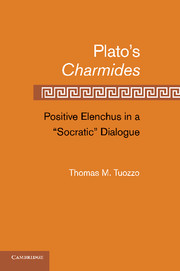
This book argues that Plato's Charmides presents a unitary but incomplete argument intended to lead its readers to substantive philosophical insights. Through careful, contextually sensitive analysis of Plato's arguments concerning the virtue of sophrosyne, Thomas M. Tuozzo brings the dialogue's lines of inquiry together, carrying Plato's argument forward to a substantive conclusion. This innovative reading of Charmides reverses misconceptions about the dialogue that stemmed from an impoverished conception of Socratic elenchus and unquestioned acceptance of ancient historiography's demonization of Critias. It views Socratic argument as a tool intended to move its addressee to substantive philosophical insights. It also argues, on the basis of recent historical research, a review of the fragments of Critias' oeuvre and Plato's use of Critias in other dialogues, that Plato had a nuanced, generally positive view of Critias. Throughout, readers are alerted to textual difficulties whose proper resolution is crucial to understanding Plato's often abstract arguments.
Galen (Claudius Galenus, 129–c. 199 CE) is the most famous physician of the Greco-Roman world whose writings have survived. A Greek from a wealthy family, raised and educated in the Greek city of Pergamon, he acquired his medical education by travelling widely in the Roman world, visiting the famous medical centres and studying with leading doctors. His career took him to Rome, where he was appointed by the emperor Marcus Aurelius as his personal physician; he also served succeeding emperors in this role. A huge corpus of writings on medicine which bear Galen's name has survived. The task of editing and publishing such a corpus, and of identifying the authentic Galenic texts within it, is a hugely challenging one, and the 22-volume edition reissued here, edited by Karl Gottlob Kühn (1754–1840) and published in Leipzig between 1821 and 1833, has never yet been equalled.