To save content items to your account,
please confirm that you agree to abide by our usage policies.
If this is the first time you use this feature, you will be asked to authorise Cambridge Core to connect with your account.
Find out more about saving content to .
To save content items to your Kindle, first ensure no-reply@cambridge.org
is added to your Approved Personal Document E-mail List under your Personal Document Settings
on the Manage Your Content and Devices page of your Amazon account. Then enter the ‘name’ part
of your Kindle email address below.
Find out more about saving to your Kindle.
Note you can select to save to either the @free.kindle.com or @kindle.com variations.
‘@free.kindle.com’ emails are free but can only be saved to your device when it is connected to wi-fi.
‘@kindle.com’ emails can be delivered even when you are not connected to wi-fi, but note that service fees apply.
In this work, first published in two volumes in 1890 and 1894, Erwin Rohde (1845–1898), the German classical scholar and friend of Nietzsche, describes the ancient Greek cult of souls and establishes the sources of the belief in the immortality of the soul, exploring its relation to life both before and after death. This belief in the survival of the soul already existed in the earliest Greek writings, but when and from where did it originate? In Volume 1 Rohde examines belief in the soul as it appears in Homeric poetry and within local cults, and finds that the idea of an afterlife is already represented in different forms in the works of Hesiod and Aeschylus. He also discusses burial rites and the Eleusinian Mysteries. Psyche, reissued here in the 1898 edition, remains a standard reference work on this topic.
One of the leading scholars and academic administrators of his time, Benjamin Jowett (1817–1893) was Master of Balliol College as well as Regius Professor of Greek and, for a time, vice-chancellor at Oxford University. Along with his achievements in the area of academic reform, Jowett is remembered for this four-volume translation of Plato's dialogues. Characterising Plato as the 'father of idealism', Jowett reminds readers that while 'he may be illustrated by the writings of moderns … he must be interpreted by his own, and by his place in the history of philosophy'. In this final volume, Plato's last dialogue, the Laws, is presented together with an introduction by Jowett. Three pieces of questionable authorship also appear in an appendix. Jowett's work represents a towering achievement in the field of classical and philosophical studies that had important influence on the subsequent study of Plato.
William L. Newman (1834–1923) published Volume 4 of Politics of Aristotle in 1902. It contains his reconstructed Greek text of books 4-8 of the Politics with critical notes, detailed commentary, and an essay on the types of constitutions discussed in the work. Newman's reconstructed text is based on the edition of Susemihl (1872) and his own fresh collations of a number of important Greek manuscripts. Newman's cautious text, always supported by extensive manuscript evidence, was widely regarded as an improvement on Bekker's more conjectural 1837 text. Newman's detailed commentary was highly praised and has been used for over a century by students of the Politics. As a scholar and pedagogue, Newman had a significant impact on nineteenth-century classical studies. His four-volume edition of the Politics stands as a monument of Victorian scholarship and will continue to be read and studied by scholars and students of Aristotle.
William L. Newman (1834–1923) published Volume 2 of Politics of Aristotle in 1887. It contains his reconstructed Greek text of books 1-2 of the Politics, critical notes, commentary, an introduction to the source manuscripts, and a discussion of the Latin translation of William of Moerbeke. Newman's reconstructed text is based on the edition of Susemihl (1872) and his own fresh collations of a number of manuscripts. His cautious text, always supported by extensive manuscript evidence, was widely regarded as an improvement on Bekker's more conjectural 1837 version. Newman's commentary was highly praised and has been used for over a century by students of the Politics. As a scholar and a pedagogue, Newman had a significant impact on nineteenth-century classical studies. His edition of the Politics stands as a monument of Victorian scholarship and will continue to be read and studied by scholars and students of Aristotle.
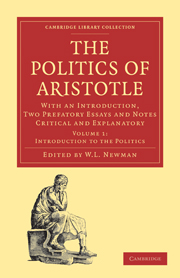
William L. Newman (1834–1923) published Volume 1 of Politics of Aristotle in 1887. It was designed as an introductory volume to accompany volumes 2–4 (1887–1902) which contain Newman's reconstructed Greek text of the Politics with a commentary, notes and essays. The essays in this volume link Aristotle's political teaching to his philosophical system and metaphysical ideas, discuss the relationship of Politics to Plato's political treatises, and place Politics within the context of the wider tradition of Greek literature. The volume focuses on books 1, 3, 4 and 5 of the Politics as these, Newman argues, contain the core of Aristotle's political teaching. Newman, both as a scholar and pedagogue, had a significant impact on nineteenth-century classical studies. His four-volume edition of the Politics stands as a monument of Victorian scholarship and will continue to be read and studied by scholars and students of Aristotle.
The Nicomachean Ethics (N.E.) presents itself as composed out of a relatively small number of “treatises” on topics in moral philosophy; the question of the unity of the N.E. therefore involves both the question of (i) how coherent each of these treatises is, and also (ii) how well they are knit together to form a coherent whole. Here I shall focus largely on the latter question, although this will require at times some attention to the former.
By “presents itself” I mean two things. First, I mean simply how the N.E. appears to a careful reader who has some background knowledge of how Aristotelian texts are constituted and how Aristotle worked as a philosopher. Aristotelian texts are compiled out of “books,” which correspond to the length of a scroll. This is a purely accidental matter, but in general this length is exploited by Aristotle as a unit of treatment of a subject. Longer works would be made by joining together discussions parsed according to books. Aristotle’s own philosophical tendencies fit well with this manner of composition, because his works are generally sparse in system and architectonics: in general he aims to discuss each subject initially on its own terms – almost as if in isolation – as if he is trusting that, if this is done well, then any composition of such discussions will harmonize, on the grounds that, as he says, truth harmonizes with truth (see i.7, 1098b11–12).
Over the years Aristotle’s discussion of contemplation and eudaimonia in Book x of the Nicomachean Ethics has been a thorn in the side of his readers. Some commentators have taken it to be inconsistent with the rest of the N.E., one even maintaining that it was not meant seriously but instead was an instance of irony. Among the reasons for these reactions are the following.
Although contemplation is mentioned in N.E. i.5 as a candidate for the good whose realization in a life constitutes a life of eudaimonia, almost all of the N.E. leading up to N.E. x is occupied with rather detailed discussions of ethical virtue, various specific ethical virtues, and topics such as practical wisdom, continence and incontinence, pleasure, and friendship, all of which have important connections with ethical virtue. In the middle of N.E. x, however, Aristotle seems to say that contemplation is the good whose realization in a life constitutes the primary form of eudaimonia. The political life, a life that includes the exercise of ethical virtue, is only a secondary form of eudaimonia. Where did this pre-eminence of contemplation come from? After all the attention he has given to ethical virtue, how could Aristotle relegate a life of ethical virtue to second place?
It is generally assumed that general justice in Nicomachean Ethicsv is an ethical virtue. There are at least two ways in which to understand this statement. One might either take the claim to be that justice is best defined as an ethical virtue, or one might take it to mean only that it is possible to characterize justice in terms of ethical virtue, without thereby holding justice to be an ethical virtue. The first claim seems to be taken for granted in most of the literature. I wish to argue that this is misguided, and that only the second claim is supported by the text. In relation to individuals, general justice is a characteristic of actions, and not an ethical state. This is not to say that Aristotle never refers to an individual as just. It is to say, however, that in his considered account, this should be seen as a shorthand way of referring either to actions, or to characteristics of the individual in question that are not identical to justice.
According to G. E. M. Anscombe, pleasure was the topic that finally and “astonishingly reduced Aristotle to babble, since for good reasons he both wanted pleasure to be identical with and to be different from the activity that it is pleasure in.” That is by any measure a harsh judgment – babble, she says: inarticulate, incomprehensible, childish prattle.
She does allow that Aristotle was reduced to this sorry state for good reasons; so, she evidently thinks that there is a partially exculpatory diagnosis for his woes. Woes he has, however: as she represents him, Aristotle fumbles and stumbles over himself twice over. He first identifies pleasure with an activity and then denies that it is an activity. That is perhaps not so bad in itself, since he may after all simply have changed his mind; but when he denies that pleasure is an activity, he does so for all the wrong reasons. Instead of relying on the sensible thought that pleasure is not an activity but rather a feeling, Aristotle instead offers a bewildering corrective: “Pleasure,” he says, “perfects the activity (energeia), not in the way a state (hexis) does, by being in the activity, but as a sort of supervening end (telos)” (teleioi de tên energeian hê hêdonê ouk hôs hê hexis enuparchousa, all’ hôs epiginomenon ti telos; E.N. 1174b31–33). If Aristotle is not babbling here, then neither is his meaning exactly pellucid. At the very least, it seems an overly technical treatment of what is at root a perfectly familiar phenomenon. Pleasure, we may be assured, is a feeling, a welcome sensation of some sort, a sensation of satisfaction or gratification, in general an enjoyable or delightful experience. Aristotle’s account of pleasure – if it is intelligible at all – seems at the very least needlessly baroque.
“And what is natural is pleasant; and all pursue their natural pleasure.”
(Aristotle, Historia Animaliumix.1, 589a8–9, trans. D. M. Balme)
Aristotle thinks that it is not enough for us to simply know what virtue is, but that we also need to know how to bring virtue about. In order to do this, it is vital to have some insight into the non-rational mechanisms of human behavior, since, for Aristotle, the acquisition of virtue does not primarily consist in intellectual instruction, but in an adequate conditioning of our non-rational motivational dispositions. Before engaging in ethical debates, therefore, the young ought to be habituated in the right way such that they non-rationally desire and feel pleasure and pain about the right things. Non-rational pleasure and pain and desire thus provide a psychological mechanism which is central for the practical purpose of Aristotle’s ethical project. But what is this mechanism? This is the question I am going to investigate in this chapter. For Aristotle, such an investigation, since it is not concerned with rational behavior, falls into the domain of his natural philosophy. And it is from this perspective that I will approach the question here, too, namely from the perspective of Aristotle’s theory of animal behavior in his De Anima.
In his Metaphysics Aristotle repudiates the poets’ claim that envy (phthonos) is natural to the divine nature, citing the adage that bards tell many lies (i.2, 982b32–983a4). The repudiation is noteworthy: Aristotle does not normally deny passions to gods or quarrel with poets. Presumably, it is indebted to his view that envy is named in a way that involves badness, is a wicked passion, and something that is felt by those who are bad (N.E. ii.6, 11078a8–13; E.E. ii.3, 1221b18–23; Rh. ii.11, 1388a34–36). Even so, his repudiation provokes several questions. What is Aristotle’s understanding of envy and its wicked nature? How does this sort of badness compare to and contrast with inappropriate realizations of passions such as anger and fear? How do passions relate to the character of those who feel them? Does (and, if so, how does) Aristotle’s understanding of passions’ inappropriateness in ethical matters fit with his understanding of their value elsewhere?
The essay to follow investigates these questions, beginning with Aristotle’s most pervasive thoughts on passions’ inappropriateness, and their connections to character (section 1). The baseness of wicked passions is then explored (section 2), followed by an examination of envy (section 3) and its baseness (section 4). That and how envy suits Aristotle’s doctrine of the mean is considered (section 5), as is the inappropriateness and appropriateness of passions in diverse domains (section 6).
Aristotle’s account of desire is extremely suggestive and worth considering in greater detail. There are a number of passages that warrant close consideration, and part of my goal here is to provide a detailed analysis of a key one: N.E. vii.6, 1149a25–b3. This passage is interesting in its own right, but when placed alongside some other key texts, it becomes significant for our understanding of non-rational desire in Aristotle’s moral psychology, in particular, concerning: (i) the ways in which non-rational desires can obey reason; (ii) the role various cognitive capacities have in the formation of non-rational desires; (iii) what it is that makes a desire count as “non-rational”; and (iv) the status of non-rational desires in virtue. My chapter has two parts. In the first, I consider the N.E. vii.6 passage in detail (sections 1–3); in the second, I address, in relation to it, the broader issues just mentioned (sections 4–7).
Before I begin, I should note that Aristotle divides desire, “orexis”, into three kinds: “epithumia” (variously translated “appetite,” “desire,” “bodily desire”), “thumos” (“spirit,” “anger,” “passion,” “temper”), and “boulêsis” (“wish,” “volition,” “rational desire”), and holds that epithumia and thumos are non-rational, whereas boulêsis is rational. To avoid potentially confusing translations, I shall leave these key terms (plus epithumia’s plural: epithumiai) untranslated (and unitalicized). I shall do the same with “akrasia” (“incontinence,” “lack of self-control”), “enkrateia” (“continence,” “self-control”) and “phantasia” (“imagination,” “appearance”) for the same reason.
According to Aristotle, the Nicomachean Ethics is a work of political science, and political science considers “just and kalon things” (i.3, 1094b14). He devotes a whole book to a discussion of justice, but he offers no explicit discussion of the kalon. The Eudemian Ethics begins by rejecting the view expressed in the Delian epigram, that the most kalon, the best, and the pleasantest are three different things. Aristotle affirms that happiness is the one thing that has all three superlative properties (1214a1–8). But he does not support this claim with a detailed account of the kalon. It is not surprising, then, that critics have tried to fill this gap in Aristotle, or that they have found it difficult to reach agreement.
I want to discuss some of the questions that arise about the kalon in the Ethics, with some reference to the use of “kalon” elsewhere in the Aristotelian corpus. I will not consider other potentially relevant sources of evidence. These sources include the Platonic corpus, the use of “kalon” and its Latin equivalent “honestum” in later ethical thought, and, more generally, the use of “kalon” in non-philosophical Greek in and before Aristotle’s time. I leave them aside because I am not confident that they have been adequately studied for our present purposes.
No work in the ancient philosophy corpus has generated more scholarly discussion in recent years than Aristotle’s Nicomachean Ethics (N.E.), and no issue that it raises has been more controversial than Aristotle’s position(s) throughout the work concerning the ultimate human good, which he consistently identifies with eudaimonia (conventionally translated as “happiness”). Debate has chiefly centered on the question whether Aristotle represents eudaimonia as comprising a plurality of intrinsically choiceworthy goods (“inclusive” end) – meaning either a set of virtuous activities or this plus various intrinsic goods such as pleasure and friends – or whether, instead, he envisions it to be a unitary goal (“dominant” end) consisting strictly in just one supremely excellent thing, more specifically, a single kind of virtuous activity. It is widely agreed that his preliminary discussion of eudaimonia in Book i of N.E. is couched in terms that are too general or too ambiguous to settle the question decisively, though they tend, in my view, to favor the “inclusive” alternative. However, in Book x Aristotle states unequivocally that the happiest life consists in the exercise of intellectual virtue or contemplation (theoria), while the political life of moral virtue (which he has been exclusively treating throughout Books ii–v and vii–ix) is happiest only “secondarily” (N.E. x.7–8, 1178a6–10). A page or two later he writes (1178b28–32):
Happiness extends, then, just so far as contemplation does, and those to whom contemplation more fully belongs are more truly happy, not incidentally but in virtue of the contemplation; for this in itself is precious. Happiness therefore must be some kind of contemplation (theoria tis).
Taken just by themselves, these passages, especially the last one quoted, undoubtedly favor the “dominant end” interpretation.