To save content items to your account,
please confirm that you agree to abide by our usage policies.
If this is the first time you use this feature, you will be asked to authorise Cambridge Core to connect with your account.
Find out more about saving content to .
To save content items to your Kindle, first ensure no-reply@cambridge.org
is added to your Approved Personal Document E-mail List under your Personal Document Settings
on the Manage Your Content and Devices page of your Amazon account. Then enter the ‘name’ part
of your Kindle email address below.
Find out more about saving to your Kindle.
Note you can select to save to either the @free.kindle.com or @kindle.com variations.
‘@free.kindle.com’ emails are free but can only be saved to your device when it is connected to wi-fi.
‘@kindle.com’ emails can be delivered even when you are not connected to wi-fi, but note that service fees apply.
At the end of his long speech on the Delphic oracle, Critias offered self-knowledge as an account of σωϕροσύνη. Socrates’ subsequent questioning led to the development of two distinct formulations of that account, which I have labeled “Critian” and “Socratic.” Socrates then announced a new beginning and set forth a two-part program of investigation: first, assessing the possibility of σωϕροσύνη conceived as self-knowledge; second, assuming that self-knowledge is possible, determining its usefulness. At the start of the possibility discussion, Socrates turns his attention specifically to the Critian formulation (167b10–c1). He begins with a confession of his own ἀπορία and with the expression of his hope that Critias will prove to be “more resourceful” (εὐπορώτερος) than he is in this matter (167b7–9). The discussion of the Critian formulation ends with Critias’ “catching” his ἀπορία, as one person’s yawning may set off another’s. At that point Socrates turns to consider the possibility of σωϕροσύνη as self-knowledge under the Socratic formulation. In this chapter, we are concerned with the discussion of σωϕροσύνη under the Critian formulation.
The Critian formulation, as Socrates restates it at the beginning of this section, is as follows:
[σωϕροσύνη is] a certain single knowledge which is a knowledge not of anything other than of itself and of the rest of the knowledges – and also, this same knowledge, of non-knowledge. (167b10–c2)
Critias’ guarded agreement at 175a8 that the full-fledged knowledge of knowledge would not be beneficial brings to an end the two-part program that Socrates had announced at the new beginning at 167a–b. Plato does not have Socrates propose yet another new beginning, nor does he have him return to take up issues mentioned or implied by the previous discussion. These are tasks for the reader. Instead, Plato has Socrates give a speech in which he summarizes their discussion from the new beginning on. This summary speech, both in what it emphasizes and in what it neglects, supplies some further indications of how the reader may continue the investigation. At the end of this speech Socrates then returns to the question that had initiated the entire discussion of σωϕροσύνη: whether Charmides is in possession of that virtue. This in turn leads into a brief final conversation between Socrates and Charmides, within which is embedded a short conversation between Charmides and Critias. In this final scene, some of the themes of the introductory scene are sounded once again, this time taking on deeper significance in light of points made in the intervening investigation.
Socrates??? Speech
Socrates begins his final speech by emphasizing how the conclusion of their recent argument, that σωϕροσύνη brings no benefit, vindicates the qualms he had earlier expressed (172c4) about their discussion:
Do you see, Critias, how reasonable it was of me to be afraid a little while ago, and how justly I accused myself of not conducting a worthy investigation (οὐδὲν χρηστὸν … σκοπῶ) into σωϕροσύνη? For that which is agreed to be the finest thing (κάλλιστον) of all would not have turned out to be useless (ἀνωϕελές), if I had been of any use for fine inquiry (εἴ τι ἐμοῦ ὄϕελος ἦν πρὸς τὸ καλῶς ζητεῖν). (175a9–b2)
The Charmides consists of Socrates’ narration, to a nameless friend, of his doings at the palaistra (wrestling school) of Taureas, across from the precinct sacred to Βασίλη, the Queen – that is, Persephone, queen of the underworld. As he tells this friend – who does not speak throughout the dialogue – he had eagerly gone to the palaistra to take up his “customary occupations” (ἐπὶ τὰς συνήθεις διατριβάς) the day after he returned to Athens from a long military campaign in Thrace. Among the many congregating there he is greeted first by his long-standing friend Chaerephon, who takes him over to sit next to Critias. Socrates answers the company’s questions about the campaign, and especially about the recent bloody battle in which he had taken part, news of which had just reached Athens. Many of their acquaintance had been killed in that battle.
The dialectical discussion that follows the speech in which Critias offers “knowing oneself” as the definition of σωϕροσύνη, and which continues almost to the end of the dialogue, is one of the most complex stretches of argument in the Platonic corpus. Despite how it might appear at first glance, the argument has a carefully worked-out structure, to which Plato provides reasonably clear signposts. It is essential for a correct understanding of the passage to take note of this structure and, in particular, to be aware of the progression in thought that it reflects.
One of the clearest signposts in the passage occurs at 167a9, where Socrates says:
Once again then, said I – third time for [Zeus] the Savior! – let us investigate, as though from the beginning (ὡς ἐξ ἀρχῆς), first, whether this is possible or not: to know, of the things a person knows and does not know, that he knows them and that he does not know them; and next, granting its possibility, what benefit there would be for us if we possessed this knowledge.
The Charmides is a brilliant dialogue, as well as a puzzling one. The charm and urbanity of its opening scene are matched by the sophistication and extraordinary abstraction of the arguments that follow. The juxtaposition of these very different sorts of brilliance raises in an acute form a central question of Plato interpretation: How are the literary and the argumentative dimensions of a Platonic dialogue related to each other? Specific details both of the dialogue’s dramatic setting and of its dialectical argumentation give rise to other interpretive questions, especially when they are viewed within the chronological framework that has until recently guided most contemporary Plato scholarship. Because the dialectical discussion of the dialogue is conducted by Socrates, is concerned with defining a virtue, does not explicitly invoke transcendent Forms, ends in apparent failure, and has a vivid dramatic setting, the dialogue is generally thought to belong to a group of “early,” “Socratic” dialogues. Yet the sophistication of the argumentation, as well as some particular substantive content of those arguments, gives our dialogue an affinity with dialogues generally viewed as “middle” or even “late.” Perhaps even more problematic for the classification of the dialogue as early is that what seems to be Socrates’ primary activity in the “early” dialogues, and what Socrates appears to claim in one of those dialogues (the Apology) to be his life mission – namely, examining people to determine whether they know what they think they know – is in this dialogue itself subjected to prolonged examination, in the course of which it seems to be thoroughly discredited.
In the previous chapter we have seen how, for Plato, philosophical understanding and philosophical progress are in an important sense contextual. The partial grasp of the truth that is the lot of most people most of the time is an understanding from a particular, situated perspective; it is the goal of the more advanced philosopher in leading elenctic dialectic to move his interlocutor from that partial understanding to a deeper insight into the truth. In the Charmides, Plato has Socrates undertake such an investigation into what the Greeks called σωϕροσύνη. Said to be the quintessentially Greek virtue, σωϕροσύνη cannot be easily translated into any modern European language. English translations of the word range from temperance, moderation, and self-restraint to sensibleness and sound-mindedness; I generally leave the word untranslated. Particularly because of its unfamiliarity to modern readers, it will be important to survey the various ways of thinking about σωϕροσύνη that were present in Greek culture at Plato’s time, and which furnished the content of unreflective views about the virtue and, in dialectical argument, the starting points for an investigation toward a more reflective conception. Further, since Plato’s Socrates interrogates not just the general cultural views of the time but also those views as they are held by specific interlocutors, often (as in the Charmides) prominent figures in recent Greek history who would be recognized by Plato’s first audience, it is important to understand, so far as we can, what information about those characters Plato may have presumed his expected audience to bring with them to a reading of the dialogue. In this chapter, I deal first with this latter question, focusing on Socrates’ chief interlocutors, Critias and Charmides. Then I turn to a brief overview of the more general Greek views about σωϕροσύνη that serve as the cultural context of the discussion in our dialogue.
When Critias introduced the definition of σωϕροσύνη as self-knowledge, he supported it with a speech about the inscription at Delphi, “Know thyself.” This inscription, Critias says, represents the god’s criticism of the standard human greeting, “Enjoy thyself,” and his recommendation that it be replaced with an exhortation to self-knowledge, which, as Critias explains, amounts to an exhortation to be temperate (σωϕρονεῖν). Subsequent worshipers at Delphi mistook the inscription as a piece of useful advice and added a few more: “Nothing too much” and “Give bond, and ruin follows.” But a greeting is different from a piece of advice, Critias insists. In Chapter 5 I developed an account of that difference according to which a greeting refers to a good that has a more fundamental role than that to which pieces of advice make reference: a good the joint dedication to which makes possible the social context within which alone the pursuit of other goods is possible. However exactly the difference between greeting and advice is to be understood, it is clear from Critias’ Delphic speech that Critias believes self-knowledge is recommended to us by the god because of its very great value.
The dialectical discussion into the nature of σωϕροσύνη is initiated in the dialogue as an investigation into whether Charmides possesses that virtue. But soon Critias assumes the role of Socrates’ chief interlocutor, and by far the greater part of the discussion is conducted with him. What significance are we to attribute to this fact? Although this question may be treated as a relatively formal point about the design of the dialogue, it also has implications not only for the nature of Plato’s representation of dialectical discussion but also for the nature and goal of such discussion itself.
According to one interpretation, the switch from Charmides to Critias represents a serious moral failure on Charmides’ part. On this view, the switch is actually the natural consequence of what, on this interpretation, counts as the true moment of failure: Charmides’ offering of an account of σωϕροσύνη that, it becomes clear, he earlier heard from Critias. This interpretation points to the fact that (1) Socrates takes some care to establish that, if σωϕροσύνη is present in Charmides, it should produce some awareness of itself in him on the basis of which he could form beliefs about its nature and attributes, which he could then formulate in words (159a1–7), and that (2) after the failure of Charmides’ first account, Socrates asks Charmides to try once more with the words:
Look to yourself and consider the kind of person σωϕροσύνη makes you by its presence, and what sort of thing it would have to be to make you like that. (160d6–8)
As we saw in Chapter 6, after the great speech in which Critias presented self-knowledge as his account of σωϕροσύνη, Socrates conducted a scrutiny of that account, which led to two new formulations of it: the Critian and the Socratic. Socrates then launched the discussion on a new beginning, saying that they must treat first the possibility and then the advantageousness of σωϕροσύνη understood as self-knowledge. Socrates first discusses the possibility question with respect to the Critian formulation. As we saw in Chapter 7, Socrates focused on the reflexive aspect of this formulation, that is, the respect in which the knowledge of itself and other knowledges takes itself as its object. The investigation into the possibility of such a thing revealed the need to locate knowledge within a dialectical division of relatives. To do that, as I have argued, would require determining the substantive, nonrelative nature to which knowledge is related.
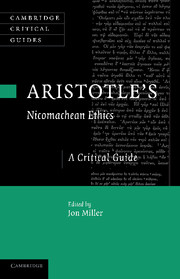
Aristotle's Nicomachean Ethics is one of the most important ethical treatises ever written, and has had a profound influence on the subsequent development of ethics and moral psychology. This collection of essays, written by both senior and younger scholars in the field, presents a thorough and close examination of the work. The essays address a broad range of issues including the compositional integrity of the Ethics, the nature of desire, the value of emotions, happiness and the virtues. The result is a volume which will challenge and advance the scholarship on the Ethics, establishing new ways of viewing and appreciating the work for all scholars of Aristotle.
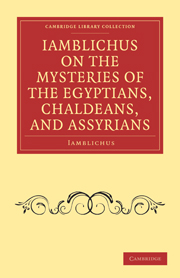
This translation from the Greek by Thomas Taylor (1758–1835) was first published in 1821. Taylor's early writings and translations into English influenced such romantic poets as Blake, Coleridge and Keats. Iamblichus is thought to have been born in Syria in the middle of the third century and is regarded as one of the great Neoplatonist philosophers. He founded a school in which he taught 'white magic' or 'theurgy'; he sought to uncover the invisible side of nature and to give Man the means to effect the union of the divine spark with its parent-flame within him. In this work, divided into ten sections, he gives a complete canon of pagan religious thought and belief and explains their background. The Neoplatonist Porphyry's Letter to Anebo, in which he criticises religious rituals and practices, and Iamblichus' response to this criticism, and defence of these traditions, are included.
Best known for his influential History of Greece, the historian and politician George Grote (1794–1871) wrote this account of Plato's dialogues as a philosophical supplement to the History. First published in 1865, Grote's account of Plato's works includes substantial footnotes and marginalia. This third volume contains discussion of Menexenus, Kleitophon, Timaeus and Kritias, as well as extensive coverage of the Republic and the Laws. It also contains the index to all three volumes, originally issued separately. Grote includes apocryphal works, as he relied on the order and classification of Plato's works specified by the ancient Greek scholar Thrasyllus of Mendes. With three volumes each running to over six hundred pages, Grote's scholarship is formidably comprehensive. The publication of Plato and the Other Companions of Sokrates confirmed him as one of the greatest authorities on Plato in the nineteenth century.