To save content items to your account,
please confirm that you agree to abide by our usage policies.
If this is the first time you use this feature, you will be asked to authorise Cambridge Core to connect with your account.
Find out more about saving content to .
To save content items to your Kindle, first ensure no-reply@cambridge.org
is added to your Approved Personal Document E-mail List under your Personal Document Settings
on the Manage Your Content and Devices page of your Amazon account. Then enter the ‘name’ part
of your Kindle email address below.
Find out more about saving to your Kindle.
Note you can select to save to either the @free.kindle.com or @kindle.com variations.
‘@free.kindle.com’ emails are free but can only be saved to your device when it is connected to wi-fi.
‘@kindle.com’ emails can be delivered even when you are not connected to wi-fi, but note that service fees apply.
Western philosophy, from early in its history, has characterized itself in part by distinguishing how its statements and methods were different from those of the poets and, having made this distinction, what role the work of poetry was to have in philosophy. This book examines some of the philosophical writers who have participated in this effort. At the beginning of this story, Plato defined the relationship between poetry and philosophy as a quarrel, indeed, as an ancient quarrel. One theme in this book is that the so-called ancient quarrel between poetry and philosophy is itself neither poetry nor philosophy. Rather, it is an image portraying the interaction of poetry and philosophy as important for the pursuit of insight into the truth of things human and divine, a truth less accessible both to poets devoid of philosophy and to philosophers devoid of poetry. The domain of the quarrel is one that longs for a certain fullness of thought that goes beyond the exigencies of inquiry confined to the boundaries of either poetry or philosophy. Whether reluctantly or not, the philosophers addressed here acknowledge the importance of poetry to philosophy by acknowledging the peculiarity and value of the poets' insights, by using the tools of the poets in their own work, or by struggling to put the poets in their proper place.
Plato fretted over the poets' claims to wisdom and, in particular, their claims to sometimes be speaking for the gods.
“Through a man puffed up with monstrous pride,” Augustine writes in his Confessions, “you brought under my eye some books of the Platonists, translated from Greek and Latin. There I read, not of course in these words, but with entirely the same sense and supported by numerous and varied reasons, ‘In the beginning was the Word and the Word was with God and the Word was God.’” Saint Augustine says that he met Christ, the Logos, in the work of Plotinus and that of his disciple Porphyry. Much later he encountered head-on both the pagan philosophers and the poets in light of this encounter. Indeed, the ancient quarrel between poetry and philosophy is at the heart of the young Augustine's own life and is at the heart of the mature Augustine's encounter with all Greek and Roman literature and philosophy in The City of God, where the poets' need for the corrective response of philosophy is rooted in the active malevolence of the demonic. Given the impact of Augustine on subsequent thought and the impact of Plotinus on Augustine, it is worthwhile starting with a brief look at the work of Plotinus.
Addressing the accusation that poetry obstructed the view of truth required that philosophy intervene, yet the intervention has shown that poetry has contributed positively to the ways in which questions are posed in philosophy, especially metaphysics and ethics.
Writing about Thomas Aquinas, G. K. Chesterton says, “He very specially possessed the philosophy that inspires poetry, as he did so largely inspire Dante's poetry.” Aquinas was a trained poet. In Naples he studied the art, rules, and methods of rhythmic composition. He wrote Office of the Blessed Sacrament, which is counted among the finest pieces of medieval literature. Thomas thoroughly understood what the poets were doing, thought the role of speaking for God was important, and allowed in several places that the pagans had been used to speak for the Divine. He also thought revelation had advanced beyond the pagans, and for him the division of labor was clear. Words from God come through revelation, through the prophets who experience something beyond their own capacity, at times even through “rapture,” a concept very close to the theia mania of the poets in the Phaedrus but trustworthy because of reasons Aquinas gives us in his treatises on prophecy, rapture, and contemplation. It is the Christian thinker (philosopher/theologian) who can judge the pagans and listen for God's voice. In the case of the prophets of God, the philosopher is bound to listen to the whole as delivered by God and, as it were, make sense. Among the pagans, however, the philosopher can dismiss more inconvenient statements that complicate the effort to “make sense.”
Aquinas was not one to put great stock in flashes of insight. What Aquinas wanted was not flash, beauty, or surprise.
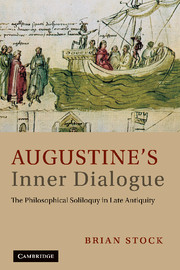
Augustine's philosophy of life involves mediation, reviewing one's past and exercises for self-improvement. Centuries after Plato and before Freud he invented a 'spiritual exercise' in which every man and woman is able, through memory, to reconstruct and reinterpret life's aims. In this 2010 book, Brian Stock examines Augustine's unique way of blending literary and philosophical themes. He proposes a new interpretation of Augustine's early writings, establishing how the philosophical soliloquy (soliloquium) has emerged as a mode of inquiry and how it relates to problems of self-existence and self-history. The book also provides clear analysis of inner dialogue and discourse, and how, as inner dialogue complements and finally replaces outer dialogue, a style of thinking emerges, arising from ancient sources and a religious attitude indebted to Judeo-Christian tradition.
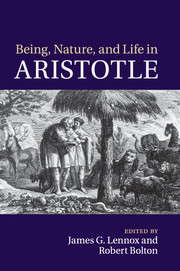
This volume of essays explores major connected themes in Aristotle's metaphysics, philosophy of nature, and ethics, especially themes related to essence, definition, teleology, activity, potentiality, and the highest good. The volume is united by the belief that all aspects of Aristotle's work need to be studied together if any one of the areas of thought is to be fully understood. Many of the papers were contributions to a conference at the University of Pittsburgh entitled 'Being, Nature, and Life in Aristotle', to honor Professor Allan Gotthelf's many contributions to the field of ancient philosophy; a few are contributions from those who were invited but could not attend. The contributors, all longstanding friends of Professor Gotthelf, are among the most accomplished scholars in the field of ancient philosophy today.
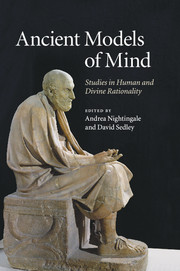
How does God think? How, ideally, does a human mind function? Must a gap remain between these two paradigms of rationality? Such questions exercised the greatest ancient philosophers, including those featured in this book: Socrates, Plato, Aristotle, the Stoics and Plotinus. This volume encompasses a series of studies by leading scholars, revisiting key moments of ancient philosophy and highlighting the theme of human and divine rationality in both moral and cognitive psychology. It is a tribute to Professor A. A. Long, and reflects multiple themes of his own work.
This book reconsiders the traditional correspondence theory of truth, which takes truth to be a matter of correctly representing objects. Drawing Heideggerian phenomenology into dialogue with American pragmatic naturalism, Christopher P. Long undertakes a rigorous reading of Aristotle that articulates the meaning of truth as a co-operative activity between human beings and the natural world that is rooted in our endeavours to do justice to the nature of things. By following a path of Aristotle's thinking that leads from our rudimentary encounters with things in perceiving through human communication to thinking, this book traces an itinerary that uncovers the nature of truth as ecological justice, and it finds the nature of justice in our attempts to articulate the truth of things.
Long understudied, Plato's Laws has been the object of renewed attention in the past decade and is now considered to be his major work of political philosophy besides the Republic. In his last dialogue, Plato returns to the project of describing the foundation of a just city and sketches in considerable detail its constitution, laws and other social institutions. Written by leading Platonists, the essays in this volume cover a wide range of topics central for understanding the Laws, such as the aim of the Laws as a whole, the ethical psychology of the Laws, especially its views of pleasure and non-rational motivations, and whether and, if so, how the strict law code of the Laws can encourage genuine virtue. They make an important contribution to ongoing debates and will open up fresh lines of inquiry for further research.