To save content items to your account,
please confirm that you agree to abide by our usage policies.
If this is the first time you use this feature, you will be asked to authorise Cambridge Core to connect with your account.
Find out more about saving content to .
To save content items to your Kindle, first ensure no-reply@cambridge.org
is added to your Approved Personal Document E-mail List under your Personal Document Settings
on the Manage Your Content and Devices page of your Amazon account. Then enter the ‘name’ part
of your Kindle email address below.
Find out more about saving to your Kindle.
Note you can select to save to either the @free.kindle.com or @kindle.com variations.
‘@free.kindle.com’ emails are free but can only be saved to your device when it is connected to wi-fi.
‘@kindle.com’ emails can be delivered even when you are not connected to wi-fi, but note that service fees apply.
David Furley begins his work The Greek Cosmologists with a concise presentation of the differences between two main approaches to natural philosophy in antiquity. One of these, the teleological tradition, best represented by Aristotle, understands form to be explanatorily irreducible and holds that teleological explanations cannot be omitted from a complete account of the natural world. Philosophers in this tradition consider matter to be continuous and to have no imperceptible microstructure; they regard qualitative change as fundamental and not reducible to rearrangement of smallest parts; and they think of the material cosmos as structured and finite in extent. The atomists, by contrast, take all change to be fully explained by the spatial rearrangement of these smallest parts, without reference to any purposes these changes might be thought to serve. They take matter to be composed of indivisible smallest parts moving in a void, treat macroscopic structures as explanatorily reducible to the properties of the smallest parts and regard the universe as infinite and unstructured.
It is important to notice that the contrast between two competing approaches is not presented as a logically exhaustive dichotomy: neither in the ancient nor the modern world are these the only possible explanatory options. Furley's point is not simply to segregate philosophical positions according to an exhaustive and exclusive dichotomy, but to note an interesting tendency of philosophical positions to cluster around certain key assumptions.
To resume: this argument for the existence of a ‘mechanical hypothesis’ in ancient Greek natural philosophy began with a conceptual examination of the meaning of the terms ‘mechanical’ or ‘mechanistic’. I distinguished the use of the term ‘mechanical’ as a systematic description of perceived features of a view from the idea that the thinkers in question were explicitly motivated by their own conception of mechanics in formulating a view. Some ancient Greek thinkers can be described as ‘mechanistic’ in the latter sense, inasmuch as they did appeal to the field of mechanics to understand the natural world. This history has received less attention than it deserves.
A tendency to describe the ancient atomists as ‘mechanistic’ seems to have deterred scholars from looking for the impact of ancient Greek mechanics on late antique philosophy. Historians of science, meanwhile, have mistakenly concluded from some remarks of Galileo's that, in antiquity, mechanics was systematically excluded from natural philosophy. In the other direction, a few histories of technology think that ‘mechanistic conceptions’ can be found as far back as Homer. I set aside some misconceptions before studying the impact of ancient Greek mechanics on natural philosophy.
Tracing the history of mechanics, I argue that there is little evidence of it – in any sense of the term – from before the fourth century bce. Branches of the field were clearly developing in the fourth century. Nonetheless, there is little definitive evidence of what the term mēchanikē meant to Aristotle.
Stauffer demonstrates the complex unity of Plato's Gorgias through a careful analysis of the dialogue's three main sections. This includes Socrates' famous argumentative duel with Callicles, a passionate critic of justice and philosophy, showing how the seemingly disparate themes of rhetoric, justice and the philosophic life are woven together into a coherent whole. His interpretation of the Gorgias sheds new light on Plato's thought, showing that Plato and Socrates had a more favourable view of rhetoric than is usually supposed. Stauffer also challenges common assumptions concerning the character and purpose of some of Socrates' most famous claims about justice. Written as a close study of the Gorgias, Stauffer also treats broad questions concerning Plato's moral and political psychology and uncovers the view of the relationship between philosophy and politics that guided Plato as he wrote his dialogues.
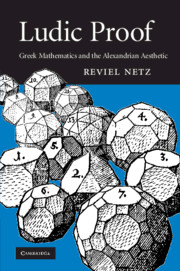
This book represents a new departure in science studies: an analysis of a scientific style of writing, situating it within the context of the contemporary style of literature. Its philosophical significance is that it provides a novel way of making sense of the notion of a scientific style. For the first time, the Hellenistic mathematical corpus - one of the most substantial extant for the period - is placed centre-stage in the discussion of Hellenistic culture as a whole. Professor Netz argues that Hellenistic mathematical writings adopt a narrative strategy based on surprise, a compositional form based on a mosaic of apparently unrelated elements, and a carnivalesque profusion of detail. He further investigates how such stylistic preferences derive from, and throw light on, the style of Hellenistic poetry. This important book will be welcomed by all scholars of Hellenistic civilization as well as historians of ancient science and Western mathematics.
Aquinas, Aristotle, and the Promise of the Common Good, first published in 2006, claims that contemporary theory and practice have much to gain from engaging Aquinas's normative concept of the common good and his way of reconciling religion, philosophy, and politics. Examining the relationship between personal and common goods, and the relation of virtue and law to both, Mary M. Keys shows why Aquinas should be read in addition to Aristotle on these perennial questions. She focuses on Aquinas's Commentaries as mediating statements between Aristotle's Nicomachean Ethics and Politics and Aquinas's own Summa Theologiae, showing how this serves as the missing link for grasping Aquinas's understanding of Aristotle's thought. Keys argues provocatively that Aquinas's Christian faith opens up new panoramas and possibilities for philosophical inquiry and insights into ethics and politics. Her book shows how religious faith can assist sound philosophical inquiry into the foundation and proper purposes of society and politics.
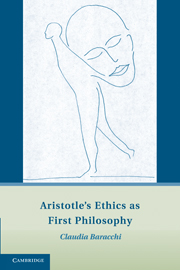
In Aristotle's Ethics as First Philosophy Claudia Baracchi demonstrates the indissoluble links between practical and theoretical wisdom in Aristotle's thinking. Referring to a broad range of texts from the Aristotelian corpus, Baracchi shows how the theoretical is always informed by a set of practices, and specifically, how one's encounter with phenomena, the world, or nature in the broadest sense, is always a matter of ethos. Such a 'modern' intimation can, thus, be found at the heart of Greek thought. Baracchi's book opens the way for a comprehensively reconfigured approach to classical Greek philosophy.
Aristotle and Confucius are pivotal figures in world history; nevertheless, Western and Eastern cultures have in modern times largely abandoned the insights of these masters. Remastering Morals provides a book-length scholarly comparison of the ethics of Aristotle and Confucius. May Sim's comparisons offer fresh interpretations of the central teachings of both men. More than a catalog of similarities and differences, her study brings two great traditions into dialog so that each is able to learn from the other. This is essential reading for anyone interested in virtue-oriented ethics.
Marina McCoy explores Plato's treatment of the rhetoric of philosophers and sophists through a thematic treatment of six different Platonic dialogues, including Apology, Protagoras, Gorgias, Republic, Sophist, and Phaedras. She argues that Plato presents the philosopher and the sophist as difficult to distinguish, insofar as both use rhetoric as part of their arguments. Plato does not present philosophy as rhetoric-free, but rather shows that rhetoric is an integral part of philosophy. However, the philosopher and the sophist are distinguished by the philosopher's love of the forms as the ultimate objects of desire. It is this love of the forms that informs the philosopher's rhetoric, which he uses to lead his partner to better understand his deepest desires. McCoy's work is of interest to philosophers, classicists, and communications specialists alike in its careful yet comprehensive treatment of philosophy, sophistry, and rhetoric as portrayed through the drama of the dialogues.
Aristotle and the Rediscovery of Citizenship confronts a question that is central to Aristotle's political philosophy as well as to contemporary political theory: what is a citizen? Answers prove to be elusive, in part because late twentieth-century critiques of the Enlightenment called into doubt fundamental tenets that once guided us. Engaging the two major works of Aristotle's political philosophy, his Nicomachean Ethics and his Politics, Susan D. Collins poses questions that current discussions of liberal citizenship do not adequately address. Drawing a path from contemporary disputes to Aristotle, she examines in detail his complex presentations of moral virtue, civic education, and law; his view of the aims and limits of the political community; and his treatment of the connection between citizenship and the human good. Collins thereby shows how Aristotle continues to be an indispensable source of enlightenment, as he has been for political and religious traditions of the past.
Stoicism is now widely recognised as one of the most important philosophical schools of ancient Greece and Rome. But how did it influence Western thought after Greek and Roman antiquity? The question is a difficult one to answer because the most important Stoic texts have been lost since the end of the classical period, though not before early Christian thinkers had borrowed their ideas and applied them to discussions ranging from dialectic to moral theology. Later philosophers became familiar with Stoic teachings only indirectly, often without knowing that an idea came from the Stoics. The contributors recruited for this volume, first published in 2004, include some of the leading international scholars of Stoicism as well as experts in later periods of philosophy. They trace the impact of Stoicism and Stoic ideas from late antiquity through the medieval and modern periods.
This book offers a comprehensive account of the major philosophical works on friendship and its relationship to self-love. The book gives central place to Aristotle's searching examination of friendship in the Nicomachean Ethics. Lorraine Pangle argues that the difficulties surrounding this discussion are soon dispelled once one understands the purpose of the Ethics as both a source of practical guidance for life and a profound, theoretical investigation into human nature. The book also provides fresh interpretations of works on friendship by Plato, Cicero, Epicurus, Seneca, Montaigne and Bacon. The author shows how each of these thinkers sheds light on central questions of moral philosophy: is human sociability rooted in neediness or strength? is the best life chiefly solitary, or dedicated to a community with others? Clearly structured and engagingly written, this book will appeal to a broad swathe of readers across philosophy, classics and political science.
One of Epicurus' central concerns is to show how human agency exists within a world whose ultimate constituents are simply extended and indivisible bits of matter (atoms) whizzing around in empty space (the void). A common way of putting this concern is to say that Epicurus wishes to defend free will against the threat of determinism. After all, the Epicurean poet Lucretius asserts that libera voluntas - often translated as 'free will' - is incompatible with causal determinism, and Epicurus (famously or infamously) posits an indeterministic atomic motion, the 'swerve', in order to defend our freedom against this threat. However, framing the issue this way risks anachronistically oversimplifying and distorting the Epicurean position. First of all, Epicurus defends at least three different sorts of freedom: “(a) Effective agency, our ability to act as we wish to in order to get what we desire. / (b) Self-formation of character, our ability to modify our desires, hopefully in a way that allows us to attain happiness. / (c) Moral responsibility, our ability to be justifiably subject to praise and blame for what we do.”
Although 'psychology' does not constitute a distinct sub-division of Epicurean theory, the term can be used to refer to a number of well-marked topics in their philosophical framework. These include (1) the bodily nature of the psyche, (2) the atomic composition of the psyche, and (3) links between psychological functions and the structure of the body. These topics fall, broadly, under 'physics' in Epicurean philosophy. However, the bodily and atomic nature of the psyche also has implications for Epicurean ethics, implications that can also be seen as part of their thinking about psychology. These implications include (4) the capacity of the psyche, in human beings, for the development of agency and responsibility, and (5) the mortal nature of the psyche. Also relevant is (6) Epicurean use of psychological language in ethical contexts, often without explicit reference to the bodily or atomic nature of the psyche, and (7) the psychological assumptions underlying the Epicurean therapy of beliefs and emotions. The focus here is on the first four topics, illustrated by reference to certain key sources, and on the issue of how to understand the theory of psyche-body relations implied in these ideas (Sections II-V). However, there is briefer comment on the latter three topics, indicating how the conception of psychology involved in those topics depends on, or is at least compatible with, Epicurean thinking about the psyche as bodily (Section VI).
Epicurean physics is fundamentally atomist. This means that it rests on two principal theses. The first is: 'All bodies are either indivisible small bodies or else are composed of indivisible small bodies.' The Greek adjective 'atomos' means 'indivisible, what cannot be divided'. When made into a noun, or when a noun is understood, usually it is translated as 'atom' or 'atoms'. Let us call this thesis the 'Atomist Thesis'. Epicurus sets it out in a canonical form at the beginning of his inquiry into physics at Letter to Herodotus 40: 'Amongst bodies, some are composites (sunkriseis); others are those from which the composites are made. These latter are indivisible (atoma) and unalterable ' Lucretius reprises the argument in the first book of the De rerum natura (DRN), calling the atoms 'principles' (principia) or 'the first elements of things' (primordia rerum). The 'composites' are rendered as concilia. It appears that Epicurus used this argument on various occasions, at least if we believe the scholion which accompanies this passage in the Letter to Herodotus: 'He also says this in the first book of On Nature and in books XIV and XV, as well as in the Great Epitome'.
Descriptions of Epicureanism in Rome often end with Lucretius in the first century BC. No innovations are expected of Epicureanism under the Principate and, in fact, anyone expecting to widen our knowledge of Epicureanism through the study of Imperial sources will often be disappointed, since Epicureans in this period mostly pronounce the familiar doctrines, while anti-Epicurean polemics, from pagan and Christian camps, are content to draw on the arsenal of well-rehearsed arguments, almost always aimed at Epicurus' materialism, his rejection of providence, his denial of the immortality of the soul and his hedonism. Certainly, Epicurus' teachings were not particularly favoured under the Principate. Throughout the first two centuries down to the time of Marcus Aurelius, Hellenistic philosophy, by comparison with resurgent Platonism and Christianity, was indeed favourably viewed; but even then Epicurus' teachings stayed in the background in comparison with Stoicism. His philosophy was eventually to lose all significant influence when, in Late Antiquity, Platonism and Christianity became dominant. One reason for the growing neglect might have been the alleged atheism of Epicurean doctrines.
A goal of Epicurean philosophy was the achievement of calm and freedom from anxiety. Epicurus believed that if people can be freed from fear - including fears relating to the actions of gods - they can then achieve ataraxia ('being undisturbed'). Epicurean cosmology and meteorology were motivated by the desire to alleviate fear of gods. While Epicurus recognized the existence of gods, he denied the possibility that they have any cosmic influence. He developed a strict materialist philosophy, designed to offer natural explanations of phenomena that were often seen as due to activities of gods. Questions about the origin and order of the world, its possible beginning and end, are potentially disturbing: violent natural phenomena, particularly thunder, lightning, hail and earthquakes, can be terrifying and destructive. If such phenomena are not due to gods, there is no reason to fear the gods' involvement in our world. Epicurean meteorology explained the meteōra (the phenomena of the sky, and earthquakes); cosmology focused on the nature of our local cosmos (kosmos), while acknowledging the existence of an infinite number of kosmoi (worlds). The Greek word kosmos carried a range of meanings; its use in natural philosophy was coloured by the worldview of the user.
“Philosophy, as long as a drop of blood shall pulse in its world-subduing and absolutely free heart, will never grow tired of answering its adversaries with the cry of Epicurus: 'The truly impious man is not he who denies the gods worshipped by the multitude, but he who affirms of the gods what the multitude believes about them'.” Karl Marx, Foreword to his 1841 Doctoral dissertation / “As you say of yourself, I TOO AM AN EPICUREAN. I consider the genuine (not the imputed) doctrines of Epicurus as containing everything rational in moral philosophy which Greece and Rome have left us.” Thomas Jefferson, Letter to William Short, 31 October 1819 / “In addition to removing all hope of help and favours from the gods, as we said, Epicurus blinds the part of our understanding that loves learning and the part of our practical reason that loves honour. He packs them tightly into a narrow vessel and removes any pure pleasure from body and soul. He degrades our nature, as if there were no greater good than the avoidance of evil.” Plutarch, Non posse 1107C