To save content items to your account,
please confirm that you agree to abide by our usage policies.
If this is the first time you use this feature, you will be asked to authorise Cambridge Core to connect with your account.
Find out more about saving content to .
To save content items to your Kindle, first ensure no-reply@cambridge.org
is added to your Approved Personal Document E-mail List under your Personal Document Settings
on the Manage Your Content and Devices page of your Amazon account. Then enter the ‘name’ part
of your Kindle email address below.
Find out more about saving to your Kindle.
Note you can select to save to either the @free.kindle.com or @kindle.com variations.
‘@free.kindle.com’ emails are free but can only be saved to your device when it is connected to wi-fi.
‘@kindle.com’ emails can be delivered even when you are not connected to wi-fi, but note that service fees apply.
In this 2005 book, Tim O'Keefe reconstructs the theory of freedom of the ancient Greek philosopher Epicurus (341–271/0 BCE). Epicurus' theory has attracted much interest, but our attempts to understand it have been hampered by reading it anachronistically as the discovery of the modern problem of free will and determinism. O'Keefe argues that the sort of freedom which Epicurus wanted to preserve is significantly different from the 'free will' which philosophers debate today, and that in its emphasis on rational action it has much closer affinities with Aristotle's thought than with current preoccupations. His original and provocative book will be of interest to a wide range of readers in Hellenistic philosophy.
This work brings together Philip van der Eijk's previously published essays on the close connections that existed between medicine and philosophy throughout antiquity. Medical authors such as the Hippocratic writers, Diocles, Galen, Soranus and Caelius Aurelianus elaborated on philosophical methods such as causal explanation, definition and division and applied key concepts such as the notion of nature to their understanding of the human body. Similarly, philosophers such as Plato and Aristotle were highly valued for their contributions to medicine. This interaction was particularly striking in the study of the human soul in its relation to the body, as illustrated by approaches to specific topics such as intellect, sleep and dreams, and diet and drugs. With a detailed introduction surveying the subject as a whole and an essay on Aristotle's treatment of sleep, this wide-ranging and accessible collection is essential reading for the student of ancient philosophy and science.
There is a mystery at the heart of Plato's Parmenides. In the first part, Parmenides criticizes what is widely regarded as Plato's mature theory of Forms, and in the second, he promises to explain how the Forms can be saved from these criticisms. Ever since the dialogue was written, scholars have struggled to determine how the two parts of the work fit together. Did Plato mean us to abandon, keep or modify the theory of Forms, on the strength of Parmenides' criticisms? Samuel Rickless offers something that has never been done before: a careful reconstruction of every argument in the dialogue. He concludes that Plato's main aim was to argue that the theory of Forms should be modified by allowing that forms can have contrary properties. To grasp this is to solve the mystery of the Parmenides and understand its crucial role in Plato's philosophical development.
The Cyrenaic school was a fourth-century BC philosophical movement, related both to the Socratic tradition and to Greek Scepticism. In ethics, Cyrenaic hedonism can be seen as one of many attempts made by the associates of Socrates and their followers to endorse his ethical outlook and to explore the implications of his method. In epistemology, there are close philosophical links between the Cyrenaics and the Sceptics, both Pyrrhonists and Academics. There are further links with modern philosophy as well, for the Cyrenaics introduced a form of subjectivism which in some ways preannounces Cartesian views, endorsed by Malebranche and Hume and developed by Kant. This 1998 book reconstructs Cyrenaic epistemology, explains how it depends on Cyrenaic hedonism, locates it in the context of ancient debates, and discusses its connections with modern and contemporary epistemological positions.
The Lysis is one of Plato's most engaging but also puzzling dialogues; it has often been regarded, in the modern period, as a philosophical failure. The full philosophical and literary exploration of the dialogue illustrates how it in fact provides a systematic and coherent, if incomplete, account of a special theory about, and special explanation of, human desire and action. Furthermore, it shows how that theory and explanation are fundamental to a whole range of other Platonic dialogues and indeed to the understanding of the corpus as a whole. Part One offers an analysis of, or running commentary on, the dialogue. In Part Two Professors Penner and Rowe examine the philosophical and methodological implications of the argument uncovered by the analysis. The whole is rounded off by an epilogue of the relation between the Lysis and some other Platonic (and Aristotelian) texts.
In fourth-century Greece (BCE), the debate over the nature of philosophy generated a novel claim: that the highest form of wisdom is theoria, the rational 'vision' of metaphysical truths (the 'spectator theory of knowledge'). This 2004 book offers an original analysis of the construction of 'theoretical' philosophy in fourth-century Greece. In the effort to conceptualise and legitimise theoretical philosophy, the philosophers turned to a venerable cultural practice: theoria (state pilgrimage). In this practice, an individual journeyed abroad as an official witness of sacralized spectacles. This book examines the philosophic appropriation and transformation of theoria, and analyses the competing conceptions of theoretical wisdom in fourth-century philosophy. By tracing the link between traditional and philosophic theoria, this book locates the creation of theoretical philosophy in its historical context, analysing theoria as a cultural and an intellectual practice. It develops a new, interdisciplinary approach, drawing on philosophy, history and literary studies.
Aristotle's theory of truth, which has been the most influential account of the concept of truth from Antiquity onwards, spans several areas of philosophy: philosophy of language, logic, ontology and epistemology. In this 2004 book, Paolo Crivelli discusses all the main aspects of Aristotle's views on truth and falsehood. He analyses in detail the main relevant passages, addresses some well-known problems of Aristotelian semantics, and assesses Aristotle's theory from the point of view of modern analytic philosophy. In the process he discusses most of the literature on Aristotle's semantic theory to have appeared in the last two centuries. His book vindicates and clarifies the often repeated claim that Aristotle's is a correspondence theory of truth. It will be of interest to a wide range of readers working in both ancient philosophy and modern philosophy of language.
This book offers an important study of Aristotle's theory of the sense-organs. It aims to answer two questions central to Aristotle's psychology and biology: why does Aristotle think we have sense-organs, and why does he describe the sense-organs in the way he does? The author looks at all the Aristotelian evidence for the five senses and shows how pervasively Aristotle's accounts of the sense-organs are motivated by his interest in form and function. The book also engages with the celebrated problem of whether perception for Aristotle requires material changes in the perceiver. It argues that, surprisingly to the modern philosopher, nothing in Aristotle's description of the sense-organs requires us to believe in such changes.
Andrea Falcon's work is guided by the exegetical ideal of recreating the mind of Aristotle and his distinctive conception of the theoretical enterprise. In this concise exploration of the significance of the celestial world for Aristotle's science of nature, Falcon investigates the source of discontinuity between celestial and sublunary natures and argues that the conviction that the natural world exhibits unity without uniformity is the ultimate reason for Aristotle's claim that the heavens are made of a special body, unique to them. This book presents Aristotle as a totally engaged, systematic investigator whose ultimate concern was to integrate his distinct investigations into a coherent interpretation of the world we live in, all the while mindful of human limitations to what can be known. Falcon reads in Aristotle the ambition of an extraordinarily curious mind and the confidence that that ambition has been largely fulfilled.
This 2005 book is a critical examination of Michel Foucault's relation to ancient Greek thought, in particular his famous analysis of Greek history of sexuality. Wolfgang Detel offers an understanding of Foucault's theories of power and knowledge based on modern analytical theories of science and concepts of power. He offers a complex reading of the texts which Foucault discusses, covering topics such as Aristotle's ethics and theory of sex, Hippocratic dietetics, the earliest treatises on economics, and Plato's theory of love. The result is a philosophically rich and probing critique of Foucault's later writings, and a persuasive account of the relation between ethics, power and knowledge in classical antiquity. His book will have a wide appeal to readers interested in Foucault and in Greek thought and culture.
Scholars of Plato are divided between those who emphasize the literature of the dialogues and those who emphasize the argument of the dialogues, and between those who see a development in the thought of the dialogues and those who do not. In this important book Russell Dancy focuses on the arguments and defends a developmental picture. He explains the Theory of Forms of the Phaedo and Symposium as an outgrowth of the quest for definitions canvassed in the Socratic dialogues, by constructing a Theory of Definition for the Socratic dialogues based on the refutations of definitions in those dialogues, and showing how that theory is mirrored in the Theory of Forms. His discussion, notable for both its clarity and its meticulous scholarship, ranges in detail over a number of Plato's early and middle dialogues, and will be of interest to readers in Plato studies and in ancient philosophy more generally.
This book traces the development of conceptions of God and the relationship between God's being and activity from Aristotle, through the pagan Neoplatonists, to thinkers such as Augustine, Boethius and Aquinas (in the West) and Dionysius the Areopagite, Maximus the Confessor and Gregory Palamas (in the East). The result is a comparative history of philosophical thought in the two halves of Christendom, providing a philosophical backdrop to the schism between the Eastern and Western Churches.
There is now a renewed concern for moral psychology among moral philosophers. Moreover, contemporary philosophers interested in virtue, moral responsibility and moral progress regularly refer to Plato and Aristotle, the two founding fathers of ancient ethics. The book contains eleven chapters by distinguished scholars which showcase current research in Greek ethics. Four deal with Plato, focusing on the Protagoras, Euthydemus, Symposium and Republic, and discussing matters of literary presentation alongside the philosophical content. The four chapters on Aristotle address problems such as the doctrine of the mean, the status of rules, equity and the tension between altruism and egoism in Aristotelian eudaimonism. A contrast to classical Greek ethics is presented by two chapters reconstructing Epicurus' views on the emotions and moral responsibility as well as on moral development. The final chapter on personal identity in Empedocles shows that the concern for moral progress is already palpable in Presocratic philosophy.
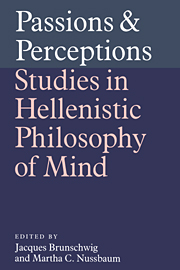
The philosophers of the Hellenistic schools in ancient Greece and Rome (Epicureans, Stoics, Sceptics, Academics, Cyrenaics) made important contributions to the philosophy of mind and the philosophy of psychology. This volume, which contains the proceedings of the Fifth Symposium Hellenisticum, describes and analyses their contributions on issues such as: the nature of perception, imagination and belief; the nature of the passions and their role in action; the relationship between mind and body; freedom and determinism; the role of pleasure as a goal; the effects of poetry on belief and passion. Written with a high level of historical and philosophical scholarship, the essays are intended both for classicists and for specialists interested in the philosophy of mind.
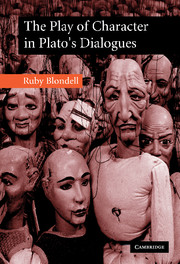
This book attempts to bridge the gulf that still exists between 'literary' and 'philosophical' interpreters of Plato by looking at his use of characterization. Characterization is intrinsic to dramatic form and a concern with human character in an ethical sense pervades the dialogues on the discursive level. Form and content are further reciprocally related through Plato's discursive preoccupation with literary characterization. Two opening chapters examine the methodological issues involved in reading Plato 'as drama' and a set of questions surrounding Greek 'character' words (especially ethos), including ancient Greek views about the influence of dramatic character on an audience. The figure of Sokrates qua Platonic 'hero' also receives preliminary discussion. The remaining chapters offer close readings of select dialogues, chosen to show the wide range of ways in which Plato uses his characters, with special emphasis on the kaleidoscopic figure of Sokrates and on Plato's own relationship to his 'dramatic' hero.
This study of Plato's ethics focuses on the concept of virtue. Based on detailed readings of the most prominent Platonic dialogues on virtue, it argues that there is a central yet previously unnoticed conceptual distinction in Plato between the idea of virtue as the supreme aim of one's actions and the determination of which action-tokens or -types are virtuous. Appreciating the 'aiming/determining distinction' provides detailed and mutually consistent readings of the most well-known Platonic dialogues on virtue as well as original interpretations of central Platonic questions. Unlike most examinations of Plato's ethics, this study does not take as its centrepiece the 'eudaimonist framework', which focuses on the relationship between virtue and happiness. Instead, it argues that the dialogues themselves begin with the idea of the supremacy of virtue, examine how that claim can be defended, and address how to determine what constitutes the virtuous action.
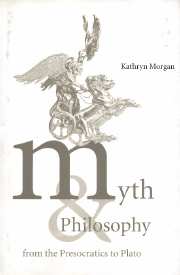
This book explores the dynamic relationship between myth and philosophy in the Presocratics, the Sophists, and in Plato - a relationship which is found to be more extensive and programmatic than has been recognized. The story of philosophy's relationship with myth is that of its relationship with literary and social convention. The intellectuals studied here wanted to reformulate popular ideas about cultural authority and they achieved this goal by manipulating myth. Their self-conscious use of myth creates a self-reflective philosophic sensibility and draws attention to problems inherent in different modes of linguistic representation. Much of the reception of Greek philosophy stigmatizes myth as 'irrational'. Such an approach ignores the important role played by myth in Greek philosophy, not just as a foil but as a mode of philosophical thought. The case studies in this book reveal myth deployed as a result of methodological reflection, and as a manifestation of philosophical concerns.
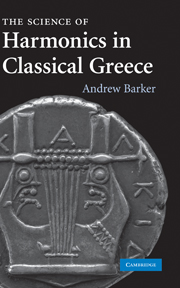
The ancient science of harmonics investigates the arrangements of pitched sounds which form the basis of musical melody, and the principles which govern them. It was the most important branch of Greek musical theory, studied by philosophers, mathematicians and astronomers as well as by musical specialists. This 2007 book examines its development during the period when its central ideas and rival schools of thought were established, laying the foundations for the speculations of later antiquity, the Middle Ages and the Renaissance. It concentrates particularly on the theorists' methods and purposes and the controversies that their various approaches to the subject provoked. It also seeks to locate the discipline within the broader cultural environment of the period; and it investigates, sometimes with surprising results, the ways in which the theorists' work draws on and in some cases influences that of philosophers and other intellectuals.
Plato's Cratylus is a brilliant but enigmatic dialogue. It bears on a topic, the relation of language to knowledge, which has never ceased to be of central philosophical importance, but tackles it in ways which at times look alien to us. In this reappraisal of the dialogue, Professor Sedley argues that the etymologies which take up well over half of it are not an embarrassing lapse or semi-private joke on Plato's part. On the contrary, if taken seriously as they should be, they are the key to understanding both the dialogue itself and Plato's linguistic philosophy more broadly. The book's main argument is so formulated as to be intelligible to readers with no knowledge of Greek, and will have a significant impact both on the study of Plato and on the history of linguistic thought.
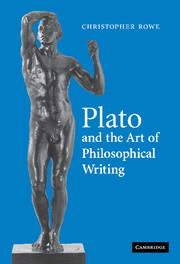
Plato's dialogues are usually understood as simple examples of philosophy in action. In this book Professor Rowe treats them rather as literary-philosophical artefacts, shaped by Plato's desire to persuade his readers to exchange their view of life and the universe for a different view which, from their present perspective, they will barely begin to comprehend. What emerges is a radically new Plato: a Socratic throughout, who even in the late dialogues is still essentially the Plato (and the Socrates) of the Apology and the so-called 'Socratic' dialogues. This book aims to understand Plato both as a philosopher and as a writer, on the assumption that neither of these aspects of the dialogues can be understood without the other. The argument of the book is closely based in Plato's text, but should be accessible to any serious reader of Plato, whether professional philosopher, classicist, or student.