To save content items to your account,
please confirm that you agree to abide by our usage policies.
If this is the first time you use this feature, you will be asked to authorise Cambridge Core to connect with your account.
Find out more about saving content to .
To save content items to your Kindle, first ensure no-reply@cambridge.org
is added to your Approved Personal Document E-mail List under your Personal Document Settings
on the Manage Your Content and Devices page of your Amazon account. Then enter the ‘name’ part
of your Kindle email address below.
Find out more about saving to your Kindle.
Note you can select to save to either the @free.kindle.com or @kindle.com variations.
‘@free.kindle.com’ emails are free but can only be saved to your device when it is connected to wi-fi.
‘@kindle.com’ emails can be delivered even when you are not connected to wi-fi, but note that service fees apply.
Augustine of Hippo (354–430 ce) was not only concerned with his own self-promotion but also eminently endowed with the rhetorical skills to convey the desired image of himself. For evidence of this we need look no further than his Confessions, in which the newly appointed bishop provides us with his version of events leading up to his conversion to Christianity in 386. While debates have arisen over the truth of the story – it has even been argued that Augustine was converted in 386 not to Christianity but to Neoplatonism – the narrator's account has set the terms of the debate so completely that his readers have accepted his judgement that the defining moment of his life was his conversion in 386 (whether it was to Christianity or Neoplatonism or some mixture of the two). O'Donnell sounds a cautionary note here:
It remains the assumption, in short, of all modern biographers – hostile, friendly, and merely attentive – that a “conversion” in Milan, on or about the time of 386, is the central and most powerful explanatory fact about Augustine's life. Augustine would be pleased that we agree with him so readily.
But perhaps we should not. Perhaps Augustine, in telling this story about himself, had interests and purposes he could not avow. Perhaps this retrospective story, which first appears almost a decade later in something like its Confessions form, is creating a structure for the past that is not irrefutable.
Was Tertullian of Carthage a schismatic? How did he view the Church and its bishops? How did he understand the exercise of authority within the Church? In this study David Rankin sets the writings of Tertullian in the context of the early third-century Church and the developments it was undergoing in relation to both its structures and its self-understanding. He then discusses Tertullian's own theology of the Church, his imagery and his perception of Church office and ministry. Tertullian maintained throughout his career a high view of the Church, and this in part constituted the motivation for his vitriolic attacks on the Church's hierarchy after he had joined the New Prophecy movement. His contribution to the development of the Church has often been misunderstood, and this thorough exploration provides a reassessment of its nature and importance.
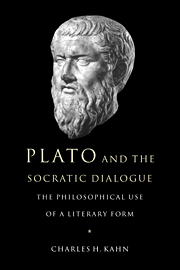
This book proposes a new paradigm for the interpretation of Plato's early and middle dialogues. Rejecting the usual assumption of a distinct 'Socratic' period in the development of Plato's thought, this view regards the earlier works as deliberate preparation for the exposition of Plato's mature philosophy. Differences between the dialogues do not represent different stages in Plato's own thinking but rather different aspects and moments in the presentation of a new and unfamiliar view of reality. Once the fictional character of the Socratic genre is recognised, there is no reason to regard Plato's early dialogues as representing the philosophy of the historical Socrates. The result is a unified interpretation of all of the dialogues down to the Republic and the Phaedrus.
This is the companion volume to Gregory Vlastos' highly acclaimed work Socrates: Ironist and Moral Philosopher. Four ground-breaking papers which laid the basis for his understanding of Socrates are collected here, in revised form: they examine Socrates' elenctic method of investigative argument, his disavowal of knowledge, his concern for definition, and the complications of his relationship with the Athenian democracy. The fifth chapter is a new and provocative discussion of Socrates' arguments in the Protagoras and Laches. The epilogue 'Socrates and Vietnam' suggests that Socrates was not, as Plato claimed, the most just man of his time. The papers have been prepared for publication by Professor Myles Burnyeat with the minimum of editorial intervention.
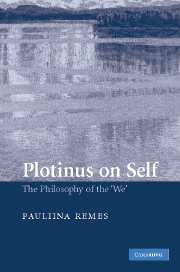
Plotinus, the founder of the Neoplatonic school of philosophy, conceptualises two different notions of self (or 'us'): the corporeal and the rational. Personality and imperfection mark the former, while goodness and a striving for understanding mark the latter. In this text, Dr Remes grounds the two selfhoods in deep-seated Platonic ontological commitments, following their manifestations, interrelations and sometimes uneasy coexistence in philosophical psychology, emotional therapy and ethics. Plotinus' interest lies in what it means for a human being to be a temporal and a corporeal thing, yet capable of abstract and impartial reasoning, of self-government and perhaps even invulnerability. The book argues that this involves a philosophically problematic rupture within humanity which is, however, alleviated by the psychological similarities and points of contact between the two aspects of the self. The purpose of life is the cultivation of the latter aspect, the true self.
This collection makes available in English twelve papers by the distinguished French scholar Professor Jacques Brunschwig. The essays deal with problems arising in the texts and doctrines of the three major philosophical schools of the Hellenistic period - Epicureanism, Stoicism and Scepticism. The author's strategy is to focus on some specific problem and then to enlarge the conclusion of his discussion so as to reformulate or reassess some more important issue. The main subjects tackled are: problems in Epicurean cosmology and linguistic theory; aspects of Stoic logic, ontology and theology; the history of Scepticism; and analysis of some of the conceptual tools used by the Sceptics in their anti-dogmatic arguments.
Neoplatonism is a term used to designate the form of Platonic philosophy that developed in the Roman Empire from the third to the fifth century AD and that based itself on the corpus of Plato's dialogues. Sara Rappe's challenging study analyses Neoplatonic texts themselves using contemporary philosophy of language. It covers the whole tradition of Neoplatonic writing from Plotinus through Proclus to Damascius. Addressing the strain of mysticism in these works, the author shows how these texts reflect actual meditational practices, methods of concentrating the mind, and other mental disciplines that informed the tradition as a whole. In providing such a broad survey of Neoplatonic writing, the book will appeal to classical philosophers classicists as well as students of religious studies.
The Theaetetus is one of the most widely studied of any of the Platonic dialogues because its dominant theme concerns the significant philosophical question, what is knowledge? In this book Paul Stern provides a full-length treatment of its political character in relationship to this dominant theme. He argues that this approach sheds significant light on the distinctiveness of the Socratic way of life, with respect to both its initial justification and its ultimate character. More specifically, he argues that Socrates' revolutionary decision to subject political life to philosophic reflection, the decision that leads directly to his trial and execution, is based on his awareness of the elusiveness of comprehensive knowledge and the implications of that elusiveness for the validity of philosophic inquiry. This view of Socrates' rationale has important consequences for our understanding of political philosophy and of the validity of the life of reason itself.
This long-awaited study of the most enigmatic figure of Greek philosophy reclaims Socrates' ground-breaking originality. Written by a leading historian of Greek thought, it argues for a Socrates who, though long overshadowed by his successors Plato and Aristotle, marked the true turning point in Greek philosophy, religion and ethics. The quest for the historical figure focuses on the Socrates of Plato's earlier dialogues, setting him in sharp contrast to that other Socrates of later dialogues, where he is used as a mouthpiece for Plato's often anti-Socratic doctrine. At the heart of the book is the paradoxical nature of Socratic thought. But the paradoxes are explained, not explained away. The book highlights the tensions in the Socratic search for the answer to the question 'How should we live?' Conceived as a divine mandate, the search is carried out through elenctic argument, and dominated by an uncompromising rationalism. The magnetic quality of Socrates' personality is allowed to emerge throughout the book. Clearly and forcefully written, philosophically sophisticated but entirely accessible to non-specialists, this book will be of major importance and interest to all those studying ancient philosophy and the history of Western thought.
Hegel's often-echoed verdict on the apolitical character of philosophy in the Hellenistic age is challenged in this collection of essays, originally presented at the sixth meeting of the Symposium Hellenisticum. An international team of leading scholars reveals a vigorous intellectual scene of great diversity: analyses of political leadership and the Roman constitution in Aristotelian terms; Cynic repudiation of the polis - but accommodation with its rulers; Stoic and Epicurean theories of justice as the foundation of society; Cicero's moral critique of the traditional political pursuit of glory. The volume as a whole offers a comprehensive guide to the main currents of social and political philosophy in a period of increasing interest to classicists, philosophers and cultural and intellectual historians.
The essays in this volume were written to celebrate the sixtieth birthday of G. E. L. Owen, who by his essays and seminars on ancient Greek philosophy has made a contribution to its study that is second to none. The authors, from both sides of the Atlantic, include not only scholars whose main research interests lie in Greek philosophy, but others best known for their work in general philosophy. All are pupils or younger colleagues of Professor Owen who are indebted to his practice of philosophical scholarship as a first-order philosophical activity. At the heart of G. E. L. Owen's work has been a preoccupation with the role of philosophical reflection on language in the metaphysics and epistemology of Plato, Aristotle and other ancient Greek thinkers. This is accordingly the general topic of the present volume, which includes five papers on Plato's critical dialogues and seven on Aristotle, prefaced by two on Heraclitus and followed by a study of the debate in Hellenistic philosophy on the sorites. This is a book for specialists in Greek philosophy and philosophers of language which will also be of interest to some linguists.
This volume of essays honours Henry Chadwick, probably the greatest and best-known of English scholars of early Christianity. The essays, written by many of the leading theologians and church historians in the English-speaking world, discuss different aspects of how Christianity developed norms and standards in its teaching, how it came to have - and to enforce - a definition of orthodoxy and heresy. It is a collection of fundamental work by internationally recognised experts. It covers issues of orthodoxy from the first right up to the sixth century, and its wide-ranging surveys of centrally important material in early Christianity will find broad appeal among scholars and students of Old and New Testaments, medieval history and patristics.
This 1999 book demonstrates a method for reading the texts of Aristotle by revealing a continuous line of argument running from the Physics to De Caelo. The author analyses a group of arguments that are almost always treated in isolation from one another, and reveals their elegance and coherence. She concludes by asking why these arguments remain interesting even though we now believe they are absolutely wrong and have been replaced by better ones. The book establishes the case that we must rethink our approach to Aristotle's physical science and Aristotelian texts, and as such will provoke debate and stimulate new thinking amongst philosophers, classicists, and historians of science.
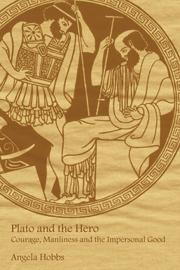
Plato's thinking on courage, manliness and heroism is both profound and central to his work, but these areas of his thought remain under-explored. This book examines his developing critique of both the notions and embodiments of manliness prevalent in his culture (particularly those in Homer), and his attempt to redefine them in accordance with his own ethical, psychological and metaphysical principles. It further seeks to locate the discussion within the framework of his general approach to ethics, an approach which focuses on concepts of flourishing and virtue, rather than on consequences or duty. The question of why courage is necessary in the flourishing life in its turn leads to Plato's bid to unify the noble and the beneficial and the tensions this unification creates between human and divine ideals. The issue of manliness also raises problems of gender: does Plato conceive of the ethical subject as human or male?
Christianity began as a little-known Jewish sect, but rose within 300 years to dominate the civilised world. It owed its rise in part to inspired moral leadership, but also to its success in assimilating, criticising and developing the philosophies of the day, which offered rationally approved life-styles and moral directives. Without abandoning their allegiance to their founder and to Holy Scripture, Christians could therefore present their faith as a 'new philosophy'. This book, which is written for non-specialist readers, provides a concise conspectus of the emergence of philosophy among the Greeks; an account of its continuance in early Christian times, and its influence on early Christian thought, especially in formulating the doctrines of the Trinity and the Incarnation; and finally a brief critical assessment of the philosophy of St Augustine - arguably the greatest philosopher of the first millennium.
While Aristotle's account of the happy life continues to receive attention, many of his claims about virtue of character seem so puzzling that modern philosophers have often discarded them, or have reworked them to fit more familiar theories that do not make virtue of character central. In this book, Paula Gottlieb takes a fresh look at Aristotle's claims, particularly the much-maligned doctrine of the mean. She shows how they form a thought-provoking ethic of virtue, one that deserves to be developed and refined. The first part of the book addresses the nature of virtue and the virtues, illuminated by the doctrine of the mean. Building on the conclusions of this analysis, the second part explains the mentality of the good person and the type of society that will allow such a person to flourish.
Given its brevity, Plato's Meno covers an astonishingly wide array of topics: politics, education, virtue, definition, philosophical method, mathematics, the nature and acquisition of knowledge and immortality. Its treatment of these, though profound, is tantalisingly short, leaving the reader with many unresolved questions. This book confronts the dialogue's many enigmas and attempts to solve them in a way that is both lucid and sympathetic to Plato's philosophy. Reading the dialogue as a whole, it explains how different arguments are related to one another and how the interplay between characters is connected to the philosophical content of the work. In a new departure, this book's exploration focuses primarily on the content and coherence of the dialogue in its own right and not merely in the context of other dialogues, making it required reading for all students of Plato, be they from the world of classics or philosophy.
This Companion presents both an introduction to the history of the ancient philosophical school of Epicureanism and also a critical account of the major areas of its philosophical interest. Chapters span the school's history from the early Hellenistic Garden to the Roman Empire and its later reception in the Early Modern period, introducing the reader to the Epicureans' contributions in physics, metaphysics, epistemology, psychology, ethics and politics. The international team of contributors includes scholars who have produced innovative and original research in various areas of Epicurean thought and they have produced essays which are accessible and of interest to philosophers, classicists, and anyone concerned with the diversity and preoccupations of Epicurean philosophy and the state of academic research in this field. The volume emphasises the interrelation of the different areas of the Epicureans' philosophical interests while also drawing attention to points of interpretative difficulty and controversy.
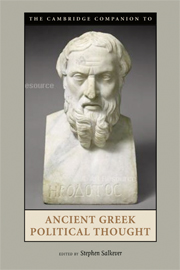
The Cambridge Companion to Ancient Greek Political Thought provides a guide to understanding the central texts and problems in ancient Greek political thought, from Homer through the Stoics and Epicureans. Composed of essays specially commissioned for this volume and written by leading scholars of classics, political science, and philosophy, the Companion brings these texts to life by analysing what they have to tell us about the problems of political life. Focusing on texts by Homer, Herodotus, Thucydides, Plato, and Aristotle, among others, they examine perennial issues, including rights and virtues, democracy and the rule of law, community formation and maintenance, and the ways in which theorizing of several genres can and cannot assist political practice.