To save content items to your account,
please confirm that you agree to abide by our usage policies.
If this is the first time you use this feature, you will be asked to authorise Cambridge Core to connect with your account.
Find out more about saving content to .
To save content items to your Kindle, first ensure no-reply@cambridge.org
is added to your Approved Personal Document E-mail List under your Personal Document Settings
on the Manage Your Content and Devices page of your Amazon account. Then enter the ‘name’ part
of your Kindle email address below.
Find out more about saving to your Kindle.
Note you can select to save to either the @free.kindle.com or @kindle.com variations.
‘@free.kindle.com’ emails are free but can only be saved to your device when it is connected to wi-fi.
‘@kindle.com’ emails can be delivered even when you are not connected to wi-fi, but note that service fees apply.
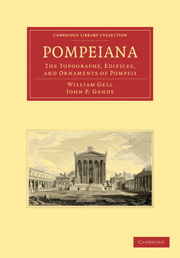
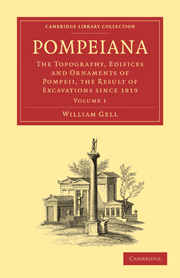
Sir William Gell (1777–1836) was a British archaeologist known for his drawings of sites and objects of classical interest. Noting that from the beginning of the excavations at Pompeii in 1748 'to the present day, no [substantial] work has appeared in the English language upon the subject of its domestic antiquities', together with architect and fellow countryman John P. Gandy he first published Pompeiana to help detail important findings that had been made by the excavators in the first two decades of the nineteenth century. To this end they provide historical discussion, analysis, and over 75 plates illustrating various points of archaeological interest including, as their subtitle notes, 'the topography, edifices, and ornaments of Pompeii'. Pompeiana is an important work that helped open the excavations to English readers and created further awareness of the treasures of the doomed city, destroyed by an eruption of Mount Vesuvius in 79 CE.
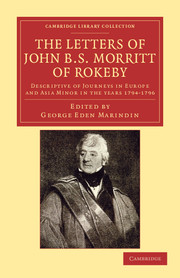
This works is an account by John Bacon Sawrey Morritt (1771–1843), traveller, classical scholar and friend of Sir Walter Scott, of his Grand Tour during the years 1794–6. His letters home were edited by G. E. Marindin (1841–1939) and published in 1914. In 1790 Morritt inherited the Rokeby estate, County Durham, and came into a considerable fortune. Educated at St John's College, Cambridge, he graduated in 1794, and soon afterwards set out for the continent. Visiting Constantinople, Troy, the Greek islands, Crete, Naples, Rome and Venice, Morritt developed a lifelong passion for European art and culture (he purchased the Rokeby Venus in 1813). He was well-read in Greek and Latin literature, had a considerable taste for antiquarian research, and was undeterred by the dangers of traversing Europe during the French Revolutionary Wars. According to his editor, 'it would be difficult to imagine a better traveller'.
This monograph on classical engraved gems, which also contains a catalogue of the collection then held by the Fitzwilliam Museum, was published in 1891. J. Henry Middleton (1846–1896) was at the time the Director of the Museum and Slade Professor of Fine Art in Cambridge. His intention was to provide an introductory volume for students of archaeology which both traced the history of the use of engraved gemstones as seals and signets from Babylonian to classical times, described the techniques used to create these miniature works of art, and gave catalogue definitions, enhanced by photographic plates, of the Fitzwilliam collection, which had for the most part been donated by Colonel W. M. Leake (1777–1860), whose antiquarian interests had been aroused when he was sent to the eastern Mediterranean to assist the Turkish army against the French in the early nineteenth century.
William Martin Leake (1777–1860) was a British military officer and classical scholar specialising in reconstructing the topography of ancient cities. He was a founding member of the Royal Geographical Society and was elected a Fellow of the Royal Society in 1815. After his retirement in 1815, he devoted the rest of his life to topographical and classical studies. These volumes, first published in 1830, contain Leake's authoritative topographical survey of the Peloponnese. Written in the form of a travelogue describing two journeys Leake undertook in the Peloponnese in 1805 and 1806, these volumes provide detailed descriptions of the ancient archaeological sites and the historical geography of the region. Leake was the first scholar to identify many ancient sites in the Peloponnese, and his precise observations led to these volumes becoming authoritative for the classical archaeological sites of the region. Volume 1 recounts his first journey of 1805.
William Martin Leake (1777–1860) was a British military officer and classical scholar specialising in reconstructing the topography of ancient cities. He was a founding member of the Royal Geographical Society and was elected a Fellow of the Royal Society in 1815. After his retirement in 1815, he devoted the rest of his life to topographical and classical studies. These volumes, first published in 1830, contain Leake's authoritative topographical survey of the Peloponnese. Written in the form of a travelogue describing two journeys Leake undertook in the Peloponnese in 1805 and 1806, these volumes provide detailed descriptions of the ancient archaeological sites and the historical geography of the region. Leake was the first scholar to identify many ancient sites in the Peloponnese, and his precise observations led to these volumes becoming authoritative for the classical archaeological sites of the region. Volume 2 recounts his second journey in 1806.
William Martin Leake (1777–1860) was a British military officer and classical scholar specialising in reconstructing the topography of ancient cities. He was a founding member of the Royal Geographical Society and was elected a Fellow of the Royal Society in 1815. After his retirement in 1815, he devoted the rest of his life to topographical and classical studies. These volumes, first published in 1835, contain Leake's account of his four extensive journeys across Greece between 1804 and 1810. Using the form of a travelogue, Leake discusses the contemporary Greek and Turkish culture and provides detailed descriptions of ancient archaeological sites and geography. Leake's precise observations and detailed descriptions were influential in shaping the study of classical topography, with these volumes providing valuable information for the ancient sites and contemporary culture of the region. Volume 3 recounts his third and fourth journeys in Macedonia and Aetolia.
William Martin Leake (1777–1860) was a British military officer and classical scholar specialising in reconstructing the topography of ancient cities. He was a founding member of the Royal Geographical Society and was elected a Fellow of the Royal Society in 1815. After his retirement in 1815, he devoted the rest of his life to topographical and classical studies. These volumes, first published in 1835, contain Leake's account of his four extensive journeys across Greece between 1804 and 1810. Using the form of a travelogue, Leake discusses the contemporary Greek and Turkish culture and provides detailed descriptions of ancient archaeological sites and geography. Leake's precise observations and detailed descriptions were influential in shaping the study of classical topography, with these volumes providing valuable information for the ancient sites and contemporary culture of the region. Volume 2 contains the conclusion of his travels in Boeotia and Attica in 1805–1806.
William Martin Leake (1777–1860) was a British military officer and classical scholar specialising in reconstructing the topography of ancient cities. He was a founding member of the Royal Geographical Society and was elected a Fellow of the Royal Society in 1815. After his retirement in 1815, he devoted the rest of his life to topographical and classical studies. These volumes, first published in 1835, contain Leake's account of his four extensive journeys across northern Greece between 1804 and 1810. Using the form of a travelogue, Leake discusses contemporary Greek and Turkish culture and provides detailed descriptions of ancient archaeological sites and geography. Leake's precise observations and detailed descriptions were influential in shaping the study of classical topography, with these volumes providing valuable information for the ancient sites and contemporary culture of the region. Volume 1 contains two journeys undertaken in Macedonia, Illyria and Thessaly in 1804 and 1805.
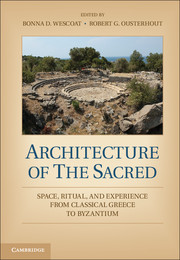
In this book, a distinguished team of authors explores the way space, place, architecture, and ritual interact to construct sacred experience in the historical cultures of the eastern Mediterranean. Essays address fundamental issues and features that enable buildings to perform as spiritually transformative spaces in ancient Greek, Roman, Jewish, early Christian, and Byzantine civilizations. Collectively they demonstrate the multiple ways in which works of architecture and their settings were active agents in the ritual process. Architecture did not merely host events; rather, it magnified and elevated them, interacting with rituals facilitating the construction of ceremony. This book examines comparatively the ways in which ideas and situations generated by the interaction of place, built environment, ritual action, and memory contributed to the cultural formulation of the sacred experience in different religious faiths.
Sir William Gell (1777–1836) was a British archaeologist well known for his drawings of sites and objects of classical interest. Gell published this new, two-volume edition of his Pompeiana in 1832, in an effort to describe the latest archaeological discoveries in the Roman city destroyed by an eruption of Mount Vesuvius in 79 CE. Concerned 'that time will incalculably diminish the freshness of those objects … stripped of their external coats by the rains of winter or the burning suns of summer', he made it his task to describe what he had seen both through description and through his own numerous illustrations. In this first volume, Gell focuses on sites including the forum, baths, and the temple of Fortune. Pompeiana reveals both the history of the excavations, the individual finds, and the processes of field archaeology itself during a more romantic age.