Refine search
Actions for selected content:
3730 results in Classical languages
Appendices
-
- Book:
- Oscan in Southern Italy and Sicily
- Published online:
- 05 October 2015
- Print publication:
- 01 October 2015, pp 258-275
-
- Chapter
- Export citation
Tables
-
- Book:
- Oscan in Southern Italy and Sicily
- Published online:
- 05 October 2015
- Print publication:
- 01 October 2015, pp xviii-xx
-
- Chapter
- Export citation
Acknowledgements
-
- Book:
- Oscan in Southern Italy and Sicily
- Published online:
- 05 October 2015
- Print publication:
- 01 October 2015, pp vi-viii
-
- Chapter
- Export citation
8 - Conclusions
-
- Book:
- Oscan in Southern Italy and Sicily
- Published online:
- 05 October 2015
- Print publication:
- 01 October 2015, pp 224-243
-
- Chapter
- Export citation
2 - Bilingualism and language contact in written texts
-
- Book:
- Oscan in Southern Italy and Sicily
- Published online:
- 05 October 2015
- Print publication:
- 01 October 2015, pp 36-62
-
- Chapter
- Export citation
Illustrations
-
- Book:
- Oscan in Southern Italy and Sicily
- Published online:
- 05 October 2015
- Print publication:
- 01 October 2015, pp xiv-xvi
-
- Chapter
- Export citation
Glossary
-
- Book:
- Oscan in Southern Italy and Sicily
- Published online:
- 05 October 2015
- Print publication:
- 01 October 2015, pp xi-xiii
-
- Chapter
- Export citation
Glossary
-
- Book:
- Oscan in Southern Italy and Sicily
- Published online:
- 05 October 2015
- Print publication:
- 01 October 2015, pp ix-x
-
- Chapter
- Export citation
Index Locorum
-
- Book:
- Oscan in Southern Italy and Sicily
- Published online:
- 05 October 2015
- Print publication:
- 01 October 2015, pp 302-306
-
- Chapter
- Export citation
6 - Legal texts
-
- Book:
- Oscan in Southern Italy and Sicily
- Published online:
- 05 October 2015
- Print publication:
- 01 October 2015, pp 167-193
-
- Chapter
- Export citation
General Index
-
- Book:
- Oscan in Southern Italy and Sicily
- Published online:
- 05 October 2015
- Print publication:
- 01 October 2015, pp 295-301
-
- Chapter
- Export citation
Contents
-
- Book:
- Oscan in Southern Italy and Sicily
- Published online:
- 05 October 2015
- Print publication:
- 01 October 2015, pp v-v
-
- Chapter
- Export citation
1 - Introduction
-
- Book:
- Oscan in Southern Italy and Sicily
- Published online:
- 05 October 2015
- Print publication:
- 01 October 2015, pp 1-35
-
- Chapter
- Export citation
4 - Dedicatory inscriptions
-
- Book:
- Oscan in Southern Italy and Sicily
- Published online:
- 05 October 2015
- Print publication:
- 01 October 2015, pp 94-132
-
- Chapter
- Export citation
3 - Alphabets, epigraphy and orthography
-
- Book:
- Oscan in Southern Italy and Sicily
- Published online:
- 05 October 2015
- Print publication:
- 01 October 2015, pp 63-93
-
- Chapter
- Export citation
Bibliography
-
- Book:
- Oscan in Southern Italy and Sicily
- Published online:
- 05 October 2015
- Print publication:
- 01 October 2015, pp 276-294
-
- Chapter
- Export citation
Copyright page
-
- Book:
- Oscan in Southern Italy and Sicily
- Published online:
- 05 October 2015
- Print publication:
- 01 October 2015, pp iv-iv
-
- Chapter
- Export citation
5 - Curse tablets
-
- Book:
- Oscan in Southern Italy and Sicily
- Published online:
- 05 October 2015
- Print publication:
- 01 October 2015, pp 133-166
-
- Chapter
- Export citation
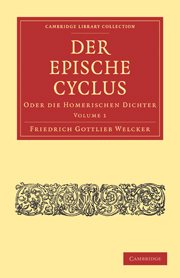
Der Epische Cyclus
- Oder die Homerischen Dichter
-
- Published online:
- 05 August 2015
- Print publication:
- 25 November 2010
- First published in:
- 1835
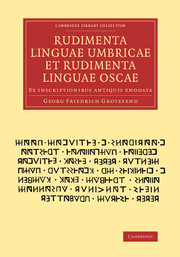
Rudimenta linguae umbricae et rudimenta linguae oscae
- Ex inscriptionibus antiquis enodata
-
- Published online:
- 05 June 2015
- Print publication:
- 05 March 2015
- First published in:
- 1835
