To save content items to your account,
please confirm that you agree to abide by our usage policies.
If this is the first time you use this feature, you will be asked to authorise Cambridge Core to connect with your account.
Find out more about saving content to .
To save content items to your Kindle, first ensure no-reply@cambridge.org
is added to your Approved Personal Document E-mail List under your Personal Document Settings
on the Manage Your Content and Devices page of your Amazon account. Then enter the ‘name’ part
of your Kindle email address below.
Find out more about saving to your Kindle.
Note you can select to save to either the @free.kindle.com or @kindle.com variations.
‘@free.kindle.com’ emails are free but can only be saved to your device when it is connected to wi-fi.
‘@kindle.com’ emails can be delivered even when you are not connected to wi-fi, but note that service fees apply.
The immorality of the ancient Romans is a commonplace in modern representations of Roman antiquity. In nineteenth-century history painting, twentieth-century sword and sandal movies and twenty-first-century TV shows alike, inebriated Roman voluptuaries lounge on their couches surrounded by gleaming marble, while they savour exotic foods and grope scantily dressed women and boys.Romans behaving badly certainly have box-office appeal but the details of their excesses in the modern imaginary are deeply rooted in the preoccupations of cultural commentators in Roman antiquity. The speeches of Cicero, the histories of Sallust, Livy and Tacitus, the philosophical works of Seneca, the Elder Pliny’s observations about the natural world – all these texts (and more) return obsessively to the vices of their authors’ fellow Romans, charting their sexual misbehaviour, their insatiable desire for luxury, their inability to subordinate their own pleasure to the public good.
The ancient Romans have been so domesticated that many modern western men (fewer women, perhaps) have been able to imagine themselves, their rusty Latin refreshed, easily adapting to life in the time of Cicero or the younger Pliny. But language is not the only barrier which separates us from the Romans. Entire vocabularies of gesture differ from one culture to another. For Romans, a particular physical movement could have a meaning quite at variance with one a modern Briton might attribute to it – even indicating a category of behaviour for which we have no close equivalent.
In 62 BCE, a young and politically ambitious Roman aristocrat, Publius Clodius, is said to have disguised himself as a women in order to infiltrate the rites of the Bona Dea, which it was sacrilege for men to observe. His purpose, according to his detractors, was to seduce the wife of Julius Caesar, the Pontifex Maximus, in whose house the ceremony was taking place. A man dressed as a woman, the profanation of religious rites, adultery with the wife of one of the leading men in Rome and the adulterer already notorious for his pernicious and disruptive political dealings – this incident, related or alluded to by numerous Roman authors, summed up the disorder of the final years of the republic. For Roman writers, adultery among the elite was a telling symptom of disease in the body politic.
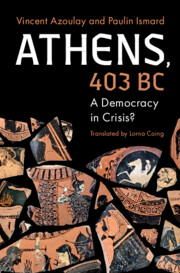
At the end of the fifth century BC, the Peloponnesian War resulted in Athens' shattering defeat by Sparta. Taking advantage of the debacle, a commission of thirty Athenians abolished the democratic institutions that for a century had governed the political life of the city and precipitated a year-long civil war. By autumn 403 BC, democracy was restored. Inspired by the model of the ancient chorus, this strikingly innovative book interprets a crucial moment in classical history through the prism of ten remarkable individuals and the shifting groups which formed around them. The former include more familiar names like the multifaceted Sokrates, the oligarch Kritias and the rhetorician Lysias, but also lesser-known figures like the scribe Nikomachos, the former slave Gerys and the priestess Lysimakhe. What leads a community to tear itself apart, even disintegrate, then rebuild itself? This question, explored through profound reflection on the past, echoes our tormented present.
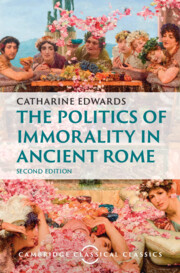
The question this book addresses is not how immoral the ancient Romans were, but why the literature they produced is so preoccupied with immorality. The modern image of immoral Rome derives from ancient accounts which are largely critical rather than celebratory. Far from being empty commonplaces, these accusations constituted a powerful discourse through which Romans negotiated conflicts and tensions in their social and political order. This study proceeds by a detailed examination of a wide range of translated ancient texts, exploring the dynamics of their rhetoric, as well as the ends to which they were deployed. Roman moralising discourse, Edwards suggests, may be seen as especially concerned with the articulation of anxieties about gender, social status and political power. This revised edition contains a substantial new Introduction which engages with critical and scholarly developments in the study of Roman culture since the original publication.
Aristophanes' Knights was a sensation in its time, famous for its assault on the Athenian politician and demagogue Cleon in the first comic drama devoted to a sustained, open satire of an individual political figure. It is also the first play Aristophanes produced in his own name, and the one that solidified his reputation as a leading comic dramatist. This is the first full-scale commentary on Knights in over a century. The Greek text is based on a fresh analysis of the manuscripts, papyri and other ancient sources. The extensive commentary situates the play in its linguistic, literary and intellectual context and allows full appreciation of its original performance context. Particular attention is paid to the poet's language and to the social and literary traditions of his time, and abundant citations and quotations of parallel passages ranging far beyond the comic poets are offered, with all Greek translated.
This is a new edition of the fragments of 'Anonymus Iamblichi', the mysterious Greek author excerpted by Iamblichus in chapter 20 of Protrepticus. The fragments are an important but overlooked source for early Greek ethical and political thought. Among other things, they criticize traditional forms of social benefaction, and they offer a strikingly modern approach to the analysis of society and economy revolving around the concept of pistis ('trust'). The text and translation are supplemented by a lengthy introduction, which analyses the language and style of the fragments and explores them in the literary and philosophical context of early Socratic literature. The detailed commentary discusses issues pertaining to text and interpretation.