To save content items to your account,
please confirm that you agree to abide by our usage policies.
If this is the first time you use this feature, you will be asked to authorise Cambridge Core to connect with your account.
Find out more about saving content to .
To save content items to your Kindle, first ensure no-reply@cambridge.org
is added to your Approved Personal Document E-mail List under your Personal Document Settings
on the Manage Your Content and Devices page of your Amazon account. Then enter the ‘name’ part
of your Kindle email address below.
Find out more about saving to your Kindle.
Note you can select to save to either the @free.kindle.com or @kindle.com variations.
‘@free.kindle.com’ emails are free but can only be saved to your device when it is connected to wi-fi.
‘@kindle.com’ emails can be delivered even when you are not connected to wi-fi, but note that service fees apply.
Chapter 1 provides a systematic account of the main moral themes and types of moralism in Galen. Among these, the most general level is represented by an unparticularised moralism, in which the author pronounces ethical verdicts with universal application. Galen’s aim here is not to override moral relativism (in the modern sense of the term) nor restrain moral freedom. Rather, he seeks to delimit what he wishes to stigmatise as deviant behaviour as lucidly as possible, so as to be able to offer rudimentary directives for goodness effectively. In this model of basic moralism, even though there are instances where the author’s moral viewpoint features in a commanding fashion, reference is made to an astute reader who either embraces, upon reflection, Galen’s viewpoint or judiciously considers what is at stake when the former goes astray.
Chapter 7 sets Recognising the Best Physician at the heart of its discussion, moving the focus from popular philosophical works to tracts of social commentary that are rich in ethical references or subtexts. I suggest that, despite its content being closely related to the material discussed in The Best Doctor is Also a Philosopher, the latter contains a more generalised advocacy of how the proper doctor ought to behave, whereas Recognising the Best Physician restricts its focus to treating Galen’s individual virtues, and renders self-projection more central to the narrative. This enables Galen to provide a more pragmatic account of the connection he envisaged between medicine, ethics and society, and place the morally didactic function of medicine in particular at the forefront of his intellectual horizons. I highlight how Recognising the Best Physician offers a plethora of passages discussing moral issues, for example the emphasis on the value of truth over deception, the issue of flattery and the ethical corruption of contemporary society. I show that to better illuminate the immorality of his medical colleagues, Galen, inspired by philosophical intertexts, notably the Republic and the Gorgias, creatively likens them to wicked and dissimulating orators. By also attributing features of self-interested politicians familiar from Platonic metaphors to contemporary charlatan physicians, Galen recategorises his rivals’ abilities and undermines their moral standing to suggest that the ideal kind of medicine to combat public disorder is the moral medicine embodied by himself. To that end, Galen sketches himself as a Platonic helmsman, entrusted with a humanistic vocation and safeguarding social and political stability.
The Byzantine author of the pseudo-Lucianic dialogue Timarion, a work dated to the twelfth century, offers an arresting prosopography of Galen centred around the characteristics of his personality that seem to have endured over time. As one might expect, his formidable prowess in medicine predominates, but other aspects that single him out from the medical conclave described in the dialogue surface too, notably his thoroughness and ambition that keep him so focused and show a transcendent devotion to his endeavours.1 Popular philosophy has been one of the least known of Galen’s passionate endeavours, and one which this book has attempted to illuminate from a number of angles.
Chapter 5 turns the spotlight on the rather overlooked treatise Exhortation to the Study of Medicine. It argues that in this work Galen constructs or conjures up images of young readers, intending it to act as an educational manual in moral intensification for prospective medical students. It hence demonstrates how Galen’s concern for his reader’s acculturation might explain the appropriation of advice and the selection of relevant material from a long-established protreptic tradition. In discussing Galen’s moralising methods and the pedagogical elements of the essay, this Chapter also draws links between Galenic and Plutarchan moralism, dealt with in detail for the first time, and thereby arguing that Galen’s moral writings need to be construed in the light of Imperial-period practical ethics. That proposition receives further support from the special features of Galen’s protreptic discourse discussed in this Chapter, especially practicability and effectiveness resulting from the author’s philosophical leanings (e.g. his Platonic-Aristotelian background) and medical expertise (the mechanics of the body and his emulation of Hippocrates in the second part of the essay).
Chapter 4 examines Galen’s credentials as an ethical philosopher in the light of his recently discovered essay Avoiding Distress. It argues that his moral agenda which is expanded upon here makes him an active participant in the practical ethics of the High Roman Empire, with a more profound attentiveness to popular philosophy than is usually admitted. Galen’s dialogue with what has been termed ‘Stoic psychotherapy’ and the Platonic-Aristotelian educational model helps build up his ethical influence through an engagement with the past. On the other hand, his individual characteristics, such as the autobiographical perspective of his narrative and the intimacy established between author and addressee, render Avoiding Distress exceptional among essays (whether Greek or Latin) treating anxiety, especially when compared to the tracts on mental tranquillity written by Seneca and Plutarch. Another distinctive element of the treatise is that Galen’s self-projection as a therapist of the emotions corresponds to his role as a practising physician as regards the construction of authority and the importance of personal experience.
Chapter 8 shows how close Galen is to the style and language of a practical moralist by focusing on the previously neglected moral aspects of Prognosis. The rich ethical material that Galen includes on the way his society functions and the role of physicians is construed as moral reportage, which also enables him to provide the image he constructs of himself as a medic with profoundly moral features. The essay’s preface stresses the quest for truth and the exercise of correct judgement as moral principles advocated by Galen for physicians and all other professionals as thinking beings. This, I suggest, has a strong theoretical background expounded upon in Galen’s ethical work, pointing to his ideological coherence on ethics and its uniform application across texts of a (seemingly) different purpose. The preface is also informed by Galen’s perception of the morality of doctors addressed in the Therapeutic Method, which I see as a sibling account of Galen’s conceptualisation of medicine as a virtuous art. Furthermore, the delineation of moral character is made central to Galen’s notion of the proper physician, which explains the fact that he formulates his text in such a way as to distinguish himself and his peers from charlatans and sophists, a group of moral outsiders traditionally depicted as quarrelsome and vainglorious. This Chapter also discusses the sophisticated discourse on malice and contentiousness that Galen sets up within the context of some of his medical case histories. The analysis of the writing technique and structure of the case histories as much as of the characters involved offers unique insights into Galen’s account of emotions, especially their causes, consequences, theorisation and phenomenology. This Chapter concludes by stressing how in these instances Galen’s medical activity impinged on the formation and sometimes the development of his moral ideas. In Prognosis ethics emerges as a robust area of thought, study and professional performance in Galen.
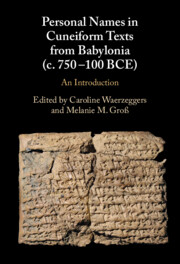
Personal names provide fascinating testimony to Babylonia's multi-ethnic society. This volume offers a practical introduction to the repertoire of personal names recorded in cuneiform texts from Babylonia in the first millennium BCE. In this period, individuals moved freely as well as involuntarily across the ancient Middle East, leaving traces of their presence in the archives of institutions and private persons in southern Mesopotamia. The multilingual nature of this name material poses challenges for students and researchers who want to access these data as part of their exploration of the social history of the region in the period. This volume offers guidelines and tools that will help readers navigate this difficult material. The title is also available Open Access on Cambridge Core.
The Luwian corpus written in Anatolian hieroglyphs consists of about 300 inscriptions. Though this is sufficiently large that Luwian is mostly understood, not all words are known in full writing. One of those is the word for ‘city, town’. Since cities play an important role in Luwian monumental inscriptions, it is remarkable that the word for such a central concept is still unknown. Using a multi-modal approach, combing orthographic, morphological, iconographical and archaeological analysis, I argue that the word for ‘city’ is /allamminna/i-/ ‘fortified settlement > city tout court’, and that the hieroglyph for ‘city’ depicts a merlon, a raised section of a fortification’s battlement, thus linking it to the Hittite tower-vessels that express the relationship between city and fortifications in a material way. The identification of /allamminna/i-/ also impacts the analysis of other Hittite and Luwian words that are hitherto not well understood or not understood at all. Furthermore, it increases our understanding of aspects of the material world and of the cultural and linguistic interactions between Anatolian and Syrian societies. Finally, it illustrates the impact of Luwian and Luwians on Hittite society.
This article examines the different uses made of a marble ostotheke (ossuary) that was discovered in 2021 during archaeological excavations in and around the church in the Araplıtepe district, near the ancient city of Metropolis. Information about the chest’s original use as a funerary object and its production date and ownership is followed by a discussion of its recycled (spolia) use as a sedimentation tank on a water channel, and by an explanation of its third and final function. A bronze lamp discovered inside the ostotheke provides important clues about the object’s final use and its relationship with its surroundings. Christian burials in and around the church dating to as early as the fifth to sixth centuries AD also provide insights into these processes. This ostotheke, which served a variety of functions from the second to the seventh centuries AD, shows that objects made in Roman times might continue to be used in different ways for a long time thereafter. This article therefore examines the ostotheke as a reflection and extension of the changing needs of people and communities over time, rather than simply as a carved marble object.
The emergence of Sardis as an urban centre in the early Iron Age coincided with local production of fine painted pottery in a distinctive regional idiom. Examples of Lydian-style pottery found across western Anatolia from the eighth century BC attest the city’s growing cultural and economic contacts as well as consistent materials and craft methods. Archaeo- metric study using neutron activation analysis (NAA) at the University of Missouri Research Reactor (MURR) examined representative specimens of Lydian-style ceramics from Sardis and compared their composition with later examples of red-gloss and red-slipped pottery, fine grey wares and transport jars commonly found at the site. The results confirm the sustained activity of local workshops from the early Iron Age into later historical periods, as Lydia became part of the Seleucid and Roman empires and Sardis a centre of regional innovation.
This article considers how a pair of authors working in different languages and generic contexts responded to the changing spatial politics of the second-century Roman empire. Understanding the Roman literary world as an interconnected bilingual system, I explore polarised responses to an increasingly decentralised and cosmopolitan Roman Mediterranean. Juvenal and Aelius Aristides navigate a tension between the city of Rome itself and the empire for which it served as the notional capital, both perceiving that the empire is becoming more homogeneous, with distinctions between centre and periphery becoming less sharp. While Juvenal sees the increasing similarity between Rome and its provinces through a xenophobic lens as a symbol of the city and its native Latin population’s moral decline, Aristides emphasises instead the benefits that Roman hegemony has brought to an oikoumene that he asserts has been rendered a single polis. These differences are partly a function of genre but can also be understood in terms of the geographical and ethnolinguistic backgrounds of each writer, and provide a valuable picture of the diversity of the empire’s cultural politics, resonating in productive ways with contemporary debates about migration and nationalism.
This article discusses two imperial Roman literary descriptions of architectural space (Luc. 10.111–35 and Stat. Silv. 4.2) as responses to the real architectural space of two imperial palatial complexes in Rome, Nero’s Golden House and Domitian’s Palatine palace. Building on definitions of baroque spatiality in architecture and on concepts of literary space, it explores the interplay between the textual worlds created by these writers and the real spaces fashioned by Roman imperial architects. It considers the convergences and divergences between the architects’ ‘Baroque’ spatial strategies and the authors’ literary conceits that intimate an illusory materiality, and between the narrated memories or virtual reconstitutions of desolate imperial vastness and the physical experiences of populated space. Finally, it reflects on both differing and common perspectives towards real and literary space constructed in the ‘Baroque’ manner by considering neo-Baroque sensibilities today in both literature and the visual arts and how these might not only problematise but also allow a convergence between the spatial turn of archaeological studies and the exploration of similar spatialities in literary culture.