Refine search
Actions for selected content:
7008 results in Algorithmics, Complexity, Computer Algebra, Computational Geometry
Properties of Classes of Random Graphs
-
- Journal:
- Combinatorics, Probability and Computing / Volume 3 / Issue 4 / December 1994
- Published online by Cambridge University Press:
- 12 September 2008, pp. 435-454
-
- Article
- Export citation
The Computational Complexity of the Tutte Plane: the Bipartite Case
-
- Journal:
- Combinatorics, Probability and Computing / Volume 1 / Issue 2 / June 1992
- Published online by Cambridge University Press:
- 12 September 2008, pp. 181-187
-
- Article
- Export citation
Predecessors in Random Mappings
-
- Journal:
- Combinatorics, Probability and Computing / Volume 5 / Issue 4 / December 1996
- Published online by Cambridge University Press:
- 12 September 2008, pp. 317-335
-
- Article
- Export citation
-
Let ℱn be the set of random mappings ϕ : {1,…,n} → {1,…,n} (such that every mapping is equally likely). For x ε {l,…,n} the elements
 are called the predecessors of x. Let Nr denote the random variable which counts the number of points x ε {l,…,n} with exactly r predecessors. In this paper we identify the limiting distribution of Nr as n → ∞. If r = r(n) = o(n⅔) then the limiting distribution is Gaussian, if r ˜ Cn⅔ then it is Poisson, and in the remaining case rn−⅔ → ∞ it is degenerate. Furthermore, it is shown that Nr is a Poisson approximation if r → ∞.
 are called the predecessors of
 Random Matrices and Brownian Motion†
-
- Journal:
- Combinatorics, Probability and Computing / Volume 2 / Issue 2 / June 1993
- Published online by Cambridge University Press:
- 12 September 2008, pp. 157-180
-
- Article
- Export citation
-
For T ∈ GLn (Fq), let Ωn (t, T) be the number of irreducible factors of degree less than or equal to nt in the characteristic polynomial of T. Let
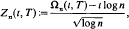
and suppose T is chosen from G Ln(Fq) at random uniformly. We prove that the stochastic process ≺Zn(t)≻t∈[0, 1] converges to the standard Brownian motion process W(t), as n → ∞.
Randomised Approximation in the Tutte Plane
-
- Journal:
- Combinatorics, Probability and Computing / Volume 3 / Issue 1 / March 1994
- Published online by Cambridge University Press:
- 12 September 2008, pp. 137-143
-
- Article
- Export citation
CPC volume 4 issue 3 Cover and Front matter
-
- Journal:
- Combinatorics, Probability and Computing / Volume 4 / Issue 3 / September 1995
- Published online by Cambridge University Press:
- 12 September 2008, pp. f1-f2
-
- Article
-
- You have access
- Export citation
A Rate for the Erdős-Turán Law*
-
- Journal:
- Combinatorics, Probability and Computing / Volume 3 / Issue 2 / June 1994
- Published online by Cambridge University Press:
- 12 September 2008, pp. 167-176
-
- Article
- Export citation
On Random Generation of the Symmetric Group
-
- Journal:
- Combinatorics, Probability and Computing / Volume 2 / Issue 4 / December 1993
- Published online by Cambridge University Press:
- 12 September 2008, pp. 505-512
-
- Article
- Export citation
Some Small Circuit-Cocircuit Ramsey Numbers for Matroids
-
- Journal:
- Combinatorics, Probability and Computing / Volume 4 / Issue 1 / March 1995
- Published online by Cambridge University Press:
- 12 September 2008, pp. 67-80
-
- Article
- Export citation
Choice Numbers of Graphs: a Probabilistic Approach
-
- Journal:
- Combinatorics, Probability and Computing / Volume 1 / Issue 2 / June 1992
- Published online by Cambridge University Press:
- 12 September 2008, pp. 107-114
-
- Article
- Export citation
Hamilton Cycles in Random Regular Digraphs
-
- Journal:
- Combinatorics, Probability and Computing / Volume 3 / Issue 1 / March 1994
- Published online by Cambridge University Press:
- 12 September 2008, pp. 39-49
-
- Article
- Export citation
CPC volume 3 issue 4 Cover and Front matter
-
- Journal:
- Combinatorics, Probability and Computing / Volume 3 / Issue 4 / December 1994
- Published online by Cambridge University Press:
- 12 September 2008, pp. f1-f2
-
- Article
-
- You have access
- Export citation
Matchings in Lattice Graphs and Hamming Graphs
-
- Journal:
- Combinatorics, Probability and Computing / Volume 3 / Issue 2 / June 1994
- Published online by Cambridge University Press:
- 12 September 2008, pp. 157-166
-
- Article
- Export citation
On the Hardness of Approximating Some Optimization Problems That Are Supposedly Easier Than MAX CLIQUE
-
- Journal:
- Combinatorics, Probability and Computing / Volume 4 / Issue 2 / June 1995
- Published online by Cambridge University Press:
- 12 September 2008, pp. 167-180
-
- Article
- Export citation
A Winning Strategy for the Ramsey Graph Game
-
- Journal:
- Combinatorics, Probability and Computing / Volume 5 / Issue 3 / September 1996
- Published online by Cambridge University Press:
- 12 September 2008, pp. 267-276
-
- Article
- Export citation
A Phase Transition for the Distribution of Matching Blocks
-
- Journal:
- Combinatorics, Probability and Computing / Volume 5 / Issue 2 / June 1996
- Published online by Cambridge University Press:
- 12 September 2008, pp. 139-159
-
- Article
- Export citation
On the Structure of Non-Hamiltonian Graphs I
-
- Journal:
- Combinatorics, Probability and Computing / Volume 1 / Issue 1 / March 1992
- Published online by Cambridge University Press:
- 12 September 2008, pp. 27-34
-
- Article
- Export citation
On Brooks' Theorem for Sparse Graphs
-
- Journal:
- Combinatorics, Probability and Computing / Volume 4 / Issue 2 / June 1995
- Published online by Cambridge University Press:
- 12 September 2008, pp. 97-132
-
- Article
- Export citation
-
Let G be a graph with maximum degree Δ(G). In this paper we prove that if the girth g(G) of G is greater than 4 then its chromatic number, χ(G), satisfies
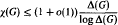
where o(l) goes to zero as Δ(G) goes to infinity. (Our logarithms are base e.) More generally, we prove the same bound for the list-chromatic (or choice) number:
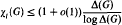
provided g(G) < 4.
Excluding Minors in Cubic Graphs
-
- Journal:
- Combinatorics, Probability and Computing / Volume 5 / Issue 1 / March 1996
- Published online by Cambridge University Press:
- 12 September 2008, pp. 57-78
-
- Article
- Export citation
Properties of Large Eden Clusters in the Plane
-
- Journal:
- Combinatorics, Probability and Computing / Volume 3 / Issue 4 / December 1994
- Published online by Cambridge University Press:
- 12 September 2008, pp. 471-505
-
- Article
- Export citation
