Refine search
Actions for selected content:
7008 results in Algorithmics, Complexity, Computer Algebra, Computational Geometry
Almost Every Graph can be Covered by
 Linear Forests
-
- Journal:
- Combinatorics, Probability and Computing / Volume 4 / Issue 3 / September 1995
- Published online by Cambridge University Press:
- 12 September 2008, pp. 257-268
-
- Article
- Export citation
-
A linear forest is the union of a set of vertex disjoint paths. Akiyama, Exoo and Harary, and independently Hilton, have conjectured that the edges of every graph of maximum degree Δ can be covered by
 linear forests. We show that almost every graph can be covered with this number of linear forests.
 Linear Forests
 linear forests. We show that almost every graph can be covered with this number of linear forests.
CPC volume 3 issue 3 Cover and Back matter
-
- Journal:
- Combinatorics, Probability and Computing / Volume 3 / Issue 3 / September 1994
- Published online by Cambridge University Press:
- 12 September 2008, p. b1
-
- Article
-
- You have access
- Export citation
Complete Subgraphs of r-partite Graphs
-
- Journal:
- Combinatorics, Probability and Computing / Volume 1 / Issue 3 / September 1992
- Published online by Cambridge University Press:
- 12 September 2008, pp. 241-250
-
- Article
- Export citation
Smallest Sets of Longest Paths with Empty Intersection
-
- Journal:
- Combinatorics, Probability and Computing / Volume 5 / Issue 4 / December 1996
- Published online by Cambridge University Press:
- 12 September 2008, pp. 429-436
-
- Article
- Export citation
Improved Upper Bounds Concerning the Erdős-Ko-Rado Theorem
-
- Journal:
- Combinatorics, Probability and Computing / Volume 1 / Issue 2 / June 1992
- Published online by Cambridge University Press:
- 12 September 2008, pp. 115-122
-
- Article
- Export citation
On Vertices of Degree n in Minimally n-Edge-Connected Graphs
-
- Journal:
- Combinatorics, Probability and Computing / Volume 4 / Issue 1 / March 1995
- Published online by Cambridge University Press:
- 12 September 2008, pp. 81-95
-
- Article
- Export citation
Random Regular Graphs: Asymptotic Distributions and Contiguity
-
- Journal:
- Combinatorics, Probability and Computing / Volume 4 / Issue 4 / December 1995
- Published online by Cambridge University Press:
- 12 September 2008, pp. 369-405
-
- Article
- Export citation
Non-Binary Matroids Having At Most Three Non-Binary Elements
-
- Journal:
- Combinatorics, Probability and Computing / Volume 3 / Issue 3 / September 1994
- Published online by Cambridge University Press:
- 12 September 2008, pp. 355-369
-
- Article
- Export citation
Local-Global Phenomena in Graphs
-
- Journal:
- Combinatorics, Probability and Computing / Volume 2 / Issue 4 / December 1993
- Published online by Cambridge University Press:
- 12 September 2008, pp. 491-503
-
- Article
- Export citation
CPC volume 1 issue 1 Cover and Front matter
-
- Journal:
- Combinatorics, Probability and Computing / Volume 1 / Issue 1 / March 1992
- Published online by Cambridge University Press:
- 12 September 2008, pp. f1-f2
-
- Article
-
- You have access
- Export citation
Analysis of a Simple Greedy Matching Algorithm on Random Cubic Graphs
-
- Journal:
- Combinatorics, Probability and Computing / Volume 4 / Issue 1 / March 1995
- Published online by Cambridge University Press:
- 12 September 2008, pp. 47-66
-
- Article
- Export citation
On Canonical Concurrent Flows, Crossing Number and Graph Expansion
-
- Journal:
- Combinatorics, Probability and Computing / Volume 3 / Issue 4 / December 1994
- Published online by Cambridge University Press:
- 12 September 2008, pp. 523-543
-
- Article
- Export citation
The Distribution of Heights of Binary Trees and Other Simple Trees
-
- Journal:
- Combinatorics, Probability and Computing / Volume 2 / Issue 2 / June 1993
- Published online by Cambridge University Press:
- 12 September 2008, pp. 145-156
-
- Article
- Export citation
-
The number,
 , of rooted plane binary trees of height ≤ h with n internal nodes is shown to satisfy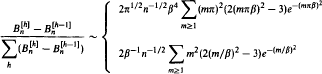
uniformly for δ−1(log n)−1/2 ≤ β ≤ δ(log n)1/2, where
 and δ is a positive constant. An asymptotic formula for
  is derived for h = cn, where 0 < c < 1. Bounds for
  are also derived for large and small heights. The methods apply to any simple family of trees, and the general asymptotic results are stated.
 , of rooted plane binary trees of height ≤
 and δ is a positive constant. An asymptotic formula for
  is derived for
  are also derived for large and small heights. The methods apply to any simple family of trees, and the general asymptotic results are stated.
Point Selections and Weak ε-Nets for Convex Hulls
-
- Journal:
- Combinatorics, Probability and Computing / Volume 1 / Issue 3 / September 1992
- Published online by Cambridge University Press:
- 12 September 2008, pp. 189-200
-
- Article
- Export citation
Author Index to Volume 5
-
- Journal:
- Combinatorics, Probability and Computing / Volume 5 / Issue 4 / December 1996
- Published online by Cambridge University Press:
- 12 September 2008, pp. 443-444
-
- Article
- Export citation
Three Thresholds for a Liar
-
- Journal:
- Combinatorics, Probability and Computing / Volume 1 / Issue 1 / March 1992
- Published online by Cambridge University Press:
- 12 September 2008, pp. 81-93
-
- Article
- Export citation
Graph Minors I: A Short Proof of the Path-width Theorem
-
- Journal:
- Combinatorics, Probability and Computing / Volume 4 / Issue 1 / March 1995
- Published online by Cambridge University Press:
- 12 September 2008, pp. 27-30
-
- Article
- Export citation
Author Index to Volume 2
-
- Journal:
- Combinatorics, Probability and Computing / Volume 2 / Issue 4 / December 1993
- Published online by Cambridge University Press:
- 12 September 2008, pp. 531-532
-
- Article
- Export citation
On Random 3-sat
-
- Journal:
- Combinatorics, Probability and Computing / Volume 4 / Issue 3 / September 1995
- Published online by Cambridge University Press:
- 12 September 2008, pp. 189-195
-
- Article
- Export citation
-
Let S be a set of m clauses each containing three literals chosen at random in a set {p1, ¬p1,…,pn, ¬pn} of n propositional variables and their negations. Let
 be the set of all such S with m = cn for a fixed c > 0. We show, improving significantly over the first moment upper bound
  , that if m and n tend to infinity with
  , then almost all
  are unsatisfiable.
 be the set of all such
  , that if
  , then almost all
  are unsatisfiable.
CPC volume 5 issue 4 Cover and Front matter
-
- Journal:
- Combinatorics, Probability and Computing / Volume 5 / Issue 4 / December 1996
- Published online by Cambridge University Press:
- 12 September 2008, pp. f1-f2
-
- Article
-
- You have access
- Export citation
