Refine search
Actions for selected content:
3404 results in Artificial Intelligence and Natural Language Processing
Lemaza : An Arabic why-question answering system*
-
- Journal:
- Natural Language Engineering / Volume 23 / Issue 6 / November 2017
- Published online by Cambridge University Press:
- 24 August 2017, pp. 877-903
-
- Article
- Export citation
NLE volume 23 issue 5 Cover and Front matter
-
- Journal:
- Natural Language Engineering / Volume 23 / Issue 5 / September 2017
- Published online by Cambridge University Press:
- 09 August 2017, pp. f1-f2
-
- Article
-
- You have access
- Export citation
NLE volume 23 issue 5 Cover and Back matter
-
- Journal:
- Natural Language Engineering / Volume 23 / Issue 5 / September 2017
- Published online by Cambridge University Press:
- 09 August 2017, pp. b1-b4
-
- Article
-
- You have access
- Export citation
Emerging trends: Inflation
-
- Journal:
- Natural Language Engineering / Volume 23 / Issue 5 / September 2017
- Published online by Cambridge University Press:
- 09 August 2017, pp. 807-812
-
- Article
-
- You have access
- Open access
- HTML
- Export citation
Syntactic methods for topic-independent authorship attribution
-
- Journal:
- Natural Language Engineering / Volume 23 / Issue 5 / September 2017
- Published online by Cambridge University Press:
- 09 August 2017, pp. 789-806
-
- Article
- Export citation
To use or not to use: Feature selection for sentiment analysis of highly imbalanced data†
-
- Journal:
- Natural Language Engineering / Volume 24 / Issue 1 / January 2018
- Published online by Cambridge University Press:
- 07 August 2017, pp. 3-37
-
- Article
- Export citation
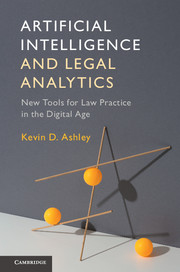
Artificial Intelligence and Legal Analytics
- New Tools for Law Practice in the Digital Age
-
- Published online:
- 13 July 2017
- Print publication:
- 10 July 2017
Frontmatter
-
- Book:
- Artificial Intelligence and Legal Analytics
- Published online:
- 13 July 2017
- Print publication:
- 10 July 2017, pp i-iv
-
- Chapter
- Export citation
Dedication
-
- Book:
- Artificial Intelligence and Legal Analytics
- Published online:
- 13 July 2017
- Print publication:
- 10 July 2017, pp v-vi
-
- Chapter
- Export citation
PART III - CONNECTING COMPUTATIONAL REASONING MODELS AND LEGAL TEXTS
-
- Book:
- Artificial Intelligence and Legal Analytics
- Published online:
- 13 July 2017
- Print publication:
- 10 July 2017, pp 311-312
-
- Chapter
- Export citation
Glossary
-
- Book:
- Artificial Intelligence and Legal Analytics
- Published online:
- 13 July 2017
- Print publication:
- 10 July 2017, pp 393-402
-
- Chapter
- Export citation
Bibliography
-
- Book:
- Artificial Intelligence and Legal Analytics
- Published online:
- 13 July 2017
- Print publication:
- 10 July 2017, pp 403-420
-
- Chapter
- Export citation
List of illustrations
-
- Book:
- Artificial Intelligence and Legal Analytics
- Published online:
- 13 July 2017
- Print publication:
- 10 July 2017, pp xv-xx
-
- Chapter
- Export citation
7 - Making Legal Information Retrieval Smarter
- from PART II - LEGAL TEXT ANALYTICS
-
- Book:
- Artificial Intelligence and Legal Analytics
- Published online:
- 13 July 2017
- Print publication:
- 10 July 2017, pp 210-233
-
- Chapter
- Export citation
Acknowledgments
-
- Book:
- Artificial Intelligence and Legal Analytics
- Published online:
- 13 July 2017
- Print publication:
- 10 July 2017, pp xxiii-xxiv
-
- Chapter
- Export citation
2 - Modeling Statutory Reasoning
- from PART I - COMPUTATIONAL MODELS OF LEGAL REASONING
-
- Book:
- Artificial Intelligence and Legal Analytics
- Published online:
- 13 July 2017
- Print publication:
- 10 July 2017, pp 38-72
-
- Chapter
- Export citation
Index
-
- Book:
- Artificial Intelligence and Legal Analytics
- Published online:
- 13 July 2017
- Print publication:
- 10 July 2017, pp 421-426
-
- Chapter
- Export citation
PART II - LEGAL TEXT ANALYTICS
-
- Book:
- Artificial Intelligence and Legal Analytics
- Published online:
- 13 July 2017
- Print publication:
- 10 July 2017, pp 169-170
-
- Chapter
- Export citation
PART I - COMPUTATIONAL MODELS OF LEGAL REASONING
-
- Book:
- Artificial Intelligence and Legal Analytics
- Published online:
- 13 July 2017
- Print publication:
- 10 July 2017, pp 1-2
-
- Chapter
- Export citation
Contents
-
- Book:
- Artificial Intelligence and Legal Analytics
- Published online:
- 13 July 2017
- Print publication:
- 10 July 2017, pp vii-xiv
-
- Chapter
- Export citation
