To save content items to your account,
please confirm that you agree to abide by our usage policies.
If this is the first time you use this feature, you will be asked to authorise Cambridge Core to connect with your account.
Find out more about saving content to .
To save content items to your Kindle, first ensure no-reply@cambridge.org
is added to your Approved Personal Document E-mail List under your Personal Document Settings
on the Manage Your Content and Devices page of your Amazon account. Then enter the ‘name’ part
of your Kindle email address below.
Find out more about saving to your Kindle.
Note you can select to save to either the @free.kindle.com or @kindle.com variations.
‘@free.kindle.com’ emails are free but can only be saved to your device when it is connected to wi-fi.
‘@kindle.com’ emails can be delivered even when you are not connected to wi-fi, but note that service fees apply.
Choosing the best word or phrase for a given context from among the candidate near-synonyms, such as slim and skinny, is a difficult language generation problem. In this paper, we describe approaches to solving an instance of this problem, the lexical gap problem, with a particular focus on affect and subjectivity; to do this we draw upon techniques from the sentiment and subjectivity analysis fields. We present a supervised approach to this problem, initially with a unigram model that solidly outperforms the baseline, with a 6.8% increase in accuracy. The results to some extent confirm those from related problems, where feature presence outperforms feature frequency, and immediate context features generally outperform wider context features. However, this latter is somewhat surprisingly not always the case, and not necessarily where intuition might first suggest; and an analysis of where document-level models are in some cases better suggested that, in our corpus, broader features related to the ‘tone’ of the document could be useful, including document sentiment, document author, and a distance metric for weighting the wider lexical context of the gap itself. From these, our best model has a 10.1% increase in accuracy, corresponding to a 38% reduction in errors. Moreover, our models do not just improve accuracy on affective word choice, but on non-affective word choice also.
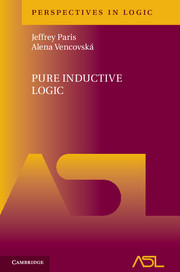
Pure inductive logic is the study of rational probability treated as a branch of mathematical logic. This monograph, the first devoted to this approach, brings together the key results from the past seventy years plus the main contributions of the authors and their collaborators over the last decade to present a comprehensive account of the discipline within a single unified context. The exposition is structured around the traditional bases of rationality, such as avoiding Dutch Books, respecting symmetry and ignoring irrelevant information. The authors uncover further rationality concepts, both in the unary and in the newly emerging polyadic languages, such as conformity, spectrum exchangeability, similarity and language invariance. For logicians with a mathematical grounding, this book provides a complete self-contained course on the subject, taking the reader from the basics up to the most recent developments. It is also a useful reference for a wider audience from philosophy and computer science.
Graph structures naturally model connections. In natural language processing (NLP) connections are ubiquitous, on anything between small and web scale. We find them between words – as grammatical, collocation or semantic relations – contributing to the overall meaning, and maintaining the cohesive structure of the text and the discourse unity. We find them between concepts in ontologies or other knowledge repositories – since the early ages of artificial intelligence, associative or semantic networks have been proposed and used as knowledge stores, because they naturally capture the language units and relations between them, and allow for a variety of inference and reasoning processes, simulating some of the functionalities of the human mind. We find them between complete texts or web pages, and between entities in a social network, where they model relations at the web scale. Beyond the more often encountered ‘regular’ graphs, hypergraphs have also appeared in our field to model relations between more than two units.
We consider automated generation of humorous texts by substitution of a single word in a given short text. In this setting, several factors that potentially contribute to the funniness of texts can be integrated into a unified framework as constraints on the lexical substitution. We discuss three types of such constraints: formal constraints concerning the similarity of sounds or spellings between the original word and the substitute, semantic or connotational constraints requiring the substitute to be a taboo word, and contextual constraints concerning the position and context of the replacement. Empirical evidence from extensive user studies using real SMSs as the corpus indicates that taboo constraints are statistically very effective, and so is a constraint requiring that the substitution takes place at the end of the text even though the effect is smaller. The effects of individual constraints are largely cumulative. In addition, connotational taboo words and word position have a strong interaction.
In this paper, we propose an unsupervised and automated method to identify noun sense changes based on rigorous analysis of time-varying text data available in the form of millions of digitized books and millions of tweets posted per day. We construct distributional-thesauri-based networks from data at different time points and cluster each of them separately to obtain word-centric sense clusters corresponding to the different time points. Subsequently, we propose a split/join based approach to compare the sense clusters at two different time points to find if there is ‘birth’ of a new sense. The approach also helps us to find if an older sense was ‘split’ into more than one sense or a newer sense has been formed from the ‘join’ of older senses or a particular sense has undergone ‘death’. We use this completely unsupervised approach (a) within the Google books data to identify word sense differences within a media, and (b) across Google books and Twitter data to identify differences in word sense distribution across different media. We conduct a thorough evaluation of the proposed methodology both manually as well as through comparison with WordNet.
This work presents the development and evaluation of an extended Urdu parser. It further focuses on issues related to this parser and describes the changes made in the Earley algorithm to get accurate and relevant results from the Urdu parser. The parser makes use of a morphologically rich context free grammar extracted from a linguistically-rich Urdu treebank. This grammar with sufficient encoded information is comparable with the state-of-the-art parsing requirements for the morphologically rich Urdu language. The extended parsing model and the linguistically rich extracted-grammar both provide us better evaluation results in Urdu/Hindi parsing domain. The parser gives 87% of f-score, which outperforms the existing parsing work of Urdu/Hindi based on the tree-banking approach.
In this paper, we present a new method based on co-occurrence graphs for performing Cross-Lingual Word Sense Disambiguation (CLWSD). The proposed approach comprises the automatic generation of bilingual dictionaries, and a new technique for the construction of a co-occurrence graph used to select the most suitable translations from the dictionary. Different algorithms that combine both the dictionary and the co-occurrence graph are then used for performing this selection of the final translations: techniques based on sub-graphs (communities) containing clusters of words with related meanings, based on distances between nodes representing words, and based on the relative importance of each node in the whole graph. The initial output of the system is enhanced with translation probabilities, provided by a statistical bilingual dictionary. The system is evaluated using datasets from two competitions: task 3 of SemEval 2010, and task 10 of SemEval 2013. Results obtained by the different disambiguation techniques are analysed and compared to those obtained by the systems participating in the competitions. Our system offers the best results in comparison with other unsupervised systems in most of the experiments, and even overcomes supervised systems in some cases.
The emergence of knowledge repositories in a variety of domains provides a valuable opportunity for semantic interpretation of high dimensional datasets. Previous researches investigate the use of concept instead of word as a core semantic feature for incorporating semantic knowledge from an ontology into the representation model of documents. On the other hand, in machine learning and information retrieval, data objects are represented as a flat feature vector. The inconsistency between the structural nature of the knowledge repositories and the flat representation of features in machine learning leads researchers to neglect the structure of the knowledge base and leverage concepts as isolated semantic features, which is known as bag-of-concepts. Although, using concepts has some advantages over words, by neglecting the relation between concepts, the problem of vocabulary mismatch remains in force. In this paper, a novel semantic kernel is proposed which is capable of incorporating the relatedness between conceptual features. This kernel leverages clique theory to map data objects to a novel feature space wherein complex data objects will be comparable. The proposed kernel is relevant to all applications which have a prior knowledge about the relatedness between features. We concentrate on representing text documents and words using Wikipedia and WordNet, respectively. The experimental results over a set of benchmark datasets have revealed that the proposed kernel significantly improves the representation of both words and texts in the application of semantic relatedness.
In the course of the previous 42 chapters we have introduced numerous more or less rational principles which our agent, dwelling in an unknown structure M for L, might choose to adopt in order to address the question
Q: In the situation of zero knowledge, logically, or rationally, what belief should I give to a sentence θ ∈ SL being true in M?
We have argued from the start, via the Dutch Book argument, that it is rational to identify belief with probability, in the sense that it should satisfy conditions (P1–3), At this point the facet of ‘rational’, or at least ‘irrational’, being used is that it is irrational to agree to bets which guarantee one a certain loss. In general however we have offered no definition of ‘logical’ or ‘rational’. Instead we have embraced certain overarching meta-principles, or slogans, which we may feel are ‘rational’, just in the way that we may feel that something is funny without being able to define what we mean by ‘funny’.
We have particularly focused on four such slogans: That it is rational to:
(i) Obey symmetries: If, in context, θ and θ′ are linked by a symmetry then they should be assigned equal probability.
(ii) Ignore irrelevant information: If θ′ is irrelevant to θ then conditioning θ on θ′ should not change the probability assigned to θ.
(iii) Enhance your probabilities on receipt of (positively) relevant information: If θ′ is supportive of θ then conditioning θ on θ′ should increase, or at least not decrease, the probability assigned to θ.
(iv) Respect analogies: The more θ′ is like θ the more conditioning on θ′ should enhance the probability assigned to θ.
Of course these are just templates for principles.
In Part 1 we placed no conditions on the arity of the relation symbols in L, the restriction to unary only happened in Part 2. In this third part we shall again allow into our language binary, ternary etc. relation symbols. As we have seen, despite the logical simplicity of unary languages, for example every formula becomes equivalent to a boolean combination of Π1 and Σ1 formulae, Unary PIL has still a rather rich theory. For this reason it is hardly surprising that with very few exceptions (for example Gaifman [30], Gaifman & Snir [32], Scott & Krauss [132], Krauss [69], Hilpinen [46] and Hoover [52]) ‘Inductive Logic’ meant ‘Unary Inductive Logic’ up to the end of the 20th century.
Of course there was an awareness of this further challenge, Carnap [12, p123 -4] and Kemeny [61], [64] both made this point. There were at least two other reasons why the move to the polyadic was so delayed. The first is that simple, everyday examples of induction with non-unary relations are rather scarce. However they do exist and we do seem to have some intuitions about them. For example suppose that you are planting an orchard and you read that apples of variety A are good pollinators and apples of variety B are readily pollinated. Then you might expect that if you plant an A apple next to a B apple you will be rewarded with an abundant harvest, at least from the latter tree. In this case one might conclude that you had applied some sort of polyadic induction to reach this conclusion, and that may be it has a logical structure worthy of further investigation.
Having said that it is still far from clear what probability functions should be proposed here (and possibly this is a third reason for the delay).
Having derived some of the basic properties of probability functions we will now take a short diversion to give what we consider to be the most compelling argument in this context, namely the Dutch Book argument originating with Ramsey [122] and de Finetti [25], in favour of an agent's ‘degrees of belief’ satisfying (P1–3), and hence being identified with a probability function, albeit subjective probability since it is ostensibly the property of the agent in question. Of course this could really be said to be an aside to the purely mathematical study of PIL and hence dispensable. The advantage of considering this argument however is that by linking belief and subjective probability it better enables us to appreciate and translate into mathematical formalism the many rational principles we shall later encounter.
The idea of the Dutch Book argument is that it identifies ‘belief’ with willingness to bet. So suppose, as in the context of PIL explained above, we have an agent inhabiting some unknown structure M ∈ T L (which one imagines will eventually be revealed to decide the wager) and that θ ∈ SL, 0 ≤ p ≤ 1 and for a stake s > 0 the agent is offered a choice of one of two wagers:
(Bet1p) Win s(1 − p) if M ⊧ θ, lose sp if M ⊭ θ.
(Bet2p) Win sp if M ⊭ θ, lose s (1 − p) if M ⊧ θ.
If the agent would not be happy to accept Bet1p we assume that it is because the agent thinks that the bet is to his/her disadvantage and hence to the advantage of the bookmaker. But in that case Bet2p allows the agent to swap roles with the bookmaker so s/he should now see that bet as being to his/her advantage, and hence acceptable. In summary then, we may suppose that for any 0 ≤ p ≤ 1 at least one of Bet1p and Bet2p is acceptable to the agent. In particular we may assume that Bet10 and Bet21 are acceptable since in both cases the agent has nothing to lose and everything to gain.