To save content items to your account,
please confirm that you agree to abide by our usage policies.
If this is the first time you use this feature, you will be asked to authorise Cambridge Core to connect with your account.
Find out more about saving content to .
To save content items to your Kindle, first ensure no-reply@cambridge.org
is added to your Approved Personal Document E-mail List under your Personal Document Settings
on the Manage Your Content and Devices page of your Amazon account. Then enter the ‘name’ part
of your Kindle email address below.
Find out more about saving to your Kindle.
Note you can select to save to either the @free.kindle.com or @kindle.com variations.
‘@free.kindle.com’ emails are free but can only be saved to your device when it is connected to wi-fi.
‘@kindle.com’ emails can be delivered even when you are not connected to wi-fi, but note that service fees apply.
In this chapter we describe and discuss the processes used to fabricate liquid crystal polymer (LCP) for microwave packaging. The normal fabrication techniques have had to be in some cases modified or even reinvented for LCP owing to the unique challenges in working with this inert material. While LCP’s chemical inertness makes it attractive for maintaining electrical performance over wide-ranging environmental conditions, it also means that LCP can be difficult to use in wet chemistries. These issues are complicated further by the fact that LCP is a plastic that can be easily flexed in thin-film form. An inherently anisotropic chemical structure adds an additional complication.
This chapter will progress through the different techniques available to form multilayer circuits and packages using LCP. In section 3.1 we discuss the available LCP formats, which include pellets and laminates. In section 3.2 we explain how copper cladding is added to LCP laminates and made ready for printed circuit board (PCB) processing. Section 3.3 covers the whole process, from laminate material to complete printed circuit board, using standard PCB technology. In section 3.4 we describe advanced process techniques that allow for complex specialized constructions. Lastly, section 3.5 gives a chapter summary.
Liquid crystal polymer (LCP) has interesting characteristics that have garneredthe attention of RF and microwave circuit designers. One major difference fromtypical high-frequency materials is that LCP is a thermoplastic. WithLCP’s advent, engineers have discovered how to integrate high-performanceelectronics directly into the thermoplastic package. The reason why LCP isattractive for RF/microwave electrical design is its unique combinationof excellent electrical and mechanical properties. LCP is extremely stable inthe presence of moisture and exhibits near-hermetic properties. Given itsrelatively low cost, LCP is rapidly becoming the material of choice for newgenerations of electronics requiring increasing integration and performance.This makes LCP a serious candidate for multi-chip module (MCM),system-in-package (SiP), and advanced packaging technology.
In section 2.1, we will first discuss LCP’s chemical properties. The basicchemistry will be introduced, and LCP’s composition will be described anddiscussed. This section is presented from an application stance and is intendedto provide a brief working background to why LCP behaves as it does.
In section 2.2 we describe LCP’s electrical properties. LCP has beencharacterized as having a very low dielectric constant and loss factor over thefrequency range from below 1 GHz up to past 110 GHz [2]. Its low dielectricconstant allows reasonable line impedances to be formed on thin-film materialand, further, minimizes the impact on the nearby electronics as well as thecapacitive detuning effects of packaging. Methods for electricalcharacterization and study results are presented. The test results of LCP inmoisture are also provided, to demonstrate its stable electrical characteristicsover humidity changes.
This chapter presents a number of subsystem-level modules that benefit from anLCP implementation. The first module, in section 7.1, is a long time delay (LTD)circuit with amplitude compensation. This module demonstrates the advantages ofhomogenous dielectric core and ply layers in a multilayer build. Known analyticsolutions for transmission lines may be readily applied for first-pass success.In addition, the homogenous multilayer build achieves amplitude compensationthrough novel LCP transmission line implementations. Lastly, this moduledemonstrates LCP’s surface mount (SMT) component compatibility withcommercially available MEMS switches.
The second module, in section 7.2, is a push–pull amplifier. This moduledemonstrates how LCP’s multilayer construction easily allows minimallyshort bondwires for high-performance chip interconnect. Further, this moduleintegrates high-performance LCP baluns to achieve excellent even-mode distortioncancellation. This module also demonstrates how LCP lends itself naturally tothe higher-level integration of LCP-enhanced passives.
Lastly, a receiver module with a built-in phased-array antenna is described insection 7.3 . In this receiver module , LCP is demonstrated to provide aconvenient platform for mechanically flexible electronics. Passive antennastructures are designed directly into the LCP build. Active semiconductor chipsare packaged into this platform to show how LCP is ideally suited for buildingup large systems.
Each module represents advanced research based on an LCP platform that extendsthe electrical performance and mechanical functionality of today’s subsystemmodules.
In this chapter we evaluate the long-term functionality of LCP packages and the protection they offer against external environments. This emerging flex material has ultra-low moisture absorption and permeation close to that of glass. It is an attractive material for making hermetic packages that can provide reliability in a low-cost and lightweight platform. Prototype LCP packages for RF to millimeter-wave frequencies have been reported recently [1–13]; the emphasis in these publications has been primarily on electrical characteristics, with less focus on the reliability aspects. Among the limited list of publications [7–13], some authors claim that LCP can be used for hermetic packages with long-term reliability. Other groups, including the authors of [13], have performed environmental tests such as measuring the water absorption of LCP-cavity packages by submerging them in water. In this chapter, a variety of reliability tests and results on an LCP package will be reported using standard tests recognized as being required for military and commercial products.
A primary hurdle for LCP packaging, or any hermetic packaging in general, is achieving a high-quality lid-seal process. This hurdle can be exacerbated by LCP’s inert chemical properties, which require a careful approach to processing. In a commercially available LCP-molded lead-frame package, a lid may be attached to a base using epoxy. In an epoxy-sealed package, a typical lid attachment process includes a cure cycle, i.e. 5 psi at 165°C for one hour [6]. Moisture can readily and detrimentally pass through this epoxy layer. In ultrasonic-welded packages, the width of the lid interface to the base must be narrow enough for it to accumulate sufficient ultrasonic energy and melt the LCP. In addition, molding small features in LCP is challenging, as the features may be too thin to form a reliable seal. For these various reasons, and given LCP’s short history, it is not surprising that the leak rate and reliability of LCP packages have not been reported extensively in the literature.
This new edition of Ahmed and Spreadbury's excellent textbook Electronics for Engineers provides, like the first edition, an introduction to electronic circuits covering the early part of degree level courses in electronics and electrical engineering. The text of the first edition has been entensively revised and supplemented to bring it up to date; two entirely new chapters have been added on the subject of digital electronics. A first chapter on the general principles of signal handling in electronic circuits is followed by descriptions of amplifiers using field-effect and bipolar transistors and integrated circuit op-amps, written from the point of view of the engineering student building up a system. Subsequent chapters discuss the principles of applying negative and positive feedback in amplifiers, leading the reader to the final two chapters covering digital circuits and their applications. All chapters conclude with a solved problem followed by a number of practice questions from various universities to which answers are given. This new edition, like the first, will prove a valuable text for first and second year courses in universities and polytechnics on electronics and electrical engineering and will be useful to practising engineers and scientists who need to use analogue and digital chips in the course of their work.
It is the aim of this book to take undergraduates in science and engineering to an acceptable level of competence in network analysis. The author assumes no previous knowledge of the subject. The book starts from basic physical ideas and progresses through essential network laws and theorems to Fourier and Laplace transform methods of analysing transient and steady-state problems. Traditional transient and alternating-current theory is covered prior to introducing transform methods, since the author believes that the gain in physical insight from such an approach is invaluable. Throughout, the relevance of the analysis to practical electric and electronic circuits is stressed. This book will be of value to students in universities and polytechnics in physics and electrical and electronics engineering departments.
Understand the structure, behaviour, and limitations of logic machines with this thoroughly updated third edition. Many new topics are included, such as CMOS gates, logic synthesis, logic design for emerging nanotechnologies, digital system testing, and asynchronous circuit design, to bring students up-to-speed with modern developments. The intuitive examples and minimal formalism of the previous edition are retained, giving students a text that is logical and easy to follow, yet rigorous. Kohavi and Jha begin with the basics, and then cover combinational logic design and testing, before moving on to more advanced topics in finite-state machine design and testing. Theory is made easier to understand with 200 illustrative examples, and students can test their understanding with over 350 end-of-chapter review questions.
With a design-centric approach, this textbook bridges the gap between fundamental analog electronic circuit textbooks and more advanced RF IC design texts. The major issues that must be taken into account when combining analog and digital circuit building blocks are covered, together with the key criteria and parameters that are used to describe system-level performance. Simple circuit models enable a robust understanding of high-frequency design fundamentals, and SPICE simulations are used to check results and fine-tune the design. With solved design examples to guide the reader through the decision process that accompanies each design task, this is an ideal textbook for senior undergraduate and graduate courses in RF CMOS circuits, RF circuit design, and high-frequency analog circuit design. Analog integrated circuit designers and RF circuit designers in industry who need help making design choices will also find this a practical and valuable reference.
Ideal for a one-semester course, this concise textbook covers basic electronics for undergraduate students in science and engineering. Beginning with the basics of general circuit laws and resistor circuits to ease students into the subject, the textbook then covers a wide range of topics, from passive circuits through to semiconductor-based analog circuits and basic digital circuits. Using a balance of thorough analysis and insight, readers are shown how to work with electronic circuits and apply the techniques they have learnt. The textbook's structure makes it useful as a self-study introduction to the subject. All mathematics is kept to a suitable level, and there are several exercises throughout the book. Password-protected solutions for instructors, together with eight laboratory exercises that parallel the text, are available online at www.cambridge.org/Eggleston.
This book, first published in 2004, is an expanded and thoroughly revised edition of Tom Lee's acclaimed guide to the design of gigahertz RF integrated circuits. A new chapter on the principles of wireless systems provides a bridge between system and circuit issues. The chapters on low-noise amplifiers, oscillators and phase noise have been significantly expanded. The chapter on architectures now contains several examples of complete chip designs, including a GPS receiver and a wireless LAN transceiver, that bring together the theoretical and practical elements involved in producing a prototype chip. Every section has been revised and updated with findings in the field and the book is packed with physical insights and design tips, and includes a historical overview that sets the whole field in context. With hundreds of circuit diagrams and homework problems this is an ideal textbook for students taking courses on RF design and a valuable reference for practising engineers.
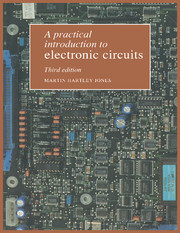
This book provides a practically based explanation of electronics which can be understood by any reader who has some knowledge of electrical circuits. Martin Hartley Jones presents a full account of the subject, starting with basic concepts such as amplification, and progressing to analogue and digital IC chip applications, including a lucid account of microcomputers. All the topics are effectively illustrated with stimulating experiments, and the mathematics is not permitted to obscure the electronic concepts, so the book remains very readable. This book is an ideal first text for degree and vocational course students in electronics. It will also be of use to those in other disciplines where electronics is a subsidiary subject. This highly successful text is now in its third edition, and builds on its predecessors by maintaining the style and logical development of the subject.
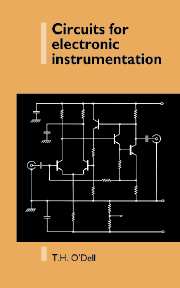
This book is an up-to-date text on electronic circuit design. The subject is dealt with from an experimental point of view, but this has not restricted the author to well-known or simple circuits. Indeed, some very recent and quite advanced circuit ideas are put forward for experimental work. Each chapter takes up a particular type of circuit, and then leads the reader on to gain an understanding of how these circuits work by proposing experimental circuits for the reader to build and make measurements on. This is the first book to take such a practical approach to this level. The book will be useful to final year undergraduates and postgraduates in electronics, practising engineers, and workers in all fields where electronic instrumentation is used and there is a need to understand electronics and the interface between the instrument and the user's own experimental system. The book's references will also be a very helpful guide to the literature.
Written in a concise, easy-to-read style, this text for senior undergraduate and graduate courses covers all key topics thoroughly. It is also a useful self-study guide for practising engineers who need a complete, up-to-date review of the subject. Key features: Rigorous theoretical treatment combined with practical detail A theoretical framework built up systematically from the Schrödinger Wave Equation and the Boltzmann Transport Equation Covers MOSFETS, HBTs and HJFETS Uses the PSP model for MOSFETS Rigorous treatment of device capacitance Describes the operation of modern, high-performance transistors and diodes Evaluates the suitability of various transistor types and diodes for specific modern applications Covers solar cells and LEDs and their potential impact on energy generation and reduction Includes a chapter on nanotransistors to prepare students and professionals for the futureProvides results of detailed numerical simulations to compare with analytical solutions End-of-chapter exercises Online lecture slides for undergraduate and graduate courses
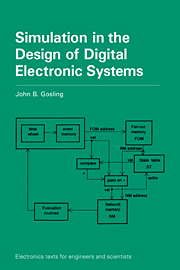
This book describes the structure of simulators suitable for use in the design of digital electronic systems. It includes the compiled code and event driven algorithms for digital electronic system simulators, together with timing verification. Limitations of the structures are also discussed. An introduction to the problems of designing models is included, partly to point to how user models might be constructed for application specific integrated circuits (ASICs) and so on, and partly to expose the limitations of the modelling process. As a guide to the use of simulators the book includes chapters which introduce the subjects of testing and design for testability. A major chapter is devoted to fault simulation. The text has an introduction to hardware accelerators and modellers.
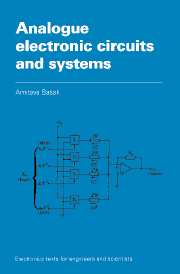
This book is an undergraduate textbook for students of electrical and electronic engineering. It is written at an intermediate level, with second year students particularly in mind, and discusses analogue circuits used in various fields. Basic electronics has been omitted so that appropriate emphasis can be given to the design of the most popular and useful circuits. The contents of chapters 3, 5, 7 and 8 are not covered together by any other single textbook available on the market. Each chapter also contains a significant number of worked examples and several carefully chosen problems at various levels of difficulty. Each topic has been carefully selected, and the author concentrates on the practical details and applications of the material he covers. Both students and practising engineers alike will therefore find this book extremely useful and informative.
Originally published in 2004, this book provides a detailed introduction to radio frequency (RF) engineering, using a straightforward and easily understood approach combined with numerous worked examples, illustrations and homework problems. The author focuses on minimising the mathematics needed to grasp the subject while providing a solid theoretical foundation for the student. Emphasis is also placed on the practical aspects of radio engineering. The book provides a broad coverage of RF systems, circuit design, antennas, propagation and digital techniques. It will provide an excellent introduction to the subject for graduate students, researchers and practising engineers.