To save content items to your account,
please confirm that you agree to abide by our usage policies.
If this is the first time you use this feature, you will be asked to authorise Cambridge Core to connect with your account.
Find out more about saving content to .
To save content items to your Kindle, first ensure no-reply@cambridge.org
is added to your Approved Personal Document E-mail List under your Personal Document Settings
on the Manage Your Content and Devices page of your Amazon account. Then enter the ‘name’ part
of your Kindle email address below.
Find out more about saving to your Kindle.
Note you can select to save to either the @free.kindle.com or @kindle.com variations.
‘@free.kindle.com’ emails are free but can only be saved to your device when it is connected to wi-fi.
‘@kindle.com’ emails can be delivered even when you are not connected to wi-fi, but note that service fees apply.
By the late eighteenth century, scientists had discovered certain types of gas, such as 'fixed air' (carbon dioxide), but their composition was little understood. Relatively few investigations into gases had taken place, and so the polymath Joseph Priestley (1733–1804) was able to make major breakthroughs in the field using a range of experimental techniques. While living near a brewery, he found that it was possible to outline the shape of the gas above fermenting beer with smoke, and that fire would burn with varying strength depending on the composition of the air. This three-volume collection first appeared between 1774 and 1777. Priestley acknowledges that Volume 3 (1777) would more greatly interest those with technical training in the physical sciences as compared with general scholars. It also highlights some new and important inferences, notably on the function of blood in respiration.
In the nineteenth century and beyond, scientists at Cambridge produced some of the most significant developments in the study of biological variation and inheritance. The work of William Bateson (several of whose books are also reissued in this series) was especially important in this regard. This book, first published in 1906 by the botanist Robert Heath Lock (1879–1915), lucidly traces these and other milestones in modern biological understanding. A readable account is given of the evolution of the discipline since the publication of Darwin's On the Origins of Species in 1859, taking in the biometrical contributions of Francis Galton and the research into mutation conducted by Hugo de Vries. The pioneering experiments of Gregor Mendel, and the more recent rediscovery of his laws of inheritance, are clearly contextualised so that non-specialist readers can appreciate the scientific progress that had been made in the half-century prior to the book's first publication.
Jane Haldimand Marcet (1769–1858) wrote across a range of topics, from natural philosophy to political economy. Her educational books were especially intended for female students, to combat the prevalent idea that science and economics were unsuitable for women, but they found broader popularity: Michael Faraday, as a young bookbinder's apprentice, credited Marcet with introducing him to electrochemistry. This two-volume work, first published in 1829, is a beginner's guide to botany. Since the chief aim was accessibility, Marcet does not dwell on the often burdensome process of plant classification, but focuses on plant forms and botany's practical applications. She presents the facts in the form of simple conversations between two students and their teacher. Based on the lectures of the Swiss botanist Candolle, Volume 2 considers agriculture and plant diseases, the cultivation of trees and culinary vegetables, and the effects of humans on flora.
An author of educational works intended especially for young women, Jane Haldimand Marcet (1769–1858) sought to combat the notion that technical topics were unsuitable for female students. Inspired by conversations with the famous scientists she entertained, she wrote textbooks in the lively form of discussions between a teacher and her two female pupils. Published anonymously at first, they found broad popularity: Michael Faraday, as a young bookbinder's apprentice, credited Marcet with introducing him to electrochemistry. The present work, an introduction to physics, astronomy and the properties of matter, sound and light, was Marcet's first, though it remained unpublished until 1819. Her other works include Conversations on Chemistry (1805), Conversations on Political Economy (1816) and Conversations on Vegetable Physiology (1829), all of which are reissued in this series. Never professing to be original, Marcet's work is noted nonetheless for its thoroughness and clear presentation of concepts.
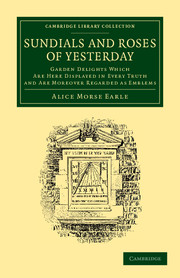
The American social historian and antiquarian Alice Morse Earle (1851–1911) published this lavishly illustrated book, among the last of her works, in 1902. By this time she had developed a distinctive style of historical writing which made innovative use of material evidence in its focus on the details of everyday life. She was particularly interested in family and society in colonial America, and her views about the importance of ancestry were reflected in her membership of the National Society of the Daughters of the American Revolution. Her fascination for beautiful things found lively expression in this learned and charming exploration of two 'garden delights'. Drawing readily on folklore, literature and anecdote, Earle brings to life her history of sundials and roses in Europe and America, touching on practical, aesthetic and symbolic aspects.
Want to learn how to present your research successfully? This practical guide for students and postdoctoral scholars offers a unique step-by-step approach to help you avoid the worst, yet most common, mistakes in biology communication. Covering irritants such as sins of ambiguity, circumlocution, inconsistency, vagueness and verbosity, misuse of words and quantitative matters, it also provides guidance to design your next piece of work effectively. Learn how to write scientific articles and get them published, prepare posters and talks that will capture your audience and develop a critical attitude towards your own work as well as that of your colleagues. With numerous practical examples, comparisons among disciplines, valuable tips and real-life anecdotes, this must-read guide will be a valuable resource to both new graduate students and their supervisors.
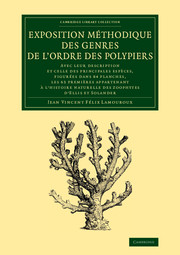
Avec leur description et celle des principales espèces, figurées dans 84 planches, les 63 premières appartenant à l'histoire naturelle des zoophytes d'Ellis et Solander
A professor of natural history at Caen and a member of the Académie des Sciences, Jean Vincent Félix Lamouroux (1779–1825) made significant contributions to the field of marine biology. Following the appearance in 1816 of his Histoire des polypiers corralligènes flexibles, he published in 1821 the present work, drawing upon John Ellis and Daniel Solander's seminal Natural History of Many Curious and Uncommon Zoophytes (1786). It divides more than 130 genera known at the time into twenty groupings. Taxonomy has progressed considerably since Lamouroux's day, yet this work, complete with eighty-four exquisitely drawn plates, serves to illuminate the contemporary understanding and classification of some remarkable marine organisms, principally those which take the form of polyps, such as corals. Moreover, a copy of this work is known to have been consulted by Charles Darwin aboard the Beagle on his famous voyage of discovery the following decade.
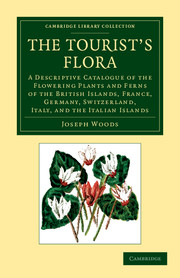
By the middle of the nineteenth century, botany was a popular amateur pursuit as well as a rapidly developing science. First published in 1850, this catalogue covers the flora of Britain, France, Germany, Switzerland and Italy - the most popular tourist destinations of the period. It was compiled over several years by Joseph Woods (1776–1864), who was an architect by profession but also an avid botanist and contributor to the Transactions of the Linnean Society. Taking care to clearly define his terms in the still-developing botanical lexicon, Woods includes hundreds of entries and technical descriptions. A testament to the contemporary market for scholarly amateur guides, this rigorous publication is the product of the author's lifelong interest and a retirement devoted to painstaking study. It remains an instructive resource for those interested in the history and dissemination of plant science.
Among the ablest anatomical teachers of his day, Robert Knox (1791–1862) also busied himself with the study of zoology and ethnology. Prepared by his pupil and colleague Henry Lonsdale (1816–76), this 1870 biography explores the scope of Knox's scientific research and the nature of his character. It describes how Knox developed at Edinburgh one of the most significant anatomical schools in Britain, playing a dominant role in expanding the comparative anatomy collection held by the city's Royal College of Surgeons. Despite his eminence and popularity as a lecturer, his reputation was deeply tarnished by his association with the notorious murderers Hare and Burke, who had provided Knox with bodies for dissection. Drawing on surviving correspondence and information gathered from friends and colleagues, Lonsdale's work stands as a robust defence and sympathetic portrait of a prominent yet controversial figure in the history of nineteenth-century medicine.
In the early nineteenth century, live plant cuttings were commonly transported between continents in wooden boxes exposed to the elements on the decks of ships; unsurprisingly, it was rare for them to arrive in good health. The glass cases devised by Nathaniel Bagshaw Ward (1791–1868) were a revolutionary step forward in preserving botanical specimens. In this monograph, first published in 1842, Ward explores some of the most common causes of plant deaths in cities and aboard ships, including air quality and temperature. Most importantly, he emphasises the need for light. Although photosynthesis would not be chemically understood until later that century, Ward recognised that a glass case was infinitely preferable to an opaque one. His rapidly adopted invention would have far-reaching effects, allowing for the safe transportation of tea from China to the Himalayas, rubber from the Amazon and medicinal species from the Andes to India.
An electrical engineer, university teacher and wide-ranging writer, Fleeming Jenkin (1833–85) filed thirty-five British patents in the course of his career. Edited by Sidney Colvin (1845–1927) and J. A. Ewing (1855–1935) and first published in 1887, this two-volume work brings together a selection of Jenkin's varied and engaging papers. The collection ranges from notes on his voyages as a marine telegraph engineer, to a critical review of Darwin's On the Origin of Species, essays on literature, and thoughts on technical education. A memoir written by Robert Louis Stevenson, his former student, provides biographical context and attests to Jenkin's many interests and talents across the arts and sciences. Volume 1 begins with Stevenson's memoir, incorporating Jenkin's records of his voyages. This is followed by writings on literature and drama. Three pieces on scientific subjects, including the review of Darwin, conclude the volume.
The orphaned son of an Anglican clergyman, David Hartley (1705–57) was originally destined for holy orders. Declining to subscribe to the Thirty-Nine Articles, he turned to medicine and science yet remained a religious believer. This, his most significant work, provides a rigorous analysis of human nature, blending philosophy, psychology and theology. First published in two volumes in 1749, Observations on Man is notable for being based on the doctrine of the association of ideas. It greatly influenced scientists, theologians, social reformers and poets: Samuel Taylor Coleridge, who named his eldest son after Hartley, had his portrait painted while holding a copy. Volume 2 is particularly concerned with human morality and the duty and expectations of mankind. Here the author is keen to show that scientific observation is not necessarily in conflict with religious conviction.
Thomas Bewick (1753–1828) is synonymous with finely crafted wood engravings of the natural world, and his instantly recognisable style influenced book illustration well into the nineteenth century. During his childhood in the Tyne valley, his two obsessions were art and nature. At fourteen, he was apprenticed to the engraver and businessman Ralph Beilby (1743–1817) with whom he later published A General History of Quadrupeds (also reissued in this series). The present work, with its text compiled from various sources, was the first practical field guide for the amateur ornithologist, inspiring also artists and writers. Each of the two volumes contains hundreds of illustrations of breathtaking beauty and precision: one for each species, neatly capturing its character in exquisite detail, interspersed with charming vignettes of country life. Volume 2, first published in 1804, covers water birds, including sandpipers, terns, grebes and guillemots.
Having trained in Edinburgh as a surgeon and served aboard Royal Navy vessels, Sir James Clark (1788–1870) developed a particular interest in the spread of the tuberculosis pandemic in Europe. A licentiate of the Royal College of Physicians from 1826, and elected to the Royal Society in 1832, he became a trusted physician and friend to Queen Victoria and Prince Albert. This early work of 1820 was based on his first-hand knowledge of the treatment of tuberculosis in southern Europe as well as the effects of climate on the disease. Among his tubercular patients in Italy around this time was the poet John Keats (who would succumb in 1821). Also reissued in this series are Clark's Treatise on Pulmonary Consumption (1835), his Memoir of John Conolly (1869), and The Influence of Climate in the Prevention and Cure of Chronic Diseases (1829), a development of aspects of the present work.
The eminent British botanist Sir William Jackson Hooker (1785–1865) expanded and developed the Royal Botanic Gardens at Kew into a world-leading centre of research and conservation. Appointed its first full-time director in 1841, Hooker came to Kew following a highly successful period in the chair of botany at Glasgow University. He quickly began to extend the gardens, arranging for the building of the now famous Palm House and establishing the Museum of Economic Botany. This volume reissues Hooker's popular guides to the gardens (sixteenth edition) and to the museum (third edition), both published in 1858. Illustrated throughout, these documents reveal the areas and specimens accessible to a receptive Victorian public. Hooker's ten volumes of Icones Plantarum (1837–54) have also been reissued in this series, along with many works by his son and equally accomplished successor, Sir Joseph Dalton Hooker (1817–1911).
Trained by his father, a market gardener, Philip Miller (1691–1771) rose to become Britain's most eminent horticulturalist in the eighteenth century. Following a period as a nurseryman in Southwark, he was appointed the head gardener of the Chelsea Physic Garden by the Society of Apothecaries in 1722, upon the recommendation of Sir Hans Sloane. Under Miller's supervision, the diversity of plants at Chelsea outstripped that of all other European botanic gardens. His talent was equally reflected in his writings. Miller's most famous work, The Gardener's Dictionary, ran to eight editions during his lifetime, as did his celebrated abridgement, reissued here in its 1771 sixth edition. Ranging widely in coverage from agriculture to winemaking, as well as incorporating traditional gardening topics, the work reflects the progress of contemporary plant science and the breadth of knowledge acquired by one of its foremost practitioners.
An Oxford-educated clergyman and prolific writer on natural history topics ranging from seashore wildlife to microscopy, John George Wood (1827–89) wrote and lectured for a receptive Victorian audience. His books were not rigorously scientific, but they made their subjects accessible to laypeople and were said to have inspired many future naturalists in their youth. His Nature's Teachings (1877) has also been reissued in this series. Theodore Wood (1862–1923) published this biography of his father in 1890. The account covers Wood's childhood and education, his clerical work and his desire to share his enthusiasm for the natural world with the public. His lecturing engagements, including a tour of America, and his home life are also discussed. An affectionate portrait of a significant figure in the history of popular science, this work sheds light on the intellectual interests of its subject and his readership.
Best known for his ideas relating to evolution, French naturalist Jean-Baptiste Lamarck (1744–1829) first built his reputation as a botanist and was elected to the prestigious Académie des Sciences in 1779. His career took a new turn in 1793 when he was made professor of 'insects, worms and microscopic animals' at the Muséum National d'Histoire Naturelle, although he lacked prior knowledge of the subject area. Undaunted, Lamarck set out to classify organisms which few naturalists had considered worthy of study since Linnaeus. He was the first to distinguish vertebrates from 'invertebrates' - a term he coined - by the presence of a vertebral column. In this groundbreaking seven-volume work, published between 1815 and 1822, he arranges invertebrates into twelve classes, laying the foundations for the modern study of these organisms. Volume 5, first published in 1818, covers arachnids, crustaceans, annelids, cirripedes and conchifera.
Being Practical Directions for the Cultivation of Flowering and Foliage Plants in Windows and Glazed Cases, and the Arrangement of Plants and Flowers for the Embellishment of the Household
The later nineteenth century saw a dramatic increase in the popularity of domestic gardening and the cultivation of plants and flowers in the home. Largely a middle-class pursuit, it caught the attention of writers and publishers who recognised and nurtured the growing demand for advice. This detailed guide first appeared in 1877 and was written for those living in towns and cities who, without substantial gardens, cultivated plants mainly in their windows. The author, John R. Mollison, intended for it to be 'understood by all', and advises on matters ranging from suitable vases, window boxes, hanging baskets and soil, to watering methods, insect prevention and the labelling of specimens, while also discussing the health-related pros and cons of keeping plants in the home. Complete with an alphabetical list of suitable species, and illustrated with a host of wood engravings, this attractive resource will interest both gardening enthusiasts and social historians.
A member, and later president, of the Académie des Sciences, French botanist and doctor René Louiche Desfontaines (1750–1833) spent the years 1783–5 on an expedition to North Africa. During his time in Tunisia and Algeria, he collected over a thousand plant specimens: more than three hundred genera were new to European naturalists at this time. Having succeeded Le Monnier in the chair of botany at the Jardin du Roi in 1786, Desfontaines helped found the Institut de France following the Revolution and published his two-volume Flora atlantica in Latin in 1798–9. A lavishly illustrated second edition appeared in four volumes in 1800. Combining its two volumes of plates into one, this reissue will give modern researchers an insight into the promulgation of pioneering plant science. Volume 1 contains the first thirteen classes of plants in the Linnaean system of taxonomy, from Monandria to Polyandria.