To save content items to your account,
please confirm that you agree to abide by our usage policies.
If this is the first time you use this feature, you will be asked to authorise Cambridge Core to connect with your account.
Find out more about saving content to .
To save content items to your Kindle, first ensure no-reply@cambridge.org
is added to your Approved Personal Document E-mail List under your Personal Document Settings
on the Manage Your Content and Devices page of your Amazon account. Then enter the ‘name’ part
of your Kindle email address below.
Find out more about saving to your Kindle.
Note you can select to save to either the @free.kindle.com or @kindle.com variations.
‘@free.kindle.com’ emails are free but can only be saved to your device when it is connected to wi-fi.
‘@kindle.com’ emails can be delivered even when you are not connected to wi-fi, but note that service fees apply.
Central to this book is a trio of chapters (4, 5 and 6) on Darwin’s Origin of Species in its first edition of 1859. Darwin called his book 'one long argument'. These three chapters clarify how this long argument is conducted; how Darwin’s analogical reasonings about natural and artificial selection support the argument; and how his various metaphors are grounded in those reasonings. The conclusions from these chapters support the claims in our chapters 1 to 3 about the decisive antecedents, from ancient times on, for Darwin’s conception of analogical reasoning and what it can do for his one long argument. Equally these conclusions support the claims made in our chapters 7and 8 as to how that reasoning should be analysed and evaluated by philosophers, biologists and historians today. Our writing combines throughout narratives that are often not overtly normative with judgements that often are so.
In the decades before the Origin, a split arises between two very different concepts of analogy, and so two views of argument by analogy. Some people, taking 'analogy' as a synonym for 'similarity',came to a new understanding of 'argument by analogy': suppose A and B are known to share a number of properties, then the probability is increased that B also possesses some other property which A is known to possess. This account remains widely assumed even today. Other people, largely within Anglican theology and concerned with the analogy between God and the world, insisted that the only correct use of the word 'analogy' was in its original Greek sense, including the Aristotelian commitment to proportionality, and so to relational comparisons, as when God is related to his creatures as a human father is to his children. This commitment grounded a view radically different from the new similarity view. In analysing what an argument by analogy is, Richard Whately, and following him J. S. Mill, specified explicitly the conditions for such an argument to be valid. It is this account that is relevant to an understanding of Darwin’s use of analogy.
This chapter engages two clusters of long-run, big-picture issues. One concerns relations between art and nature. Aristotle’s views on this were challenged in the late seventeenth century by Robert Boyle in defending the new mechanical philosophy. Darwin is aligned with neither Aristotle nor Boyle; nor with German Romantic philosophers, such as Schelling. The agrarian contexts of Darwin’s science, and its alignments with agrarian rather than industrial forms of capitalism, illuminate Darwin’s views, including his natural theological views, of art-nature relations. A second cluster of issues concerns the role of the selection analogy in later controversies about natural selection, notably involving Alfred Russel Wallace and Francis Galton in the nineteenth century, and Ronald Fisher and Sewall Wright in the twentieth century. We stress that Darwin’s theorising is sometimes ancient in its resources and sometimes modern, which is not surprising given the intellectual life he was leading. His analogical argument belongs in the science classroom not because it is up-to-date but precisely because, like all science, it is of its time.
Against this background, we turn to Darwin himself. We first look at the selection analogy in his theorising before writing the Origin. Darwin arrived at his theory of natural selection before contemplating such an analogy. We cannot, then, understand the analogy as what led him to the theory. Its role was to support a theory already arrived at. The evolutionary process takes place over millions of years at an imperceptibly slow pace, and so is inaccessible to direct observation. However, here and now we can observe the selective human breeding of domestic animals and cultivated plants. Darwin can then use an argument by analogy to give his theory indirect empirical support. The struggle for existence in the wild and the human breeders are not intrinsically similar agencies, but are relationally comparable in having the same kind of causal relation to the animals and plants that they are acting on with effects similar in kind but not in degree.
There are conditions satisfied by successful analogical arguments which Darwin’s argument satisfies. Darwin first establishes that breeding practices are an analogical model of the struggle for existence in the wild: just as humans discriminate in favour of animals and plants with desirable traits, so the struggle for existence discriminates in favour of creatures with traits best enabling them to cope with that struggle. Domestic breeding creates new varieties because it is systematic – there will be a tendency always to discriminate in favour of the same set of traits. The struggle for existence will have the same systematic tendency to favour certain traits at the expense of others. Therefore it is possible for it also to create new varieties. Darwin now alternates the analogy and its proportionality: if natural selection (NS) is to new wild varieties as artificial selection (AS) is to new domesticated varieties, then NS is to AS as new wild varieties are to new domesticated varieties. Thus if NS is a massively more efficient selector than AS, and the greater the cause, the greater the effect, then, a fortiori, NS should produce not only new varieties but new species.
Here we examine how the Origin deploys the selection analogy. Darwin works in a vera causa tradition. To discover the true cause of some phenomenon, one first establishes that the cause exists (an existence case); then shows that it has the power to produce the effect (an adequacy case); and finally that it has in fact done so (a responsibility case). After examining how breeding practices produce new varieties, Darwin establishes the existence of natural selection. In the wild, resources are limited, and so there is a struggle for existence, with the individuals with the most favourable traits most likely to survive. Next comes the argument showing that natural selection should produce new species, that it is causally competent and adequate. This argument includes reasoning a fortiori: natural selection, being far more comprehensive, precise and prolonged than artificial selection, is a much greater power and so able to produce the adaptive diversification of distinct species over eons of time. Darwin, in later chapters, offers evidence that natural selection has in fact been responsible for producing new species, new genera and even new classes of animals and plants.
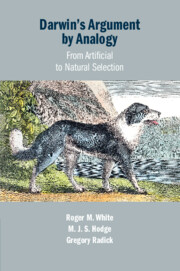
In On the Origin of Species (1859), Charles Darwin put forward his theory of natural selection. Conventionally, Darwin's argument for this theory has been understood as based on an analogy with artificial selection. But there has been no consensus on how, exactly, this analogical argument is supposed to work – and some suspicion too that analogical arguments on the whole are embarrassingly weak. Drawing on new insights into the history of analogical argumentation from the ancient Greeks onward, as well as on in-depth studies of Darwin's public and private writings, this book offers an original perspective on Darwin's argument, restoring to view the intellectual traditions which Darwin took for granted in arguing as he did. From this perspective come new appreciations not only of Darwin's argument but of the metaphors based on it, the range of wider traditions the argument touched upon, and its legacies for science after the Origin.
Knowing how to prepare, write and publish high-quality research papers can be challenging for scientists at all stages of their career. This manual guides readers through successfully framing and presenting research findings, as well as the processes involved in publishing in learned journals. It draws on the author's wealth of practical experience, from working in academic research for over 40 years and teaching scientific writing in over 20 countries, to gaining insights as a journal editor. Well-written and logical, it provides clear step-by-step instructions to enable readers to become more effective at writing articles, and navigating difficulties related to journal submission, the review process, editing and publication. It comprehensively covers themes such as publication ethics, along with current topics including Open Access publishing and pre-print servers. This is a useful, user-friendly guide for graduate students, early career scientists, and more experienced researchers, particularly in the life and medical sciences.
The final stages of getting a paper into shape for submission relies on checking its English presentation (or getting help in doing this). The main author revises the paper to reach a final draft. The role of the co-authors is discussed, including the sequence of their names. Conflicts of interest must be considered here. Setting out the paper in clear sections and subsections is stressed as it makes the paper easier for editor and reviewers to follow. The need for a letter of submission is considered.
The chapter indicates our reasons for publishing, the framework of a communication, how to introduce the topic and put forward a hypotheses before considering each of the conventional sections of a paper. It also emphasizes that the sequence in how a paper is compiled section by section will not be the order given here.
This chapter emphasizes the fact that an author starts drafting a paper by compiling the results, the experimental findings (data) that have the evidence to support (or refute) the hypothesis under test. It emphasizes the need for selection to be fair considering positive, negative and neutral data, the order and logic in dealing with the sequence of presentation of the data, and how every experiment needs tight controls. Statistical issues are discussed.
The authors will consider the reasons for writing papers, their mindset, and then are given an outline of the whole process involved from setting out to the final publishing of an article. This is an overview given a simply as possible to the whole task ahead of them.
Journals all have different ways of presenting papers. Authors are made aware of the main issues in ensuring that the MS to be submitted complies with the journal publisher's requirements. There are many items to check before a paper is submitted, such that a checklist ought to be drawn up. The different ways of approaching submission, nowadays mainly on 'electronic gateways', are discussed. The types of files that are acceptable and how to upload them is covered.
Authors are made aware in this chapter of the nature of peer reviewing, its very positive and its often negative side. The relationship between the author,editor and peer reviewers can be stressful and instruction is given in how to deal with them. Reporting methods can differ, and the level of detailed comment differs widely.The author is given advice on how to handle the problems this three-way exchange.The nature of rebuttal is considered. Abuse of the peer-reviewing system and its anonimity are discussed.
The cardinal points – 12 in all – focus the authors on what primarily must be kept in mind when going through the whole business of preparing and publishing a paper. The last words deal with the need for the paper to be presented in the best idiomatic English. This leads on to giving references that cover different aspects of writing and publishing a paper, including that of the best use of language.
Authors have to be made aware of copyright which protects publications from misuse by other interested parties. It deals with national and international aspects of copyright, how personal identities must be carefully protected, how to seek permission to copy other works, how long copyright remains in place, and where to seek help when issues arise.
A published paper is presented so that the author can see how it will finally appear. Annotations are added to draw attention to many different items, particularly where the publisher will put in information pertaining to its place in the scientific literature. Fonts, sizes, columns and other layout features as well as the sequence of presentation are highlighted.