To save content items to your account,
please confirm that you agree to abide by our usage policies.
If this is the first time you use this feature, you will be asked to authorise Cambridge Core to connect with your account.
Find out more about saving content to .
To save content items to your Kindle, first ensure no-reply@cambridge.org
is added to your Approved Personal Document E-mail List under your Personal Document Settings
on the Manage Your Content and Devices page of your Amazon account. Then enter the ‘name’ part
of your Kindle email address below.
Find out more about saving to your Kindle.
Note you can select to save to either the @free.kindle.com or @kindle.com variations.
‘@free.kindle.com’ emails are free but can only be saved to your device when it is connected to wi-fi.
‘@kindle.com’ emails can be delivered even when you are not connected to wi-fi, but note that service fees apply.
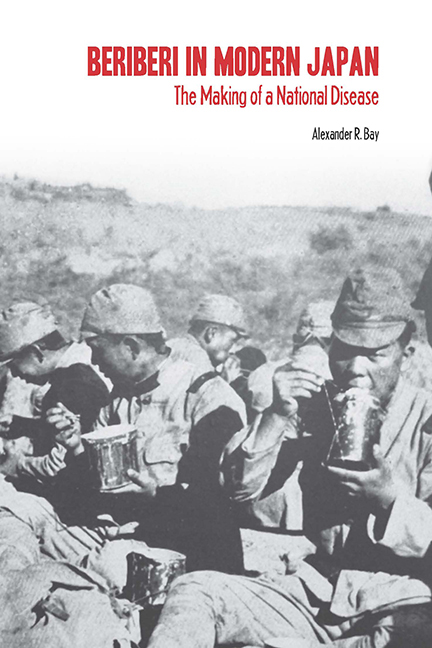
In modern Japan, beriberi (or thiamin deficiency) became a public health problem that cut across all social boundaries, afflicting even the Meiji Emperor. During an age of empire building for the Japanese nation, incidence rates in the military ranged from 30 percent in peacetime to 90 percent during war. Doctors and public health officials called beriberi a "national disease" because it festered within the bodies of the people and threatened the health of the empire. Nevertheless, they could not agree over what caused the disease, attributing it to a diet deficiency or a microbe.
InBeriberi in Modern Japan, Alexander R. Bay examines the debates over the etiology of this "national disease" during the late nineteenth and early twentieth centuries. Etiological consensus came after World War I, but the struggle at the national level to direct beriberi prevention continued, peaking during wartime mobilization. War served as the context within which scientific knowledge of beriberi and its prevention was made. The story of beriberi research is not simply about the march toward the inevitable discovery of "the beriberi vitamin," but rather the history of the role of medicine in state-making and empire-building in modern Japan.
Alexander Bay is assistant professor of history at Chapman University.
Plagues have inflicted misery and suffering throughout history. They can be traced through generations in our genes, with echoes in religion and literature. Featuring essays arising from the 2014 Darwin College Lectures, this book examines the spectrum of tragic consequences of different types of plagues, from infectious diseases to over-population and computer viruses. The essays analyse the impact that plagues have had on humanity and animals, and their threat to the very survival of the world as we know it. On the theme of plagues, each essay takes a unique perspective, ranging from the impact of plagues on history, medicine, the evolution of species, and biblical metaphors, to their impact on national economies, and even our highly connected digital lifestyles. This engaging and timely collection challenges our understanding of plagues, and asks if plagues are the manifestation of nature's checks and balances in light of human population growth and our impact on climate change.
In October 1934, American-designed and built Douglas DC-2 and Boeing Model 247-D commercial airliners finished second and third behind a special-purpose British de Havilland DH.88 Comet air racer in the 11,300-mile London-to-Melbourne MacRobertson Trophy Race. The New York Times hailed the performance of the two revolutionary aircraft as a victory for American aeronautical technology and its superiority over European technologies. The diminutive British entry, equipped with two propellers capable of only changing their pitch once in flight, carried only its pilot and copilot. Hamilton Standard controllable-pitch propellers enhanced the overall performance of the much larger transports, especially Dutch KLM's DC-2 Uiver, as they carried passengers and mail much like they would have in regular commercial operations (Figure 17). The crews of the DC-2 and 247-D lost the race and the resulting $50,000 prize, but won the international competition for aeronautical technological superiority. Introduced to the world through the MacRobertson Race, the variable-pitch propeller was a critical technology to the Aeronautical Revolution of the late 1920s and early 1930s in the United States and Great Britain.
Aircraft designers drew upon an impressive listing of aerodynamic, propulsive, and material innovations as they worked to meet the specifications issued by their military and commercial clients. Streamlined design involved the removal or redesign of drag-inducing structures such as fixed landing gear, engines and radiators, struts and wires, open cockpits, and armament to increase overall performance. Flaps mounted on the trailing edge of the wings changed the aerodynamic shape of the wing to create more lift at takeoff and landing. Lightweight air-cooled radial engines offered increased horsepower while the NACA's cowling reduced drag and improved cooling at the same time. Structural improvements in the form of all-metal construction, internally supported cantilever wings, and retractable landing gear resulted in further efficiency and operational durability. How those innovations were incorporated into a particular design and in what combination was the key to realizing the modern airplane.
Despite the promise of increased performance offered by the variable-pitch propeller, the aeronautical community did not immediately welcome its introduction. The engineers and companies developing this new technology had to overcome much opposition. Besides the economic and technical arguments that the new propeller's cost, weight, and complexity of operation were too great, there was a larger reason for its limited introduction in the early 1930s.
The propeller specialists contributed to the development of the airplane during a vibrant period of innovation in North America and Europe from World War I to the end of World War II. The themes of culture, community, specialty, reinvention, and use take the reader from the mind's eye, the drawing boards, workshops, research and development facilities, and factories populated by the specialists to the spectacular aerial pathways, commercial air routes, and battlefields in the sky that the aeronautical community used to change the world. The propeller specialists weave in and out of this overarching Aeronautical Revolution, a period that witnessed the intense technical development of the airplane and the rise of modern aviation.
A propeller community existed since the early days of the airplane. During the years preceding and following the Wrights’ first flight at Kitty Hawk, aeronautical enthusiasts experimented with a variety of propeller designs and materials. They focused on improved versions of the Wrights’ fixed-pitch propeller with its permanently set blade angle and made from layers of wood. It was cheap, easy to manufacture, fit well into the established design paradigm of keeping everything in an airplane as light and simple as possible, and, most important, it worked for the thousands of airplanes produced during World War I and into the 1920s. The search for more performance led propeller specialists to reevaluate the status quo regarding the technology. As a result, they pursued simultaneous and interwoven technical trends centered on infrastructure, design, and materials as they began to question their place in the aeronautical community during the war and the immediate postwar period.
American and European military organizations established new aeronautical research and development facilities and workshops during World War I to place propeller technology on a practical and operational footing. The central role of the US government in developing propeller testing equipment and techniques provided the fundamental infrastructure for immediate wartime production needs and future advances in the postwar era. Engineers reacted to dynamic design requirements by using their experience from different disciplines to pioneer their specialty within the new field of aeronautical engineering. With the staff, equipment, and procedures in place, development-based organizations like the US Army Air Service's Engineering Division fostered the latest points of departure in propeller technology.
On August 24, 1940, Flight Lt. Gordon Olive led “A” Flight of 65 Squadron on an early afternoon patrol over the Thames Estuary. Controllers directed the four Spitfires to intercept an incoming raid of approximately sixty bombers protected by a heavy escort of forty fighters at about 20,000 feet. Seeing the fighters above them, Olive ordered “A” Flight to climb. They attacked “down sun,” with the sun at their backs and in the eyes of their targets, from 28,000 feet. He damaged a twin-engine Messerschmitt Bf 110 fighter that dived away to escape destruction. Aware of the danger of other Luftwaffe aircraft in his vicinity, Olive climbed above them and pursued another Bf 110. As he was about to destroy his second target, five single-engine Bf 109s attacked him from above. Olive immediately climbed toward and above them. He attacked the rearmost fighter until running out of ammunition before returning to the squadron's forward airfield at Manston near the Channel Coast in Kent. In a chaotic and deadly environment where altitude, or “the high ground,” was the key to survival, Olive had climbed three times, met his enemies, and drove them away. Just two months before, his Spitfire struggled against the Luftwaffe's fighters in combat. The addition of a constant-speed propeller of American origin enhanced the performance of Olive's Spitfire and helped make it a truly world-class fighter.
During the spring, summer, and fall of 1940, Fighter Command of Great Britain's RAF faced Nazi Germany's Luftwaffe in an aerial duel to control the skies over France and England. After the fall of France, this struggle for the air, if lost by the RAF, would be a prelude to an invasion of the British Isles. The resultant Battle of Britain represented a dramatic change in warfare where the survival of a nation depended upon a small group of aviators, called the “few” by Prime Minister Winston S. Churchill, and their Spitfire and Hurricane fighter aircraft. It also demonstrated the importance of air power weaponry, which included well-known systems such as radar and the fighter-interceptor, but fundamental technologies such as the variable-pitch propeller as well.
On September 28, 1923, two Curtiss air racers flown by American naval aviators took first and second place in the Schneider Trophy seaplane contest at Cowes, the Isle of Wight, in southwestern England. Lt. David Rittenhouse won the competition with an average speed of 177.38 mph, almost three miles per minute, and a good 20 mph over the slower third place flying boat design from Great Britain. His diminutive gray CR-3 biplane equipped with floats represented the latest concepts in high-speed design, primarily aerodynamic streamlining and drag reduction (Figure 13). Its modified Curtiss D-12 engine was one of the most powerful in the world at 500 horsepower. The newest component of the Curtiss racing system was a duralumin propeller developed by Dr. S. Albert Reed, which to Stanley Spooner, the founder and editor of Flight weekly, “undoubtedly contributed considerably” to the Navy's victory. The dramatic success of American and European air racers equipped with Dr. Reed's propeller led the international aeronautical community to embrace it as an airminded symbol of “Progress” through technological innovation.
Reed's approach to propeller innovation offered an attractive alternative to the ground-adjustable-pitch, or detachable-blade, propeller created by the Engineering Division and Standard Steel. If a fixed-pitch propeller made from a single piece of metal could turn faster and propel the airplane at ever-higher speeds as well as withstand the elements, then it would be a significant step forward in the development of propulsion technology. The Reed propeller did not offer the flexibility of being able to change its blade pitch on the ground. Despite that limitation, the use of Reed propellers in the aerial spectacles of the 1920s, primarily air racing, electrified the aeronautical community with their promise of increased speed and durability. Reed the inventor and his corporate backers, the international aeronautical community, and the specialists at McCook Field reacted to that enthusiasm in different ways. The resultant tension revealed the important place of communal perceptions of what constituted ultimate success or failure in the evolution of technology.
On October 1, 1918, the Propeller Testing Laboratory of the United States Army Air Service's Engineering Division began operations at McCook Field in Dayton, Ohio. The core structure within the facility was a streamlined propeller whirl-test rig that was a functional indicator of the promising future of aeronautics. In a confidential 1918 publication, the Army claimed that the collection of what was the largest and most powerful propeller testing equipment in the world was the result of “engineering of a pioneer character.” Under the leadership of civilian specialist engineers, primarily Frank W. Caldwell, the Engineering Division developed propeller testing techniques and facilities that were major contributions to the field of aeronautical engineering. The laboratory was a clear indication of the Army's cutting-edge work in aeronautics and reflected the US government's intent to wage a modern industrial and aerial war in Europe.
The story of the development of propeller whirl-testing facilities and techniques by the Army Air Service from World War I to the early 1930s highlights the almost singular role that the US government played in nurturing a new industry and its engineering community. Engineers used their experience from different disciplines to shape a new one, aeronautical engineering, as they reacted to dynamic design requirements. In the process, they created the fundamental infrastructure from which the modern airplane evolved. The pioneering propeller testing procedures and practices at the Westinghouse Electric and Manufacturing Company of East Pittsburgh, Pennsylvania, from 1917 to 1918, McCook Field from 1918 to 1928, and Wright Field in Dayton, from 1928 to 1931, demonstrated the evolution of this new professional field as it pertained to the unique and highly-sophisticated “Army style” of engineering centered on development and innovation.
Building a Foundation for Engineering Development
World War I was the catalyst for increased aeronautical development in Europe and the United States and it directly stimulated the development of the propeller. The wood, fixed-pitch propeller, which was most efficient for only one predetermined flight condition, gave satisfactory performance for aircraft that operated at low speeds and altitudes. As the war raged on, the aeronautical industries of the warring nations produced increasingly faster, more powerful, and deadlier aircraft capable of flying in excess of 100 miles per hour and ever higher altitudes. New propellers had to be stronger and able to withstand those ever-expanding performance thresholds.
In comparison to airframes and engines, there has been little or no discussion of propellers in the vast sea of literature on the history of flight. As a result, the main body of evidence for this project consisted of archival and published primary sources. Secondary materials addressing the technical development of propellers and flight and broader issues in the history of technology had their place as well. The following essay discusses the sources central to this work.
Primary Sources
The primary sources used in this book reflect the interplay between airframe, engine, and propeller specialists and their clients and collaborators, the airline industry and national governments. Delving into the private and public records of all the historical actors revealed a broader context of innovation while understanding the role of the propeller. That research methodology also made up for a paucity of resources in critical areas while still facilitating a book whose sum was greater than its individual parts. In other words, while a propeller manufacturer's records were not available regarding a particular design, that information would appear in the files of a government research organization or an aircraft manufacturer that would be the ultimate user of that product.
Archives
Boeing Company Archives, Seattle, Washington, Long Beach, California, and St. Louis, Missouri
The Boeing Company maintains the world's premier corporate aerospace archive for itself and its legacy companies, which include Douglas, McDonnell, and North American. The collections include the personal papers of executives and engineers, subject files for each aircraft model, and general marketing materials. Boeing was a member company of the United Aircraft and Transport Corporation during the crucial years of 1929–1934. The papers of engineer, Claire Egtvedt, include the verbatim transcripts of the corporation's Technical Advisory Committee meetings, which discuss in detail the technical direction of its member companies. In the case of the variable-pitch propeller, aircraft and engine designers debated the merits of the new technology with the specialists dedicated to their development. The files on the Boeing Model 200, Model 221A, and Model 247, and Douglas DC-2 generated the documentary evidence for how the variable-pitch propeller became an integral part of those modern airplanes.
On the afternoon of Wednesday, April 6, 1938, a United Air Lines Mainliner, a Douglas Sleeper Transport, departed from the Newark, New Jersey, airport with fourteen passengers aboard, a crew of three, and enough fuel to reach Chicago. They rolled on the runway for only a brief fifteen seconds before lifting off. Then pilot George Grogan, sitting in the left seat, pointed the futuristic silver twin-engine airliner northeast toward New York City. As they cruised over Central Park at 6,000 feet and just over 200 mph, the propeller on the right engine stopped turning (Figure 1). To any observer, that was an indication of engine failure, loss of power, and an impending crash. Remarkably, Grogan maneuvered the Mainliner through the clouds, climbed, and turned without losing speed or altitude. When he was finished, Grogan restarted the right engine and the motionless propeller began whirling again. He then shut down the left engine, stopped its propeller and set its blades parallel to the wind like he had for the other, and proceeded on with an aerial tour of New York, Connecticut, and New Jersey before returning to Newark on two running engines.
The passengers aboard Grogan's Mainliner had experienced the first public demonstration of a revolutionary aeronautical innovation, a practical propeller capable of maximizing the power of an aircraft engine and the performance and safety of an airplane overall. The next day, United Air Lines inaugurated its fifteen-hour coast-to-coast transcontinental service with Douglas Sleeper Transport (DST) and DC-3 airliners capable of flying as high as 20,000 feet at an unprecedented speed of three miles a minute across the United States.
The Douglas airliners and their propellers were “modern” in every sense of the word. Compared to the slow, fabric-covered biplane of the World War I era, they were the state of the art in aeronautical technology; the flying embodiment of the combined aerodynamic, structural, and propulsive innovations that first made flight a global endeavor. These high-speed streamlined metal monoplanes resulted from an Aeronautical Revolution that swept through North America and Europe during the twenty years between the world wars. Parallel and intertwined advances in technology, governmental regulation, entrepreneurial growth, and cultural awareness created aviation as we know it today.
On May 20, 1927, Charles A. Lindbergh and the Spirit of St. Louis took off from New York bound for Paris for the first successful solo nonstop flight from the United States to Europe. The Ryan-built airplane incorporated some of the latest aeronautical developments: a radial air-cooled engine; monoplane configuration; earth-inductor compass; and a metal, ground-adjustable-pitch propeller. Even so, the heavily laden plane barely cleared the telephone wires at the end of Roosevelt Field by twenty feet. The Spirit's spectacular takeoff highlighted a critical limitation of its propeller. Built by the Standard Steel Propeller Company of Pittsburgh, the device's blades could be adjusted on the ground for efficiency for different operating conditions, primarily takeoff or cruise, but once the blades were set they could not be changed in flight. Searching for every bit of economy for the 3,610-mile flight, Lindbergh had two choices. He could have an easy takeoff with a possible fatal landing in the Atlantic short of Europe or attempt a risky one with a much more desirable landing on French soil. The metal ground-adjustable propeller was the best available technology using a promising new design that pointed the way toward more advanced propellers for high performance aircraft of the 1930s (Figure 10).
The development of the metal ground-adjustable propeller was a major technological milestone of the Aeronautical Revolution of the late 1920s and 1930s. It represented almost a decade of work to improve the overall performance of the airplane by propeller specialists working for the federal government and private industry. The two partners in this pioneering development were the propeller unit at McCook Field and the Standard Steel Propeller Company. Caldwell and his colleagues conducted research and issued specifications and contracts for the new propellers to increase overall aircraft performance. Their civilian partner, Standard Steel, developed new designs, attempted to make them practical, and produced them for profit. Tracing the development of the metal ground-adjustable propeller, known as the “Propeller That Took Lindbergh Across,” reveals important themes for the history of aviation: the key role a specific device played in an event that captivated the world, the importance of government–business partnerships in solving technical challenges, and how communities perceived new innovations, especially in terms of the fundamental choices they made to push technology forward.